The Island That Got 400 Million Pieces of Plastic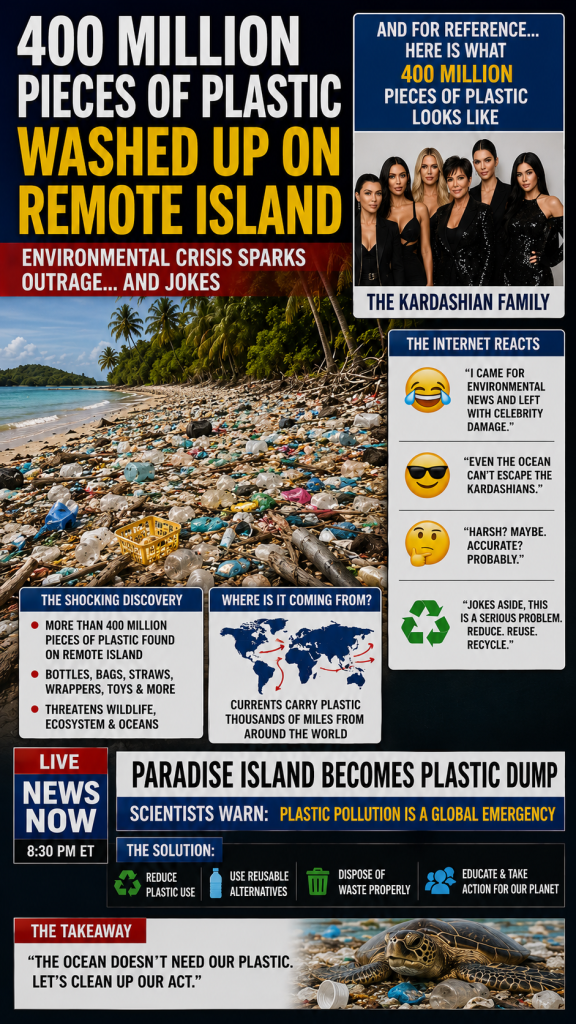
One evening, a serious news anchor sat behind the desk with the kind of face that said, “Please stop laughing, this is bad news.”
He looked into the camera and said, “It was reported that more than 400 million pieces of plastic have washed up on a remote island.”
Now, that was a terrible thing. Nobody wants to hear that a beautiful island has become a trash drawer for the ocean.
People at home imagined bottles, bags, straws, food wrappers, and all the little plastic things humans use for five seconds and then somehow send on a world tour.
The island was supposed to look like paradise.
Blue water. White sand. Palm trees. Birds flying around like they were paid by the tourism board.
It was the kind of place people see on postcards and say, “One day, I’ll go there,” even though their bank account says, “No, you won’t.”
But instead of being peaceful, the island had plastic everywhere.
Plastic on the beach.
Plastic near the trees.
Plastic floating in the water.
Plastic sitting there like it had booked an all-inclusive vacation.
The anchor continued, “And for reference, here is what 400 million pieces of plastic looks like.”
Everyone watching leaned forward.
They expected a huge mountain of garbage.
Maybe a giant trash pile so big it could have its own zip code.
Maybe a beach completely covered in bottles.
Maybe a plastic monster rising from the ocean like a villain in a low-budget disaster movie.
But then the screen changed.
Instead of showing the trash, it showed a photo of the Kardashian family.
For a second, the room went quiet.
Then everybody understood the joke.
A man sitting on his couch said, “Oh no.”
His wife said, “Did they just compare plastic to the Kardashians?”
He said, “They did not compare. They presented evidence.”
Somewhere, a teenager watching with her parents said, “That’s rude.”
Her dad said, “But is it wrong?”
Her mom gave him a look.
He quickly said, “I mean, save the turtles.”
Back on the island, the animals were not laughing. They were dealing with the plastic problem every day.
A crab named Clarence was trying to walk across the beach when he bumped into a bottle cap.
He sighed. “Again?”
His friend, a tired seagull named Pamela, landed beside him and said, “This place used to be peaceful.
Now every time I try to eat, I accidentally pick up a shampoo lid.”
Clarence looked around. “Where is all this coming from?”
Pamela pointed at the ocean. “Humans.”
Clarence said, “They don’t even live here.”
Pamela said, “Exactly. That’s the impressive part. They can ruin a place from far away.”
The island animals held a meeting under a palm tree.
The turtles came first because they were worried.
The birds came next because they were nosy.
The crabs arrived late because walking sideways takes time.
A wise old turtle named Milton slowly lifted his head and said, “Friends, our island is in danger.”
A young crab raised his claw. “Can we move?”
Milton said, “We are crabs and turtles. Moving is not exactly our strongest skill.”
A bird said, “What if we return the plastic to the humans?”
Everyone liked that idea.
So they started sorting the trash. Bottles in one pile. Bags in another.
Forks, wrappers, and random pieces of mystery plastic in another.
Clarence picked up a strange plastic object and said, “What is this?”
Pamela looked at it. “I think it is part of a toy.”
Clarence said, “Why is there half a toy on my beach?”
Pamela said, “Because somewhere a child broke it, someone threw it away, and the ocean said, ‘Let me handle shipping.’”
The animals worked all day.
But every time they cleaned one area, more plastic washed in.
It was like the ocean had a trash subscription.
Every morning: new delivery.
No one asked for it.
No one wanted it.
No one knew how to cancel.
Meanwhile, the news story went viral. People online started arguing.
One person wrote, “This is heartbreaking. We need to reduce plastic waste.”
Another wrote, “True, but that Kardashian joke was wild.”
Someone else said, “I came for environmental news and left with celebrity damage.”
The news anchor became famous for the joke. People shared the clip everywhere.
At the news station, the producer said, “That was a strong joke.”
The anchor said, “Thank you.”
The producer said, “Also, we may be getting a phone call from someone’s lawyer.”
The anchor said, “Worth it.”
But behind the funny joke, the problem was serious.
Four hundred million pieces of plastic on one remote island meant the ocean was carrying human garbage to places where humans were not even living.
That was the scary part.
The island had not done anything wrong.
It did not order takeout.
It did not buy bottled water.
It did not need plastic forks.
Yet somehow, it became the final resting place for everyone’s bad habits.
One day, a group of scientists arrived on the island to study the mess. They wore hats, gloves, and serious faces.
One scientist picked up a plastic bottle and said, “This may have traveled thousands of miles.”
Clarence the crab watched from behind a rock.
“Great,” he said. “Even the trash gets to travel more than I do.”
Another scientist found an old toothbrush.
Pamela the seagull looked offended. “Who brushes their teeth and thinks, ‘You know where this belongs? Paradise.’”
The cleanup began slowly. People gathered bags of plastic. They carried out bottles, wrappers, and broken objects.
It was hard work, and the island still had a long way to go, but at least someone was paying attention.
That night, the news anchor ended the story with a serious message.
He said, “Plastic pollution is a growing problem, and even remote places are not safe from it.”
Then he paused.
Everyone waited.
Would he make another Kardashian joke?
He looked at the camera and said, “Please recycle.”
That was it.
Simple. Serious. Safe.
But then his co-anchor quietly whispered, “And maybe stop producing so much plastic.”
The anchor stared ahead and said nothing.
Because sometimes the world gives you a serious problem, a shocking number, and one joke so sharp that nobody forgets the message.
Four hundred million pieces of plastic washed onto one island.
That is sad.
That is scary.
And unfortunately for the Kardashians, it is also now very easy to picture.