The Driverless Car That Got Pulled Over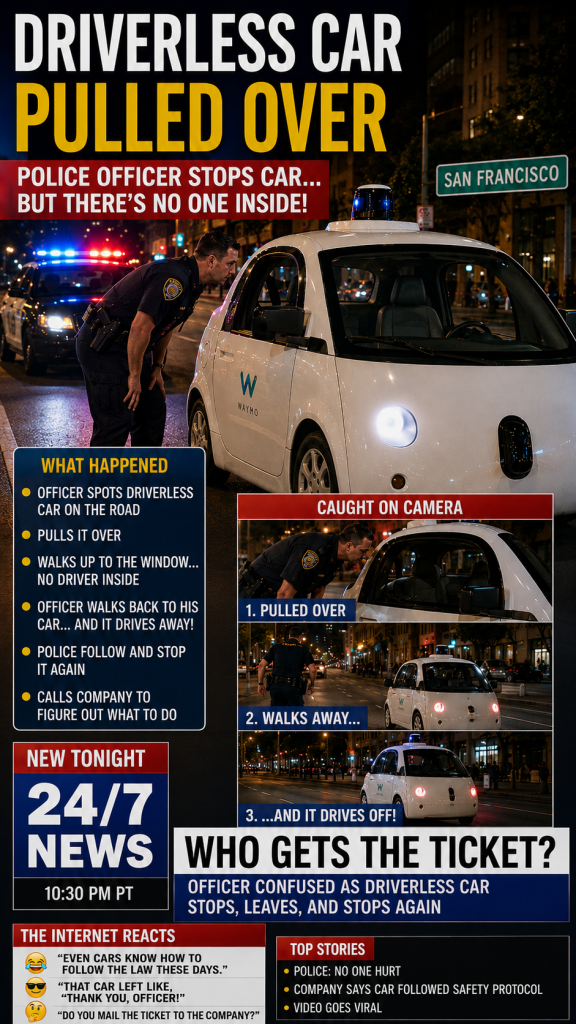
One night in San Francisco, a police officer was driving around, expecting a normal shift.
Maybe he would stop a speeding car, help someone find directions, or tell one confused tourist that no, the Golden Gate Bridge was not “just around the corner.”
Then he saw something strange.
A small driverless car was moving down the street.
The officer looked once.
Then he looked again.
The car had no driver.
But somehow, it was still driving like it had somewhere important to be.
The officer said, “Not today.”
He turned on the police lights.
The driverless car slowed down and pulled over.
For a few seconds, everything looked normal. The police car was behind it. The little driverless car was stopped.
The officer got out and walked toward it like he was about to ask for license and registration.
Then he reached the window.
There was no one inside.
The officer leaned closer.
Still no one.
He looked through the windshield.
No driver.
No passenger.
Not even a nervous robot holding the steering wheel.
Just seats, screens, and silence.
The officer stood there with the face of a man whose job training had not covered this situation.
He probably wanted to say, “Do you know why I pulled you over?”
But then he realized the car might answer, “No, because I don’t have ears.”
People on the sidewalk started recording. Because in San Francisco, the only thing faster than technology is someone pulling out a phone to film it.
One man whispered, “Is he giving a ticket to a car?”
Another said, “That car is about to ask for a lawyer.”
The officer walked around the car, checking it carefully. He looked confused but professional.
He was trying to stay calm, but his face said, “I did not join the police department to argue with a toaster on wheels.”
Then something even funnier happened.
The officer walked back to his patrol car.
And the driverless car drove away.
Not fast. Not wild. Just calmly.
Like it had said, “Thank you for your time, officer,” and left.
The officer turned around and saw it moving.
For a second, he froze.
You could almost hear his thoughts.
“Did that car just leave me?”
Yes. It did.
The officer rushed back to his car and followed it again.
Now the situation had become ridiculous. A police officer was chasing a car with no driver, no attitude, and no fear.
The car was not running from the law. It was just following whatever robot brain told it to do.
The driverless car went a little farther and stopped again.
This time, more officers arrived.
They surrounded the car like it was a tiny criminal.
One officer said, “Who’s driving?”
Another said, “Nobody.”
The first officer said, “Then who do we talk to?”
Everyone went quiet.
Because that was the big question.
Do you give a ticket to the car?
Do you mail it to the company?
Do you arrest the software?
Do you say, “Step out of the vehicle,” and wait for the dashboard to respond?
One officer knocked on the window.
Nothing happened.
Another officer shined a flashlight inside.
Still nothing.
The car just sat there, quiet and innocent, like a student pretending not to know the answer.
Then one officer found a phone number on the car and called the company.
“Hello,” he said. “We pulled over one of your cars.”
The person on the phone said, “Was anyone hurt?”
“No.”
“Was there a driver?”
The officer paused.
“That is the problem.”
The company explained that the car was programmed to stop when police lights appeared, then move to a safer location if needed.
The officer nodded, but he still looked like he wanted to give the car detention.
Meanwhile, the video went online.
People loved it.
Everyone had jokes.
One person wrote, “Even driverless cars are getting pulled over now.”
Another wrote, “The car saw the police and said, ‘I know my rights.’”
Someone else said, “That car left because it knew it had no license.”
But the funniest comment came from a man watching the news later.
The anchor said the car had no driver behind the wheel.
The man said, “And somehow police still managed to stop it.”
His friend said, “Well, at least nobody was driving badly.”
The man said, “Exactly. That’s probably why they were suspicious.”
Back at the police station, the officer had to explain what happened.
His boss asked, “So you pulled over a car?”
“Yes.”
“Was there a driver?”
“No.”
“Did the car leave?”
“Yes.”
The boss rubbed his forehead.
“So the suspect fled?”
The officer said, “Technically, the suspect relocated.”
Another officer nearby said, “Can we even call it fleeing if it has no legs?”
Nobody answered.
The next day, everyone in town had an opinion.
Some people said driverless cars were the future. Others said they were scary.
Some said they were safer than human drivers because at least they did not text, yell, eat fries, and try to change music at the same time.
But one old man at a coffee shop said, “I don’t trust a car that can leave without me.”
That felt fair.
The driverless car, of course, did not care about the drama.
It probably went back to the company garage and told the other cars, “You will not believe what happened to me tonight.”
Another car asked, “Did you get a ticket?”
“No.”
“Did you panic?”
“No.”
“Did you drive away from the police?”
“Yes.”
The other cars gasped.
And from that day on, that little driverless car became a legend.
It was not fast.
It was not dangerous.
It did not even have a face.
But it made police officers, news anchors, and everyone online ask one important question:
When a car with no driver gets pulled over…
Who gets the ticket?