Soldier’s Return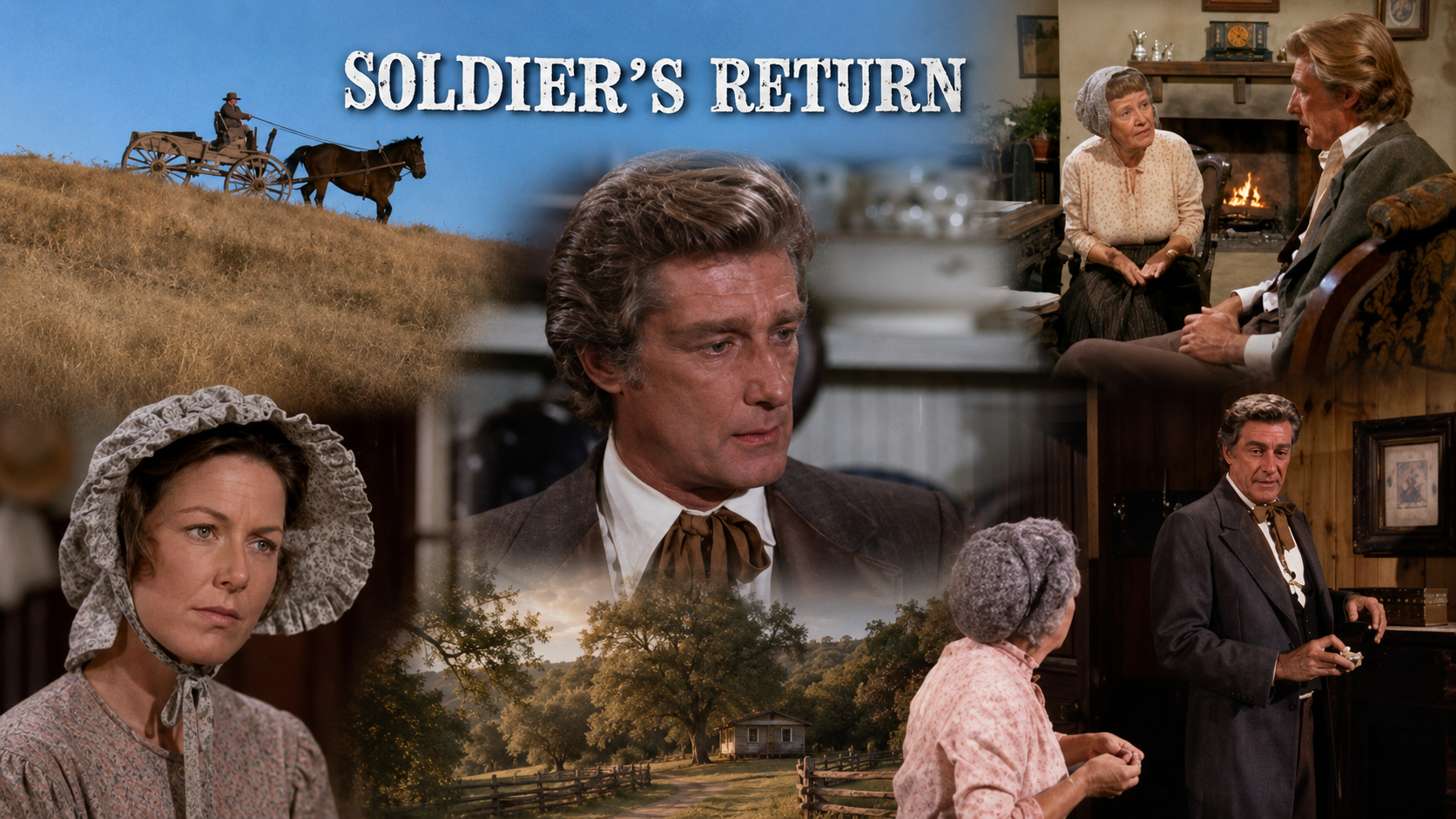
Part 1: The Man Who Came Back
After twelve long years away, Granville Whipple returned to Walnut Grove.
He arrived on the afternoon stagecoach with one suitcase, one violin case, and a face that looked older than his years.
The town remembered him as Mrs. Whipple’s talented son, the young man who had left home to become a musician.
He had played with a busy orchestra in Philadelphia, performing before large crowds and important people.
But when he stepped down from the coach, he did not look proud.
He looked tired.
His mother hurried toward him with tears in her eyes.
“Granville,” she whispered.
He smiled softly. “Hello, Mother.”
Mrs. Whipple held him tightly. She had waited years for this moment. Her son was finally home.
But as she hugged him, she felt how thin he was. His body trembled slightly.
His eyes kept moving, as if he expected danger to appear from nowhere.
That night, Mrs. Whipple made a special supper.
Charles and Caroline Ingalls came to welcome him, along with Mary, Laura, Doc Baker, and Reverend Alden.
Everyone tried to make Granville feel at home.
Laura asked him about Philadelphia.
“Did you really play music in front of hundreds of people?”
Granville smiled. “Sometimes more than that.”
Laura’s eyes widened. “I can’t imagine that many people listening to one song.”
Granville looked down at his hands. “Sometimes I couldn’t either.”
For a while, the evening felt peaceful.
But when a plate slipped from the table and crashed to the floor, Granville jumped up so fast his chair fell behind him.
His face turned pale.
His breathing grew hard.
Everyone became quiet.
Mrs. Whipple touched his arm. “Granville, you’re safe.”
He looked around the room, ashamed.
“I’m sorry,” he said.
Charles spoke gently. “No harm done.”
But everyone could see the truth.
Granville had come home from Philadelphia, but part of him was still somewhere else.
Later that night, thunder rolled over Walnut Grove.
Granville woke in terror.
The thunder became cannon fire in his mind.
The rain became gunshots.
His bedroom disappeared, and suddenly he was back at the Battle of Shiloh.
Smoke filled the air.
Men screamed.
The ground shook.
He saw soldiers falling beside him.
He heard voices calling for help.
He tried to move, but pain shot through his leg.
Then he screamed.
Mrs. Whipple rushed into his room and found him sitting up in bed, covered in sweat.
“It’s over,” she said, holding him. “You’re home now.”
Granville shook his head.
“No, Mother,” he whispered. “I never really left.”
Part 2: The Secret Pain
The next morning, Doc Baker came to see him.
Granville tried to act calm, but his hands would not stop shaking. Doc Baker noticed everything.
“How long have the nightmares been happening?” he asked.
Granville looked toward the window. “Since Shiloh.”
“And the pain?”
“My leg still hurts.”
Doc Baker waited before asking the harder question.
“Are you taking morphine?”
Granville closed his eyes.
Mrs. Whipple’s face filled with worry.
Finally, Granville answered, “Yes.”
The room became still.
Morphine had been given to many wounded soldiers after the war.
It helped with pain, but it could also trap a man.
Granville had started using it after his injury.
At first, it helped him sleep.
Then it helped him get through the day. Soon, he could not live without it.
“I tried to stop,” Granville said. “Many times.
But when I stop, the dreams come stronger.
The pain comes back. My body feels like it is fighting against me.”
Doc Baker spoke kindly. “You are not weak, Granville.
You are sick. But sickness can be treated.”
Granville laughed sadly. “Can you treat memories too?”
Doc Baker did not answer right away.
Then he said, “Not alone. But with help, a man can learn how to live with them.”
Granville was not sure he believed that.
Over the next few days, he tried to stay busy.
He helped his mother around the house.
He fixed a broken fence.
He walked through town and listened to the sound of wagons, children, and church bells.
But peace did not come easily.
At night, the nightmares returned.
In the morning, his body begged for morphine.
One afternoon, Charles found him sitting near Plum Creek.
Granville held a small bottle in his hand.
Charles sat beside him without judging.
Granville stared at the water.
“I was a musician before the war,” he said. “I thought my hands were made for music.”
Charles listened quietly.
“Then Shiloh happened. I saw things no man should see.
I carried men who were missing parts of themselves.
I heard boys crying for their mothers. After that, music felt useless.”
Charles said softly, “Maybe music is still part of what can save you.”
Granville shook his head. “I don’t know if I deserve saving.”
Charles looked at him firmly.
“Every man deserves a chance to come home.”
Those words stayed with Granville.
That evening, he gave the morphine bottle to Doc Baker.
“I want to stop,” he said.
Doc Baker nodded. “It will be hard.”
Granville’s voice shook. “I know.”
Mrs. Whipple took his hand.
“You won’t do it alone.”
Part 3: The Song of Healing
The days that followed were some of the hardest days of Granville’s life.
Without morphine, his body suffered.
He shook with chills.
He could not sleep.
His leg ached.
His temper rose quickly, then disappeared into shame.
Sometimes he cried. Sometimes he sat silently for hours.
Mrs. Whipple stayed near him.
Doc Baker checked on him.
Charles visited whenever he could.
Reverend Alden prayed with him, not in a loud way, but gently, like a man sitting beside another man in pain.
Slowly, the worst passed.
Granville was still troubled, but his eyes began to clear.
He began walking each morning. He began eating again.
He even smiled once when Laura brought him wildflowers.
Then one afternoon, Laura saw him sitting on the porch with his violin.
“Are you going to play?” she asked.
Granville looked at the violin like it belonged to another man.
“I don’t know if I still can.”
Laura sat on the porch step.
“You won’t know unless you try.”
Granville raised the violin. His hands trembled.
The first sound was rough and broken.
He almost stopped.
But Laura said, “Try again.”
So he did.
This time, the note was clearer.
Then another came.
Then another.
The music floated softly across the yard.
Mrs. Whipple came to the doorway and covered her mouth.
Tears filled her eyes. She had not heard her son play like that in years.
The song was not happy.
It carried sadness.
But beneath the sadness, there was hope.
Word spread through Walnut Grove that Granville was playing again.
At the next town gathering, Reverend Alden asked if he would share a song.
Granville was afraid.
Standing before people reminded him of the orchestra.
It reminded him of the life he had lost. But then he looked at his mother.
He looked at Charles, Caroline, Mary, Laura, Doc Baker, and the neighbors who had not turned away from him.
So he lifted his violin.
The room grew quiet.
Granville began to play.
The song was slow at first, like someone walking through darkness.
Then it rose gently, like morning light touching the prairie.
Every person in the room felt the pain in the music, but they also felt courage.
When the final note faded, nobody clapped right away.
They were too moved.
Then Charles stood.
One by one, everyone else stood too.
The applause filled the room.
Granville lowered his violin, tears in his eyes.
For the first time in many years, he did not feel like a broken soldier.
He felt like a man who was still alive.
Later that evening, he walked outside with Charles.
“The war took a lot from me,” Granville said.
Charles nodded. “Yes, it did.”
Granville looked across the quiet prairie.
“But maybe it doesn’t get to take everything.”
Charles smiled. “No. It doesn’t.”
Granville took a deep breath.
The night was calm.
No cannon fire.
No screams.
Just wind moving through the grass and the soft sound of home.
And in that quiet moment, Granville Whipple finally understood something.
Coming home was not just arriving in Walnut Grove.
Coming home was learning to live again.


