My dad’s sixtieth birthday invitation said, “Black tie only—dress properly or don’t come.” Then Mom called and whispered, “Your sister’s boyfriend is a senator’s son. We can’t have you embarrassing us.” I walked in anyway, holding my daughter’s hand, prepared to be humiliated. But the entire room fell silent when the governor stopped in the middle of his speech, smiled at my little girl, and said, “There you are.”
The Birthday Invitation
Part 1
My father’s sixtieth birthday invitation came in a thick cream envelope with gold letters.
It looked expensive.
Beautiful.
Perfect.
Just like everything my family cared about.
I stood in my small kitchen and opened it while my five-year-old daughter, Emma, sat at the table coloring a purple dog with wings.
At the bottom of the invitation, one sentence made my heart drop.
Black tie only. Dress properly or do not come.
I read it twice.
Then I read it again.
Emma looked up at me with her bright little eyes.
“Are we going to Grandpa’s party, Mommy?”
I forced a smile.
“Maybe, sweetheart.”
Two hours later, my mother called.
“Claire,” she said softly. “Your sister’s boyfriend will be there.”
I already knew where this was going.
“He’s Senator Wallace’s son,” she continued. “There will be important people at the party. Your father doesn’t want any awkwardness.”
“What awkwardness?” I asked.
She sighed.
“You’re a single mother. You work at a diner. You don’t exactly fit the evening.”
The words hurt, but they did not surprise me.
My family had always treated me like I was a stain on their clean white tablecloth.
My sister Vanessa had the good job, the perfect clothes, the wealthy boyfriend, and the kind of life my parents loved showing off.
I had Emma.
I had bills.
I had tired feet from long diner shifts.
And to me, Emma was worth more than all of it.
“I’m his daughter,” I said.
“And we love you,” Mom replied quickly. “But your father has worked hard for his reputation.”
There it was.
Reputation.
That was what mattered most.
Not family.
Not love.
Not kindness.
Only what other people thought.
“So you don’t want me there,” I said.
“We don’t want you embarrassed.”
I almost laughed.
“No, Mom. You don’t want me seen.”
She went quiet.
I hung up before she could say anything else.
That night, I almost stayed home.
But then Emma came out of my bedroom wearing a little navy dress I had bought from a thrift store. She twirled in a circle, smiling like she was in a movie.
“Do I look fancy enough, Mommy?”
My throat tightened.
I knelt down and fixed the bow in her hair.
“You look perfect.”
So we went.
The hotel ballroom looked like something from another world. Chandeliers glowed above us. People laughed softly while holding champagne glasses. Women wore diamonds. Men wore black suits.
The moment Emma and I walked in, the room changed.
People looked.
Then whispered.
My sister Vanessa saw me first. Her smile disappeared.
Her boyfriend, Grant Wallace, looked me up and down like I was something unpleasant.
Then my father turned.
For one second, I saw anger flash across his face.
He walked toward me quickly.
“Claire,” he said in a tight voice. “I thought your mother explained.”
“She did,” I said.
His eyes dropped to Emma, then back to me.
“This is not the place for drama.”
I held my daughter’s hand tighter.
“I came to wish my father a happy birthday.”
Before he could answer, the man speaking on stage stopped in the middle of his speech.
The whole room turned.
Governor Daniel Hayes was standing at the microphone.
He stared at us.
Then his face softened.
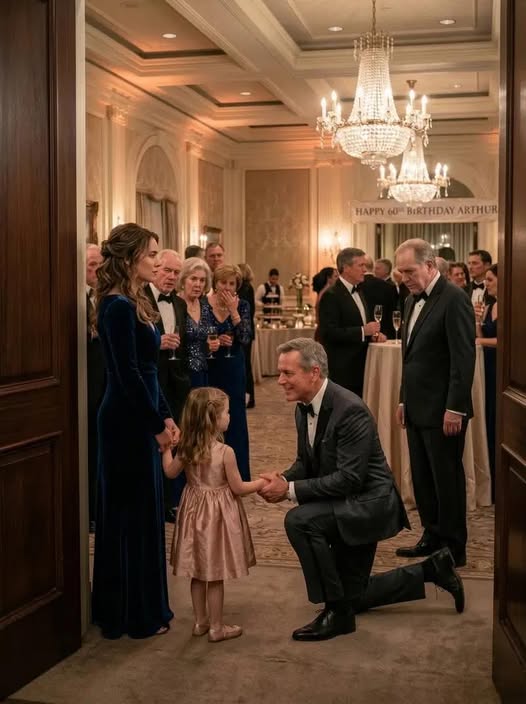
He stepped away from the stage, walked through the silent ballroom, and stopped in front of my daughter.
Then he knelt down and smiled.
“There you are, sweetheart,” he said. “I’ve been waiting to meet you.”
The room went completely silent.
Part 2
Emma looked at me, confused.
Then she looked back at the governor.
“You know me?”
Governor Hayes smiled kindly.
“I know your mother,” he said. “And I know she helped my wife when she needed it most.”
My father’s face turned pale.
Vanessa whispered, “What is happening?”
I stood frozen.
Six months earlier, Governor Hayes’s wife, Caroline, had come into the diner where I worked.
It was late.
She was alone.
Her eyes were red, and her hands were shaking.
At first, I did not know who she was.
To me, she was just a woman who looked like she was breaking inside.
She ordered coffee and toast.
Then she realized she had forgotten her wallet.
My manager was annoyed, so I paid for the meal myself.
When she started crying in the booth, I sat with her during my break.
She told me her daughter had been in the hospital after a terrible accident. The news reporters were everywhere. Everyone wanted a statement. Everyone wanted a photo.
But no one had asked if she was okay.
So I listened.
That was all.
I listened until she could breathe again.
Before she left, she asked for my name.
A week later, flowers came to the diner.
Then a thank-you note.
Then she quietly started a college fund for Emma.
I tried to refuse it.
Caroline only said, “Kindness should never disappear without coming back.”
I never told my family.
They had already decided who I was.
The poor daughter.
The single mother.
The waitress.
The disappointment.
Governor Hayes stood and turned to the room.
“Claire Morgan showed my family compassion on one of the worst nights of our lives,” he said clearly. “She asked for nothing. She wanted nothing. People like that deserve respect in every room they enter.”
His words filled the ballroom.
My father forced a smile.
“Governor, of course Claire is welcome here.”
I slowly turned to him.
“Really?”
His jaw tightened.
My mother hurried over.
“Claire, this is not the time.”
I looked around at the guests, the cameras, the expensive dresses, and the relatives who had ignored me for years.
“It became the time,” I said, “when you told me my life was too embarrassing for your guest list.”
Vanessa stepped closer.
“Stop making this about you.”
I laughed softly.
“No, Vanessa. You mean stop telling the truth.”
Grant Wallace looked uncomfortable now. His father, Senator Wallace, leaned toward him and whispered something. Grant’s face turned red.
Then Emma pointed at my father.
“Mommy,” she asked loudly, “is that the grandpa who didn’t want us to come?”
No one spoke.
My father opened his mouth, but nothing came out.
My mother covered her lips with shaking fingers.
Governor Hayes looked at my father, and his kind expression faded.
My father cleared his throat.
“Children misunderstand adult conversations.”
I stepped forward.
“No, Dad. She understood perfectly.”
For years, I had tried to earn my place in that family.
I sent birthday cards that no one answered.
I smiled through dinners where Vanessa’s success was praised while my hard work was ignored.
I stayed quiet when my mother corrected my clothes, my job, my apartment, and even the way I raised my daughter.
But that night, standing in a borrowed dress with Emma beside me, I finally understood.
They were not ashamed because I had failed.
They were ashamed because I survived without needing their approval.
Part 3
The party continued, but everything felt different.
People who had ignored me before suddenly smiled at me.
Some came over and introduced themselves.
A few told me I had a beautiful daughter.
My father stood near the stage, stiff and embarrassed.
Vanessa stayed beside Grant, but he barely looked at her.
Twenty minutes later, Caroline Hayes arrived.
The moment she saw me, she crossed the ballroom and hugged me in front of everyone.
“Claire,” she said warmly. “I’m so happy you came.”
Then she bent down and gave Emma a small silver bracelet.
“For the little girl your mother talks about so proudly,” Caroline said.
Emma smiled so wide I nearly cried.
My mother pulled me into the hallway.
Her eyes were full of tears.
“Claire,” she whispered, “we made a mistake.”
I looked at her for a long moment.
“No,” I said softly. “A mistake is forgetting to call. A mistake is burning dinner. This was a choice.”
She flinched.
“I never wanted to hurt you.”
“But you did,” I said. “Again and again. And you always called it love.”
Before she could answer, my father walked over.
His face was red with anger, but his voice was low.
“You didn’t have to humiliate me.”
I looked at him calmly.
“You invited humiliation,” I said. “I just walked through the door.”
For once, he had no answer.
Emma tugged on my hand.
“Can we go home, Mommy?”
I looked back at the ballroom.
At the family who had tried to hide us.
At the strangers who had shown us more kindness than blood ever had.
Then I smiled.
“Yes, sweetheart. We can.”
As we walked toward the door, Caroline called after us.
“Dinner next week, Claire. No black tie required.”
Emma giggled.
And for the first time that night, I smiled for real.
After that evening, my father sent three messages.
My mother called twice.
Vanessa posted a family photo without me, then deleted it when people started asking why I was missing.
I did not chase them.
I did not beg.
I did not explain myself anymore.
The next morning, I took Emma out for pancakes.
She sat across from me with syrup on her chin and sunlight in her hair.
“Mommy,” she asked, “was Grandpa mad because we came?”
I reached across the table and held her little hand.
“No, baby,” I said. “He was mad because we came without being ashamed.”
Emma thought about that.
Then she nodded like she understood.
I smiled at her.
“Never make yourself smaller just because someone else is uncomfortable with your strength.”
She went back to eating her pancakes.
And I realized something important.
Family is not always the people who share your name.
Sometimes family is the person who sees your pain and sits beside you.
Sometimes it is the person who remembers your kindness.
Sometimes it is the little girl holding your hand while you walk into a room that tried to reject you.
That night, I did not ruin my father’s birthday.
I simply showed up as myself.
And the truth did the rest.