Part 1
The school hallway was almost empty when Julie Andrews heard the small voice.
It was soft.
So soft that most people would have walked past without noticing.
But Julie stopped.
She had come to the school that afternoon as a guest speaker for a children’s music program. The teachers were excited. The students had clapped. Everyone wanted to meet her, shake her hand, and tell her how much her songs had meant to them.
But now the visit was over.
The classrooms were quiet.
The chairs had been pushed back under the desks.
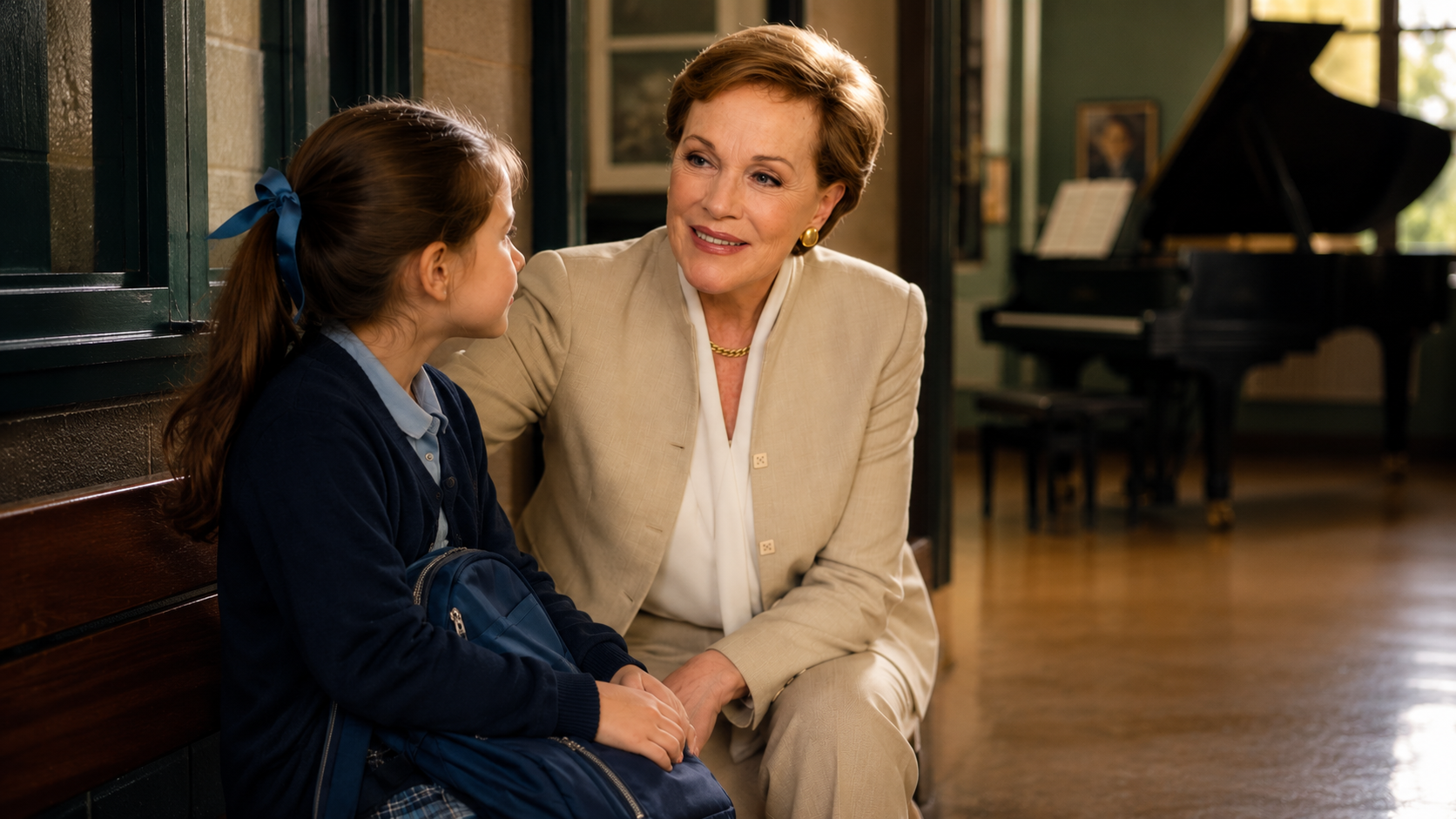
And near the music room, sitting alone on a wooden bench, was a little girl with a backpack in her lap.
She could not have been more than ten.
Her hair was tied back with a faded blue ribbon, and her shoes barely touched the floor. She was looking down at her hands while singing to herself.
Julie stood still.
The girl’s voice was not loud or polished. It trembled in places. Some notes were unsure. But there was something honest in it.
Something pure.
Julie listened for a moment, then gently knocked on the open doorframe.
The little girl gasped and stopped singing.
“I’m sorry,” Julie said kindly. “I didn’t mean to frighten you.”
The girl quickly wiped her eyes.
“I wasn’t supposed to be singing,” she whispered.
Julie smiled softly. “Who told you that?”
The girl shrugged.
“Nobody. I just… I don’t like people hearing me.”
Julie stepped closer but kept enough distance so the child would not feel trapped.
“What’s your name?”
“Emily.”
“That was a lovely song, Emily.”
Emily looked down. “No, it wasn’t.”
Julie sat beside her on the bench.
For a while, neither of them spoke.
Then Emily said, “My class is doing the spring concert. Everyone has a part except me.”
“Why don’t you have a part?” Julie asked.
Emily’s fingers tightened around her backpack strap.
“Because I froze during practice. Everyone laughed.”
Julie’s face softened.
“Oh, my dear,” she said. “That must have hurt.”
Emily nodded, trying not to cry.
“I wanted to sing. I practiced every night. But when I stood in front of everyone, my voice disappeared.”
Julie looked at the quiet hallway.
Then she said, “Do you know something? Courage does not mean you are never scared. Courage means you try even when your knees are shaking.”
Emily glanced at her.
“But what if I fail again?”
Julie smiled.
“Then you breathe, stand up, and try one more time.”
Emily did not answer.
Julie reached into her purse and pulled out a small card. On the back, she wrote a few words.
“Sing because your heart needs to,” she said. “Not because the room is ready.”
Emily read the words again and again.
For the first time that day, she smiled.
Before Julie left, she said, “Would you sing one line for me?”
Emily hesitated.
Then, in the quiet hallway, she sang.
This time, her voice still trembled.
But it did not disappear.
And Julie Andrews clapped softly, as if Emily had just performed on the greatest stage in the world.
Part 2: The Voice That Came Back
The next week, Emily carried Julie’s card everywhere.
She kept it in her coat pocket.
At night, she placed it beside her bed.
Every time she felt afraid, she read the words.
“Sing because your heart needs to. Not because the room is ready.”
The spring concert came faster than Emily wanted.
That evening, the school gym was full of parents, teachers, and students. Emily stood behind the curtain, shaking.
Her music teacher came over.
“Are you sure?” she asked gently.
Emily nodded.
“I want to try.”
When her name was called, the room became silent.
Emily walked to the front.
For one terrible second, she froze again.
She saw faces.
Rows and rows of faces.
Then she remembered Julie sitting beside her in the empty hallway.
She took one breath.
Then another.
And she began to sing.
At first, her voice was small.
But then it grew stronger.
By the second verse, the room was completely still. No one laughed. No one whispered. They listened.
When the song ended, Emily stood there with tears in her eyes.
Then the applause began.
It was warm.
Loud.
Real.
Her mother was crying in the front row.
Her teacher hugged her tightly.
And Emily finally understood that one bad moment did not have to decide her whole life.
Years passed.
Emily grew older, but she never forgot that afternoon after school.
She joined the choir.
Then theater.
Then music college.
Eventually, she became a teacher at a small community arts center, helping children who were shy, nervous, or afraid to be seen.
One rainy afternoon, a little boy stayed after class. He sat alone near the piano, humming softly.
Emily recognized the fear in his eyes.
She sat beside him, just as Julie had once sat beside her.
“You have a beautiful voice,” she said.
The boy looked down. “I’m scared people will laugh.”
Emily smiled gently.
Then she pulled out an old card from her desk drawer.
The ink had faded, but the words were still clear.
“Someone gave this to me when I needed it most,” she said.
The boy read it.
“Sing because your heart needs to. Not because the room is ready.”
Emily looked out the window as rain tapped against the glass.
She never saw Julie Andrews again.
But that one gentle conversation had stayed alive.
It had helped one shy little girl find her voice.
And through Emily, it helped many more children find theirs.
Because encouragement does not end when the moment passes.
Sometimes, it keeps moving from heart to heart.
And quietly changes two futures.
Then three.
Then countless more.


