Part 1
The old violin had seen better days.
Its wooden body was scratched, one corner had been carefully glued back together, and the bow had lost so much horsehair that it looked almost worn out. Yet every Saturday morning, sixteen-year-old Lily Parker carried it to the same quiet corner near Covent Garden in London.
She wasn’t there to become famous.
She wasn’t even hoping to earn much money.
She simply wanted to keep one promise.
Years earlier, her father had placed that violin into her small hands and smiled.
“No matter what happens,” he had said, “never stop playing. Music will always help you find your way home.”
But her father was gone now.
A sudden illness had taken him two years before.
Since then, Lily lived with her mother, who worked two jobs just to keep a small apartment. Money was always tight. Music lessons had become impossible, and Lily’s dream of attending a conservatory slowly faded.
Still, every weekend she played.
Some people smiled.
Some dropped a few coins into her violin case.
Most simply walked past without noticing.
Each passing week became a little harder.
One afternoon, Lily overheard two teenagers laughing nearby.
“She’s not even that good.”
“I’ve heard children play better.”
The words struck deeper than they knew.
That evening, Lily went home without saying a word.
She placed her violin back into its case and didn’t touch it for nearly two weeks.
Whenever she walked past the instrument, she remembered those voices.
Maybe they were right.
Maybe she had never been talented.
Maybe she was only holding on because of her father.
One rainy Saturday, her mother quietly asked, “Aren’t you going to play today?”
Lily forced a smile.
“I think I’m finished.”
Her mother looked disappointed but didn’t argue.
Sometimes a broken heart needs silence before it can hear hope again.
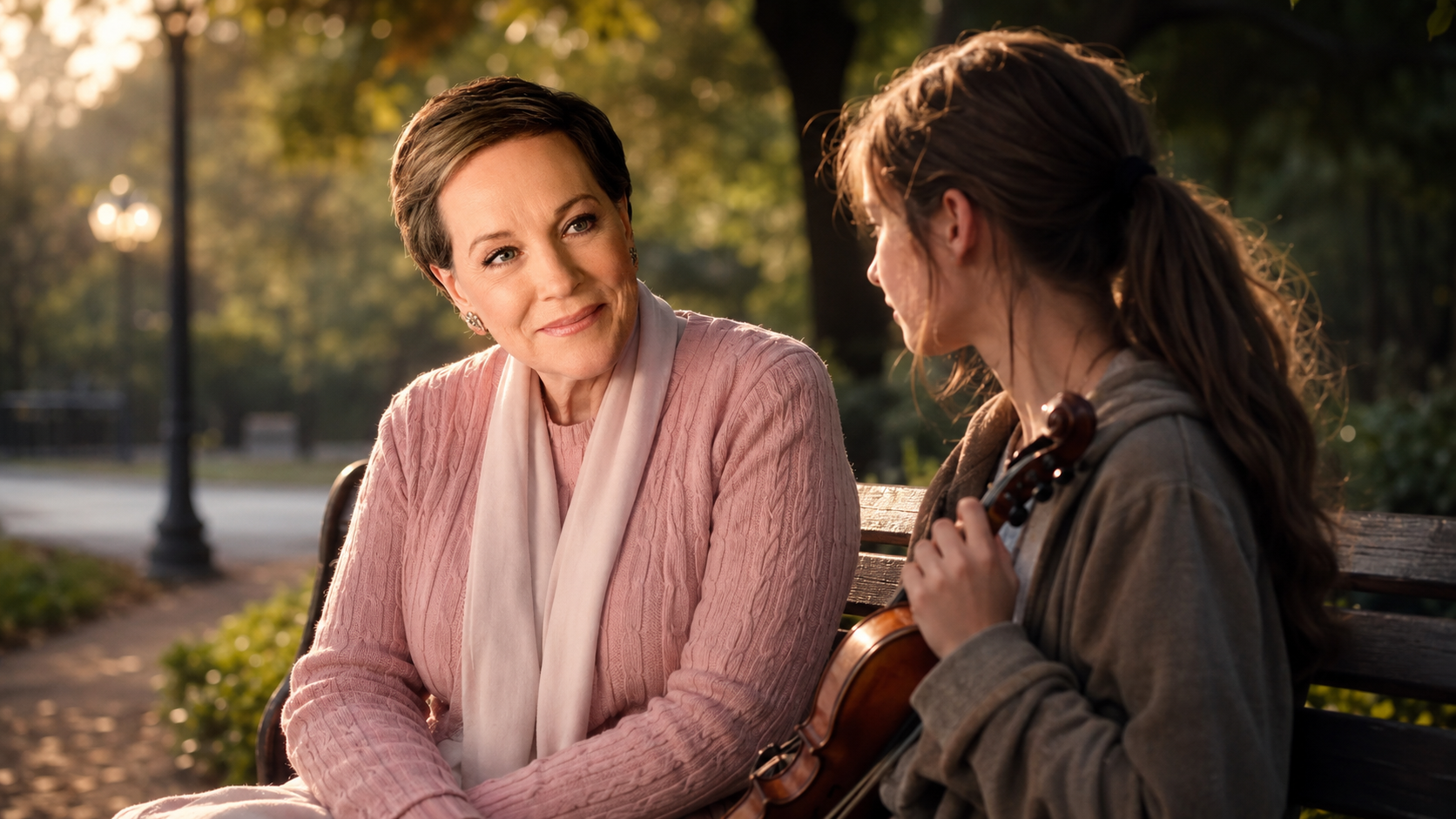
Later that afternoon, Lily wandered through a nearby park.
Rain had finally stopped.
The benches were still wet, and only a few visitors remained.
Near the fountain, an elderly woman sat reading a small notebook while enjoying the peaceful afternoon.
Lily recognized her immediately.
Julie Andrews.
The legendary actress and singer had been visiting London for a charity event, though Lily never imagined she’d see her sitting alone in a public park.
Trying not to stare, Lily walked quietly past.
But something unexpected happened.
Julie looked up and smiled warmly.
“That’s a beautiful violin case.”
Lily stopped.
“Oh… thank you.”
“You play?”
“I used to.”
Julie closed her notebook.
“Used to?”
Lily hesitated.
Then, without meaning to, everything came pouring out.
She spoke about her father.
About the promise.
About the street performances.
About the strangers who laughed.
And finally she whispered,
“I think they were right.”
Julie listened without interrupting.
Not once.
When Lily finally finished, there was a long silence.
Then Julie asked a simple question.
“Who taught you that strangers are allowed to decide your dream?”
Lily blinked.
“No one.”
Julie smiled gently.
“My dear… audiences clap, critics write reviews, strangers offer opinions.”
She looked toward the violin case.
“But none of them decide whether music belongs in your heart.”
Lily stared at the ground.
“I’ve made mistakes.”
Julie nodded.
“So have I.”
“You?”
Julie laughed softly.
“More than I can count.”
She explained how every performer experiences doubt.
Every singer misses notes.
Every actor forgets lines.
Every musician has performances they’d rather forget.
“But confidence,” Julie said, “isn’t believing you’ll never fail.”
“It’s believing that one difficult day isn’t the end of your story.”
The words settled deeply inside Lily.
Before leaving, Julie reached into her handbag.
Lily expected an autograph.
Instead Julie handed her a small folded piece of paper.
“Don’t open it until tomorrow.”
Lily thanked her, still unsure what had just happened.
The next morning, she unfolded the note.
Inside, written in elegant handwriting, were only two sentences.
“The world already has enough people who quit too soon.”
“Please don’t let music lose you.”
At the bottom was one final line.
“Meet me next Saturday morning, if you’re willing.”
Lily looked at the address.
It wasn’t a theater.
It wasn’t a concert hall.
It was a small community music center she had never heard of.
She had no idea why Julie wanted her there.
But something inside her heart, silent for weeks, had begun to play again.
To Be Continued in Part 2…
Part 2: The Music That Found Its Way Home
The following Saturday, Lily arrived nearly thirty minutes early.
She almost turned around twice.
The community music center looked ordinary from the outside—old brick walls, flower boxes beneath the windows, and children’s drawings taped to the front door.
Nothing about it suggested that someone as famous as Julie Andrews would spend her morning there.
Lily took a deep breath and stepped inside.
Instead of a grand performance hall, she found a cheerful room filled with children holding violins, cellos, flutes, and clarinets. Some played beautifully. Others squeaked through every note. Yet no one laughed. Every mistake was met with encouragement instead of criticism.
Julie greeted her with the same gentle smile.
“I’m glad you came.”
She introduced Lily to the group—not as a struggling street musician, but as “a young violinist who has a gift for bringing emotion into every note.”
Lily nearly looked behind her, wondering if Julie meant someone else.
The morning was filled with music games, simple rehearsals, and laughter. Lily slowly relaxed. She even helped a nervous eight-year-old girl who kept dropping her bow.
“I can’t do it,” the little girl whispered.
Lily smiled.
“You don’t have to play perfectly today. You just have to keep playing.”
The words surprised her.
They were the very lesson Julie had given her.
Later, Julie invited Lily into a small rehearsal room.
“I have something to show you.”
She opened an old folder filled with yellowed concert programs, handwritten notes, and newspaper clippings.
“These are from performances where I thought I’d failed,” Julie said.
Lily stared in disbelief.
“You kept these?”
“I did.”
“Why?”
“So I would remember that disappointment never lasted forever.”
Julie pointed to one program with a handwritten note across the front.
“Not my best performance. Keep learning.”
“If I had stopped after that night,” Julie said softly, “I would have missed so many beautiful moments that came afterward.”
Lily felt tears gathering in her eyes.
For the first time in months, she realized that one cruel comment didn’t define her future.
Over the next several weeks, Lily returned every Saturday.
She practiced with the children.
She played duets with volunteer musicians.
She laughed more than she had since her father passed away.
Most importantly, she began playing on the streets again.
This time, something had changed.
She no longer watched people’s faces, waiting for approval.
She played because the music made her feel close to her father.
Some days she earned only a few coins.
Other days tourists stopped to listen until the last note faded into the air.
One afternoon, a music teacher happened to pass by and heard Lily perform.
He introduced himself and asked where she had studied.
Lily smiled.
“I’ve mostly been teaching myself.”
He invited her to audition for a scholarship at a local youth music academy.
Weeks later, Lily stood outside the audition room with trembling hands.
Before she walked in, she unfolded the little note Julie had given her months earlier.
“Please don’t let music lose you.”
She smiled.
This time, she wasn’t trying to prove anything.
She simply wanted to share the music she loved.
Her performance wasn’t flawless.
She missed one difficult passage.
Her bow slipped once.
But she never stopped.
When the final note ended, the room remained silent for a moment before the judges applauded.
A week later, the acceptance letter arrived.
Lily had earned a full scholarship.
That evening, she visited the same park where she had first met Julie.
She found the same bench.
Though Julie wasn’t there, Lily sat quietly with her violin and played the melody her father used to love.
As the final note drifted into the evening air, she realized something beautiful.
Julie Andrews hadn’t given her success.
She hadn’t handed her fame or fortune.
She had given her something far more valuable.
She had helped her believe in herself again.
Years later, after becoming a violin teacher, Lily framed Julie’s handwritten note and hung it on the wall of her own studio.
Whenever a student whispered, “I’m not good enough,” Lily would smile and repeat the words that had changed her life forever.
“Confidence isn’t believing you’ll never fail.”
“It’s believing that one difficult day isn’t the end of your story.”
And in that small room, filled with hopeful young musicians, the kindness of one quiet conversation continued to echo—just like a beautiful melody that never truly fades.
The End.


