Part 1
Lily Carter was twelve years old, but she had already learned how to disappear in a room full of people.
At school, she sat in the back row.
At lunch, she ate near the window.
At her foster home, she helped wash dishes, folded her clothes neatly, and always said thank you. But she rarely asked for anything.
Her foster mother, Mrs. Helen Morris, noticed this from the first week.
Lily was kind. Lily was polite. Lily never caused trouble.
But there was a sadness in her eyes that made Helen’s heart ache.
One afternoon, Helen found Lily standing alone in the living room, facing the old television. A movie musical was playing. On the screen, Julie Andrews sang with warmth and grace.
Lily did not know Helen was watching.
Softly, almost like a secret, Lily began to sing along.
Her voice was small at first. Then it grew stronger.
Helen froze.
The quiet child who barely spoke at dinner had the voice of an angel.
When Lily noticed Helen standing there, she stopped at once.
“I’m sorry,” Lily whispered.
Helen smiled gently.
“Sorry for what, sweetheart?”
Lily looked down. “For being loud.”
Helen stepped closer. “That was not loud. That was beautiful.”
Lily shook her head. “It doesn’t matter.”
“Why not?”
“Because nobody comes to hear me.”
Helen did not know what to say.
A few weeks later, the town announced a children’s charity concert. The event would raise money for foster care programs. Helen thought of Lily right away.
“You should sing,” she said.
Lily’s face went pale. “No. I can’t.”
“Yes, you can.”
“What if I forget the words?”
“Then you start again.”
“What if they laugh?”
Helen took her hand. “Then I will be the loudest person clapping.”
Lily wanted to believe her.
But believing was hard when so many people in her life had left.
One evening, a special guest visited the rehearsal hall.
Julie Andrews herself had agreed to help prepare the children for the charity concert.
The room went silent when she entered.
She was graceful, warm, and calm. But what Lily noticed most was her kindness.
Julie listened to every child. She praised the nervous ones. She encouraged the shy ones. She never made anyone feel small.
When it was Lily’s turn, she almost ran off the stage.
Julie walked up slowly.
“What is your name, dear?”
“Lily,” she whispered.
“That is a lovely name.”
Lily held her song sheet so tightly the paper bent.
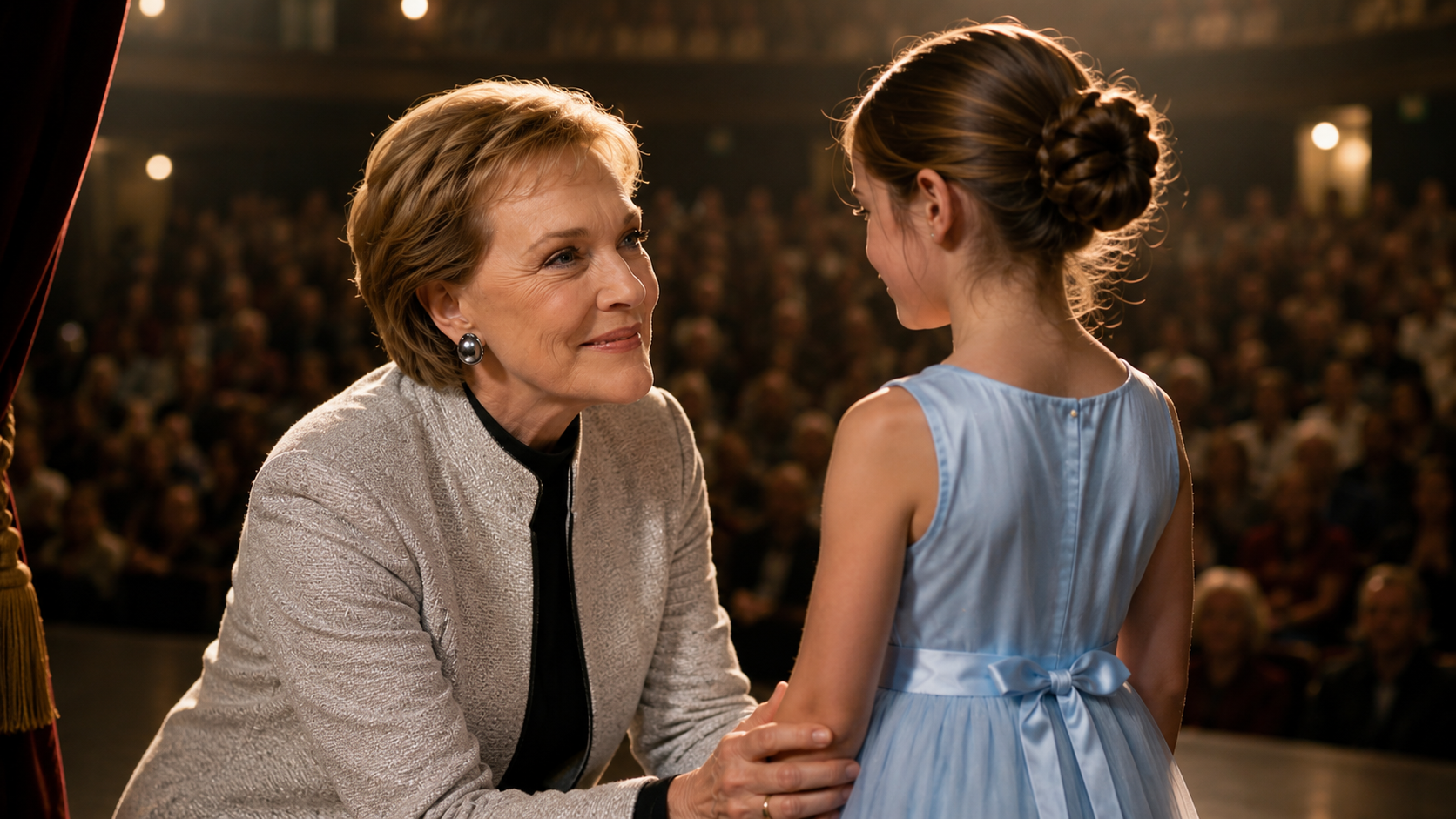
Julie sat beside her on the edge of the stage.
“May I tell you a secret?” Julie asked.
Lily nodded.
“Every performer feels afraid sometimes. Courage is not the absence of fear. Courage is singing even when your hands are shaking.”
Lily looked at her.
“But what if no one cares?”
Julie’s eyes softened.
“Someone always cares. Sometimes, they are closer than you think.”
Those words stayed with Lily.
For the next two weeks, Julie helped her practice. She taught Lily how to breathe, how to stand tall, and how to look above the audience when the room felt too big.
But more than anything, Julie helped Lily believe her voice mattered.
The night of the concert arrived.
The theater was full.
Lily stood behind the curtain in a pale blue dress Helen had bought from a small shop downtown. Her hands trembled.
“I can’t do it,” Lily whispered.
Julie knelt in front of her.
“Yes, you can.”
Lily shook her head. “Nobody is here for me.”
Julie glanced toward the front row, then smiled.
“Are you sure?”
Before Lily could ask what she meant, the announcer called her name.
The curtain opened.
The lights were bright.
The audience waited.
And in the front row sat someone Lily had not seen in almost six years.
Part 2: The Front Row
Lily could not breathe.
For a moment, the whole theater disappeared.
The lights, the audience, the music, even Julie Andrews standing quietly at the side of the stage — all of it faded.
Because sitting in the front row was her older brother, Daniel.
He was taller now. His hair was darker. His face looked older than the boy she remembered.
But Lily knew him at once.
Daniel had been taken to a different foster home when Lily was six. They had cried and held hands until the very last second. After that, letters came for a while.
Then they stopped.
Lily thought he had forgotten her.
Daniel stood slowly.
His eyes were full of tears.
Lily’s lips trembled.
The music began.
But she could not sing.
A soft voice came from the side of the stage.
“Breathe, Lily.”
It was Julie.
Lily closed her eyes.
She remembered what Julie had told her.
Courage is singing even when your hands are shaking.
So Lily took one small breath.
Then another.
And then she sang.
At first, her voice was soft. But as she looked at Daniel, it grew stronger. Every note carried the pain of missing him, the fear of being forgotten, and the hope that maybe life was finally giving something back.
The audience became still.
No one whispered.
No one moved.
By the final verse, Lily was no longer the quiet girl hiding in the back row.
She was standing tall.
She was being heard.
When the song ended, there was a moment of silence.
Then the theater rose to its feet.
Helen cried openly.
Daniel clapped with both hands pressed to his heart.
Julie Andrews smiled with tears in her eyes.
Lily ran from the stage straight into Daniel’s arms.
“I thought you forgot me,” she cried.
Daniel held her tightly. “Never. I looked for you for years.”
Later, Helen learned the truth.
Daniel had aged out of foster care and spent years trying to find Lily. Records had been moved. Names had changed. Homes had closed. But he never stopped searching.
When Julie heard Lily’s story during rehearsals, she quietly asked the concert organizers to help look for him.
And they found him just three days before the show.
Julie had arranged for Daniel to sit in the front row.
Not as a surprise to frighten Lily.
But as a reminder that she was not alone.
After the concert, Daniel visited often. He and Helen worked together to make sure Lily never lost him again.
Months passed.
Lily grew brighter. She joined the school choir. She laughed more. She even helped other quiet children find the courage to sing.
One spring morning, Helen asked Lily what had changed that night.
Lily thought for a moment.
Then she smiled.
“I found my voice,” she said. “And I found my family again.”
Years later, Lily would still remember that stage.
She would remember the bright lights, the shaking hands, and the woman who told her courage did not mean being fearless.
It meant trying anyway.
And whenever Lily saw a quiet child standing alone, afraid to be heard, she would sit beside them and say the same words Julie Andrews once said to her.
“Someone always cares. Sometimes, they are closer than you think.”
For Lily, one song had become more than a performance.
It became the beginning of a new life.


