Inspiring Lessons: Teaching Dr. Martin Luther King Jr.’s Legacy to Students
Posted on: January 7, 2025
Posted in: Advocacy | Member Resources
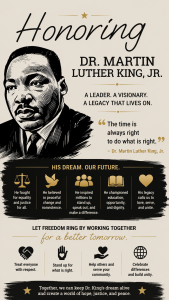
Dr. Martin Luther King Jr. is remembered as one of the most important leaders in American history. His work during the Civil Rights Movement changed the nation and inspired people across the world. Through courage, determination, and a commitment to nonviolent action, Dr. King helped challenge racial segregation and discrimination while encouraging millions of people to believe that positive change was possible.
Today, educators continue to teach students about Dr. King’s life because his message remains as important as ever. His dream of equality, justice, and opportunity for all people provides valuable lessons for young learners. Understanding his story helps students learn about history while encouraging them to think about their own role in creating a fair and respectful society.
This collection of resources and learning opportunities can help teachers guide meaningful discussions about Dr. King’s legacy, the Civil Rights Movement, and the responsibilities of citizenship.
Who Was Dr. Martin Luther King Jr.?
Dr. Martin Luther King Jr. was born on January 15, 1929, in Atlanta, Georgia. He grew up during a time when racial segregation was common throughout much of the United States. Laws and social customs separated Black Americans and white Americans in schools, restaurants, transportation, and many other parts of everyday life.
Even as a child, King experienced discrimination firsthand. He saw how unfairly Black people were treated and began asking questions about why society accepted such injustice. These experiences shaped his understanding of equality and helped inspire his future work.
King excelled in school and eventually attended Morehouse College in Atlanta. After earning his degree, he continued his education at Crozer Theological Seminary in Pennsylvania and later earned a doctorate from Boston University. During these years, he studied religion, philosophy, ethics, and social justice.
One of the greatest influences on King’s thinking was Mahatma Gandhi, the Indian leader who successfully used nonviolent resistance to challenge British rule in India. King believed that peaceful protest could be a powerful tool for achieving social change without hatred or violence.
The Beginning of a Movement
Dr. King’s leadership gained national attention during the Montgomery Bus Boycott in Alabama.
In 1955, Rosa Parks, a Black woman, was arrested after refusing to give up her seat to a white passenger on a segregated city bus. Her arrest sparked outrage throughout the Black community.
Local leaders organized a boycott of Montgomery’s bus system. Black citizens refused to ride the buses and instead walked, carpooled, or found other ways to travel.
At just 26 years old, Martin Luther King Jr. was chosen to help lead the movement.
The boycott lasted 381 days.
Despite threats, arrests, intimidation, and violence, participants remained committed to peaceful protest. Eventually, the United States Supreme Court ruled that segregation on public buses was unconstitutional.
The success of the Montgomery Bus Boycott showed the nation that organized, nonviolent action could create meaningful change.
Building the Civil Rights Movement
Following the success in Montgomery, King became one of the most recognizable leaders in the Civil Rights Movement.
In 1957, he helped establish the Southern Christian Leadership Conference (SCLC), an organization dedicated to advancing civil rights through nonviolent action.
The organization worked to end racial segregation and secure voting rights for African Americans.
Throughout the late 1950s and early 1960s, King traveled extensively, speaking at churches, schools, rallies, and public events.
His speeches inspired people to join the movement and believe in the possibility of a more equal society.
However, his activism also brought danger.
King and his family received death threats. His home was bombed. He was arrested multiple times. Yet he continued his work because he believed that remaining silent in the face of injustice was not an option.
The Birmingham Campaign
One of the most significant moments in the Civil Rights Movement occurred in Birmingham, Alabama, in 1963.
At the time, Birmingham was one of the most segregated cities in America.
Civil rights activists organized peaceful demonstrations to challenge discriminatory laws and practices.
The response from local authorities was harsh.
Police used fire hoses, police dogs, and mass arrests against peaceful protesters, including children.
Images of these events were broadcast across the nation and shocked millions of Americans.
The brutality shown toward peaceful demonstrators increased support for the Civil Rights Movement and highlighted the urgent need for change.
While jailed in Birmingham, King wrote his famous “Letter from Birmingham Jail.”
In the letter, he explained why people had a moral responsibility to challenge unjust laws.
His words remain some of the most influential writings on civil rights and social justice.
The March on Washington and “I Have a Dream”
Perhaps the most famous moment of King’s life came on August 28, 1963.
More than 250,000 people gathered in Washington, D.C., for the March on Washington for Jobs and Freedom.
Standing before the Lincoln Memorial, King delivered his historic “I Have a Dream” speech.
In the speech, he spoke about a future where children of all races could live together as equals.
He imagined a nation where people would not be judged by the color of their skin but by the content of their character.
The speech became one of the most powerful moments in American history.
Its message of hope, equality, and unity continues to inspire people around the world.
Even today, many students first learn about Dr. King through the words of this unforgettable speech.
The Fight for Voting Rights
Although important progress had been made, many African Americans still faced barriers when trying to vote.
In several Southern states, discriminatory laws prevented Black citizens from participating fully in elections.
King and other civil rights leaders organized campaigns to challenge these restrictions.
One of the most important events occurred in Selma, Alabama.
Peaceful marchers attempted to walk from Selma to Montgomery to demand voting rights.
On March 7, 1965, a day known as “Bloody Sunday,” state troopers attacked protesters crossing the Edmund Pettus Bridge.
The violence was broadcast on television and shocked viewers nationwide.
Public support for voting rights grew rapidly.
Later that year, Congress passed the Voting Rights Act of 1965, a landmark law that helped protect voting rights for African Americans and other minority groups.
The Civil Rights Act of 1964
The Civil Rights Movement achieved another major victory with the passage of the Civil Rights Act of 1964.
This historic legislation prohibited discrimination based on race, color, religion, sex, or national origin.
It ended legal segregation in public places and strengthened protections against discrimination in employment and education.
Dr. King’s leadership played a major role in building public support for the law.
The Civil Rights Act remains one of the most important pieces of legislation in American history.
Dr. King’s Nobel Peace Prize
In 1964, at just 35 years old, Martin Luther King Jr. received the Nobel Peace Prize.
He became one of the youngest recipients of the award.
The Nobel Committee recognized his leadership in promoting nonviolent resistance and advancing civil rights.
King accepted the award on behalf of all those who worked for justice and equality.
He viewed the prize not as a personal achievement but as recognition of an entire movement dedicated to human dignity.
Expanding the Fight for Justice
In the later years of his life, King broadened his focus beyond civil rights.
He began speaking about poverty, economic inequality, housing discrimination, and opposition to war.
He believed that true equality required more than legal rights.
People also needed access to jobs, education, healthcare, and economic opportunities.
King launched the Poor People’s Campaign to draw attention to poverty affecting Americans of all backgrounds.
His goal was to create a society where everyone could live with dignity and opportunity.
A Life Cut Short
On April 4, 1968, tragedy struck.
Dr. Martin Luther King Jr. was assassinated while standing on the balcony of the Lorraine Motel in Memphis, Tennessee.
He was only 39 years old.
The news shocked the nation and the world.
Millions mourned his loss.
Despite his death, King’s ideas continued to inspire future generations.
His vision of equality and justice did not die with him.
Instead, it became a lasting legacy that continues to influence movements for civil rights and social change today.
Teaching Dr. King’s Legacy in Today’s Classrooms
Teaching about Dr. King is about more than memorizing dates and historical events.
It is about helping students understand values such as:
- Respect
- Equality
- Courage
- Responsibility
- Empathy
- Community service
- Peaceful problem-solving
Educators can encourage students to explore questions such as:
- What does fairness mean?
- Why is it important to stand up for others?
- How can people create positive change without violence?
- What responsibilities come with freedom?
- How can young people help improve their communities?
These discussions help students connect history to modern life.
Classroom Activities and Learning Opportunities
Reading Historical Documents
Students can examine speeches, letters, photographs, and newspaper articles from the Civil Rights Movement.
Primary sources provide firsthand insight into the experiences of people who lived through this period.
Speech Analysis
Analyzing the “I Have a Dream” speech allows students to explore persuasive language, symbolism, and themes of hope and equality.
Research Projects
Students can research key figures such as:
- Rosa Parks
- John Lewis
- Thurgood Marshall
- Ella Baker
- Medgar Evers
- Fannie Lou Hamer
These projects help students understand that many individuals contributed to the movement.
Community Service
Service projects can encourage students to put Dr. King’s values into action.
Activities might include volunteering, organizing donation drives, or supporting local community initiatives.
Reflection Essays
Students can write about what Dr. King’s message means to them and how they can promote kindness and fairness in their daily lives.
Why Dr. King’s Message Still Matters
More than five decades after his death, Martin Luther King Jr.’s words continue to inspire people around the world.
His vision reminds us that progress requires courage, cooperation, and determination.
Many of the issues he addressed—fairness, opportunity, equal treatment, and respect for human dignity—remain important topics today.
Young people can learn from his example by understanding that positive change often begins with ordinary individuals who choose to make a difference.
King believed that every person had the power to contribute to a better future.
That belief remains one of the most powerful lessons educators can share with students.
Conclusion
Dr. Martin Luther King Jr.’s life was a remarkable journey of leadership, sacrifice, and hope. Through peaceful action, powerful words, and unwavering courage, he helped transform American society and inspired people across the globe.
Teaching his legacy gives students the opportunity to learn about one of the most important chapters in history while reflecting on their own role in creating a fair and compassionate world.
By studying his achievements, understanding the struggles of the Civil Rights Movement, and embracing the values he championed, students can carry forward the dream that Dr. King worked so hard to achieve—a society where every person is treated with dignity, respect, and equality.