Money Crop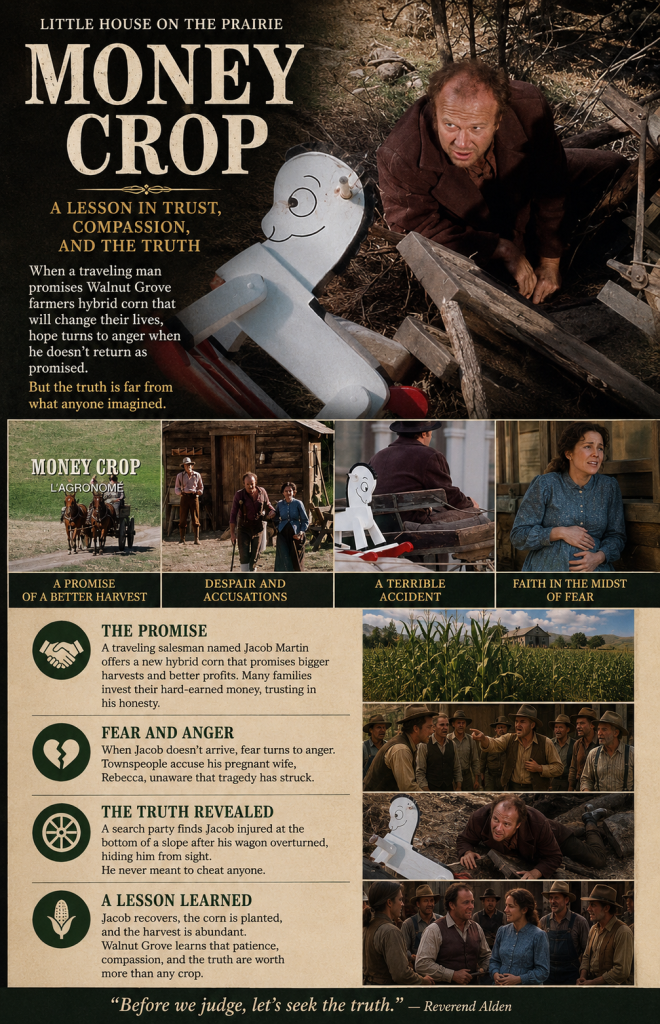
The spring sun rose slowly over the fields surrounding Walnut Grove.
The long winter had finally passed, and farmers throughout the community were preparing for another growing season.
Charles Ingalls stood beside his wagon, looking over his land.
Every year seemed to bring a new challenge. Some years it was drought. Other years it was hail, insects, or poor prices.
Farming was never easy, but Charles believed hard work and faith could carry a family through almost anything.
Still, money was tight.
Very tight.
The previous harvest had not been as successful as many had hoped, and several farmers were struggling to pay their bills.
That was why the arrival of a traveling businessman caught everyone’s attention.
His name was Jacob Martin.
Jacob arrived in Walnut Grove driving a polished wagon and speaking confidently about a revolutionary new type of seed corn.
The townspeople gathered at Oleson’s Mercantile to hear him speak.
“Hybrid corn,” Jacob announced proudly. “Stronger plants. Bigger ears. Better harvests. More profit.”
The farmers exchanged interested looks.
Bigger harvests meant bigger income.
For families struggling to make ends meet, the opportunity sounded almost too good to pass up.
Jacob explained that farmers across other parts of the country had already begun planting the new hybrid corn with excellent results.
“If you invest now,” he said, “your harvest could be the best you’ve ever had.”
The promise was hard to ignore.
Soon, many farmers—including Charles, Jonathan Garvey, and several others—decided to place orders.
The seed wasn’t cheap.
Some families used savings.
Others borrowed money.
Everyone hoped the investment would pay off.
Jacob promised to return within two weeks with a wagon loaded with seed corn.
Planting season would begin immediately afterward.
Before leaving town, Jacob introduced everyone to his wife, Rebecca.
Rebecca was young, kind, and expecting their first child.
The people of Walnut Grove welcomed her warmly.
She seemed honest and genuine.
No one suspected trouble ahead.
The day of delivery arrived.
The farmers gathered early near the center of town.
Wagons lined the road.
Everyone was eager.
Charles smiled as he spoke with Jonathan.
“If this corn works half as well as he claims, we might finally get ahead.”
Jonathan laughed.
“I’d settle for breaking even.”
The morning passed.
No wagon appeared.
The afternoon arrived.
Still nothing.
By evening, concern began to spread.
“Maybe he had a breakdown,” Charles suggested.
But others were less patient.
The next day came.
Still no Jacob.
Still no corn.
Now concern turned into anger.
The farmers had trusted him.
Many had invested money they couldn’t afford to lose.
Harriet Oleson was among the first to voice what others were beginning to think.
“What if we’ve been cheated?”
The possibility spread through town like wildfire.
People became nervous.
Then frustrated.
Then furious.
The longer Jacob remained missing, the more convinced they became that he had taken their money and disappeared.
“He’s a swindler,” one farmer declared.
“A thief,” said another.
The accusations grew louder each day.
Unfortunately, there was one person still in town.
Rebecca.
His pregnant wife.
At first, people treated her kindly.
But as days passed, patience vanished.
Farmers began confronting her.
“Where is your husband?”
“When is he coming back?”
“Did you know about this all along?”
Rebecca answered the same way every time.
“I don’t know where he is.”
The truth was she was frightened.
Jacob had never disappeared before.
He always kept his promises.
Something felt terribly wrong.
Yet nobody wanted to hear that.
They wanted answers.
And since Jacob wasn’t there, Rebecca became the target of their anger.
One afternoon Rebecca left the mercantile carrying groceries.
Several townspeople stared at her as she walked down the street.
Their whispers followed her.
She lowered her eyes.
The tension was becoming unbearable.
Charles noticed.
He stepped beside her.
“How are you holding up?”
Rebecca forced a smile.
“I’ve been better.”
“You still haven’t heard from him?”
She shook her head.
“No.”
Charles frowned.
Something about the situation didn’t make sense.
Jacob had seemed sincere.
He had introduced his wife.
He had spoken openly.
Why would a con man leave his pregnant wife behind?
The more Charles thought about it, the less the story fit.
“I think something happened,” Charles said quietly.
Rebecca looked at him hopefully.
“You do?”
Charles nodded.
“I don’t know what. But I don’t believe he ran away.”
For the first time in days, Rebecca felt a small spark of comfort.
Someone believed her.
Meanwhile, far from Walnut Grove, Jacob Martin lay injured at the bottom of a steep hillside.
Days earlier, while transporting a wagon loaded with hybrid corn, disaster had struck.
One of the horses had stumbled near a narrow stretch of road.
The wagon shifted.
The heavy load became unstable.
Within seconds the wagon overturned.
Jacob was thrown violently down the embankment.
The wagon crashed after him.
The horses broke free and fled.
Jacob survived.
But barely.
His leg was broken.
Several ribs were cracked.
A deep wound on his head left him weak and dizzy.
Worst of all, he was hidden from view.
Anyone traveling the road would never see him below the steep slope.
Day after day he remained trapped.
Unable to walk.
Unable to call loudly enough for help.
Watching helplessly as time passed.
Thinking constantly of Rebecca.
And their unborn child.
Back in Walnut Grove, tempers continued to rise.
At a town meeting, several farmers demanded action.
“We need to find him.”
“If he stole our money, he belongs in jail.”
Others agreed.
The discussion became heated.
Charles finally stood.
“What if he didn’t run away?”
The room grew quiet.
“What do you mean?” someone asked.
“What if he’s hurt? What if there’s another explanation?”
Several people rolled their eyes.
Harriet crossed her arms.
“Oh Charles, you’re always trying to see the best in people.”
“Maybe because sometimes the best is actually there,” Charles replied.
The room fell silent.
Eventually Reverend Alden spoke.
“I think Charles makes a good point.”
The minister looked around.
“Before we judge this man, perhaps we should search for him.”
Many reluctantly agreed.
The following morning, several groups organized search parties.
They spread out along nearby roads and trails.
Charles joined one group.
Jonathan joined another.
For hours they searched.
Nothing.
By afternoon many began losing hope.
Then something caught Jonathan’s attention.
Broken wagon tracks.
They disappeared suddenly near a bend in the road.
Jonathan climbed down from his horse.
“Over here!”
The others rushed over.
Together they examined the area.
Then Charles spotted something below.
A piece of broken wood.
Far down the slope.
His heart skipped.
“Jonathan…”
The men carefully climbed downward.
As they reached the bottom, their eyes widened.
There lay the shattered wagon.
And beside it…
Jacob Martin.
Alive.
But barely.
The men worked quickly.
They carried Jacob to safety and rushed him back to Walnut Grove.
When Rebecca saw her husband, tears flooded her eyes.
“Jacob!”
He reached weakly for her hand.
“I’m sorry,” he whispered.
Rebecca sobbed with relief.
“You came back.”
The entire town learned the truth within hours.
Suddenly everything changed.
The man everyone had called a thief had nearly died trying to deliver exactly what he promised.
The realization hit hard.
Many felt ashamed.
Especially those who had treated Rebecca badly.
Harriet Oleson was unusually quiet.
Several farmers avoided Rebecca’s eyes.
They remembered every accusation.
Every harsh word.
Every judgment.
And now they knew they had been wrong.
Doc Baker worked tirelessly to treat Jacob’s injuries.
The recovery would be long.
But he would survive.
A week later, the recovered seed corn was finally delivered.
Most of it had survived the accident.
Planting season could continue.
The farmers were relieved.
But many felt there was a deeper lesson to learn.
One evening, several townspeople gathered at the Martin home.
Charles, Caroline, Jonathan, Grace, Reverend Alden, and others arrived carrying food and supplies.
Rebecca answered the door.
To her surprise, nearly the entire town stood outside.
Charles smiled.
“We thought you might need some help.”
Rebecca’s eyes filled with tears.
The townspeople entered.
Some apologized openly.
Others offered hugs.
Several admitted they had judged too quickly.
Rebecca accepted every apology with grace.
She understood their fear.
Fear had made them angry.
Fear had made them forget compassion.
But now they were trying to make things right.
And that mattered.
As weeks passed, Jacob slowly regained his strength.
The hybrid corn was planted across Walnut Grove.
The crops grew strong and healthy.
By midsummer, the fields looked better than anyone had imagined.
Tall green stalks stretched toward the sky.
Farmers began feeling hopeful again.
By harvest time, the results were remarkable.
The new corn produced larger yields than traditional crops.
Families earned more money.
Bills were paid.
Repairs were made.
Some even managed to save a little for the future.
The investment had worked.
But strangely, that wasn’t what people remembered most.
What stayed with them was the lesson.
The memory of how quickly fear had turned neighbors against one another.
And how important it was to seek the truth before making judgments.
Late one afternoon, Charles stood beside Jonathan overlooking the golden fields.
The harvest wagons moved across the countryside.
Children laughed nearby.
The town seemed peaceful again.
Jonathan smiled.
“Looks like the hybrid corn really worked.”
Charles nodded.
“It did.”
Then he looked toward the Martin home in the distance.
“But I think we got something more valuable than corn.”
Jonathan laughed.
“What’s that?”
Charles smiled.
“A reminder.”
“A reminder of what?”
Charles folded his arms.
“That people deserve a chance before we decide who they are.”
Jonathan nodded slowly.
“That’s true.”
The two friends watched the sun sink toward the horizon.
Golden light covered Walnut Grove.
Families returned home after another long day.
The fields swayed gently in the breeze.
And somewhere nearby, Rebecca Martin sat on her porch beside her recovering husband, their hands resting together as they dreamed about the child soon to enter the world.
The town had nearly lost trust.
It had nearly lost compassion.
But in the end, kindness had returned.
The truth had been found.
And Walnut Grove learned once again that patience, understanding, and faith often reveal what anger and fear cannot.
For years afterward, whenever someone in Walnut Grove was tempted to jump to conclusions, they remembered the story of the Money Crop—the season when a missing wagon, an injured farmer, and a frightened pregnant wife taught an entire community the value of giving others the benefit of the doubt.
And that lesson proved worth far more than any harvest.