Part 1: “Mom, I Don’t Want a Bath” — Then I Learned Why
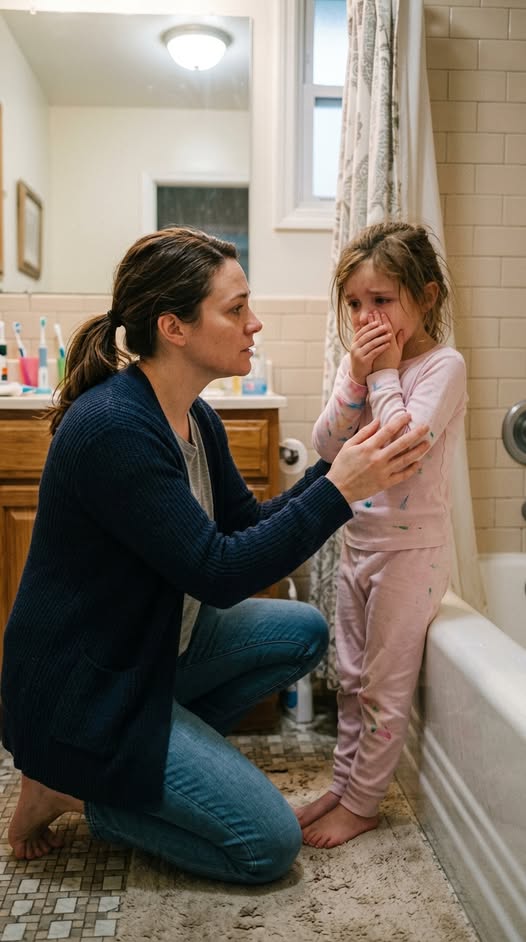
“Mommy… I don’t want to take a bath anymore.” My daughter started saying it every night after my second marriage. At first, it seemed harmless. Normal. Something parents hear all the time. But it wasn’t.
“Mommy… I don’t want to take a bath anymore.”
The first time Lily said it, her voice was so small I could barely hear it, drowned out by the running water and the clatter of dishes in the sink.
She was six years old. Usually chatty. Usually stubborn, as children often are. A little girl who loved bubble baths, played with toy boats, and wrapped herself in a towel like a queen after drying her hair.
So when she stood in the bathroom doorway that Tuesday evening, her arms wrapped around herself and her eyes fixed on the floor, I couldn’t help but smile.
“You still have to take a bath, honey.”
She didn’t protest.
She simply started crying.
Not to complain. Not to pout.
She was crying so hard she couldn’t take it anymore, as if the water had hurt her.
I turned off the faucet and knelt before her.
“Hey,” I said softly. “What’s wrong?”
She shook her head violently, her ponytail swishing back and forth.
“Please… don’t make me do this.”
I should have known right then.
But I didn’t.
My life had become a constant balancing act, and tiredness makes you lose sight of the most important warning signs.
I had remarried eight months earlier.
Ryan had been like a godsend when he came into our lives. Patient. Caring. The kind of man who remembered Lily’s favorite cereal and quietly fixed things around the house without me asking.
After my first husband died in a work accident, I spent three years surviving. Not truly living.
Ryan was like warmth after a long, cold winter.
When Lily changed after the wedding—quieter, more clingy, with nightmares—I told myself what you always say when you don’t want to face a deeper problem:
She’s just settling in.
A new house. A new routine. A new father figure.
I repeated it to friends. To the pediatrician when she started wetting the bed again. To my mother when she talked about Lily. She seemed nervous.
At first, she refused baths once or twice a week.
Then it became every night.
Every single night.
As soon as I mentioned bathing, her whole body would stiffen. Her face would turn chalk white. Her hands would shake. Sometimes she would cower in a corner, as if I were trying to endanger her.
One night, I lost my patience.
“Lily, stop. It’s just a bath.”
As soon as I said those words, she screamed.
Not like a scolded child. More like a child experiencing something terrible.
Her knees buckled and she collapsed to the floor. She was shaking so violently I thought something serious had happened. I collapsed next to her and tried to support her, but she resisted and gasped:
“No, no, no, please…”
“Lily!” I cried. “Talk to me!”
She pressed her face into the carpet and sobbed so hard she could barely breathe…
What she said next made my blood run cold What I know now The hardest part wasn’t the truth, but realizing how long it had been there. My daughter had told me everything. Not with words. But with fear. With her behavior. With that simple sentence. “I don’t want to take a bath.” Now I know: when a child displays an inexplicable fear… there’s often a truth behind it that we don’t want to see. And listening can save lives. Would you have recognized the signs—or would you have ignored them too?
Part 2: The Truth Behind the Door
I did not shout.
I did not ask too many questions.
Something deep inside me knew this moment was too important to ruin with panic.
I wrapped Lily in a blanket, picked up my car keys, and drove straight to my mother’s house.
Ryan called twenty minutes later.
“Where are you?” he asked.
“At my mother’s.”
“Why?”
I looked at Lily sleeping on the couch, her face still wet from crying.
“Because Lily is scared.”
There was silence.
Then Ryan laughed softly.
“Claire, she’s a child. Children make things up.”
That was the moment I knew.
Not because he sounded angry.
Because he sounded prepared.
The next morning, I called Lily’s school counselor. She spoke to Lily gently and let her draw pictures instead of forcing her to explain.
Lily drew our house.
She drew me.
She drew herself.
Then she drew Ryan standing near the bathroom door.
The counselor looked at the picture, then looked at me.
A few minutes later, she left the room and returned with a woman from child protection and a police officer.
My legs almost gave out.
Ryan denied everything.
He said Lily was confused. He said I was emotional. He said I was ruining our family.
But when the police checked his phone and computer, they found things he had tried to delete.
Enough evidence.
Enough to arrest him.
As they put him in handcuffs, Ryan looked at me with cold eyes.
“You believed a child over your husband?”
I looked at him and said,
“No. I believed my daughter.”
Part 3: Learning to Feel Safe Again
After Ryan was gone, people expected life to return to normal.
But pain does not leave just because the danger is gone.
For months, Lily could not walk near the bathroom without shaking. She hated closed doors. She cried if I stepped out of the room. At night, she climbed into my bed and held my hand until morning.
I blamed myself every day.
I remembered every sign I had missed.
The nightmares.
The bedwetting.
The fear.
The way she stopped laughing when Ryan entered the room.
But Lily’s therapist told me something I never forgot.
“You cannot change what happened. But you can become the safe place she needs now.”
So I did.
Every night, I sat beside the bathtub with her. Some nights, we did not turn on the water. Some nights, we only washed her hands. Some nights, we just sat on the bathroom floor and read books.
Slowly, Lily began to breathe again.
One evening, almost a year later, she looked at the bathtub and whispered,
“Mommy?”
“Yes, baby?”
“Can we use bubbles tonight?”
I tried not to cry.
“Of course we can.”
She stepped into the water slowly. Her hands still trembled, but this time she did not run.
As the bubbles rose around her, she smiled for the first time in a long time.
That night, I understood something.
Children do not always know how to explain their fear.
Sometimes they do not say, “Something is wrong.”
Sometimes they say,
“Mommy… I don’t want to take a bath anymore.”
And when they do, we must listen.
Because small words can carry very big pain.
And a mother’s greatest job is not to explain those words away.
It is to hear them before it is too late.