Heartwarming Fiction — A story of gratitude, memory, and the lasting power of kindness.
The Letters That Never Arrived
The package arrived on a quiet Tuesday morning.
It was wrapped in brown paper, tied with faded blue string, and addressed to Melissa Gilbert in careful, trembling handwriting. There was no return address—only a small note taped to the top.
“These belonged to my mother. She wrote them for nearly forty years, but she never had the courage to send them.”
Melissa sat at her kitchen table and slowly untied the string.
Inside were dozens of letters.
Some were written on lined notebook paper. Others were folded inside handmade envelopes decorated with tiny flowers. The oldest letter had been dated more than three decades earlier.
Each one began the same way.
Dear Melissa,
The writer’s name was Eleanor Hayes.
In the first letter, Eleanor explained that she had begun watching Little House on the Prairie during one of the loneliest seasons of her life. Her husband had recently died, her children had moved away, and the small home they had built together suddenly felt painfully empty.
“Watching Laura laugh, struggle, and keep going reminded me that sorrow does not have to be the end of the story,” Eleanor wrote.
Melissa read on.
Over the years, Eleanor had written about birthdays, illnesses, weddings, grandchildren, and ordinary afternoons when she simply needed to tell someone what was in her heart.
She wrote after surviving surgery.
She wrote when her daughter stopped speaking to her after a painful argument.
She wrote when her first grandchild was born.
She wrote when her old farmhouse was nearly destroyed by a storm.
In every letter, Eleanor thanked Melissa for helping her believe in courage, family, and second chances.
Yet none of the letters had ever been mailed.
At the bottom of the package was a final note written by Eleanor’s granddaughter, Sophie.
“My grandmother is eighty-seven now. She lives in a care home in Willow Creek. Her memory is fading, but she still remembers you. Last week, she asked me whether her letters had ever reached you. I did not know what to say, so I sent them.”
Melissa held the note for a long time.
She had received many letters throughout her career, but these felt different. They were not requests for autographs or photographs. They were pieces of a life—honest, fragile, and deeply personal.
That evening, Melissa called the number Sophie had included.
A young woman answered.
“Is this Sophie Hayes?” Melissa asked.
“Yes.”
“This is Melissa Gilbert.”
There was silence on the line.
Then Sophie whispered, “I am sorry. Could you say that again?”
Melissa smiled.
“I received your grandmother’s letters.”
Sophie began to cry.
She explained that Eleanor’s health had declined quickly. Some days she remembered everyone. Other days she became confused and frightened. But whenever someone mentioned Little House on the Prairie, her face brightened.
“She always said Laura felt like the daughter she never got to know,” Sophie said.
Melissa looked at the bundle of letters beside her.
“Would it be all right if I came to meet her?”
Sophie could barely speak.
“You would really do that?”
“Yes,” Melissa replied. “She spent forty years writing to me. I think it is time I answered.”
Three days later, Melissa traveled quietly to Willow Creek.
She had expected a private visit.
But somehow, word began to spread.
The owner of the town bakery heard that Eleanor’s favorite actress was coming and prepared a basket of fresh bread. Children from the elementary school made handmade cards. The librarian displayed old books about pioneer families. Neighbors who had known Eleanor for years gathered outside the care home carrying flowers.
By the time Melissa’s car arrived, nearly the entire town was waiting.
Melissa stepped out, surprised by the crowd.
No one shouted. No one pushed forward.
They simply stood together, smiling, because this day was not about fame.
It was about Eleanor.
Inside the care home, Sophie led Melissa down a quiet hallway.
“My grandmother has been having a difficult morning,” Sophie warned. “She may not recognize you.”
Melissa nodded.
“That is all right. I will recognize her.”
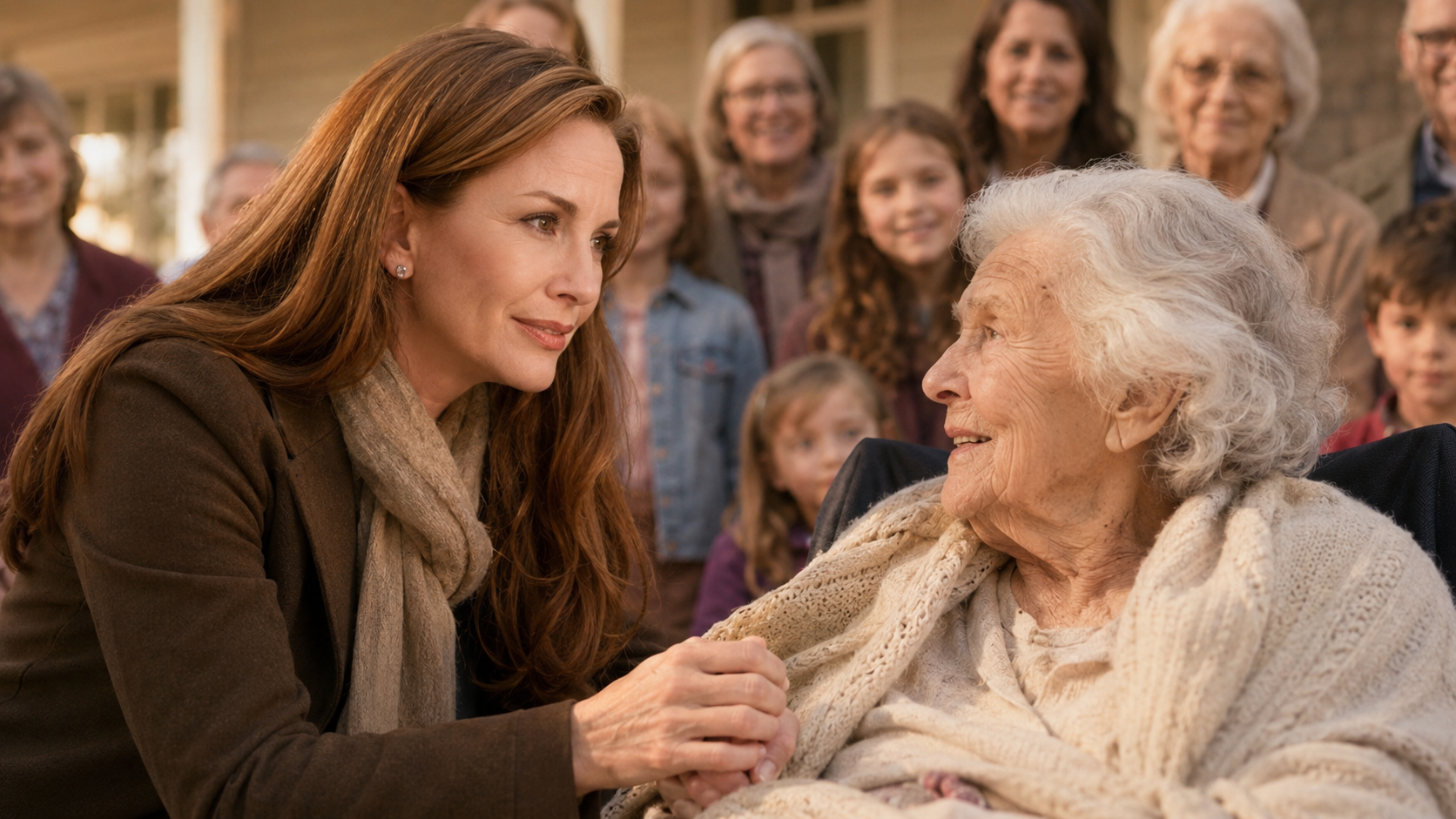
Eleanor sat beside a window with a knitted blanket across her knees. Her white hair was neatly brushed, and one of the old letters rested unopened in her lap.
Melissa entered slowly.
“Hello, Eleanor.”
The elderly woman looked up.
For several seconds, she seemed uncertain.
Then her eyes moved toward Melissa’s face.
Her hands began to tremble.
“Laura?” she whispered.
Melissa knelt beside her chair and gently took her hand.
“My name is Melissa,” she said softly. “And I finally received your letters.”
Eleanor stared at her.
Then tears filled her eyes.
“You read them?”
“Every one.”
Eleanor pressed a hand to her heart.
“I thought they had been forgotten.”
Melissa shook her head.
“No letter written with love is ever truly forgotten.”
Outside the room, Sophie covered her mouth and cried.
But the most powerful moment was still to come.
Melissa reached into her bag and removed a letter of her own.
On the envelope, she had written:
To Eleanor, with gratitude for forty years of courage.
“I brought you an answer,” Melissa said.
Eleanor held the envelope carefully, as though it were something precious.
Then she looked toward the window, where the townspeople were waiting in the garden below.
“Would you read it to me?” she asked.
Melissa smiled.
“I would be honored.”
Part 2: The Answer That Brought a Town Together
Melissa opened the letter.
The room became completely still.
Sophie stood near the doorway. Two nurses paused in the hallway. Outside, more townspeople gathered beneath Eleanor’s window, waiting quietly.
Melissa began to read.
Dear Eleanor,
Your letters did not arrive late. They arrived at the moment they were needed most.
Eleanor’s eyes remained fixed on Melissa.
You wrote to thank me for giving you courage, but your words have given courage back to me. You reminded me that a story can continue long after the screen goes dark. It can live inside a person’s choices, inside the way they forgive, and inside the kindness they offer when no one is watching.
Melissa paused as her voice grew unsteady.
You believed that Laura helped you through difficult years. But the truth is, women like you gave Laura meaning. Every time you chose hope after loss, every time you reached out to your family, and every time you began again, you carried the spirit of that story into the real world.
Eleanor pressed the letter against her chest.
Melissa continued.
Thank you for trusting me with your life. Thank you for writing even when you were afraid to send the words. And thank you for reminding me that we are never too old to be seen, heard, or loved.
With all my heart,
Melissa
For a moment, no one spoke.
Then Eleanor smiled.
It was a small smile, but it seemed to brighten the entire room.
“I waited a long time for that,” she whispered.
Melissa squeezed her hand.
“I am sorry it took me so long.”
Eleanor shook her head.
“You came.”
Sophie opened the window.
The people gathered outside began to clap.
Eleanor looked down and saw neighbors, teachers, shopkeepers, children, and old friends standing together in the garden.
“What are they doing here?” she asked.
“They came for you,” Sophie said.
Eleanor looked confused.
“For me?”
Melissa leaned closer.
“You mattered to more people than you realized.”
Later that afternoon, the care home staff moved Eleanor’s chair outside beneath an old maple tree. The townspeople formed a gentle circle around her.
The bakery owner handed out warm rolls. The schoolchildren gave Eleanor their handmade cards. The librarian brought a copy of a book Eleanor had once donated decades earlier.
One by one, people began sharing stories.
A nurse remembered how Eleanor had comforted her during her first difficult week at work.
A neighbor remembered how Eleanor had delivered soup after his wife died.
A teacher remembered that Eleanor had quietly purchased winter coats for three children whose families were struggling.
Sophie listened in amazement.
Her grandmother had spent years believing that her life had been small and ordinary.
But the town remembered it differently.
They remembered every kindness.
Melissa sat beside Eleanor as the stories continued.
At one point, Eleanor leaned toward her.
“I always thought famous people were the ones who changed lives,” she said.
Melissa smiled.
“Most lives are changed by people no one writes headlines about.”
Eleanor looked around at the gathering.
“Then perhaps I did something worthwhile.”
“You did far more than that,” Melissa replied.
Before leaving Willow Creek, Melissa made one final request.
She asked whether the town library might preserve copies of Eleanor’s letters—not because they were written to an actress, but because they told the story of an ordinary woman who survived grief, repaired broken relationships, and continued choosing hope.
The librarian agreed immediately.
The letters were later displayed in a small reading room under a sign that read:
“Words We Were Afraid to Send.”
Soon, residents began leaving letters of their own.
Some wrote apologies to family members.
Some wrote messages to people they had lost.
Others wrote words of gratitude they had never spoken aloud.
Once a month, the town held a gathering where people could read their letters privately, mail them, or simply place them in a wooden box and let the burden go.
The project spread to nearby schools, churches, and care homes.
Children began writing to lonely seniors. Families reconnected. Old disagreements softened.
What began with one forgotten bundle of letters became a movement of honesty and compassion.
Melissa stayed in contact with Eleanor and Sophie.
They spoke by phone whenever Eleanor felt strong enough. Sometimes Eleanor remembered every detail of their meeting. Other times she only remembered that someone kind had come to visit.
But she always remembered the letter.
Sophie kept it framed beside her grandmother’s bed.
Several months later, Eleanor passed away peacefully with her family beside her.
At her memorial, the entire town gathered once again beneath the maple tree.
Melissa could not attend, but she sent a message that Sophie read aloud.
“Eleanor spent years believing her letters had gone nowhere. Yet they traveled farther than she ever imagined. They reached a town, a family, and many hearts—including mine.”
After the service, Sophie placed the original bundle of letters in the library archive.
The final letter remained unfinished.
It contained only one sentence.
Dear Melissa, today I finally realized that an ordinary life can still become a beautiful story.
Years later, visitors still came to Willow Creek to see the reading room.
They came because of Melissa Gilbert’s kindness.
But they stayed because of Eleanor.
And above the wooden letter box, the town added one more message:
“Do not wait too long to tell someone what they mean to you.”
Because sometimes, a few forgotten words can bring two strangers together.
And sometimes, one heartfelt answer can remind an entire town that every life deserves to be remembered.


