The Widow on Miller Road
The storm came down hard on Walton’s Mountain.
All night, the wind screamed through the trees. Rain beat against windows like handfuls of stones. By morning, fences were broken, roads were muddy, and half the valley looked like it had been shaken by an angry hand.
But the worst damage was at the small farm on Miller Road.
That farm belonged to Mrs. Eleanor Briggs, a quiet widow who had lived alone since her husband passed three winters before. Her barn had stood for forty years.
By sunrise, it was gone.
The roof had collapsed. The front wall leaned into the mud. Hay was ruined. Tools were scattered everywhere. Her two cows stood near the fence, restless and cold.
Mrs. Briggs stood in front of the wreckage with her hands folded tightly against her chest. She did not cry. She only stared.
John Walton was driving past in his old truck when he saw her.
He stopped right away.
“Morning, Mrs. Briggs,” he said gently.
She turned, trying to smile. “Morning, John.”
But her voice broke.
John looked at the barn, then at the sky. More rain was coming.
“Anybody hurt?” he asked.
“No,” she said. “Just the barn.”
John stepped closer. “A barn can be rebuilt.”
Mrs. Briggs shook her head slowly. “Not by me.”
John understood.
Times were hard. Lumber cost money. Men needed paying. A widow with no sons nearby could not simply rebuild what the storm had taken.
“I’ll talk to some folks,” John said.
She looked down at the mud. “I don’t want charity.”
John nodded. “Then don’t call it charity. Call it neighbors.”
That afternoon, John went into town. He stopped at Ike Godsey’s store, the sawmill, and the church. He asked quietly. No big speeches. No praise. Just a simple request.
“Mrs. Briggs needs help.”
Some people promised wood. Some offered nails. Others said they would come when they could.
But the problem was time.
Another storm was expected the next day. If the animals stayed out one more night, Mrs. Briggs could lose more than a barn.
That evening, John sat at the kitchen table, silent.
Olivia noticed right away.
“Something on your mind?” she asked.
John looked toward the window.
“Eleanor Briggs lost her barn.”
Olivia’s face softened. “Poor woman.”
“She won’t ask for help,” John said. “And if we wait until morning, it may be too late.”
John-Boy looked up from his notebook. “What are you thinking, Daddy?”
John stood slowly.
“I’m thinking a barn doesn’t need daylight to be built.”
By sunset, word moved quietly through Walton’s Mountain.
No bell rang. No posters were made. No one asked for attention.
But one by one, lanterns appeared along Miller Road.
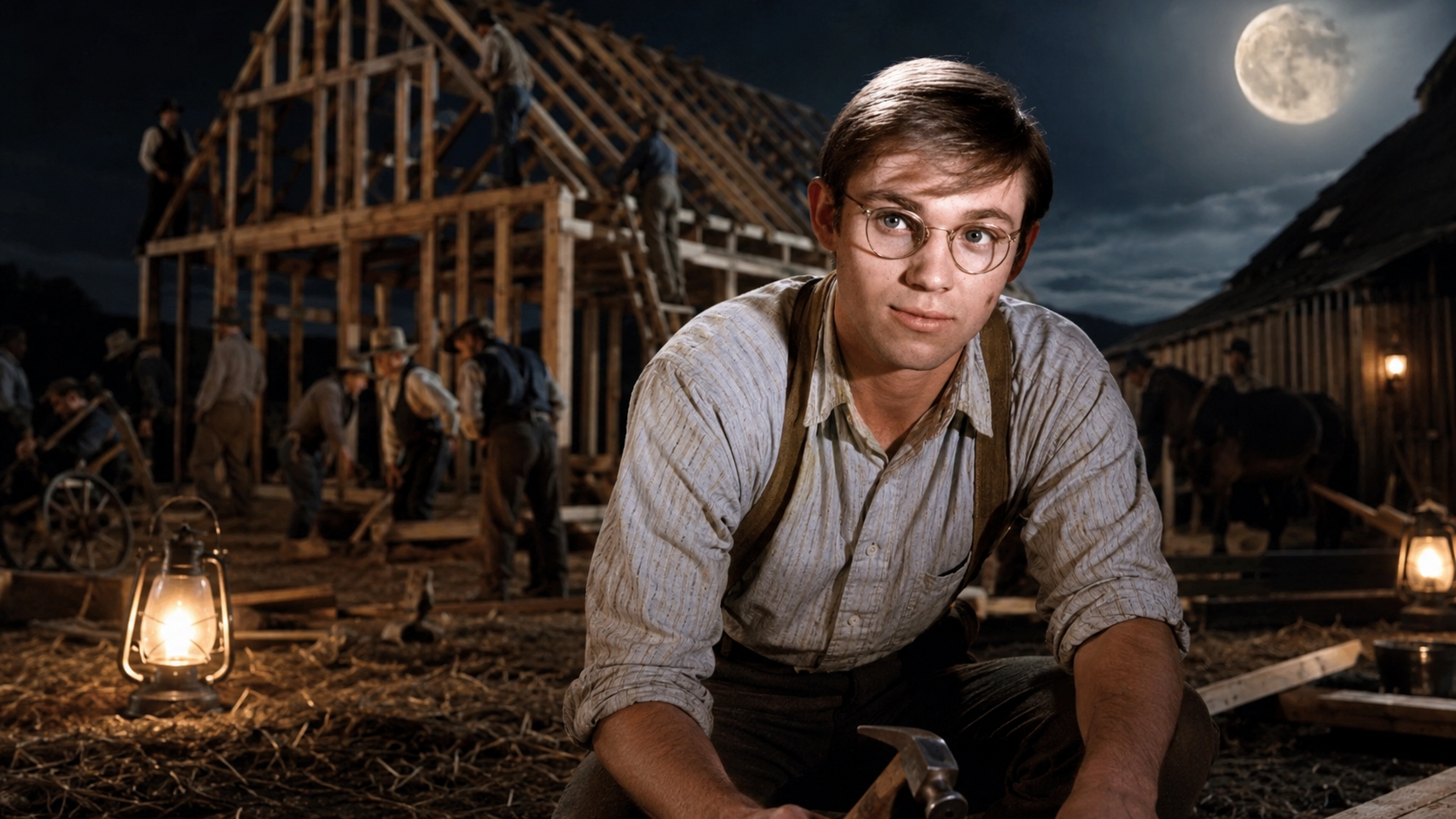
Men came carrying hammers. Boys came with boards. Women brought coffee, biscuits, and blankets. Even Ike Godsey arrived with a wagon full of supplies.
And in the center of it all stood John Walton.
He did not act like a hero.
He simply picked up a hammer and went to work.
The Barn That Rose Before Morning
The night was cold, but no one complained.
Lantern light glowed against the broken barn. Hammers rang through the darkness. Sawdust mixed with rainwater. Boots sank deep into the mud.
John Walton worked harder than anyone.
He lifted beams. Measured boards. Held walls steady. When someone grew tired, he gave them a quiet nod.
“Take a breath. We’ve got time.”
But they did not have much time.
Clouds gathered again over the mountain.
Mrs. Briggs stood on her porch, wrapped in a shawl, watching in disbelief. She had gone inside only once, but she could not stay away. Every time she looked out, the barn looked a little stronger.
Around midnight, she walked down into the yard.
“John,” she said softly.
He turned, wiping rain from his face. “You ought to be inside where it’s warm.”
“I can’t let you all do this.”
John gave her a small smile. “You’re not letting us. We already started.”
Her eyes filled with tears.
“My husband built the first barn,” she whispered. “Every board had his hands on it.”
John looked at the half-raised frame.
“Then we’ll make sure this one honors him.”
Those words stayed with her.
By two in the morning, the walls were standing.
By four, the roof beams were in place.
By sunrise, the new barn stood strong against the gray morning sky.
It was not fancy. It was not perfect.
But it was solid.
And it was built with kindness.
Mrs. Briggs stepped into the yard as the first light touched the mountain. The cows were led inside. Fresh hay was stacked in one corner. Her tools were cleaned and placed neatly along the wall.
For a long moment, she said nothing.
Then she covered her mouth and cried.
The whole town grew quiet.
John Walton looked down, uncomfortable with praise.
Mrs. Briggs walked to him and took his rough, tired hands in hers.
“I don’t know how to repay you,” she said.
John shook his head.
“You don’t owe me anything.”
“But I do,” she whispered.
He smiled gently. “Then someday, when someone else needs help, you help them.”
Years passed after that night.
Children grew up. Families moved away. New houses appeared along the mountain road. But people still talked about the barn on Miller Road.
They remembered how John Walton gathered the town without asking for credit.
They remembered how neighbors came together in the dark.
They remembered how one widow woke to find hope standing where loss had been.
And whenever someone asked why Walton’s Mountain was special, the older folks would point toward that old barn and say:
“Because once, in the middle of the night, kindness built that.”
And no one ever forgot John Walton for it.


