Charles Ingalls and the Birthday Money Problem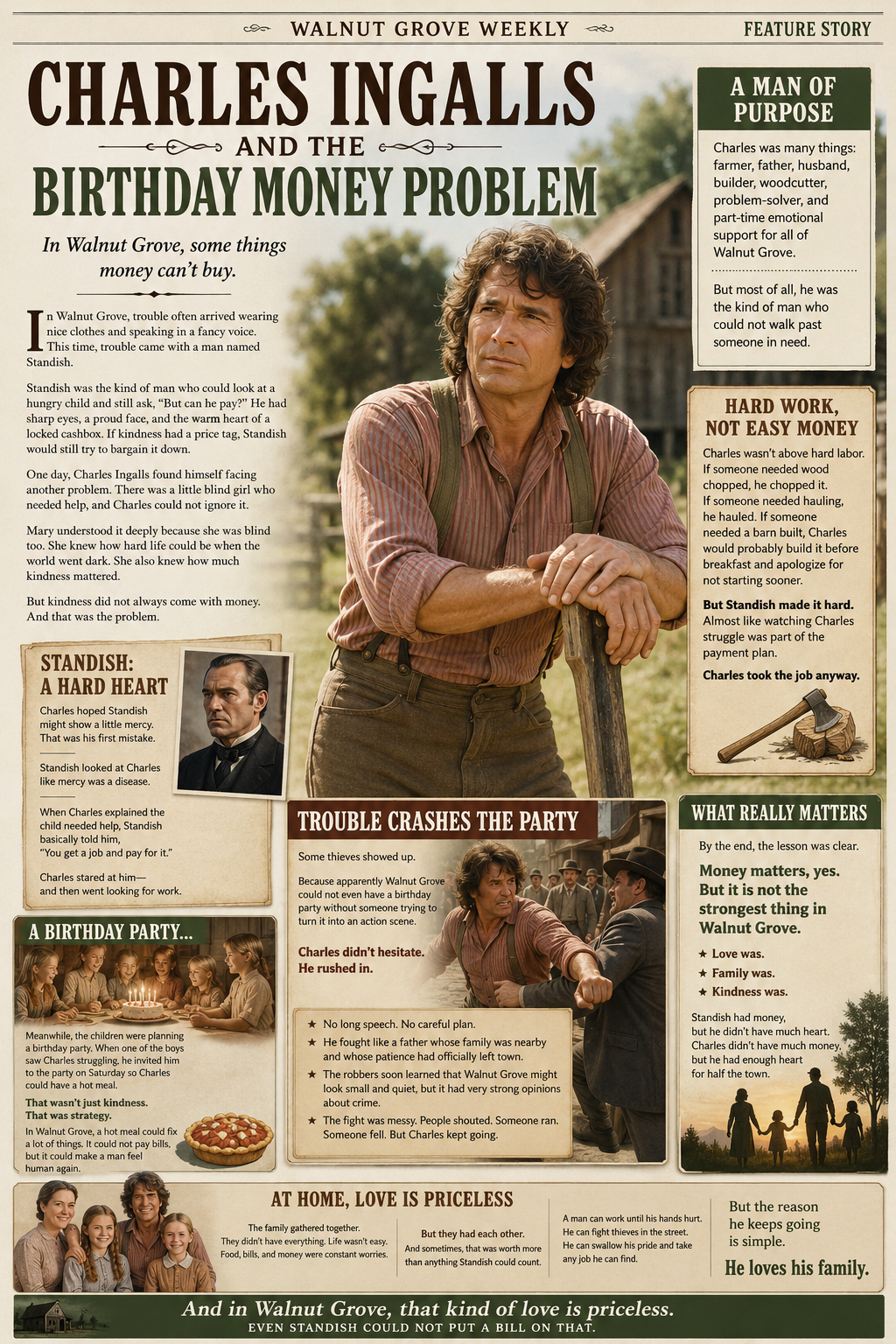
In Walnut Grove, trouble often arrived wearing nice clothes and speaking in a fancy voice.
This time, trouble came with a man named Standish.
Standish was the kind of man who could look at a hungry child and still ask, “But can he pay?”
He had sharp eyes, a proud face, and the warm heart of a locked cashbox.
If kindness had a price tag, Standish would still try to bargain it down.
One day, Charles Ingalls found himself facing another problem.
There was a little blind girl who needed help, and Charles could not ignore it.
Charles was many things: farmer, father, husband, builder, woodcutter, problem-solver, and part-time emotional support for all of Walnut Grove.
But most of all, he was the kind of man who could not walk past someone in need.
When the girl’s situation became clear, everyone felt sad.
Mary understood it deeply because she was blind too.
She knew how hard life could be when the world went dark. She also knew how much kindness mattered.
But kindness did not always come with money.
And that was the problem.
Charles wanted to help, but helping cost money.
In Walnut Grove, money was always hiding somewhere far away, usually behind unpaid bills, broken wagon wheels, and children needing shoes.
When Charles spoke to Standish, he hoped the man might show a little mercy.
That was his first mistake.
Standish looked at Charles like mercy was a disease.
Charles tried to explain that the child needed help.
Standish listened with the same face a brick wall would have worn.
Then he basically told Charles, “You get a job and pay for it.”
Charles stared at him.
Now, Charles Ingalls was patient.
He could deal with storms, stubborn animals, broken fences, and Mrs. Oleson talking for longer than any human should legally be allowed to talk.
But Standish’s cold attitude made his blood boil.
Still, Charles held himself together. Mostly.
He went looking for work. He was not above hard labor.
If someone needed wood chopped, Charles chopped it. If someone needed hauling, he hauled.
If someone needed a barn built, Charles would probably build it before breakfast and apologize for not starting sooner.
But Standish did not make it easy. He gave Charles a hard time, almost like watching Charles struggle was part of the payment plan.
Charles took the job anyway.
He worked long hours. He was tired, dusty, and probably smelled like sweat, wood, horse, and regret. But he kept going because he had a purpose.
Meanwhile, the children were planning a birthday party. A real birthday party. The kind with laughter, food, and enough excitement to make everyone forget their problems for a little while.
When one of the boys saw Charles struggling, he felt sorry for him. He invited him to the birthday party on Saturday so Charles could have a hot meal.
That was not just kindness. That was strategy.
In Walnut Grove, a hot meal could fix a lot of things. It could not pay bills, but it could make a man feel human again.
Charles accepted, because even heroes need supper.
But before the party could become peaceful, trouble decided to run through town like it had lost its manners.
Some thieves showed up.
Of course they did.
Because apparently Walnut Grove could not even have a birthday party without someone trying to turn it into an action scene.
Charles saw the danger and did what Charles always did. He rushed in.
No long speech. No careful plan. No “Let us discuss this calmly.” Just Charles running straight toward trouble like his brain said, “This looks dangerous,” and his legs replied, “Good, let’s go.”
The thieves probably thought they had picked an easy place.
They were wrong.
They had picked the town where Charles Ingalls lived.
Charles started fighting them with the energy of a man who had been overworked, underpaid, insulted by Standish, and denied peace for several days.
He was not just fighting robbers. He was fighting bills, frustration, hunger, and every rude man who had ever said, “Get a job and pay for it.”
The fight was messy. People shouted. Someone ran.
Someone fell. Someone probably dropped something important. A peaceful street turned into complete chaos.
And through it all, Charles kept going.
Now, Charles was not a fancy fighter. He did not fight like a trained gentleman.
He fought like a father whose family was nearby and whose patience had officially left town. That kind of fighting is very serious.
The robbers soon learned that Walnut Grove might look small and quiet, but it had very strong opinions about crime.
After the fight, everything settled down again.
People checked on each other. The danger passed. Charles was tired, but he had done the right thing.
Again.
By the end, the lesson was clear. Money mattered, yes.
People needed it to buy food, pay bills, and help children get care.
But money was not the strongest thing in Walnut Grove.
Love was.
Family was.
Kindness was.
Standish had money, but he did not have much heart.
Charles did not have much money, but he had enough heart for half the town.
And that made all the difference.
At home, the family gathered together. They did not have everything.
Their life was not easy. Their table was not always full.
Their pockets were not always heavy. But they had each other.
And sometimes, that was worth more than anything Standish could count.
Mary understood it. Caroline understood it.
The children understood it. Even Charles, tired as he was, knew the truth.
A man could work until his hands hurt. He could fight thieves in the street.
He could swallow his pride and take any job he could find.
But the reason he kept going was simple.
He loved his family.
And in Walnut Grove, that kind of love was priceless.
Even Standish could not put a bill on that.