Part 1
Twelve-year-old Emily Carter had a voice she kept hidden.
Every morning, before the sun fully rose over her small town, she would stand by her bedroom window and sing softly. Her favorite songs were from the movies her grandmother loved most. And above all, Emily loved Julie Andrews.
To Emily, Julie’s voice felt like sunlight. It was gentle, strong, and full of hope. Whenever Emily felt lonely or afraid, she would play Julie’s songs and sing along in a whisper.
But she never sang in front of people.
At school, Emily was quiet. She sat near the back of the classroom, kept her eyes low, and rarely raised her hand. Some children had big laughs and loud voices. Emily had dreams that felt too big for her small heart to carry.
Her music teacher, Mrs. Bennett, noticed her.
One afternoon, after class, Mrs. Bennett heard Emily humming while stacking books near the piano. The sound was soft, but beautiful.
“Emily,” Mrs. Bennett said gently, “was that you singing?”
Emily froze. Her cheeks turned red.
“I’m sorry,” she said quickly.
“Sorry?” Mrs. Bennett smiled. “You have nothing to be sorry for. That was lovely.”
Emily looked down. “I only sing when no one is listening.”
Mrs. Bennett walked closer. “Maybe one day, you’ll sing when everyone is listening.”
Emily shook her head. “I can’t. I’m not brave like Julie Andrews.”
Mrs. Bennett’s face softened. “Bravery doesn’t mean you’re never scared. It means you sing anyway.”
A few weeks later, the town announced a special charity concert. Local children were invited to perform, and all the money raised would help repair the old community theater.
Mrs. Bennett asked Emily to sing.
Emily’s heart nearly stopped.
“In front of everyone?” she asked.
“Yes,” Mrs. Bennett said. “And I believe you can do it.”
Emily wanted to say yes. Deep inside, she imagined standing on stage, singing with a clear voice, and seeing her mother smile from the front row. But fear wrapped around her like a heavy blanket.
“What if I forget the words?” Emily asked.
“Then you take a breath and begin again.”
“What if people laugh?”
“Then they are not listening with their hearts.”
Emily went home that day with the permission slip in her hand. She placed it on her desk and stared at it for hours.
That night, her grandmother found her sitting beside the record player, holding an old Julie Andrews album.
“You know,” Grandma Ruth said, sitting beside her, “even the greatest stars were once nervous children with shaking hands.”
Emily looked at her. “Do you think Julie Andrews was ever scared?”
Grandma Ruth smiled. “Of course. But she had something stronger than fear.”
“What?”
“Love for the music.”
Those words stayed with Emily.
The next morning, she signed the paper.
For two weeks, Emily practiced every day. Sometimes her voice shook. Sometimes she cried because she felt she would never be good enough. But each time, she thought of Julie Andrews and tried again.
Then, three days before the concert, something unbelievable happened.
Mrs. Bennett came into class with shining eyes.
“Children,” she said, “we have a very special visitor coming to the theater rehearsal tomorrow.”
Everyone began whispering.
Emily listened closely.
Mrs. Bennett smiled. “Julie Andrews will be visiting our town.”
Emily’s heart skipped.
She was sure she had heard wrong.
Julie Andrews? Here?
The woman whose voice had carried Emily through lonely days? The person who made her believe songs could heal hearts?
Emily could hardly sleep that night.
The next afternoon, the children gathered inside the old theater. The seats were dusty, the curtains were faded, and the stage lights flickered above them. Still, to Emily, it felt magical.
Then the side door opened.
Julie Andrews walked in.
She was graceful, warm, and smiling. The room became silent, not from fear, but from wonder.
Julie greeted the children kindly. She listened to a few performers rehearse, offering gentle words and encouragement.
Emily stood behind the curtain, gripping her music sheet so tightly it wrinkled.
When it was her turn, her feet would not move.
Mrs. Bennett whispered, “Emily, you’re next.”
“I can’t,” Emily said, her voice trembling.
Before Mrs. Bennett could answer, Julie Andrews turned and looked toward her.
“Is someone hiding back there?” Julie asked softly.
Emily stepped out slowly, her face pale.
Julie smiled. “Hello, dear.”
Emily could barely speak. “Hello.”
Mrs. Bennett explained, “Emily has a beautiful voice, but she’s nervous.”
Julie nodded with understanding. “Nerves often arrive when something matters to us.”
Emily looked up. “I wanted to sing like you. But I don’t think I can.”
Julie walked closer and gently took the wrinkled music sheet from Emily’s hands.
“My dear,” she said, “you do not need to sing like me.”
Emily blinked.
Julie smiled. “You need to sing like Emily.”
For the first time, Emily stopped thinking about being perfect.
Julie continued, “A voice is not beautiful because it sounds exactly like someone else. It is beautiful because it carries truth.”
Emily felt tears in her eyes.
Julie placed a gentle hand over her heart. “Sing from here. That is where courage begins.”
Emily took a deep breath.
The piano started.
At first, her voice came out small. But Julie stood near the front row, watching with kind eyes. Mrs. Bennett smiled from beside the piano. Grandma Ruth’s words echoed in Emily’s mind.
Love for the music.
Emily sang again, stronger this time.
By the final note, the theater was quiet.
Then Julie Andrews began to clap.
Soon, everyone joined.
Emily stood on the stage with tears on her cheeks, not because she was afraid, but because, for the first time, she believed she could be heard.
Part 2
The night of the charity concert arrived with golden lights glowing outside the old community theater.
Families filled the seats. Children hurried backstage. Parents carried flowers, cameras, and proud smiles. The air smelled like polished wood, dust, and excitement.
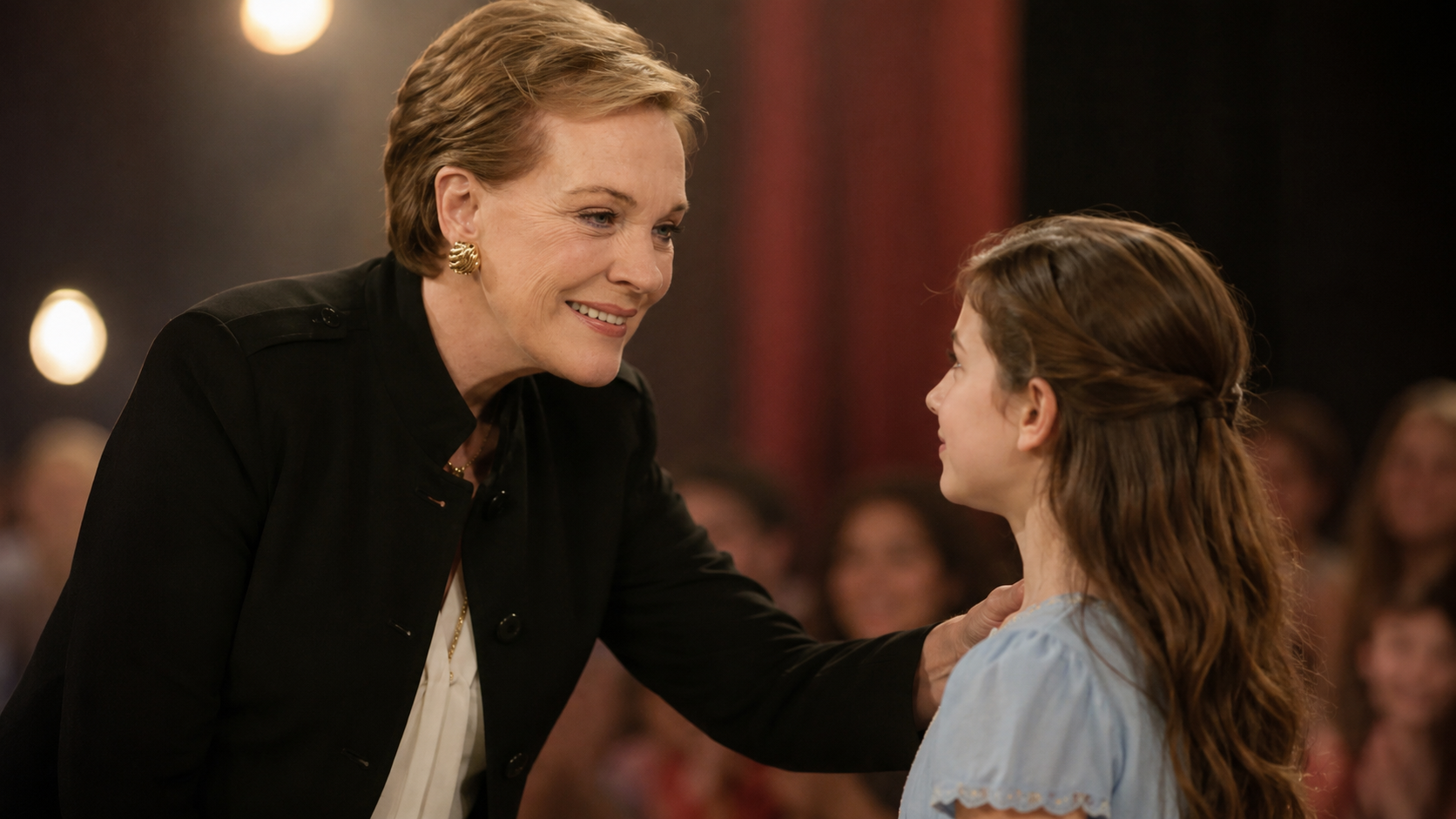
Emily stood behind the curtain in a pale blue dress her grandmother had sewn by hand. Her mother fixed a loose curl near her face.
“You look beautiful,” her mother whispered.
Emily tried to smile, but her hands were shaking.
“What if I lose my courage again?” she asked.
Grandma Ruth held her hand. “Then remember what Julie told you.”
Emily closed her eyes.
You need to sing like Emily.
When the concert began, Emily watched from the side of the stage. One child played the violin. Another recited a poem. A group of students sang together.
The crowd clapped kindly after each performance.
But with every passing minute, Emily’s fear grew louder.
Then she saw Julie Andrews sitting quietly near the front row. Julie was not there as a star that night. She was there as someone who believed in young dreamers.
Their eyes met.
Julie smiled and gave a small nod.
It was enough.
Mrs. Bennett stepped onto the stage.
“Our next performer is a young girl with a very special voice,” she said. “Please welcome Emily Carter.”
Emily walked onto the stage.
The lights were bright. The audience looked endless. For a second, she forgot how to breathe.
Then the piano began.
Emily opened her mouth, but no sound came out.
A nervous silence filled the room.
Her face burned. Her heart pounded. She wanted to run.
Then, from the front row, Julie gently touched her own heart.
Emily remembered.
Sing from here.
Emily took one slow breath.
Then she began.
Her voice was soft at first, like a candle in the dark. But as the song went on, it grew warmer and clearer. She stopped looking at the crowd and started feeling the music.
She sang about hope. She sang about dreams. She sang like a girl who had been afraid for too long and was finally stepping into the light.
By the final note, Emily’s voice filled the theater.
For a moment, no one moved.
Then the audience rose to their feet.
The applause was loud and full. Emily looked out and saw her mother crying, Grandma Ruth smiling, Mrs. Bennett clapping proudly, and Julie Andrews standing with everyone else.
Emily covered her mouth, overwhelmed.
After the concert, people came to thank her. Some told her she had made them cry. Others said her song reminded them of their own childhood dreams.
But the moment Emily would remember forever came later, when Julie Andrews found her near the backstage door.
“You were wonderful,” Julie said.
Emily shook her head shyly. “I was so scared.”
Julie smiled. “Yes. And you sang anyway. That is courage.”
Emily looked down at her shoes. “Do you think I could really become a singer one day?”
Julie’s answer was gentle but firm.
“I think you already are one.”
Those words changed something inside Emily.
From that day on, she still felt nervous sometimes. But she no longer let fear decide for her.
She joined the school choir. She sang at church. She performed at town events. Each time, her voice grew stronger—not because it became perfect, but because it became honest.
Years later, when Emily became a music teacher herself, she kept an old photo on her classroom wall. It showed a young girl in a blue dress standing beside Julie Andrews in the old community theater.
Whenever one of her students said, “I’m too scared to sing,” Emily would smile and say the same words that had once saved her dream.
“Bravery doesn’t mean you’re never scared. It means you sing anyway.”
And every time she said it, she remembered the day one unexpected meeting gave her the courage to believe.
Because sometimes, all a young dream needs is one kind voice saying:
You already are enough.


