The Man Who Wanted to Become a Violinist
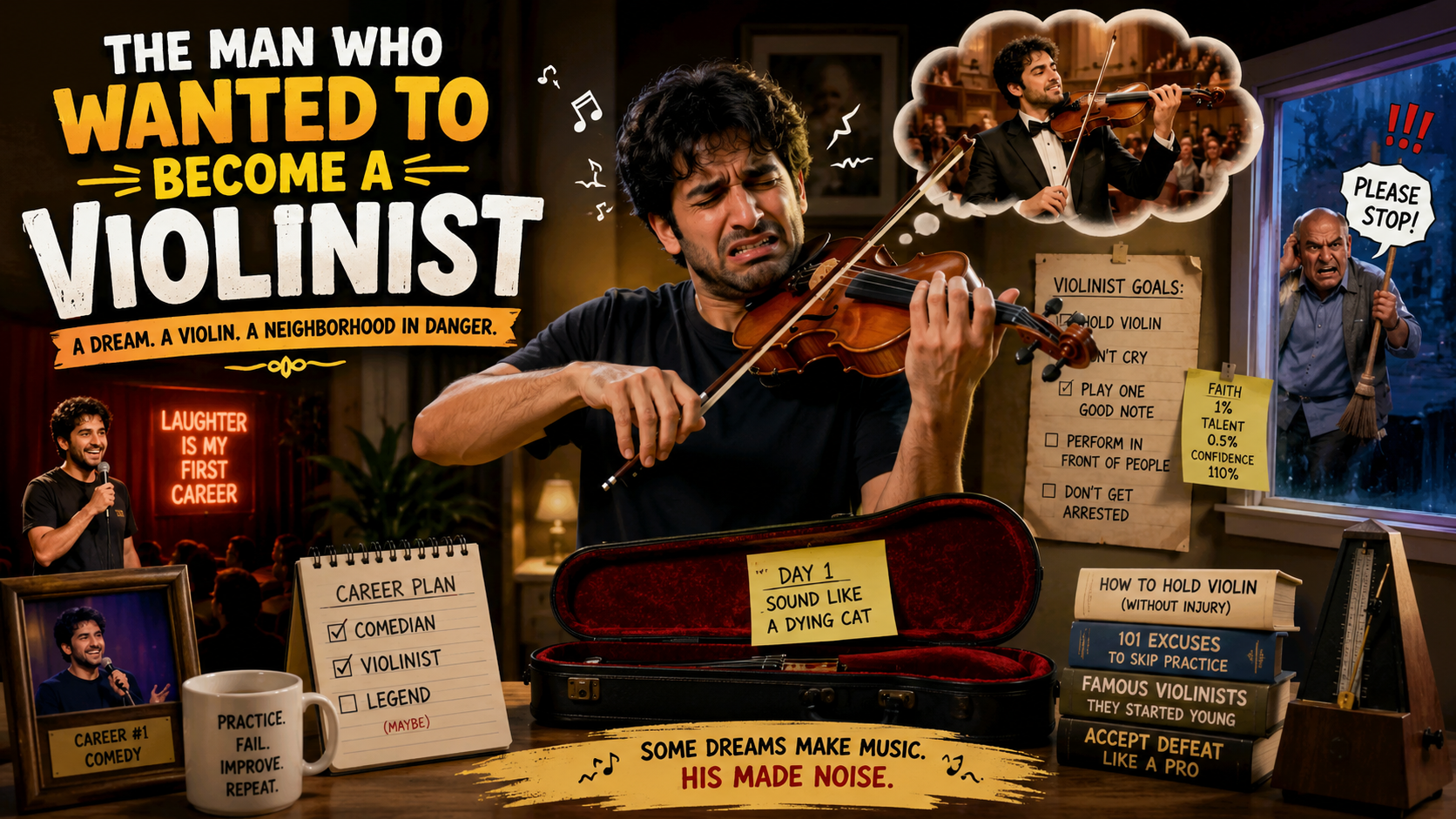
One night, a young comedian walked onto the stage with a microphone in his hand and a dream in his heart. Not a normal dream, like buying a house or getting eight hours of sleep. No, his dream was much bigger and much more dangerous.
He wanted to start a second career as a violinist.
The crowd laughed because he did not look like a man about to join a fancy orchestra. He looked like a man who had just remembered he left rice cooking at home. But he was serious. At least, serious enough to talk about it on stage.
He told everyone that when people say they want a second career, they usually choose something normal. Some people become real estate agents. Some open coffee shops. Some start podcasts even when nobody asked them to. But him? He wanted to pick up the violin and enter the world of beautiful music, painful practice, and neighbors calling the police.
He imagined himself standing in a black suit under bright lights, holding the violin like a professional. In his mind, he looked elegant. In real life, he probably looked like someone trying to hold a very expensive wooden sandwich.
The problem was simple: the violin is not an easy instrument. A piano at least gives you a correct note when you press the key. A guitar can forgive you a little. Even drums allow you to hit things and call it music. But the violin? The violin is strict. The violin has no mercy. If you make one tiny mistake, it screams like a cat who just saw a ghost.
Still, he believed in himself.
He thought, “How hard can it be?”
That was the first mistake.
So he got a violin. At first, he felt proud. He opened the case slowly, like he was revealing treasure. The violin was shiny, beautiful, and quiet. That was its best sound: silence.
Then he picked it up and placed it under his chin. Right away, his body became confused. His neck said, “Why are we holding furniture?” His shoulder said, “I did not sign up for this.” His left hand froze like it had just been asked a math question in public.
Then came the bow.
He pulled the bow across the strings and created a sound so ugly that somewhere nearby, a dog stopped barking out of respect. It was not music. It was a warning signal. It sounded like a door opening in a haunted house while someone stepped on a duck.
But he did not quit.
He practiced again.
The second sound was not better. It was just louder.
His neighbors probably heard it and thought, “Something is dying, but very slowly.”
After a few days, he began to understand why parents make children learn violin early. It is not because children are talented. It is because children have no shame. A child can make terrible sounds for six years and still smile. Adults cannot do that. Adults play one bad note and immediately think about selling the instrument online.
But he kept going because he had a dream. He wanted to become that cool person who could casually say, “Oh, I play violin.” That sentence sounds powerful. It makes people imagine candlelight, classical music, and deep emotions.
But when he said it, people would ask, “Really? Can you play something?”
That was the dangerous part.
Because learning violin is one thing. Playing in front of people is another. At home, you can lie to yourself. You can play three notes and say, “Wow, I’m improving.” But in front of people, those same three notes sound like a mosquito with financial problems.
He imagined performing at a family gathering. Everyone would be eating, laughing, having a nice time. Then he would stand up and say, “I have prepared a song.”
The whole room would become quiet.
Not because they were excited.
Because they were afraid.
He would lift the violin, close his eyes, and begin. After five seconds, someone’s auntie would say, “Is this a sad song?” Another person would whisper, “No, I think the song is injured.”
But the funniest part was that he still believed there was a chance. Maybe not a big chance. Maybe not even a medium chance. But a tiny chance. A chance the size of one grain of rice. He could become a violinist someday.
Maybe not a famous one.
Maybe not a good one.
But technically, if he held a violin and made sound, he was a violinist. That was the beauty of low standards.
He said people always tell adults it is never too late to follow your dreams. But they never mention that sometimes your dream fights back. The violin definitely fights back. It sits there looking pretty, then the moment you touch it, it punishes your confidence.
Still, he liked the idea. Comedy was his first career, but violin could be his second. And if violin did not work, he could always combine both. He could walk on stage, play one terrible note, and the audience would laugh immediately.
That might be the plan all along.
By the end, he stood there with the microphone, smiling like a man who had accepted his own disaster. He might never become the next great violin master. He might never play in a grand concert hall. But he had already learned something important.
Dreams are beautiful.
Practice is painful.
And the violin is just a tiny wooden box that can humble a grown man in under three seconds.