The Prime Minister and the King Question
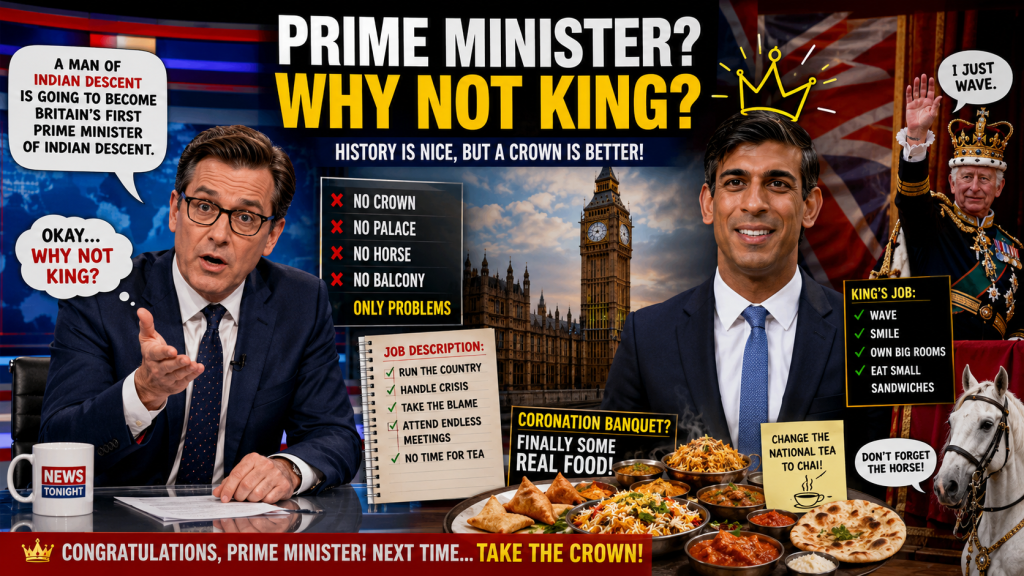
One night, a news host sat behind his desk with a serious face, like he was about to explain something very important to the whole world.
He looked at the camera and said, “A man of Indian descent is going to become Britain’s first prime minister of Indian descent.”
That sounded like a big historical moment. Everyone in the studio nodded. The map behind him looked serious. The music sounded serious. Even the desk looked like it had been polished for serious news.
But the host paused for one second too long.
Then he looked confused and said, “Okay… why not king?”
The whole studio went quiet.
Nobody expected that question.
The camera operator almost dropped the camera. The producer in the back whispered, “Did he just ask why he can’t be king?”
The host looked at his notes again. “I mean, if we’re making history, why stop at prime minister?”
Now everyone was laughing.
The host leaned forward. “Britain had a queen for seventy years. They have kings, queens, dukes, lords, knights, and people whose job is just to wear hats at weddings. But suddenly when an Indian guy shows up, they say, ‘Congratulations, you may run the government… but don’t touch the crown.’”
The audience laughed louder.
The host continued, “That feels like inviting someone to your house and saying, ‘You can cook dinner, pay the bills, fix the roof, and take care of the kids… but don’t sit in Grandpa’s chair.’”
In the control room, the producer started sweating. He knew the host was going off-script.
The host picked up a paper and pretended to read. “The official title is prime minister. That means he gets responsibility, pressure, blame, meetings, angry newspapers, and zero castles.”
Then he looked up. “That is not a promotion. That is a punishment with a nice suit.”
The audience clapped.
He pointed at the picture on the screen. “Look at him. He looks calm. He looks smart. He looks like he knows how to fix an economy and still explain Wi-Fi to his parents. Give that man a crown.”
Someone in the audience shouted, “Yes!”
The host nodded. “Exactly. If you trust him with the country, you can trust him with one shiny hat.”
Then he imagined the royal meeting.
In his royal voice, he said, “Welcome, sir. You may become prime minister.”
Then in another voice, he replied, “Great. Do I get a palace?”
“No.”
“A crown?”
“No.”
“A horse?”
“No.”
“So what do I get?”
“Problems.”
The audience exploded with laughter.
The host shook his head. “That’s how they get you. They give you the title that sounds powerful, but the king still gets the balcony.”
Then he acted like he was standing on a balcony, waving slowly. “The king just waves. That’s the whole job. He waves, smiles, and owns rooms nobody is allowed to enter.”
Then he pretended to be the prime minister, running around with papers. “Meanwhile, the prime minister is downstairs trying to stop the price of bread from turning into the price of jewelry.”
He paused and smiled.
“Honestly, I think Britain should try something new. First Indian prime minister? Nice. First Indian king? Now that’s a headline.”
Then he imagined the coronation.
“There would be music, drums, gold, elephants on the invitation—not real elephants, calm down—and the whole country watching like, ‘Wait, when did this become the best wedding ever?’”
The host laughed at his own idea.
He continued, “And the food? Come on. The royal banquet would finally have flavor. No more tiny sandwiches that taste like weather. We’re talking curry, biryani, samosas, naan, and one British uncle in the corner saying, ‘Actually, I’ve always loved spices.’”
The crowd cheered.
Then he got serious again, but only a little.
“Look, becoming prime minister is a big deal. It shows change. It shows history. It shows that a country can move forward.”
He paused.
“But still… why not king?”
The audience laughed again because now the question had become the whole joke.
The host leaned back in his chair like a man who had solved politics.
“I’m just saying, if you’re going to break tradition, break it properly. Don’t just open the front door. Open the palace gate. Let him ride in on a horse. Let him wave from the balcony. Let him change the national tea to chai.”
The crowd lost it.
He ended with a straight face.
“Congratulations to Britain’s new prime minister. But Britain, next time, don’t be shy. Give the man the crown.”
Then he looked into the camera and whispered, “And maybe the horse too.”