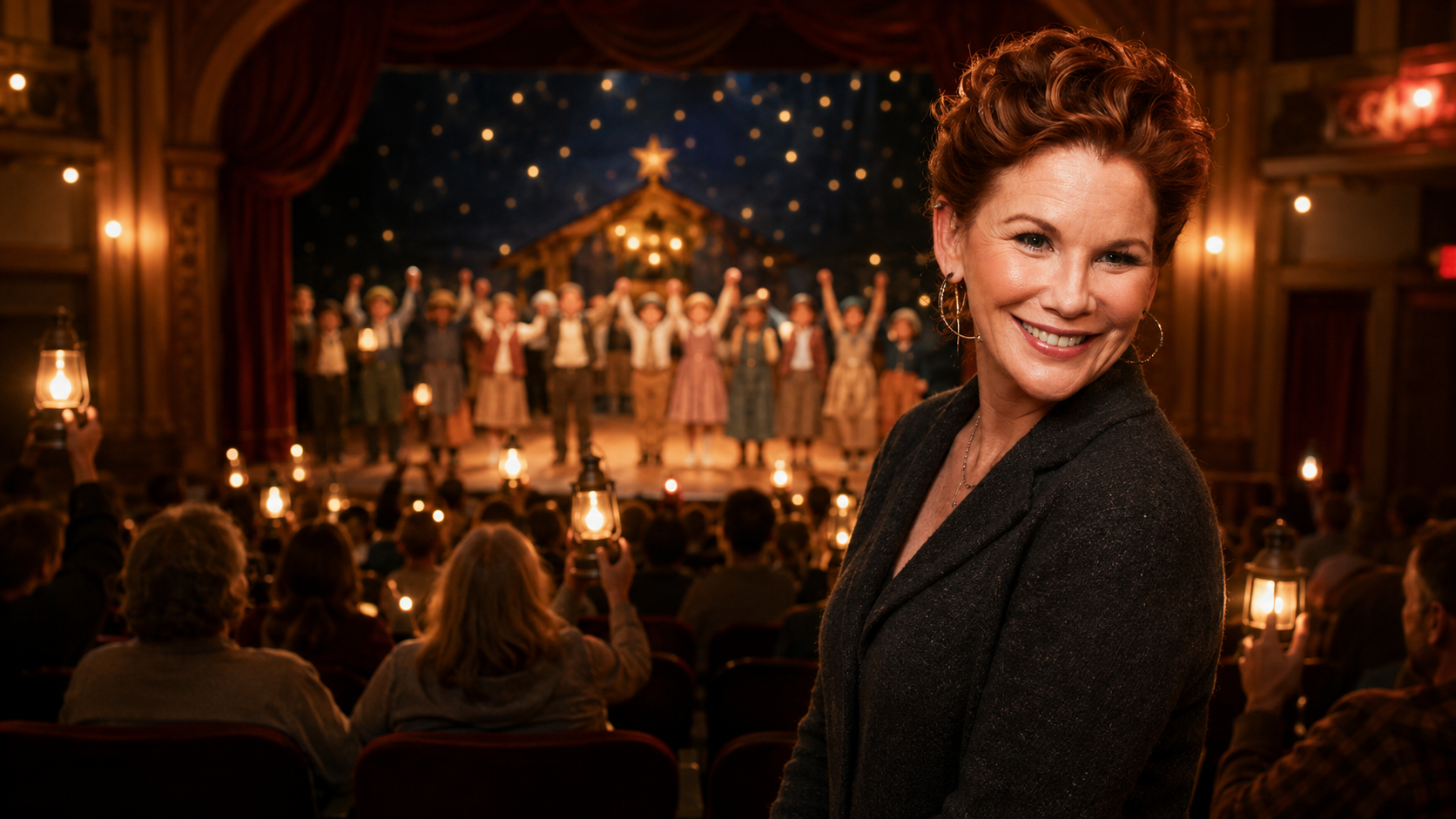
 The Theater Everyone Had Forgotten
The old Marigold Theater had been dark for nearly twelve years.
It stood at the end of Willow Street in the small town of Bellweather, its faded red doors locked beneath a cracked wooden sign. Once, families had filled its seats every weekend. Children had dressed as pirates, princesses, farmers, and kings while proud parents watched from the audience.
But after the town’s factory closed, many families moved away. Donations stopped. The roof began to leak, the heating system failed, and the final children’s performance was canceled before opening night.
After that, the theater became another place people passed without looking.
Only one person still believed it could come alive again.
Her name was Eleanor Briggs.
Eleanor was sixty-eight years old and had directed children’s plays in Bellweather for more than three decades. She kept the theater keys in a small tin box beside her bed, even though the building was no longer considered safe.
Every Tuesday afternoon, she met with a handful of children in the basement of the public library. They rehearsed scenes between shelves of donated books and folding chairs.
There was twelve-year-old Lily Grant, who loved singing but was terrified of performing in front of others.
There was ten-year-old Noah Bennett, whose father had recently lost his job.
And there was eight-year-old Samuel Ortiz, who had never spoken above a whisper since his mother passed away.
Eleanor believed the children needed more than a place to rehearse.
They needed somewhere to dream.
One rainy morning, she mailed a letter to Melissa Gilbert.
Eleanor did not expect an answer. She had found an old address connected to a charity event and simply wrote from the heart.
She explained that Bellweather’s children had no theater, no music program, and few places where they could feel seen.
At the end of the letter, she wrote:
“We do not need fame. We only need one open door.”
Three weeks passed.
Then four.
Eleanor assumed the letter had disappeared among thousands of others.
But one cold afternoon, a woman in a plain coat arrived at the Marigold Theater.
Eleanor was standing beneath the damaged awning, trying to stop rainwater from flowing under the front door.
“Mrs. Briggs?” the woman asked.
Eleanor turned and froze.
It was Melissa Gilbert.
Melissa smiled warmly and held out her hand.
“I received your letter.”
Eleanor stared at her, unable to speak.
Melissa looked up at the broken sign, then toward the dark windows.
“Would you show me inside?”
The theater smelled of dust, damp wood, and old curtains.
Several seats were torn. The stage floor had warped near the back wall. A family of pigeons had made a home in the balcony.
But when Melissa stepped onto the stage, she did not laugh or look disappointed.
Instead, she stood silently beneath the broken lights.
“My first memories of acting were not about applause,” she said. “They were about finding a place where I belonged.”
Eleanor’s eyes filled with tears.
“I only want that for them,” she whispered.
Melissa visited the children’s rehearsal at the library later that afternoon.
Lily forgot every line when she saw her.
Noah nearly fell out of his chair.
Samuel hid behind a bookshelf.
Melissa sat on the floor with them and asked each child why they loved theater.
Lily said, “Because when I sing, I do not feel invisible.”
Noah said, “Because stories make hard days feel smaller.”
Samuel said nothing.
But before Melissa left, he handed her a folded paper.
On it, he had drawn the Marigold Theater with bright lights, open doors, and a crowd waiting outside.
At the bottom he had written four words:
“Please make it shine.”
Melissa carried the drawing back to her hotel.
The next morning, she called Eleanor.
“I want to help,” she said. “But I need one promise.”
“Anything.”
“No one tells the town who paid for it.”
Eleanor was stunned.
“You want to remain anonymous?”
“This should belong to the children,” Melissa replied. “Not to me.”
Within two weeks, workers arrived at the theater.
They repaired the roof, replaced dangerous wiring, cleaned the seats, reinforced the stage, and installed a new heating system. Local volunteers painted the lobby and washed the windows.
The official explanation was that an anonymous donor had paid the largest expenses.
Rumors spread quickly.
Some people believed a former resident had become wealthy.
Others thought the state had secretly provided funding.
Eleanor kept her promise.
Melissa returned quietly several times, always after sunset or early in the morning. She helped sew costumes, painted part of the scenery, and listened to the children rehearse.
The first production would be an original play called The Lantern in Winter, a story about a village that loses hope until a group of children carries light from house to house.
Lily received the leading role.
Noah played the mayor’s son.
Samuel was given one short line near the end.
At first, Samuel refused to say it.
His line was simple:
“No light is too small.”
Each rehearsal, he stood silently while the other children waited.
Melissa never forced him.
Instead, she sat beside him at the edge of the stage.
“Sometimes courage is not loud,” she told him. “Sometimes it begins as a whisper.”
Slowly, Samuel began practicing the line with her.
First without sound.
Then in a whisper.
Then clearly enough for Eleanor to hear.
Opening night was scheduled for December 19.
Every ticket sold within three days.
Families who had not entered the theater in years began talking about old performances, first dates, school concerts, and grandparents who had once sat in the front row.
The Marigold Theater was becoming part of the town again.
But two nights before the performance, disaster struck.
A winter storm rolled over Bellweather.
Heavy snow covered the streets. Wind tore down power lines. By morning, half the town had no electricity.
The theater lost power completely.
An electrician examined the system and shook his head.
“The damage is outside the building,” he said. “It may take days to repair.”
Eleanor gathered the children on the dark stage.
“I am sorry,” she told them. “We may have to cancel.”
Lily began to cry.
Noah stared at the floor.
Samuel held his paper lantern against his chest.
Melissa stood in the shadows near the back of the theater, listening.
For a moment, no one spoke.
Then Samuel stepped forward.
In a small but steady voice, he said his line.
“No light is too small.”
Everyone turned toward him.
Melissa looked at the children, then at Eleanor.
“What if we do not cancel?” she asked.
Eleanor looked around the freezing, powerless theater.
“How can we perform without lights?”
Melissa smiled gently.
“Maybe the answer is already in Samuel’s hands.”
To be continued in Part 2.
Part 2: The Night Bellweather Found Its Light
The idea sounded impossible at first.
The Marigold Theater had no electricity, no working stage lights, and barely enough heat to keep the pipes from freezing.
But Melissa Gilbert looked at the paper lantern in Samuel’s hands and saw something more than a prop.
She saw a way forward.
“What if every family brings a lantern, flashlight, or battery-powered candle?” she asked. “We could light the stage together.”
Eleanor hesitated.
“It will not look professional.”
Melissa smiled.
“It will look human.”
Word spread through Bellweather that the performance would continue despite the power outage.
The mayor allowed volunteers to clear the street leading to the theater. A local hardware store donated batteries. The fire department inspected every lantern and helped create safe walking paths inside the building.
The bakery next door provided hot chocolate.
Families arrived wearing heavy coats and carrying lights of every kind.
Some brought camping lanterns.
Some brought flashlights.
Others brought small battery candles from Christmas decorations.
One elderly woman arrived holding an antique lantern that had belonged to her father.
“This hung backstage during the first play performed here,” she told Eleanor.
By seven o’clock, every seat was filled.
The theater was cold, but no one complained.
Hundreds of tiny lights glowed across the dark room.
The curtains opened by hand.
The children stepped onto the stage.
At first, Lily’s voice trembled.
Then she saw the lights shining in the audience.
She imagined each one as a person saying, “We believe in you.”
She began to sing.
Her voice rose through the theater, soft at first, then clear and strong.
Parents reached for one another’s hands.
Noah delivered his lines with such confidence that his father, sitting near the back, covered his face and cried.
For months, Noah had watched him struggle with unemployment and shame. But on that stage, Noah was no longer a worried child.
He was brave.
He was joyful.
He was free.
Then came Samuel’s scene.
He walked onto the stage carrying a small lantern.
The theater became completely still.
Eleanor stood behind the curtain, holding her breath.
Melissa watched from the final row.
Samuel looked toward the empty seat where his mother would have sat.
Then he lifted the lantern and spoke.
“No light is too small.”
His voice reached every corner of the room.
For one second, there was silence.
Then the audience stood.
The applause was so loud that Samuel’s eyes widened.
He looked toward Melissa.
She placed one hand over her heart.
Samuel smiled.
It was the first time Eleanor had seen him smile onstage.
The children completed the final scene, walking through the audience and sharing their lanterns with the villagers in the story.
But something unexpected happened.
People in the audience began passing their own lights toward the aisles.
Soon the whole theater was glowing.
The old walls, the repaired ceiling, the faded gold decorations, and the children’s faces shone brighter than they ever had under electric stage lights.
When the curtain closed, no one left.
Eleanor stepped onto the stage to thank the volunteers and the anonymous donor.
Before she could finish, Lily walked to the front.
“There is someone else we should thank,” she said.
Melissa sat very still.
Eleanor’s face changed.
She had promised to protect Melissa’s privacy.
But Lily was not talking about the money.
“She taught us that being afraid does not mean we should stop,” Lily said. “She told us that courage can begin as a whisper.”
Samuel looked toward the back row.
Every person in the theater followed his gaze.
Melissa slowly stood.
A wave of surprise moved through the crowd.
Some people gasped.
Others began clapping.
Eleanor stepped forward.
“She asked that her gift remain anonymous,” Eleanor explained. “She wanted this theater to belong to the children.”
Melissa walked toward the stage as the audience applauded.
When she reached the front, she did not make a long speech.
She simply looked at the children.
“I helped repair a building,” she said. “But all of you brought it back to life.”
Then she turned toward the crowd.
“What happened tonight was not created by one person. It happened because an entire town decided that its children’s dreams were worth protecting.”
The applause became even louder.
But opening night held one more surprise.
Noah’s father came onto the stage carrying a wooden box.
He explained that during the repairs, workers had discovered it beneath a loose floorboard.
Inside were photographs, programs, and handwritten notes from productions dating back almost seventy years.
One photograph showed Eleanor as a young girl standing on the same stage.
Beside her was her mother, who had founded Bellweather’s first children’s theater group.
On the back, her mother had written:
“A theater is not only where stories are performed. It is where people remember that they belong to one another.”
Eleanor pressed the photograph to her chest.
She had never seen it before.
The audience grew quiet.
Then the mayor made an announcement.
The town council had voted that morning to protect the Marigold Theater as a permanent community arts center.
Local businesses had already pledged funding for future productions.
The school district would use the building for music lessons, writing workshops, and student performances.
And Noah’s father, who had construction experience, had been offered a full-time job managing the theater’s maintenance.
Noah ran into his arms.
The crowd stood again.
What began as a children’s play had become something much larger.
It had restored a building.
It had given a father work.
It had helped a shy girl find her voice.
It had taught a grieving boy to speak again.
Most of all, it had reminded Bellweather that hope did not always arrive with great noise.
Sometimes it came quietly, through a handwritten letter.
Sometimes it came through an anonymous gift.
And sometimes it came from a child holding a paper lantern in a dark theater.
Melissa returned to Bellweather the following summer.
By then, the Marigold Theater hosted programs every week.
Lily helped younger children learn their songs.
Noah worked backstage beside his father.
Samuel had written a short play about a boy who carried light through a storm.
Before leaving, Melissa stood in the lobby and looked at a new framed photograph from opening night.
It showed the children bowing beneath hundreds of glowing lanterns.
Below it were the words Eleanor’s mother had written long ago:
“Here, we remember that we belong to one another.”
Melissa smiled.
She had wanted her donation to remain a secret.
But the real gift had never been the money.
It was the belief that a forgotten place could still become a home.
And long after the lights returned, the people of Bellweather continued telling the story of the winter night when darkness covered their town—and a group of children taught everyone how to shine.
This is a fictional, heartwarming story created for inspiration and entertainment.


