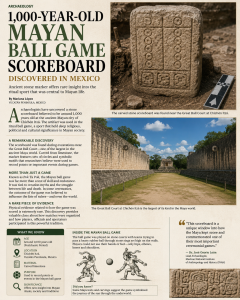
1,000-Year-Old Mayan Ball Game Scoreboard Discovered at Chichen Itza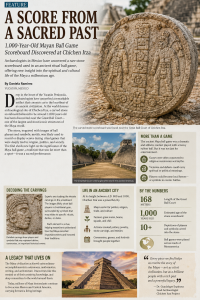
Deep beneath the soil of one of Mexico’s most famous archaeological sites, a remarkable discovery has offered a new window into the ancient world of the Maya.
Archaeologists working at Chichen Itza, the legendary city located on the Yucatán Peninsula, uncovered a stone scoreboard believed to be around 1,000 years old.
The artifact, connected to the sacred Mayan ball game, is helping researchers better understand a tradition that was far more than a simple sport.
The discovery has captured the attention of historians, archaeologists, and history enthusiasts around the world.
While Chichen Itza has been studied for generations, finds like this remind us that the ancient city still holds many secrets waiting to be revealed.
A Discovery Beneath Ancient Ground
The stone scoreboard was discovered during archaeological work near the Great Ball Court of Chichen Itza.
This massive structure is one of the largest and best-preserved ball courts ever built in the ancient Americas.
Stretching hundreds of feet in length, the court once echoed with the sounds of players, spectators, priests, and rulers who gathered to witness important ceremonial games.
When researchers uncovered the carved stone, they immediately realized they had found something significant.
The object was carefully examined and cleaned, revealing detailed carvings that had survived centuries beneath the earth.
Experts determined that the artifact likely dates between A.D. 800 and 1000, a period when Chichen Itza stood at the height of its power and influence.
During this era, the city served as a major political, religious, and economic center in the Maya world.
The scoreboard’s carvings include images associated with ball players and symbols connected to Mayan religious beliefs.
These details have provided archaeologists with valuable clues about the role the game played in everyday life and sacred ceremonies.
The Ancient City of Chichen Itza
To understand the importance of the discovery, it helps to understand Chichen Itza itself.
Chichen Itza is one of the most famous archaeological sites in the world.
Located in modern-day Mexico, it was once a thriving city that attracted traders, pilgrims, warriors, and leaders from across the region.
The city is perhaps best known for El Castillo, the massive pyramid dedicated to the feathered serpent deity Kukulkan.
However, Chichen Itza contains many other remarkable structures, including temples, observatories, ceremonial platforms, and the enormous Great Ball Court.
For centuries, the city served as a center of knowledge, religion, and government.
The Maya people who lived there developed sophisticated systems of mathematics, astronomy, architecture, and agriculture.
Their achievements continue to amaze modern researchers.
Yet among all of Chichen Itza’s impressive monuments, few places reveal as much about Maya culture as the Great Ball Court.
More Than a Game
When people hear about an ancient ball game, they may imagine something similar to modern sports.
But the Mayan ball game was much more than recreation.
The game was deeply connected to religion, mythology, politics, and social life.
Matches could symbolize cosmic battles between opposing forces such as light and darkness, life and death, or order and chaos.
Ancient artwork and inscriptions show that ball games often carried enormous significance.
Victories and defeats could represent spiritual messages or political statements.
Some historians believe that important games were held during religious festivals and special ceremonies.
Leaders may have used the events to demonstrate power, settle disputes, or strengthen alliances.
The game itself required remarkable athletic skill.
Players used a heavy rubber ball that could weigh several pounds.
They typically struck the ball using their hips, thighs, or forearms while avoiding the use of their hands.
The objective varied depending on local traditions, but maintaining control of the ball demanded strength, balance, and endurance.
Playing the game could be dangerous.
Injuries were likely common because of the ball’s weight and the physical demands placed on participants.
Yet despite the risks, the game remained one of the most important traditions throughout much of ancient Mesoamerica.
The Great Ball Court
The Great Ball Court at Chichen Itza stands as a testament to the importance of the sport.
Measuring approximately 168 meters (551 feet) long and 70 meters (230 feet) wide, it is the largest known ball court in the ancient Americas.
Visitors today can still walk through the impressive structure and imagine the events that once unfolded there.
Tall stone walls line both sides of the court. Mounted high on these walls are stone rings through which players may have attempted to pass the ball during certain versions of the game.
The court’s remarkable acoustics add to its mystery. Even a quiet sound made at one end can often be heard clearly at the other.
Researchers believe thousands of spectators may have gathered there during major events. The court would have been a place of excitement, competition, and spiritual significance.
The newly discovered scoreboard adds another piece to the puzzle of how these events were organized and remembered.
Decoding the Carvings
One of the most fascinating aspects of the discovery is the artwork carved into the stone.
Ancient Maya artists often used images and symbols to communicate stories, beliefs, and historical events.
Every figure, posture, and decorative element could carry meaning.
The scoreboard contains images believed to represent ball players.
Their clothing, equipment, and poses offer clues about the way the game was played.
Researchers are carefully studying the carvings to determine what messages they were intended to convey.
Some symbols may identify specific ceremonies.
Others may represent important individuals, deities, or mythological events.
Each detail helps archaeologists reconstruct a clearer picture of life in Chichen Itza a thousand years ago.
While some aspects remain uncertain, experts agree that the artifact reflects the sophisticated artistic traditions of the Maya civilization.
The Spiritual Meaning of the Ball Game
For the Maya, sports and religion were often intertwined.
Ancient stories recorded in texts such as the Popol Vuh describe supernatural ball games involving gods and heroes.
These tales connect the game to themes of sacrifice, rebirth, and the struggle between life and death.
In one famous myth, heroic twins challenge powerful underworld rulers to a ball game.
Their journey becomes a story of courage, transformation, and ultimate victory.
Because of these connections, many scholars believe the ball game served as a symbolic reenactment of sacred events.
Participants may have represented divine forces during ceremonial matches.
The newly discovered scoreboard could therefore have been more than a simple record of scores or results.
It may have carried religious significance, reminding players and spectators of deeper spiritual meanings associated with the game.
Life in Ancient Chichen Itza
At its height, Chichen Itza was a bustling urban center.
Markets were filled with traders exchanging goods from distant regions. Craftsmen produced pottery, jewelry, textiles, and tools.
Priests conducted ceremonies in temples dedicated to various deities.
Farmers worked surrounding lands to grow crops such as maize, beans, squash, and chili peppers.
Families lived in homes built from local materials while participating in community traditions and religious celebrations.
The ball game would have been woven into this larger social fabric.
Major matches may have attracted visitors from neighboring communities.
Leaders could have attended important games to demonstrate their status and influence.
The newly discovered scoreboard provides another glimpse into this vibrant world.
A Civilization of Knowledge
The Maya civilization achieved remarkable accomplishments long before European contact.
They developed one of the most advanced writing systems in the ancient Americas.
Their mathematical knowledge included the concept of zero, an achievement reached independently by only a few civilizations.
Maya astronomers carefully tracked the movements of planets, stars, and celestial events.
Their calendars were highly sophisticated and reflected centuries of observation.
Architects designed cities aligned with astronomical phenomena. Temples and pyramids were built with impressive precision.
The scoreboard discovered at Chichen Itza reflects the same spirit of creativity and intellectual achievement that defined Maya society.
Even a ceremonial sports artifact demonstrates careful planning, skilled craftsmanship, and cultural significance.
Preserving the Past
Discoveries like this highlight the importance of archaeological preservation.
Many ancient sites face threats from natural erosion, environmental changes, tourism pressures, and illegal looting.
Archaeologists work carefully to protect fragile artifacts while gathering information about the past.
The stone scoreboard underwent detailed documentation after its discovery.
Researchers photographed, measured, and analyzed the artifact to ensure that valuable information would not be lost.
Modern technology allows experts to create digital models, helping scholars study the carvings without damaging the original stone.
These efforts ensure that future generations can continue learning from the discovery.
What the Discovery Means
Although it may appear to be a single stone object, the scoreboard has the potential to answer important historical questions.
Researchers hope it will provide new insights into:
- The organization of ball game events.
- The symbolism associated with ceremonial competitions.
- The artistic styles used during Chichen Itza’s peak.
- Religious practices connected to the sport.
- Relationships between political power and public ceremonies.
Each new finding contributes to a broader understanding of Maya civilization.
Archaeology often advances through small pieces of evidence rather than dramatic breakthroughs.
A carved stone, a pottery fragment, or an inscription can transform our understanding of ancient history.
The scoreboard represents one such opportunity.
Global Interest in the Maya
The Maya continue to fascinate people around the world.
Movies, documentaries, books, and museum exhibitions frequently explore their achievements and mysteries.
Yet modern researchers emphasize that the Maya are not simply a civilization of the past.
Millions of Maya descendants still live throughout Mexico, Guatemala, Belize, Honduras, and El Salvador.
Their languages, traditions, and cultural heritage remain vibrant today.
Discoveries at sites like Chichen Itza help preserve and celebrate that legacy.
They remind us that ancient accomplishments continue to shape modern identities and historical understanding.
The Ongoing Search for Answers
Archaeologists believe Chichen Itza still holds many secrets beneath its surface.
Every excavation reveals new clues about how the city functioned and evolved over time.
Hidden structures, buried offerings, forgotten pathways, and ceremonial objects continue to emerge through careful research.
The scoreboard is part of this larger story.
Its discovery raises new questions:
Who commissioned its creation?
Which ceremonies was it associated with?
Did it commemorate a specific event?
What messages were intended for those who viewed it?
Future studies may provide answers.
For now, the artifact stands as a powerful reminder of the complexity and richness of Maya civilization.
A Window Into a Lost World
Standing in the Great Ball Court today, visitors can imagine the scene from a thousand years ago.
Athletes move across the stone court. Spectators watch intently. Priests conduct rituals. Leaders observe from ceremonial platforms.
The rubber ball strikes the walls with a sharp echo.
Above the crowd, symbols carved into stone remind everyone that the game represents more than competition.
It is a reflection of faith, tradition, and community.
The newly discovered scoreboard may have witnessed countless moments like these.
Though centuries have passed, the stone still carries the stories of the people who created it.
Conclusion
The discovery of a 1,000-year-old Mayan ball game scoreboard at Chichen Itza is far more than an archaeological curiosity.
It is a rare connection to one of the world’s most remarkable civilizations.
The artifact provides valuable evidence about the sacred ball game that played a central role in Maya culture.
It sheds light on religious beliefs, artistic traditions, public ceremonies, and daily life within one of the greatest cities of ancient Mesoamerica.
As researchers continue their work, the scoreboard will help unlock new chapters of Maya history.
Its carvings, symbols, and craftsmanship offer a glimpse into a world that flourished centuries before the modern era.
Most importantly, the discovery reminds us that history is never truly finished.
Beneath ancient stones and forgotten ground, countless stories remain waiting to be told.
And at Chichen Itza, one of those stories has just begun to emerge once again.