S1.E3: The Calf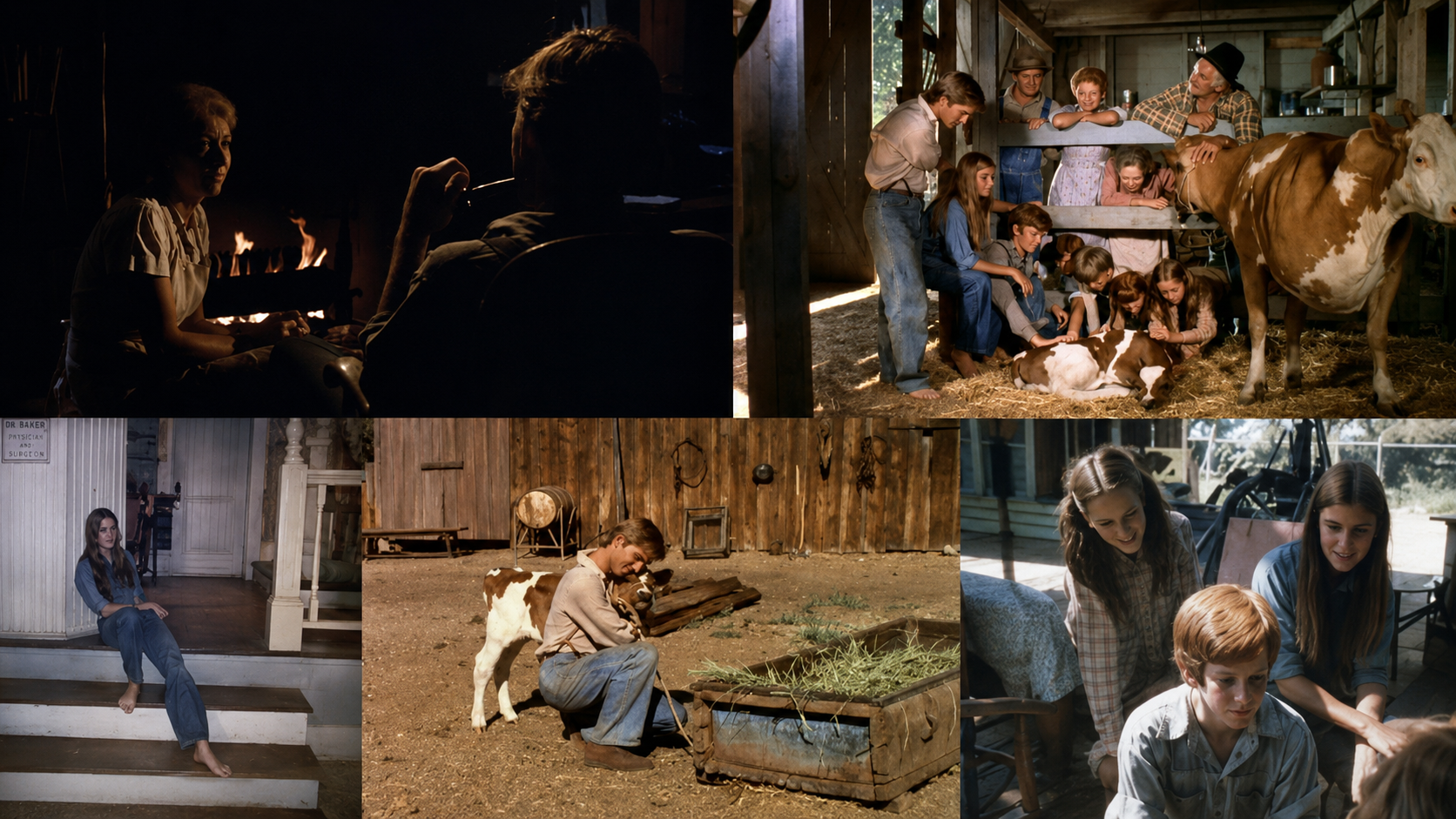
Part 1: The Little Calf
Morning came softly to Walton’s Mountain.
The sky was pale blue, the trees were still, and the air smelled of hay, wood smoke, and fresh earth.
Inside the Walton barn, something wonderful had happened during the night.
A calf had been born.
The children crowded around the stall with wide eyes.
Elizabeth stood closest, holding her breath as the tiny calf tried to stand on shaky legs.
“Oh, John-Boy, look at him,” she whispered. “He’s so little.”
The calf slipped, then pushed himself up again. His mother lowered her head and gently licked him.
Jason laughed softly. “He’s got more courage than balance.”
Mary Ellen smiled. “He’s beautiful.”
Even Grandpa Walton came in with a grin. “Well now, that little fellow looks like he came into the world ready to cause trouble.”
The children fell in love with him at once.
To them, he was not just an animal. He was a new member of the family.
Elizabeth wanted to name him right away.
“We should call him Chance,” she said. “Because he got a chance to live here with us.”
Jim-Bob liked the name. Ben said it sounded too fancy for a calf. But after a little arguing, everyone agreed.
Chance became the most important thing on the mountain that morning.
After breakfast, the children hurried back to the barn before school.
John-Boy watched them from the doorway with a smile, but he also noticed something else.
His father was not smiling the same way.
John Walton stood near the stall with his arms crossed. His face was quiet and serious. He looked at the calf, then looked away.
John-Boy knew that look.
It meant money was short.
The Walton family had never had much.
They worked hard for everything they owned.
The sawmill helped, the farm helped, and everyone did their part.
But some seasons were harder than others.
That evening, after supper, John-Boy overheard his father talking quietly with Olivia.
“We need the money,” John said.
Olivia’s voice was gentle. “I know.”
“The calf will bring enough to help with the bills.”
There was a pause.
“The children love him,” Olivia said.
John sighed. “I know they do. But love doesn’t pay for flour, shoes, and medicine.”
John-Boy froze in the hallway.
He understood what his father meant.
The calf was going to be sold.
The next day, a farmer came by to look at Chance.
He was a rough-looking man with strong hands and muddy boots. He walked around the calf, nodded, and said he would buy him.
Then he said the words the children never forgot.
“He’ll make good beef.”
Elizabeth’s face turned white.
“Beef?” she asked.
The man looked confused. “That’s what I’m buying him for.”
The barn went silent.
Mary Ellen stepped back.
Jason looked angry.
Jim-Bob clenched his little fists.
Elizabeth began to cry.
John-Boy turned to his father. “Daddy, you can’t let him do that.”
John Walton’s face was filled with pain, but his voice stayed calm.
“Son, this is a farm. Animals are sometimes raised for food.”
“But not Chance,” Elizabeth cried. “He trusts us.”
John knelt down in front of her.
“I know, honey.”
“Then don’t sell him.”
John looked at all his children. He wished he could tell them yes.
He wished he could keep every animal, fix every hurt, and give his family everything they needed without sacrifice.
But life on Walton’s Mountain was not that easy.
“We need that money,” he said quietly.
The children did not answer.
For the first time, the calf no longer felt like a happy gift.
He felt like a heartbreak waiting to happen.
Part 2: A Hard Lesson
For the next few days, the children spent every free moment with Chance.
They brushed his soft coat, brought him extra hay, and talked to him like he could understand every word.
Elizabeth sat beside him in the straw and whispered, “Don’t worry. We won’t let them take you.”
John-Boy watched her and felt a heavy ache in his chest.
He was old enough to understand his father’s trouble, but young enough to still feel the unfairness of it.
He knew the family needed money. He knew his father carried more worries than he ever spoke aloud.
But he also knew the calf was alive.
He had eyes.
He had a name.
He had become part of their hearts.
That night, the children gathered upstairs after the lamps were out.
“We have to do something,” Jason said.
“Like what?” Mary Ellen asked.
“We could hide him,” Ben said.
“In the woods?” Jim-Bob asked.
Elizabeth nodded quickly. “Yes. We can take him where nobody will find him.”
John-Boy shook his head. “A calf can’t live hidden in the woods. He needs his mother. He needs food.”
Elizabeth looked at him with tears in her eyes. “So we just let him die?”
John-Boy had no answer.
The next morning, the farmer came back with his wagon.
The children ran to the barn before breakfast, but their father was already there.
John was tying a rope gently around Chance’s neck.
Elizabeth screamed.
“No!”
She threw herself between her father and the calf.
John stopped.
“Elizabeth.”
“No, Daddy. Please don’t.”
Olivia came into the barn and pulled Elizabeth close, but the little girl fought to get free.
“You said we should be kind to God’s creatures,” Elizabeth cried. “How is this kind?”
The words hit John hard.
He looked at Olivia.
Then he looked at the calf.
The farmer waited outside, impatient.
John-Boy stepped forward.
“Daddy, is there no other way?”
John’s jaw tightened.
“There’s always another way, son. But most of them are harder.”
“Then let us try,” John-Boy said.
The children all looked at their father.
“We’ll earn the money,” Jason promised.
“We can do extra chores,” Mary Ellen added.
“I’ll help at the mill,” Ben said.
Elizabeth wiped her face. “I’ll do anything.”
John looked at their small, hopeful faces. He knew they could not truly replace the money. Not quickly. Not easily.
But he also saw something important.
This was not just about a calf anymore.
It was about their hearts.
It was about teaching them that life was hard, but mercy mattered too.
The farmer called from outside. “John, we making a deal or not?”
John turned toward the door.
For a long moment, nobody moved.
Then John untied the rope from the calf’s neck.
“No deal,” he said.
The children gasped.
The farmer frowned. “You changing your mind?”
“I am.”
“You’re making a mistake.”
John’s voice stayed firm. “Maybe. But it’s my mistake to make.”
The farmer climbed onto his wagon and left in anger.
Elizabeth ran to her father and hugged him tightly.
“Thank you, Daddy.”
John held her close.
But his face was still troubled.
That night, John sat alone on the porch. John-Boy came and sat beside him.
“You did the right thing,” John-Boy said.
John looked out at the dark trees.
“I did the kind thing. Sometimes the right thing is harder to know.”
John-Boy stayed quiet.
John continued, “That money still has to come from somewhere.”
“I know.”
“You children wanted to save that calf. Now you’ll have to help carry the cost.”
John-Boy nodded. “We will.”
And he meant it.
The next morning, the Walton children began working harder than ever.
They chopped extra wood.
They gathered berries to sell.
They helped at the sawmill.
Mary Ellen took in mending from a neighbor.
Jason offered to play music at a small gathering for a little pay.
Even Elizabeth collected eggs carefully and proudly counted each coin they earned.
It was not easy.
They were tired.
They complained sometimes.
But every time they saw Chance running awkwardly in the yard, they remembered why they were doing it.
For the first time, saving something they loved meant sacrifice.
And sacrifice made love feel even stronger.
Part 3: What the Calf Taught Them
Weeks passed on Walton’s Mountain.
Chance grew stronger every day. His legs were no longer shaky.
He followed the children around the barnyard like a loyal friend, and Elizabeth believed he understood every word she said.
The family still struggled, but little by little, the children’s hard work helped.
It did not solve everything.
Life was still life.
There were still bills, cold mornings, worn-out shoes, and long hours at the mill.
But something had changed inside the family.
The children had learned that love was not only a feeling. Love also meant work. It meant giving up time, energy, and comfort for something that mattered.
One afternoon, John-Boy found his father repairing a fence.
“Daddy,” he said, “do you regret keeping Chance?”
John leaned on the hammer and looked across the field.
“I regret that I had to choose at all.”
John-Boy nodded.
His father continued, “When you’re young, you think every choice has a clean answer. Good or bad. Right or wrong. But most choices are mixed. You give up one thing to save another.”
“Did we do that?”
John smiled a little.
“Yes. We gave up money to save a calf. But maybe we saved something else too.”
“What?”
John looked toward the house, where Elizabeth was laughing as Chance chased after her.
“Your kindness.”
That evening, Grandma made a simple supper. There was not much on the table, but everyone seemed grateful.
Grandpa raised his cup.
“To Chance,” he said.
The children laughed.
Grandma shook her head. “Zeb Walton, don’t you start making speeches over livestock.”
But Grandpa only smiled.
“That little calf taught this family more than some schoolteachers could.”
Olivia looked at John with soft eyes.
“He taught us all something.”
Later that night, John-Boy sat at his desk by the window. The house was quiet.
Downstairs, the fire had burned low. Outside, the mountain rested under the moonlight.
He opened his notebook and began to write.
He wrote about a calf born in the barn.
He wrote about children who loved him.
He wrote about a father forced to make a hard decision.
And he wrote about how sometimes the smallest life can open the largest lesson.
When he finished, he looked out toward the barn.
Chance was safe.
But John-Boy knew the story was not only about saving the calf.
It was about growing up.
It was about seeing his father not as a man who always had easy answers, but as a man trying his best in a difficult world.
It was about understanding that mercy could cost something.
And maybe that was why it mattered so much.
The next morning, Elizabeth ran into the barn with fresh hay.
“Good morning, Chance,” she said brightly.
The calf lifted his head and made a soft sound.
John-Boy stood in the doorway and smiled.
Behind him, his father came up quietly.
“He’s getting big,” John said.
“Yes, sir.”
“Bigger animals eat more.”
John-Boy looked worried for a second.
Then he saw the small smile on his father’s face.
They both laughed.
For a moment, the worries of the world felt lighter.
The sun rose over Walton’s Mountain again, shining on the barn, the house, the fields, and the family that had learned to hold on to kindness, even when life made it hard.
And from that day on, whenever the children looked at Chance, they remembered that love is not always easy.
But it is always worth protecting.


