The Carnival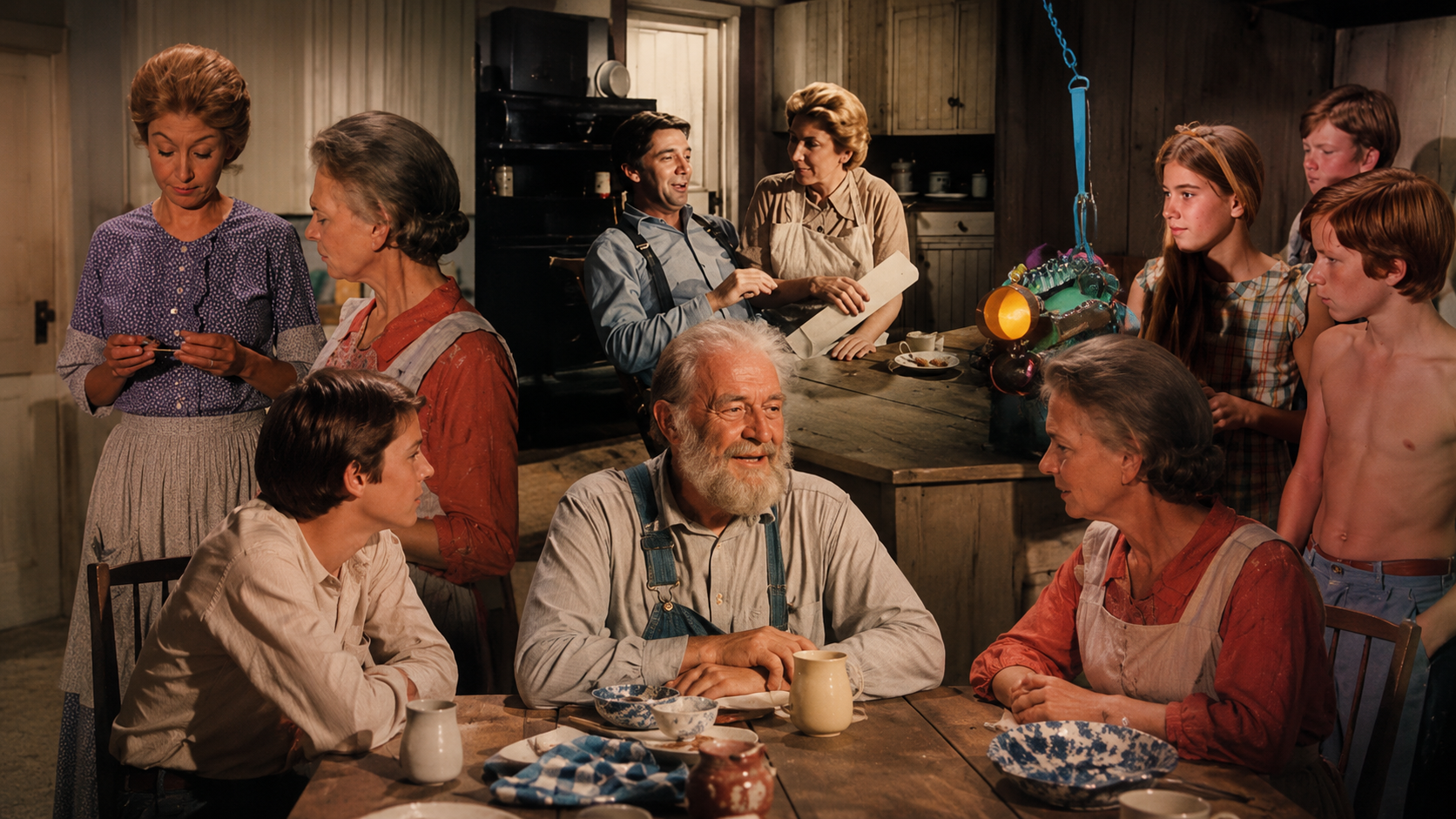
Part 1: Left Behind on Walton’s Mountain
The carnival came to Walton’s Mountain like a dream full of color, music, and laughter.
For three days, the quiet field near Ike Godsey’s store turned into a place of bright lights, painted wagons, and happy voices.
Children ran from one booth to another with sticky fingers and wide smiles.
The smell of popcorn, candy apples, and roasted peanuts filled the cool mountain air.
The Walton children loved every moment.
Ben tried to win a prize at the ring toss. Jim-Bob stood for a long time watching the mechanics of the Ferris wheel.
Elizabeth held Olivia’s hand tightly as she stared at the carousel horses going round and round.
Jason listened to the carnival band, tapping his foot to the music.
John-Boy watched everything with careful eyes. To him, the carnival was more than fun.
It was a moving world, filled with people who carried stories from town to town.
By Sunday night, the carnival was already packing up.
By Monday morning, it was gone.
Or at least, most of it was.
Four carnival performers had been left behind.
Their names were Marco, Lydia, Samuel, and Rosie.
Marco was a juggler with quick hands and a smile that came easily, even when life was hard.
Lydia was a tightrope walker, quiet and graceful, with eyes that seemed older than her years.
Samuel was an older magician, gentle and wise, with a worn black coat and a small case full of tricks.
Rosie was a young clown who made children laugh, though without her makeup, she looked shy and unsure.
They stood in the empty field, staring at the road where the carnival wagons had disappeared.
“Well,” Marco said, trying to laugh, “I suppose this is one way to take a vacation.”
Rosie did not laugh.
“They left us,” she said softly.
Samuel looked tired. “They must have thought we were in another wagon.”
Lydia folded her arms against the morning chill. “And now we have no wagon, no money, and no place to sleep.”
A few minutes later, John Walton drove by in his truck.
He saw them standing near the empty carnival grounds and slowed down.
“You folks all right?” he asked.
Marco stepped forward. “We were with the carnival, sir. Seems they moved on without us.”
John looked at the four strangers. He could see they were tired, hungry, and worried.
“Well,” he said, “you can’t stand out here all day.”
“We don’t want to trouble anyone,” Lydia said.
John nodded toward his truck. “Trouble or not, my house has food and a roof. Come on.”
When John brought them home, the Walton children were full of questions.
“A real magician?” Elizabeth asked, looking at Samuel.
Samuel smiled and pulled a coin from behind her ear.
Elizabeth gasped. “How did you do that?”
“Magic,” Samuel said.
Jim-Bob stared at Marco. “Can you really juggle knives?”
“When I have to,” Marco said. “But apples are safer.”
Rosie gave a small smile. “And I’m a clown.”
Ben looked confused. “You don’t look like one.”
Rosie laughed softly. “That’s because I left my face in my bag.”
Olivia welcomed them kindly and gave them breakfast.
Grandma watched them closely at first, but after Samuel praised her biscuits, she decided he had good sense.
At supper that night, the performers told stories about the road.
They had been to towns in Virginia, North Carolina, Tennessee, and beyond.
They had slept in wagons, barns, and sometimes under the stars.
They had performed for rich people, poor people, lonely people, and children who had never seen a carnival before.
“It sounds exciting,” John-Boy said.
Samuel looked at him. “It is exciting, son. But excitement is not the same thing as belonging.”
The room grew quiet.
Rosie looked down at her plate. “Sometimes people laugh at us, but they don’t really see us.”
Olivia’s face softened.
“Well,” she said, “while you’re here, you’ll be seen.”
The next day, news spread quickly across Walton’s Mountain.
Some people were curious.
Some were friendly.
Others were suspicious.
At Ike Godsey’s store, a few townspeople whispered.
“Carnival people are always trouble.”
“They move from place to place.”
“You never know about folks like that.”
John heard them and turned around.
“They’re guests in my home,” he said firmly. “And they’ll be treated with respect.”
The store became quiet.
But the whispers did not completely stop.
The performers tried to find a way back to the carnival, but it was not easy.
The carnival had moved on, and nobody knew exactly where it had gone next.
So the four strangers stayed with the Waltons.
At first, they felt embarrassed.
Then slowly, they began to relax.
Marco helped John and the boys at the mill. Lydia helped Olivia with sewing.
Samuel entertained the younger children after supper.
Rosie helped Elizabeth make paper dolls and taught her how to smile even when she felt nervous.
For a few days, the Walton house became a little brighter.
But trouble was coming.
And before long, the carnival performers would have to prove to Walton’s Mountain that they were not the kind of people others had judged them to be.
Part 2: A Town That Had to Learn
The longer the carnival performers stayed, the more the Walton children liked them.
Marco made hard work feel like a game.
At the mill, he could toss small pieces of wood from one hand to the other without dropping them.
Ben tried to copy him and nearly hit Jim-Bob in the head.
“Careful,” John said. “This is a sawmill, not a circus.”
Marco grinned. “Sometimes they feel the same.”
Lydia was quieter. She helped Olivia hang laundry and mend clothes.
She moved with such calm balance that even simple work looked graceful.
Mary Ellen asked her one afternoon, “Were you ever scared walking on a tightrope?”
Lydia looked at the sky before answering.
“Every time.”
“Then why do it?”
“Because courage is not the same as never being afraid,” Lydia said. “Courage is taking the next step anyway.”
Mary Ellen remembered those words.
Samuel became Grandpa’s favorite guest.
The two men sat on the porch in the evenings, trading stories. Samuel talked about towns he had seen.
Grandpa talked about Walton’s Mountain as if it were the finest place on earth.
Rosie became closest to Elizabeth.
One afternoon, Elizabeth found Rosie sitting alone behind the house, holding her clown makeup box.
“Why are you sad?” Elizabeth asked.
Rosie smiled quickly. “I’m not sad.”
Elizabeth sat beside her. “You look sad.”
Rosie sighed. “Sometimes I make everyone laugh so they won’t notice I’m lonely.”
Elizabeth thought about that.
Then she leaned against Rosie’s shoulder.
“I notice,” she said.
Rosie’s eyes filled with tears, but she smiled.
Meanwhile, the town continued to talk.
Some people liked the performers. Others did not trust them.
Then one morning, Ike discovered money missing from his store.
It was not much, but it was enough to start trouble.
“I had it in the drawer last night,” Ike said, nervous and upset. “Now it’s gone.”
A man standing nearby muttered, “Funny how money disappears after carnival people come to town.”
John’s face hardened. “You have no proof.”
“No,” the man said. “But it makes sense.”
John-Boy felt anger rise inside him.
“It only makes sense because they’re different,” he said.
The accusation reached the Walton house by afternoon.
Rosie was hurt. Marco tried to joke, but his smile was weak. Lydia looked angry in a quiet way. Samuel said nothing for a long time.
Finally, Samuel spoke.
“We’ve been called many things on the road. Thieves. Beggars. Frauds. You learn to keep walking.”
Olivia shook her head. “You shouldn’t have to.”
John decided to help Ike search the store carefully.
By evening, they found the missing money.
It had slipped behind a loose board under the counter.
Ike felt ashamed.
“I’m sorry,” he told the performers. “I should have looked harder before people started talking.”
Samuel gave him a kind smile.
“It is easier to lose money than to lose trust.”
Ike nodded. “You’re right.”
But the damage had already been done.
The performers realized that many people had judged them before knowing them.
That night, John-Boy sat at his desk and began writing about them.
He wrote about how people feared what they did not understand.
He wrote about how strangers could become friends if given a chance.
But the story was not finished yet.
The next day, a heavy storm rolled over Walton’s Mountain.
The sky turned dark. Wind bent the trees. Rain fell hard against the windows.
During the storm, a small barn near the edge of town caught fire after lightning struck it.
Inside the barn were two children who had taken shelter there on their way home.
The fire spread fast.
People ran from Ike’s store toward the smoke, but fear stopped many of them at the barn door. The flames were too strong.
John and several men tried to get close, but the smoke pushed them back.
Then Lydia stepped forward.
“There’s a back loft window,” she said, pointing through the rain.
“How do you know?” John asked.
“I saw it when we passed yesterday.”
The window was high and hard to reach.
Marco looked at the narrow beams along the side of the barn.
“I can climb that.”
Before anyone could stop him, Marco climbed the wet wooden frame. He moved fast, holding tight with strong hands.
Lydia followed part of the way, balancing across a narrow support beam as if it were a tightrope.
The townspeople stared in shock.
Together, Marco and Lydia reached the loft window. Marco broke it open, and smoke poured out.
Inside, the children were coughing and crying.
Marco pulled one child out first and passed him carefully down to John. Lydia helped the second child through the window, holding her steady despite the wind and rain.
Samuel helped calm the frightened children, wrapping them in blankets. Rosie made silly faces through her tears until the youngest child stopped crying.
By the time the fire was put out, everyone was soaked, shaken, and silent.
The same people who had whispered about the carnival performers now looked at them with shame and respect.
One woman stepped forward.
“You saved those children.”
Marco shrugged, breathing hard. “Anyone would have tried.”
John shook his head.
“No. Not anyone. You did.”
For the first time since they arrived, the performers were not seen as strangers.
They were seen as people.
And on Walton’s Mountain, that changed everything.
Part 3: A Different Kind of Home
After the barn fire, Walton’s Mountain felt different.
People who had once avoided the carnival performers now greeted them warmly. At Ike’s store, folks offered coffee, food, and apologies.
Some apologies were awkward.
Some were quiet.
But they were real.
Ike told Samuel, “I judged you too quickly.”
Samuel smiled gently. “Most people do, now and then.”
Rosie became popular with the children in town.
They followed her wherever she went, begging her to make funny faces or show them tricks.
Rosie laughed more freely now. She no longer looked like someone trying to disappear.
Lydia gave Mary Ellen a small lesson in balance.
“Keep your eyes forward,” Lydia said. “Don’t look down at everything that could go wrong.”
Mary Ellen stepped carefully across a fallen log.
“I think that advice works for more than tightropes,” she said.
Lydia smiled. “It does.”
Marco helped Ben and Jim-Bob build a wooden practice frame behind the barn, though John warned them there would be no knife juggling on Walton property.
Samuel spent an evening teaching John-Boy a card trick.
“You must never use magic to fool people in a cruel way,” Samuel said. “A good trick should leave someone smiling, not ashamed.”
John-Boy nodded.
“That sounds like good advice for writing too.”
Samuel laughed. “Maybe all art is a kind of magic.”
A few days later, word finally came from the carnival.
A message reached Ike’s store.
The carnival had discovered the four performers were missing and was now in Charlottesville.
A wagon would pass near Walton’s Mountain the next morning to collect them.
The news brought mixed feelings.
The performers were happy to return to their work.
But leaving the Waltons was harder than they expected.
That evening, Olivia made a special supper. Everyone gathered around the table.
There was roast chicken, potatoes, beans, fresh bread, and apple pie.
Grandpa raised his glass.
“To our carnival friends,” he said. “You came here as strangers and leave as part of the story of this mountain.”
“Hear, hear,” Grandma said.
Rosie wiped her eyes.
“I don’t usually cry before dessert,” she joked.
Elizabeth reached for her hand. “Do you have to go?”
Rosie looked at her gently.
“Yes, sweetheart. But I won’t forget you.”
Samuel looked around the table.
“You have given us more than food and shelter,” he said. “You reminded us what home feels like.”
John spoke quietly.
“Home isn’t always a place you stay forever. Sometimes it’s a place that treats you kindly when you need it most.”
The next morning, the wagon arrived.
The Walton family stood outside to say goodbye.
Marco shook John’s hand. “Thank you for trusting us.”
John smiled. “Thank you for proving trust is worth giving.”
Lydia hugged Olivia. “You made me feel welcome.”
Olivia answered, “You were welcome.”
Samuel gave John-Boy a small deck of cards.
“For your stories,” he said.
John-Boy smiled. “I’ll write this one carefully.”
Rosie knelt in front of Elizabeth and placed a small red clown nose in her hand.
“For when you need to make someone smile,” she said.
Elizabeth hugged her tightly.
“I’ll miss you.”
“I’ll miss you too.”
The wagon began to move.
The performers waved until they were only small shapes on the road.
For a long time, the Waltons stood quietly together.
That night, John-Boy sat at his desk and opened his journal.
He wrote about the carnival that came and went.
He wrote about four performers who were left behind by accident but found kindness on a mountain.
He wrote about a town that learned not to judge people by their clothes, their work, or the road they traveled.
And he wrote about the lesson his family had learned.
Sometimes strangers arrive at your door with nothing.
No money.
No home.
No promise of tomorrow.
But if you open your heart, they may leave behind something greater than they ever took.
They may leave behind laughter.
They may leave behind courage.
They may leave behind a story worth remembering.
And for the Waltons, that was exactly what the carnival left behind.
The End.


