PART 1
For thirty years, Hank Miller had two things he never missed.
His early morning coffee.
And a Willie Nelson concert.
Hank was a truck driver from Oklahoma, a quiet man with rough hands, tired eyes, and a heart softer than most people knew. He spent most of his life on highways, hauling loads from state to state, sleeping in truck stops, eating gas station meals, and watching the sunrise through a windshield.
But whenever Willie Nelson came anywhere close enough to drive to, Hank was there.
Dallas.
Tulsa.
Austin.
Kansas City.
Little county fairs.
Big outdoor stages.
Rain or shine, Hank showed up.
He always wore the same old denim jacket, the one with a faded Willie Nelson patch sewn on the back. His wife, Mary, used to tease him.
“One day that jacket is going to fall apart right on your shoulders.”
Hank would smile and say, “Then I’ll frame it.”
His love for Willie’s music started when he was young. Hank’s father had played “Blue Eyes Crying in the Rain” on an old radio in their garage. Years later, after his father passed, that song became more than music. It became memory.
Every concert felt like visiting an old friend.
Hank never tried to get close to the stage. He never pushed for attention. He just stood there with his hat in his hands, singing along softly.
To him, Willie’s songs felt honest.
They sounded like hard roads, lost love, family, mistakes, forgiveness, and the kind of pain people carry quietly.
Mary went with him to many shows. Later, when their children grew up, they came too. His daughter, Emily, used to say Willie Nelson was part of the family because his voice was always playing in their house.
Then Hank got sick.
At first, he blamed it on age. He was tired more often. His back hurt. His appetite disappeared. But one doctor visit turned into many more.
Cancer.
The word hit the family like a storm.
Hank tried to stay strong. He still joked with the nurses. He still wore his Willie jacket to treatment. He still told Mary not to worry, even when his voice shook.
But the sickness took more from him every month.
Then came the news that Willie Nelson would be performing only three hours away.
Hank stared at the ticket in his hand for a long time.
Mary had bought it before his health got worse.
“You don’t have to go,” she said gently.
Hank nodded, but his eyes filled with tears.
“I’ve never missed one,” he whispered.
For the first time in thirty years, Hank could not make the drive.
That night, Emily sat at the kitchen table and wrote a letter.
She wrote about her father’s life on the road.
She wrote about the concerts.
She wrote about the denim jacket.
She wrote about how Willie’s music had carried Hank through grief, loneliness, and now cancer.
She ended the letter with one simple line:
“My dad cannot come to your show this time, but I want you to know that your music has been with him his whole life.”
The family mailed it with no expectations.
They only hoped someone might read it.
Maybe, if they were lucky, Hank would receive a signed photo.
But what happened next was something none of them were ready for.
PART 2
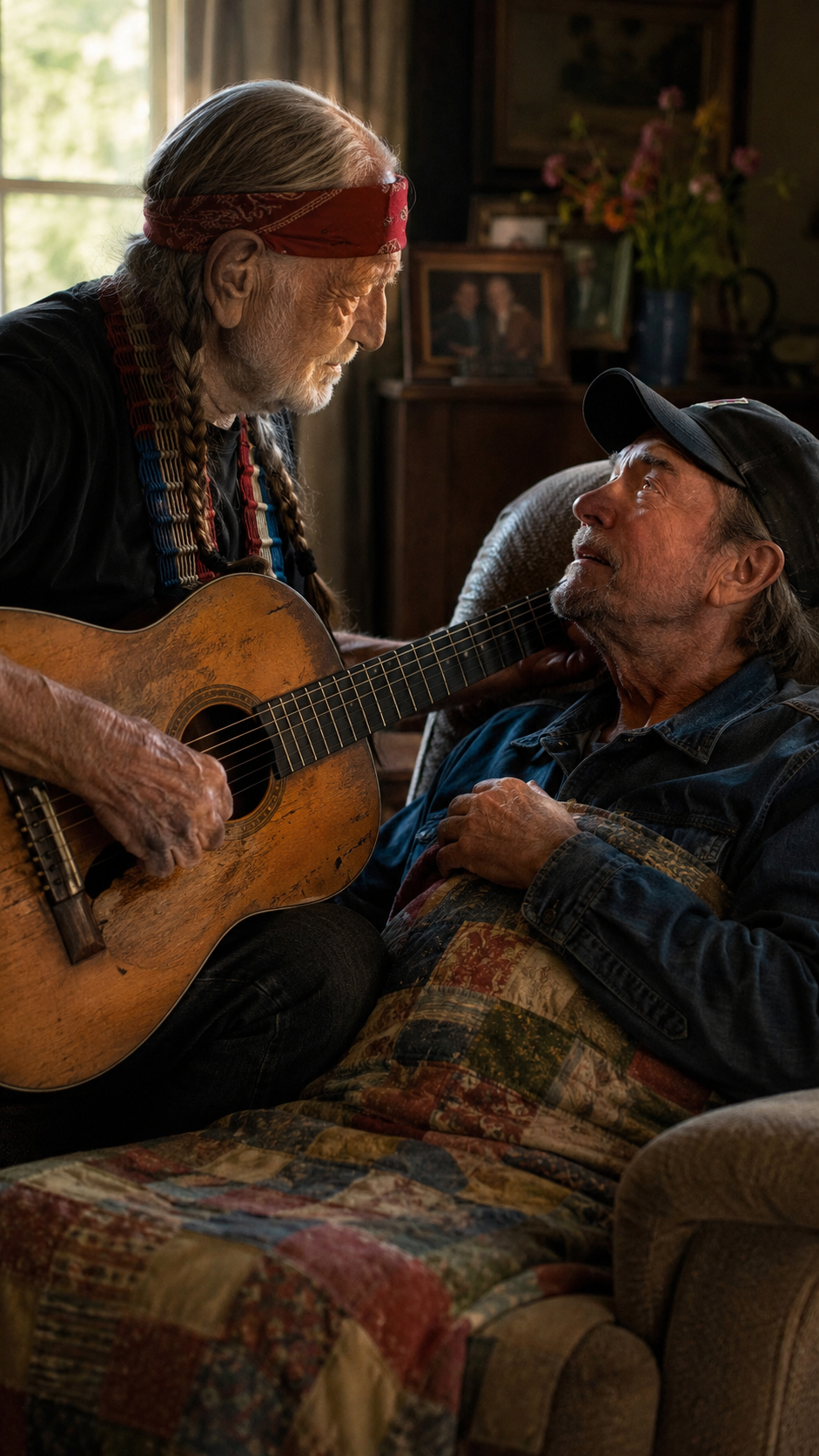
Three weeks later, Hank was resting in his favorite chair by the window.
His body was weak, but Willie’s music played softly from a small speaker nearby.
Mary was folding blankets when she heard a car pull into the driveway.
Then another.
Then a quiet knock came at the door.
Emily opened it and froze.
Standing on the porch was Willie Nelson.
His braids rested over his shoulders. His guitar case was in one hand. His face was gentle, calm, and kind.
Emily covered her mouth.
Willie smiled softly.
“I heard there’s a man here who’s been coming to see me for thirty years,” he said.
Mary began to cry before she could speak.
They led Willie into the living room.
Hank turned his head slowly.
For a moment, he said nothing.
He just stared, as if he was afraid the sickness was making him dream.
Then his lips trembled.
“Willie?”
Willie stepped closer and took his hand.
“Hank,” he said, “I figured it was my turn to come see you.”
Hank broke down.
The truck driver who had spent his whole life being strong cried like a child.
Willie sat beside him, not rushing, not acting like a star, just like an old friend who had come by for a visit.
They talked about highways, old songs, small-town concerts, and the first time Hank ever saw Willie perform.
Then Willie opened his guitar case.
The room went completely still.
He picked up Trigger, his famous old guitar, and began to play.
Not for a crowd.
Not under bright lights.
Not for cameras.
Just for Hank.
He sang “Blue Eyes Crying in the Rain.”
Mary held Hank’s hand. Emily stood in the doorway with tears running down her face. Even the nurses who had come that afternoon stood quietly, wiping their eyes.
Hank sang along in a weak voice.
Every word mattered.
Every note felt like a gift.
When the song ended, Hank looked at Willie and whispered, “You don’t know what this means to me.”
Willie squeezed his hand.
“I think I do.”
Before leaving, Willie signed Hank’s old denim jacket. But the autograph was not the greatest gift.
The greatest gift was the visit.
The song.
The kindness.
The reminder that sometimes the music we love finds its way back to us when we need it most.
Hank passed away a few months later, peacefully, with his family beside him.
At his funeral, his denim jacket was placed near his photo.
And when the service ended, his family played “On the Road Again.”
Not as a goodbye filled with sadness.
But as a tribute to a man who had lived his life with love, loyalty, and music in his heart.
For thirty years, Hank Miller went wherever Willie Nelson sang.
But in the end, Willie came to him.
And that final concert, inside a small living room, became the most beautiful one of all.


