The Ebony Alert Confusion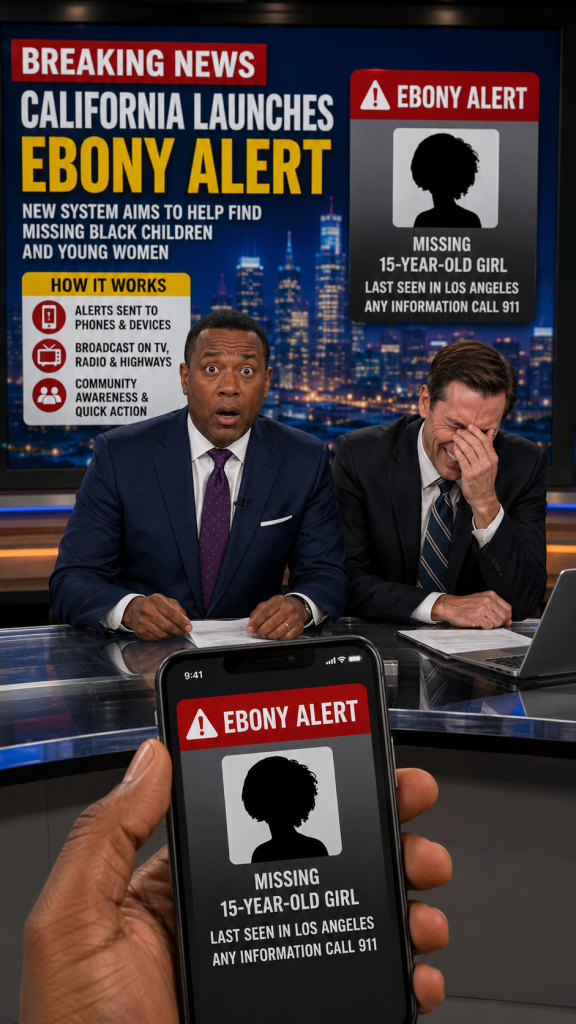
One night, a very serious news anchor sat behind the desk with his best “important news” face.
He looked into the camera and said California had become the first state in the country to create something called an “Ebony Alert.”
The moment he said it, his co-anchor tried to stay professional.
He failed immediately.
His head went down. His shoulders started shaking.
The pencil in his hand became useless.
You could tell he was fighting for his life, not because the news was bad, but because the name sounded like something his grandma would say when she saw too many cousins walking into the house at once.
“Ebony Alert” was meant to help find missing Black children and young Black women.
That was the serious part. It was important.
It was needed. It was made to bring attention to cases that too often did not get enough public notice.
But the name?
The name walked into the room wearing sunglasses and a leather jacket.
The anchor tried to continue like a normal professional man.
He said the alert would work like other public safety alerts, sending information to phones, media, and the community when someone was missing.
But his co-anchor was still looking down at the desk, laughing into his hand like a student in class who just heard the teacher say something accidentally funny.
The first anchor looked at him like, “Brother, please. We are on live television.”
The second anchor looked back like, “I know. That is the problem.”
At home, people watching the news were confused too.
A man named Darnell was sitting on his couch eating chips when his phone buzzed.
He picked it up and saw: EBONY ALERT.
Darnell froze.
His wife, Tanya, looked over and said, “What is it?”
Darnell said, “I don’t know. My phone just called me by my auntie’s perfume name.”
Tanya took the phone and read it carefully. “It’s an alert for a missing person.”
Darnell instantly became serious. “Oh. Okay. That matters.”
Then he paused.
“But they really named it Ebony Alert?”
Tanya sighed. “Yes.”
Darnell nodded slowly. “That sounds like something that happens when the barbecue runs out of hot sauce.”
Across town, a group of friends were at a restaurant when everyone’s phones buzzed at the same time.
One friend said, “Amber Alert?”
Another looked at his screen and said, “No. Ebony Alert.”
The whole table went quiet.
Then Marcus said, “Is that for missing people, or did someone steal my cousin’s Durag?”
Everyone told him to stop.
Marcus raised his hands. “I’m just asking! I support the alert. I just need better branding.”
Even the alert office had problems on the first day.
A government worker named Linda was in charge of testing the system.
She sat at her computer with three cups of coffee and a folder full of instructions.
Her boss walked in and said, “Linda, remember, this is a very serious program.”
Linda said, “Of course.”
Then she clicked the wrong button.
Every phone in California buzzed.
EBONY ALERT TEST: THIS IS ONLY A TEST.
Five seconds later, the office phone started ringing nonstop.
One caller said, “Hello, I just got the alert. Am I supposed to do something?”
Linda said, “No, sir. It’s only a test.”
The man said, “Okay, because I was about to call my whole family.”
Another caller said, “Is this about my neighbor’s music?”
Linda said, “No.”
A third caller said, “Can I sign up for Latino Alert too?”
Linda put her head on the desk.
Meanwhile, the news anchors were still trying to survive.
The first anchor said, “This alert is designed to help bring attention to missing Black youth.”
The second anchor finally lifted his head, wiped his eyes, and said, “That is a good thing.”
The first anchor nodded. “Very good.”
Then the second anchor added, “But they could have called it something else.”
The first anchor stared at him.
“Like what?”
The second anchor thought for a moment and said, “I don’t know. The Missing Persons Alert?”
The first anchor said, “That already exists.”
“The Community Alert?”
“Too vague.”
“The Find Them Alert?”
“That sounds like a detective show.”
The second anchor leaned back. “Fine. Ebony Alert it is.”
Then he started laughing again.
The producer in the control room was yelling, “Stay serious! Stay serious!”
But it was too late. Once laughter enters a news studio, it moves in and pays rent.
The funny part was that everyone agreed the alert itself was important. Nobody was making fun of the purpose.
People wanted missing children found. They wanted families helped. They wanted the public to pay attention.
They were only confused because the name sounded like it came from a 1970s soul album.
Somewhere in Sacramento, the person who named it was probably very proud.
He probably stood in a meeting and said, “We need something strong. Something memorable. Something powerful.”
Then someone said, “Ebony Alert.”
And the room went, “Yes. That’s the one.”
Nobody stopped to ask, “Will comedians destroy us?”
The answer was yes.
By the next morning, everyone was talking about it. Some people supported it. Some people joked about it. Some people did both at the same time.
Darnell told Tanya, “Look, I’m glad it exists. But if my phone says Ebony Alert at 3 a.m., I’m waking up ready to find somebody and also attend a family reunion.”
Tanya said, “Just read the message and help if you can.”
Darnell nodded. “You’re right.”
Then his phone buzzed again.
He looked down and said, “It’s a weather alert.”
Tanya asked, “What kind?”
Darnell said, “Rain.”
He paused.
“Should’ve called it a Moisture Alert.”
Tanya threw a pillow at him.
And that was the whole point of the strange news day. Sometimes something can be serious and still have a funny name.
Sometimes the world creates a helpful program but gives it a title that makes every news anchor fight laughter on live TV.
The Ebony Alert was made to save lives.
But on its first night in the news, it also almost took out two anchors, one pencil, and every serious face in the studio.