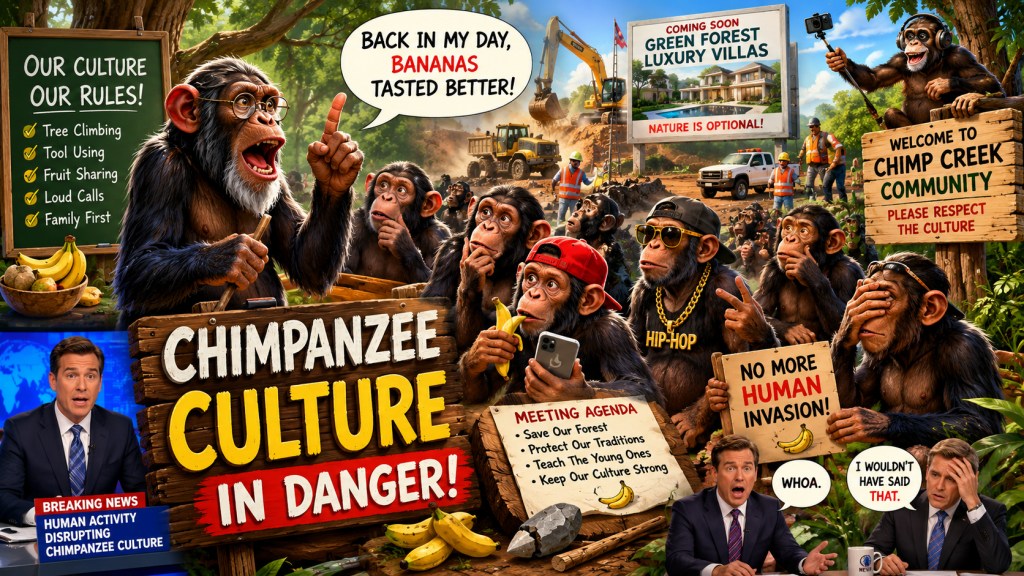
 One evening, a serious-looking news host sat at his desk with the face of a man about to explain something very important. Behind him was the usual world map, the kind that makes every small problem look like it is about to become international news.
He looked into the camera and said, “A new study says that as humans move into formerly wild areas of Africa, human activity is disrupting chimpanzee culture.”
Now, that sounded very serious. And it was serious. But the way he said “chimpanzee culture” made everyone stop for a second.
Because nobody knew chimpanzees had culture.
Most people thought chimpanzees just climbed trees, ate fruit, screamed loudly, and threw things when they were upset. Basically, they were like toddlers with better upper-body strength.
But according to the news, chimpanzees had culture. That meant somewhere in the forest, there might be a chimpanzee community with rules, traditions, gossip, family drama, and maybe even one old chimp who sits in the corner saying, “Back in my day, bananas tasted better.”
The host continued. “Chimpanzee culture includes learned behaviors passed from one generation to another.”
That made sense. One chimp teaches another chimp how to use sticks to find food. Another chimp teaches the young ones which trees are safe. Another one probably teaches them which cousin is annoying and should not be invited to the fruit pile.
But then humans arrived.
At first, the chimpanzees were confused. They looked down from the trees and saw people building roads, cutting grass, putting up houses, and walking around like they owned the place.
One young chimp asked, “What are they doing?”
An older chimp sighed. “They call it development.”
“What does development mean?”
“It means they destroy our quiet place and then name it something like Green Forest Luxury Villas.”
Soon, the chimpanzees had problems. Their favorite paths were blocked. Their fruit trees were gone. Their peaceful mornings were ruined by machines, trucks, and one human who kept playing loud music while wearing sunglasses indoors.
The chimpanzee leader called a meeting.
All the chimps gathered around a large tree. Some sat on branches. Some sat on rocks. One brought snacks because he thought it was going to be a long meeting.
The leader stood up and said, “Family, we have a problem. The humans are changing our land.”
A young chimp raised his hand. “Can we ask them to leave?”
The leader said, “We tried. They called it noise.”
Another chimp said, “Can we throw things?”
The leader said, “That is our traditional way, but we must be careful. They have cameras now.”
The oldest chimp, Grandpa Mobo, slowly stood up. Everyone became quiet because Grandpa Mobo was respected. He had survived many dry seasons, many snake scares, and one very confusing afternoon when he accidentally fought his own reflection in a river.
Grandpa Mobo cleared his throat and said, “This is not good. When I was young, chimp culture was strong. We had dances. We had fruit-sharing rules. We had proper screaming hours. Nobody screamed before sunrise unless there was danger or family drama.”
The younger chimps nodded.
“Now look at us,” Grandpa Mobo continued. “The young ones are picking up human habits. Yesterday, I saw my grandson sitting on a rock, staring at a shiny piece of glass for three hours.”
The grandson said, “It was a phone.”
Grandpa Mobo shouted, “Exactly! A phone! You are a chimpanzee! You should be climbing trees, not watching videos of other chimpanzees climbing trees!”
The whole group gasped.
Things got worse.
Some young chimps started copying humans. One began walking on two legs all day because he thought it looked “professional.” Another tried to open a small fruit stand and charged three leaves per banana. A teenage chimp started saying he wanted to become an influencer.
Grandpa Mobo nearly fainted.
“In my time,” he said, “if you wanted attention, you screamed from a tree like a normal chimp!”
The final problem came when one chimp suggested creating a homeowners association.
That was when the forest fell silent.
A chimp named Bako said, “We need rules. No loud screaming after 9 p.m. No messy fruit piles. No climbing on private branches.”
Grandpa Mobo looked horrified.
“Private branches?” he said. “This is a forest! Every branch is public!”
But Bako had already made a sign: Welcome to Chimp Creek Community. Please Respect the Culture.
Nobody knew what to do.
Meanwhile, in the news studio, the host tried to explain all of this with a straight face. He said the loss of chimpanzee culture was a real problem because each group had unique behaviors. Some used tools differently. Some had special calls. Some had traditions that helped them survive.
Then the host paused and added, “Incidentally, chimpanzee culture is also what my grandpa calls hip-hop.”
The studio went quiet for half a second.
Then another anchor appeared on screen. He looked shocked, like someone had just dropped a coconut on the conversation.
“Whoa,” he said.
The first host smiled nervously.
The second anchor shook his head and said, “I wouldn’t have said that.”
And honestly, he was right.
Because sometimes a joke walks into the room, looks around, and says, “Maybe I should leave.”
Back in the forest, the chimpanzees were still trying to save their culture. Grandpa Mobo gathered the young chimps and taught them the old ways.
He showed them how to crack nuts with stones. He taught them the correct family greeting, which involved a loud call and a little jump. He explained that not every shiny thing needed to be touched.
One young chimp asked, “But what about humans?”
Grandpa Mobo looked toward the road in the distance.
“We cannot stop everything,” he said. “But we can remember who we are.”
The chimps nodded proudly.
Then one baby chimp raised his tiny hand and asked, “Can we still throw fruit?”
Grandpa Mobo smiled.
“Yes,” he said. “But only for cultural reasons.”
And that is how the chimpanzees began protecting their traditions—one banana, one tree, and one very loud family meeting at a time.