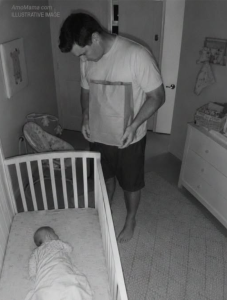
 My Husband Was Caught on the Baby Camera at 2 A.M. Every Night Holding a Paper Bag — When I Saw What Was Inside, I Gasped
Bringing my baby home should have been the happiest time of my life.
That was what everyone told me.
They said I would feel joy the moment I walked through the front door with my newborn in my arms. They said our house would feel warmer, fuller, and more complete. They said motherhood would come naturally, like my heart already knew what to do.
But no one told me how hard it could be.
No one told me that joy and sadness could live inside the same body.
No one told me that I could love my baby deeply and still feel like I was disappearing.
My son, Noah, was born on a rainy Tuesday morning. He was small, warm, and perfect. The nurses placed him on my chest, and I cried harder than I had ever cried before. My husband, Daniel, stood beside the hospital bed with tears in his eyes too.
“He’s beautiful,” Daniel whispered.
I looked at our baby’s tiny face and nodded.
For that moment, everything felt right.
But once we came home, life changed quickly.
The first few days were a blur. Noah cried often. I cried too. My body hurt. I was exhausted in a way I had never known before. Sleep came in tiny pieces, never enough to make me feel rested.
People visited with gifts, flowers, and meals. They smiled at the baby and told me how lucky I was.
And I was lucky.
I knew that.
But inside, I felt heavy.
Some mornings, I sat on the edge of the bed and stared at the wall, unable to move. Other times, I held Noah and felt guilty because I was not smiling like mothers in pictures did.
Daniel tried his best.
He changed diapers. He warmed bottles. He rubbed my back when I cried for no clear reason.
“You’re doing great,” he would say.
But I didn’t feel great.
I felt broken.
After two weeks, my doctor told me I might have postpartum depression. Hearing those words made me feel both scared and relieved. At least there was a name for what was happening to me.
Daniel held my hand in the doctor’s office.
“We’ll get through this,” he said.
I believed him.
For a while, I thought we were fighting the same battle together.
But then I started noticing something strange.
Almost every night, I would wake up and Daniel would be gone.
At first, I didn’t think much of it. With a newborn in the house, nobody slept normally. Maybe he was checking on Noah. Maybe he was using the bathroom. Maybe he was downstairs drinking water.
But then it happened again.
And again.
One night, I woke up at 2:45 a.m. The room was dark, and Daniel’s side of the bed was empty.
I reached my hand across the sheets.
Cold.
He had been gone for a while.
I listened carefully.
The house was quiet.
No crying baby.
No running water.
No footsteps.
A strange feeling moved through my chest.
I tried to ignore it.
I told myself I was just tired. I told myself depression was making my mind imagine problems.
Then Daniel came back into the room about ten minutes later.
He moved softly, trying not to wake me.
“Where were you?” I asked.
He froze.
Then he said, “Just checking on Noah.”
His voice sounded calm, but something about it felt off.
“Oh,” I said.
He climbed into bed and turned away from me.
I stayed awake for a long time.
The next few nights, I watched more closely.
Every night, around the same time, Daniel left our bed.
Sometimes he was gone for fifteen minutes.
Sometimes thirty.
Once, nearly an hour.
When I asked him, his answer was always the same.
“Just checking on the baby.”
But Noah’s room had a baby camera. If Daniel was only checking on him, why did he look so nervous when I asked?
One afternoon, while Noah slept in his crib, I sat on the couch with my phone in my hand. I opened the baby camera app.
I had used it many times to check if Noah was awake.
But that day, I noticed the saved recordings.
The camera kept short clips whenever it detected movement.
My heart started beating faster.
Part of me felt bad. I did not want to spy on my husband. But another part of me needed to know the truth.
I opened the recording from the night before.
The screen showed Noah’s nursery in black and white.
At 2:03 a.m., the door opened.
Daniel entered.
But he was not empty-handed.
He was carrying a brown paper bag.
I sat up straight.
The bag was medium-sized, folded at the top. Daniel held it carefully, like there was something important inside.
He walked to the crib and looked down at Noah.
Then he gently touched the baby’s blanket.
After that, he sat on the floor beside the rocking chair.
He opened the paper bag.
My mouth went dry.
I leaned closer to the screen.
But the video was too dark to see clearly.
I opened another recording.
Same thing.
Daniel entered at 2:01 a.m. with a paper bag.
He checked on Noah.
Then he sat on the floor and opened the bag.
Another night.
Same thing.
Another bag.
Another secret.
The size of the bag changed each night. Sometimes it was small. Sometimes it looked full. Sometimes Daniel carried it close to his chest.
My mind began to race.
Was he hiding alcohol?
Was he taking something?
Was he bringing something unsafe into the baby’s room?
Was he doing something behind my back?
I felt sick.
I watched more recordings from the past month.
Every night, there he was.
At almost exactly 2 a.m.
With a paper bag.
I finally found one recording where he sat closer to the camera. His hands moved slowly as he opened the bag.
Something slid out.
I paused the video and zoomed in.
At first, I could not understand what I was seeing.
Then I realized.
They were photographs.
Old photographs.
I gasped.
Daniel pulled one photo after another from the bag and placed them on the floor. Then he took out a bundle of letters tied with a faded blue ribbon.
He sat there, surrounded by old memories, while our baby slept nearby.
I stared at the screen, confused.
Why was my husband sitting in the nursery at 2 a.m. looking at old photos and letters?
And why was he hiding it from me?
That night, I decided not to sleep.
I pretended to be tired and got into bed early. Daniel kissed my forehead.
“Try to rest,” he said softly.
I nodded.
He turned off the light.
For the next two hours, I lay still in the dark, listening to his breathing.
At 1:58 a.m., Daniel moved.
He slowly slipped out of bed.
I kept my eyes closed.
He stood beside the bed for a moment, as if checking whether I was awake. Then he left the room.
I waited.
Then I got up.
The hallway was cold under my feet. A small light from the nursery spilled across the floor.
The door was not fully closed.
I stepped closer and looked inside.
Daniel was sitting on the floor.
The paper bag was beside him.
Photographs were spread around his knees.
In his hand was a letter.
His shoulders were shaking.
He was crying.
For a moment, I forgot all my fear.
I pushed the door open.
“Daniel?”
He looked up quickly.
His face went pale.
“Emily,” he whispered. “You’re awake.”
“What are you doing?” I asked.
He looked down at the photos, then back at me.
“I didn’t want you to see this.”
My chest tightened.
“See what?”
He did not answer right away.
I stepped into the room and sat down across from him.
Noah slept quietly in his crib, unaware that his parents were sitting on the floor with a secret between them.
Daniel picked up one photograph and handed it to me.
It showed a young woman sitting on a porch, holding a little boy on her lap. The woman had soft eyes and dark hair. The boy looked about three years old.
“That’s my mom,” Daniel said.
I looked at him.
I knew Daniel’s mother had died when he was young, but he rarely talked about her. Whenever I asked, he gave short answers and changed the subject.
“And that’s me,” he said, pointing to the boy.
I looked at the photo again.
The child had Daniel’s eyes.
“What is all this?” I asked gently.
Daniel swallowed hard.
“My mother’s things.”
He opened the paper bag wider.
Inside were letters, birthday cards, baby photos, and small keepsakes. There was a tiny knitted hat, a dried flower pressed inside a book, and a pair of little blue baby shoes.
“I found them in the attic a few weeks after Noah was born,” he said.
“You never told me.”
“I know.”
“Why?”
He wiped his face.
“Because I didn’t know how.”
The room was silent.
Then Daniel began to speak.
“When Noah was born, everyone kept saying I was going to be a great father. They said I looked natural holding him. They said I knew what to do.”
He gave a sad laugh.
“But I don’t know what I’m doing, Emily. I’m scared every day.”
I stared at him.
He had looked so strong. So calm. While I was falling apart, I thought he was holding everything together.
“I never had a real father,” he continued. “My dad left when I was little. I barely remember him. My mom raised me alone. She was everything to me.”
He looked at the photo in his hand.
“She died when I was twelve.”
His voice broke.
“After that, I moved from one relative to another. Nobody was cruel to me, but nobody really wanted me either. I always felt like I was in the way.”
Tears filled my eyes.
Daniel had never told me this much before.
“When Noah was born, I looked at him and felt love so strong it scared me,” he said. “Then I started thinking, what if I fail him? What if I become like my father? What if I leave him emotionally, even if I stay in the house?”
“Daniel…”
“I don’t know how to be a dad,” he whispered. “So every night, I come in here and look through my mom’s things.”
“Why at 2 a.m.?”
“Because that’s when the house is quiet. Because you’re sleeping. Because Noah is sleeping. Because I can fall apart without anyone seeing.”
My heart broke.
All those nights I thought he was hiding something terrible, he had been hiding his fear.
He picked up a letter from the floor.
“This is the one I read most.”
He handed it to me.
The paper was old and soft, folded many times.
I opened it carefully.
It was written in gentle handwriting.
My sweet Daniel,
One day, when you are grown, I hope you know how loved you were. I hope life is kind to you, but if it is not, I hope you still choose kindness. I hope you become a man who protects people, not hurts them. I hope you love with patience. I hope you stay when staying matters. And if you ever become a father, I hope you hold your child with the same love I hold you now.
By the time I finished reading, I was crying too.
Daniel looked away.
“I read that every night,” he said. “I keep asking myself if I can become the man she wanted me to be.”
I reached for his hand.
“You already are.”
He shook his head.
“No, I’m not. I’m terrified.”
“Being terrified doesn’t mean you’re failing,” I said. “It means you care.”
He looked at me, his eyes full of pain.
“I didn’t want to add more weight to you,” he said. “You were already struggling so much after the birth. I thought if I told you, it would make things worse.”
I squeezed his hand.
“And I thought I was the only one falling apart.”
He lowered his head.
“I’m sorry.”
“I’m sorry too.”
For the first time since Noah was born, we were honest with each other.
Not the kind of honesty where people say, “I’m fine,” just to survive the day.
Real honesty.
The kind that hurts, but also heals.
I told Daniel how dark my thoughts had become some mornings. I told him I felt guilty for not being the happy mother everyone expected me to be. I told him I sometimes feared Noah deserved someone better than me.
Daniel cried when he heard that.
“He could never have a better mother,” he said.
Then he told me more about his childhood.
He told me about waiting at school for a father who never came.
He told me about sleeping on couches after his mother died.
He told me about birthdays where he pretended not to care because he knew no one had remembered.
He told me he had spent most of his life afraid of needing anyone.
Then Noah was born, and suddenly he needed us.
And that scared him more than anything.
We sat on the nursery floor until almost morning.
At one point, Noah stirred in his crib. Daniel got up and lifted him gently.
Our baby curled against his chest.
Daniel held him and whispered, “I’m trying, little man. I promise I’m trying.”
I stood and wrapped my arms around both of them.
In that moment, I understood something important.
A family is not perfect people living perfect lives.
A family is tired people choosing love again and again.
The next day, things did not magically become easy.
Postpartum depression did not vanish overnight.
Daniel’s childhood pain did not disappear because we talked about it once.
But something changed between us.
We stopped pretending.
Daniel called a therapist.
I kept going to my doctor.
We made a plan for the nights.
Instead of both of us suffering alone, we took turns.
Sometimes Daniel stayed up with Noah while I slept.
Sometimes I handled the early feeding while Daniel rested.
Sometimes, when neither of us could sleep, we sat together in the nursery and talked quietly.
The paper bags did not disappear.
But they were no longer a secret.
Daniel bought a small wooden box and placed his mother’s letters and photos inside. He kept it on the nursery shelf.
One evening, he showed me the baby shoes.
“These were mine,” he said.
They were tiny and worn.
He smiled sadly.
“My mom kept everything.”
“She loved you very much,” I said.
He nodded.
“I know that now.”
Months passed.
Noah grew quickly.
He learned to smile, then laugh, then roll over. Each small milestone felt like a miracle.
Daniel became the kind of father who noticed everything.
He noticed when Noah liked a certain song.
He noticed when Noah was cold.
He noticed when I needed a break before I even asked.
One afternoon, I walked into the living room and found Daniel lying on the floor with Noah on his chest. Noah was asleep, his little hand resting on Daniel’s shirt.
Daniel looked up at me.
“What?” he asked.
I smiled.
“Nothing.”
But it was not nothing.
I was looking at a man who had been afraid he would fail.
And yet, every day, he was showing up.
One year later, on Noah’s first birthday, we invited family and friends to our house.
There were balloons, cake, and too many toys.
Noah smashed frosting all over his face while everyone laughed.
After the party ended and the house grew quiet, Daniel disappeared for a few minutes.
For once, I did not worry.
I found him in the nursery, standing in front of the wooden box.
He was holding his mother’s letter.
“Are you okay?” I asked.
He nodded.
“I wish she could see him.”
I walked beside him.
“I think she would be proud of you.”
His eyes softened.
“You really think so?”
“I know so.”
He folded the letter and placed it back in the box.
Then he took out a fresh piece of paper.
“What are you doing?” I asked.
“Writing something for Noah.”
I watched as he sat at the small nursery table and began to write.
My son,
One day, when you are grown, I hope you know how loved you were. I hope you never wonder if your father wanted you. I did. From the first moment I saw you, I wanted to be better because of you.
I am not perfect. I will make mistakes. But I promise I will stay. I promise I will listen. I promise I will hold you when life feels too heavy.
And if you ever become a father one day, I hope you know love does not have to be perfect to be real. It only has to be honest.
Love, Dad.
When he finished, he placed the letter inside the wooden box next to his mother’s.
I cried quietly.
Daniel noticed and smiled.
“Good tears?” he asked.
“Very good tears,” I said.
That night, after Noah fell asleep, Daniel and I sat together on the nursery floor.
There was no paper bag this time.
No secret.
No fear hiding in the dark.
Just us.
Two tired parents.
Two imperfect people.
Two hearts learning how to heal.
I thought back to the night I first opened the baby camera recordings.
I remembered the fear in my stomach.
The questions.
The suspicion.
The gasp when I saw what was inside the bag.
I had thought I was about to uncover betrayal.
Instead, I uncovered grief.
I uncovered love.
I uncovered a wound my husband had carried since childhood.
And hidden inside that simple brown paper bag were not secrets meant to hurt me.
They were pieces of his past.
Pieces of his mother.
Pieces of a little boy who had lost too much too soon.
And every night, while I thought Daniel was pulling away from us, he was actually trying to find his way closer.
Closer to Noah.
Closer to me.
Closer to the father he wanted to become.
Now, whenever I see a paper bag, I think about that night.
I think about how easy it is to misunderstand silence.
I think about how many people carry pain quietly because they do not want to burden the ones they love.
And I think about Daniel sitting beside our baby’s crib at 2 a.m., reading his mother’s words under the soft glow of the nursery light.
Trying not to break.
Trying to become.
Trying to love better than he had been loved.
That was the night our marriage changed.
Not because everything became perfect.
But because we finally stopped hiding our pain.
And sometimes, that is where healing begins.