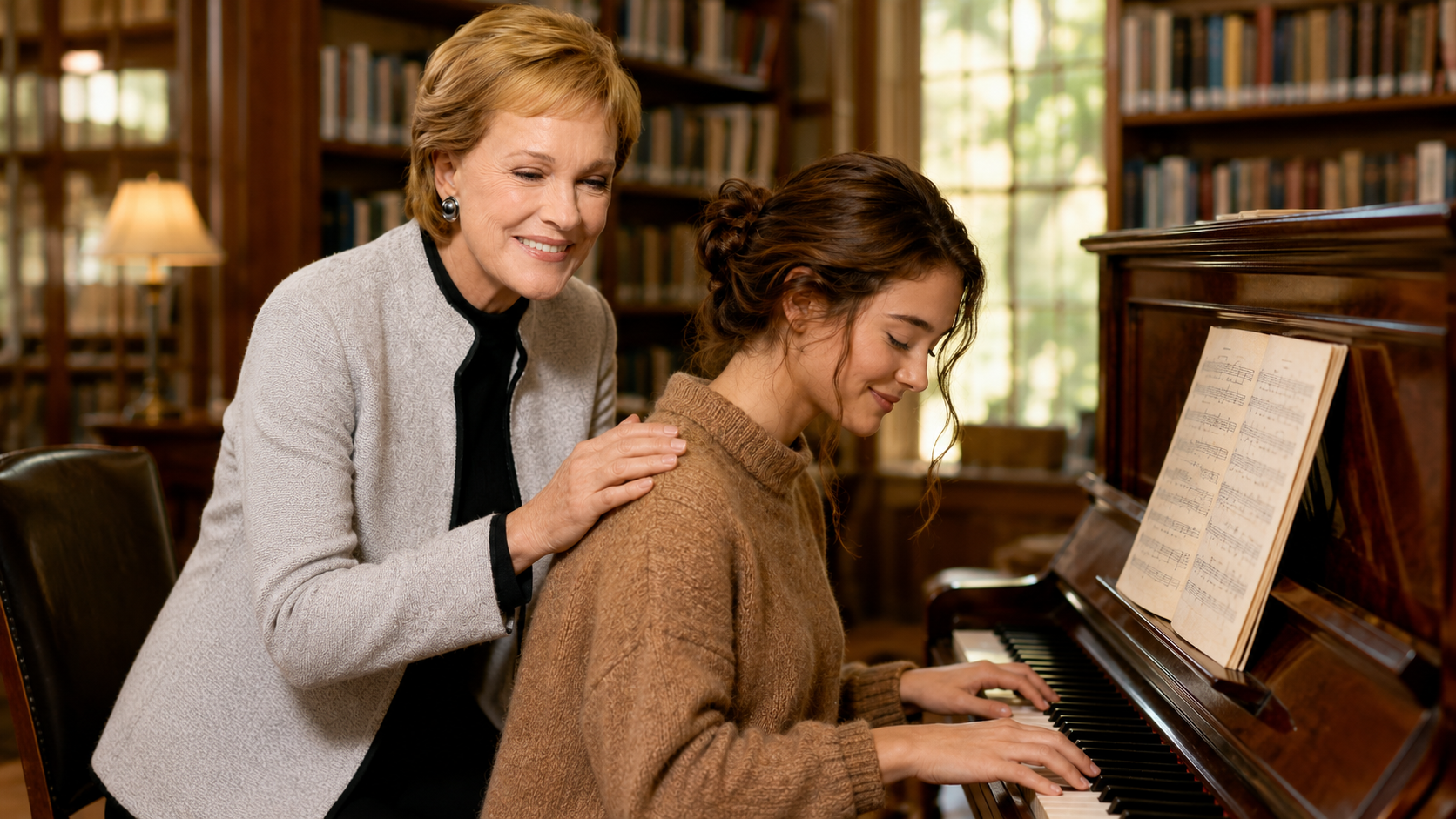
Part 1: The Music Between the Shelves
Every Tuesday evening, after the town library had closed, twenty-seven-year-old Clara Bennett remained behind to straighten the shelves.
She worked there as a part-time assistant, repairing torn pages, returning books to their proper places, and helping elderly visitors use the computers.
Most people thought Clara loved the silence.
The truth was that she stayed late for the music.
In a quiet corner of the library stood an old upright piano. Its dark wooden surface was scratched, several keys had turned yellow, and one pedal no longer worked properly.
The instrument had been donated years earlier, but almost nobody played it.
Clara did.
Only when the building was empty.
She had dreamed of becoming a pianist since childhood. When she was eight, she had heard a musician performing in the town hall. The sound had made her feel as though a door had opened inside her.
But Clara’s family had struggled financially. Piano lessons were impossible, and they could not afford an instrument.
Her mother had once promised, “Perhaps next year.”
Then Clara’s father became ill, and every extra coin went toward medicine and household bills.
The following year never came.
Still, Clara refused to abandon the dream completely.
At sixteen, she discovered a beginner’s piano book in the library. She copied diagrams of the keyboard into an old notebook and practiced the finger movements on the kitchen table.
Years later, when she began working at the library, she found more books.
She learned how to read music one page at a time.
She studied scales during lunch breaks.
She watched free lessons on the library computers.
At night, she practiced quietly on the old piano, stopping whenever she heard footsteps in the corridor.
Clara never told anyone.
She was embarrassed that she had learned so slowly and worried that a trained musician would laugh at her mistakes.
But there was one person she wrote to.
Julie Andrews.
Clara had admired Julie since childhood. It was not only her voice or her films that inspired her. It was the warmth Clara felt whenever Julie spoke about music, courage, and finding one’s place in the world.
Over the years, Clara wrote several letters.
She never asked for money or attention.
She simply described what music meant to her.
In one letter, she wrote:
I may never perform on a real stage, but when I play alone in the library, I feel that my life becomes larger than the room around me.
Clara never knew that one of those letters had reached Julie.
Nor did she know that Julie had kept it.
One rainy afternoon in November, the library manager, Mrs. Foster, approached Clara with an unusual request.
“We’re holding a small gathering on Saturday,” she said. “A guest will be visiting to support our literacy program.”
“Who is coming?” Clara asked.
Mrs. Foster smiled mysteriously.
“It’s a surprise.”
Clara assumed it might be a local author or council member.
On Saturday morning, she arranged chairs, prepared tea, and placed donated books on a display table.
Then a black car stopped outside.
The library doors opened.
And Julie Andrews walked in.
Clara froze beside the reception desk.
For a moment, she could not speak.
Julie greeted the staff warmly and thanked them for their work. She spoke with families, read a short story to the children, and praised the library for making knowledge available to everyone.
Clara tried to remain in the background.
But near the end of the visit, Julie looked across the room and said, “Is Clara Bennett here?”
Every head turned.
Clara’s face grew warm.
Slowly, she stepped forward.
Julie smiled.
“I believe you once wrote to me about an old piano.”
Clara’s eyes filled with tears.
“You read my letter?”
“I did,” Julie replied. “And I have thought about it many times.”
Mrs. Foster quietly closed the library doors after the last visitors left.
Only the staff, Julie, and Clara remained.
Julie walked toward the old piano.
“Would you play something for me?” she asked.
Clara’s heart pounded.
“I’m not properly trained.”
“That wasn’t my question,” Julie said gently.
Clara sat on the worn bench.
Her hands trembled as she placed them over the keys.
She began with a simple melody she had practiced for months.
The first few notes were uncertain.
Then she forgot about the room.
She forgot about being afraid.
She played for the little girl who had once tapped silent notes on a kitchen table. She played for her parents, who had wanted to give her more but could not. She played for every year she had kept the dream hidden.
When the final note faded, Clara lowered her hands.
“I know it isn’t perfect,” she whispered.
Julie stepped closer.
“No,” she said. “But it is honest. And honest music has a beauty that perfection cannot replace.”
Clara wiped her eyes.
Then Julie asked, “Why have you never applied to study music?”
Clara gave a small, embarrassed laugh.
“Because lessons cost money. So do auditions, travel, and tuition. And I’m too old to begin.”
Julie’s expression became serious.
“My dear, you began years ago. You simply began without anyone noticing.”
She reached into her handbag and removed an envelope.
Clara stared at it.
Inside was a letter from a respected music academy in London.
They were inviting Clara to attend a private audition.
Her travel expenses had been covered.
A year of professional lessons had also been arranged to help her prepare.
Clara read the letter twice.
Then a third time.
“I don’t understand,” she said.
“Your library sent a recording of you playing,” Julie explained.
Clara looked toward Mrs. Foster.
The manager smiled guiltily.
“I heard you practicing one evening,” she admitted. “You were too talented to remain a secret.”
Clara pressed the letter against her chest.
But Julie had not finished.
“There is one more gift,” she said.
From outside came the sound of a delivery truck.
Two men entered the library carrying a polished piano bench.
Clara looked through the window.
A beautiful restored upright piano was being carefully unloaded.
A small brass plate above the keyboard read:
For every dream that began in silence.
Clara covered her mouth.
Julie placed a hand on her shoulder.
“This piano is for the library,” she said. “It should remain somewhere that anyone can use it, regardless of how much money they have.”
Clara nodded through her tears.
“It’s perfect.”
“No,” Julie replied with a smile. “It is only a beginning.”
Six weeks later, Clara travelled to London for her audition.
She entered the academy with shaking hands and a borrowed dress.
When she sat before the judges, she remembered Julie’s words.
Honest music has a beauty that perfection cannot replace.
Clara began to play.
And for the first time in her life, she did not try to hide.
Part 2: The Door That Stayed Open
Clara did not expect to be accepted.
She knew that most applicants had studied with professional teachers since childhood. They understood advanced theory, had performed in competitions, and owned expensive instruments.
Clara had learned from library books.
She had practiced on a broken piano after closing time.
But three weeks after the audition, a letter arrived.
Her hands shook as she opened it.
The academy had accepted her into a special development program.
The letter praised her musical sensitivity, discipline, and unusual ability to make simple pieces feel deeply personal.
Clara read the first paragraph aloud to her mother.
By the time she reached the end, they were both crying.
The academy offered Clara partial financial support, while an anonymous donor covered the remaining fees.
Clara suspected Julie had helped.
Whenever she asked, however, Julie only said, “Some gifts are best repaid by passing them forward.”
Training was harder than Clara had imagined.
For the first time, she had to play in front of teachers who corrected every mistake.
Her posture was wrong.
Her timing was uneven.
Her fingers had developed habits that took months to change.
Some days, she left her lessons feeling as though she had no talent at all.
One evening, after struggling through the same piece repeatedly, Clara called Mrs. Foster.
“I don’t belong here,” she said. “Everyone else is so far ahead.”
Mrs. Foster listened patiently.
Then she replied, “Do you remember how many years you practiced without applause?”
“Yes.”
“You didn’t stop then. Don’t stop now simply because people can finally hear you.”
Clara returned to the practice room.
She stayed until midnight.
Slowly, her confidence grew.
She learned to perform with other musicians. She studied composition and discovered that she loved teaching beginners.
Two years later, Clara gave her first public recital.
The performance took place not in a grand concert hall, but in the town library where her dream had begun.
The shelves were decorated with flowers. Children sat cross-legged near the front. Elderly visitors filled the back rows.
The restored piano stood in the center of the room.
On the front row sat Clara’s mother, Mrs. Foster, and Julie Andrews.
Before Clara began, she addressed the audience.
“This piano taught me that dreams do not always begin with perfect conditions,” she said. “Sometimes they begin with one borrowed book, one quiet room, and one person who believes you should keep going.”
She played for nearly an hour.
When she finished, the audience rose to their feet.
But the most important moment came afterward.
A shy twelve-year-old boy named Samuel waited near the piano.
“My family can’t afford lessons,” he told Clara. “But I want to learn.”
Clara knelt beside him.
“Can you come to the library on Tuesday evenings?”
Samuel nodded.
“Then we’ll begin.”
Clara started offering free weekly lessons.
At first, only Samuel attended.
Then came two sisters whose mother worked nights.
A retired bus driver joined because he had always wanted to play jazz.
A teenager with hearing loss learned to feel rhythm through vibrations in the instrument.
Soon, the library’s small music corner became crowded.
Clara asked local musicians to volunteer. The academy donated used sheet music. Families contributed headphones, notebooks, and folding chairs.
They called the program The Open Door Music Project.
No student was charged.
No one was turned away because of age, money, or experience.
Julie visited whenever her schedule allowed. She never arrived with photographers or announcements. She simply sat beside nervous beginners and listened.
Five years passed.
Clara completed her studies and became a respected teacher and composer. She performed across the country, but she always returned to the library on Tuesdays.
One winter evening, Mrs. Foster handed her an envelope.
“This arrived for you,” she said.
The handwriting was unfamiliar.
Inside was a letter from Samuel, the first child Clara had taught.
He was now seventeen and had been offered a place at a leading conservatory.
His letter read:
You once told me that music belonged to anyone willing to listen and learn. I believed you because you treated me as though my dream mattered before I had done anything to prove it.
One day, I hope to teach another child for free, just as you taught me.
Clara carried the letter to the piano.
Julie happened to be visiting that evening.
Without speaking, Clara handed it to her.
Julie read the letter and smiled.
“There it is,” she said.
“What?”
“The real gift.”
Clara looked around the library.
Samuel was helping a younger student practice scales. The retired bus driver was teaching a small jazz group. Parents were arranging chairs while children searched the shelves for music books.
Julie touched the brass plate above the piano.
“For every dream that began in silence,” she read.
Clara finally understood.
The unexpected gift had never been only the piano, the lessons, or the audition.
The true gift was an open door.
A door Clara had walked through.
A door she had chosen not to close behind her.
Years later, when Clara became the director of a national program providing free instruments and lessons to underserved communities, reporters often asked how her career had begun.
They expected her to mention Julie Andrews.
They expected a story about a surprise visit or a generous donation.
Clara always smiled and answered:
“It began with a library book that anyone could borrow.”
Then she would add:
“And with someone who reminded me that a quiet dream is still a dream worth hearing.”
The old library piano remained in the same corner for decades.
Its polished surface eventually became scratched again.
The brass plate faded.
Thousands of fingers pressed its keys.
Some students became professional musicians.
Others became teachers, nurses, mechanics, parents, or shopkeepers.
Not everyone pursued music as a career.
But each person carried away something valuable—the understanding that a beginning did not need to be grand to change a life.
Sometimes it only needed a free book.
A patient teacher.
A generous stranger.
And the courage to play the first note.
THE END.


