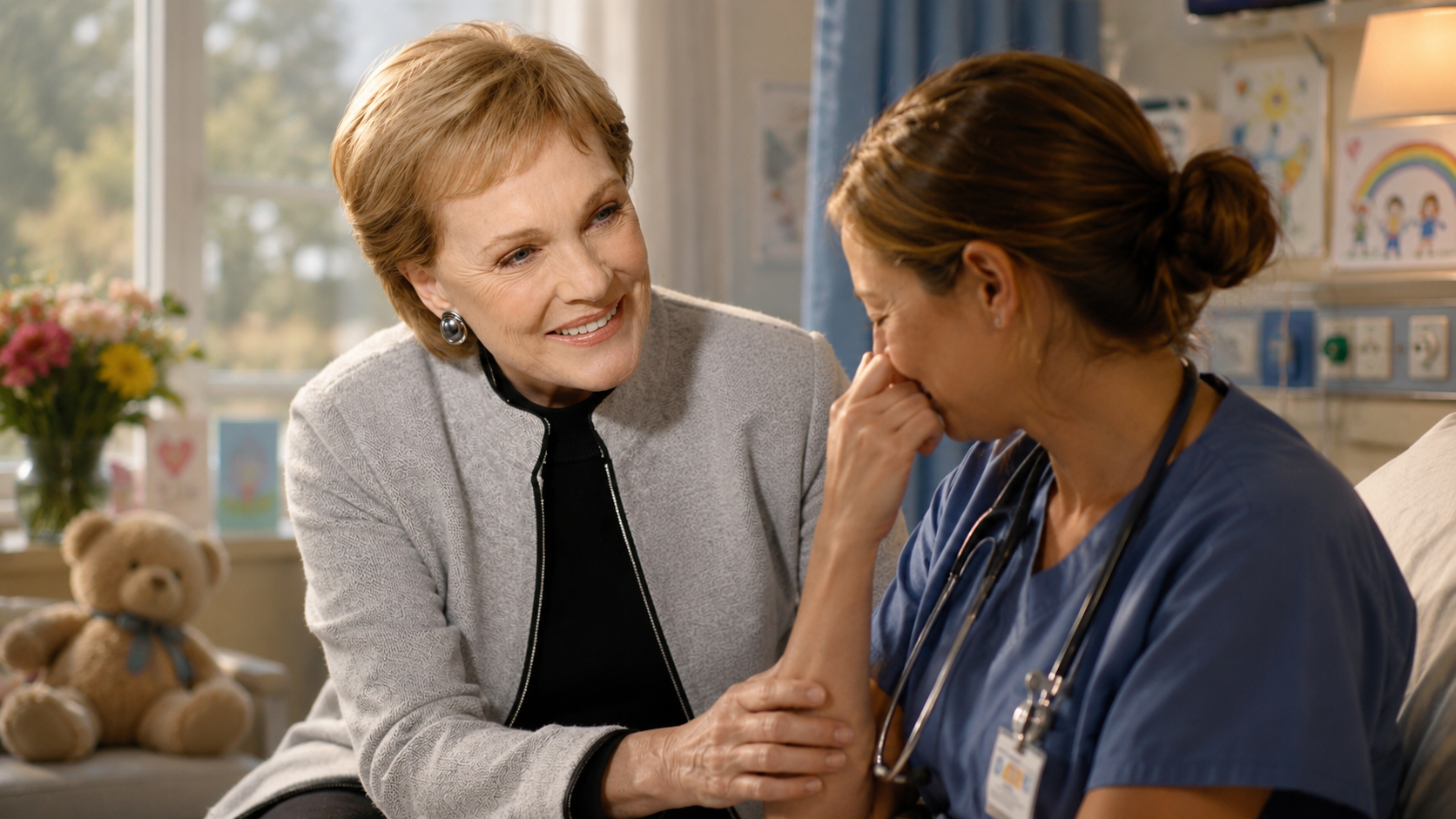
Part 1: The Nurse Who Never Rested
By the time the morning sun reached the windows of St. Catherine’s Hospital, twenty-nine-year-old nurse Emma Clarke had already worked for eleven hours.
Her shift was supposed to end at seven.
It was nearly eight-thirty.
Emma stood beside an elderly patient named Mr. Wilson, carefully adjusting the blanket around his thin shoulders.
“Is that better?” she asked.
Mr. Wilson nodded.
“You always take good care of me,” he said. “But you never smile anymore.”
Emma paused.
For a moment, she did not know how to answer.
Then she gave him the small, polite expression she used with every patient.
It was not a real smile.
It had not been real for a long time.
“I’m just tired,” she said.
But Emma knew tiredness was only part of the truth.
For six years, she had worked in the hospital’s medical ward. She had comforted frightened patients, held the hands of people receiving difficult news, and stayed beside families during their most painful moments.
She remembered every face.
She remembered the young father who had asked her to record a final message for his children.
She remembered the elderly woman who had no family, so Emma sat beside her after her shift and read poetry aloud.
She remembered the little boy who had brought her a paper flower after she helped his mother recover.
Emma had once believed that caring for people would fill her heart.
For a while, it had.
But year after year, she gave away more of herself without learning how to restore what she had lost.
She stopped meeting friends for dinner.
She stopped playing the piano in her apartment.
She stopped visiting the small lake where she and her late mother had once fed the ducks every Sunday.
Even on her days off, Emma thought about the hospital.
Had Mr. Wilson eaten?
Was Mrs. Patel still frightened about her surgery?
Had the new nurse remembered to call the family in Room 214?
Emma cared for everyone.
But somewhere along the way, she had forgotten how to care for herself.
That morning, after checking on her final patient, Emma walked into the empty staff room.
She poured herself a cup of coffee and stared at it until it became cold.
On the wall was a photograph taken during her first year at the hospital.
Emma stood in the middle of a group of young nurses, laughing with her head tilted back.
She barely recognized that woman.
“Where did you go?” she whispered.
A knock sounded at the door.
Her supervisor, Mrs. Daniels, stepped inside.
“Emma, I need a favor.”
Emma immediately straightened.
“What happened?”
“We have a special guest visiting the children’s recovery wing this afternoon. One of the nurses called in sick. Could you stay a few more hours?”
Emma’s body begged her to say no.
She had barely slept.
Her feet hurt.
She had promised herself she would go home, take a warm bath, and finally call her younger sister.
But Mrs. Daniels looked worried.
“Of course,” Emma answered.
“You’re a lifesaver.”
Emma looked down at her cold coffee.
She did not feel like one.
Several hours later, the children’s recovery wing was brighter and noisier than usual.
Paper stars hung from the ceiling. Volunteers carried flowers through the hallway. Children who were well enough to leave their rooms gathered in a small activity area.
Emma had not asked who the special guest was.
She was too busy preparing medicine and checking charts.
Then she heard a familiar voice.
It was gentle, elegant, and filled with warmth.
Emma looked toward the doorway.
Julie Andrews had entered the room.
The children immediately became excited. Some recognized her from films their parents and grandparents had shown them. Others simply sensed that someone special had arrived.
Julie greeted each child without rushing.
She asked their names.
She admired their drawings.
She listened as one little girl explained every detail of a stuffed rabbit’s imaginary life.
Emma watched from behind the nurses’ station.
There was something unusual about the way Julie gave people her attention.
She did not simply wait for them to stop speaking.
She truly listened.
For a moment, Emma remembered how she used to listen before exhaustion had turned every conversation into another responsibility.
Julie began reading a story to the children.
Her voice filled the room, softening the noise of machines and footsteps beyond the doors.
Several nurses gathered nearby.
Emma stayed at the desk.
She told herself she had too much work.
In truth, she did not know how to stand among smiling people anymore.
After the reading, a seven-year-old patient named Lily approached Emma.
Lily had spent almost two months recovering from a serious infection. She was usually quiet, but that afternoon she held a sheet of paper covered in bright crayon.
“This is for Miss Andrews,” Lily whispered. “Will you give it to her?”
“You can give it to her yourself.”
Lily shook her head.
“I’m scared.”
Emma looked at the drawing.
It showed a woman in a white dress standing beneath a rainbow. Beside her was a nurse wearing blue.
“Who is the nurse?” Emma asked.
“You.”
Emma’s throat tightened.
“Why did you draw me?”
“Because you stayed when I cried at night.”
Emma had almost forgotten those nights.
To Lily, they had mattered.
Emma took the child’s hand.
“Come on,” she said. “We’ll give it to her together.”
They crossed the room slowly.
Julie was speaking with a hospital volunteer when she noticed them approaching.
Lily immediately hid behind Emma.
Julie lowered herself so she was closer to the child’s height.
“Hello,” she said. “Have you brought me something wonderful?”
Lily slowly held out the drawing.
Julie studied it as though it belonged in a gallery.
“This is beautiful,” she said. “And who is standing beside me?”
“That’s Nurse Emma,” Lily answered. “She doesn’t smile much, but she’s very kind.”
Emma felt her cheeks grow warm.
Julie looked up at her.
Their eyes met for only a moment, but Emma felt as though Julie had noticed something everyone else had missed.
“She must be very special,” Julie said.
“She is,” Lily replied.
After Lily returned to the other children, Emma began to walk away.
“Miss Clarke?” Julie called.
Emma turned.
“Thank you for bringing her over.”
“It was nothing.”
Julie glanced toward Lily.
“I don’t believe it was nothing.”
Emma looked down at the medical chart in her hands.
“We’re simply doing our jobs.”
“Sometimes,” Julie said gently, “the things we call simple are the very things someone remembers forever.”
Before Emma could answer, another child called Julie’s name.
The moment passed.
But the words followed Emma for the rest of the afternoon.
When her shift finally ended, rain had begun falling outside.
Emma changed out of her uniform and walked toward the hospital entrance.
She expected the lobby to be empty.
Instead, she found Julie sitting alone near the windows, holding a cup of tea.
Her driver had apparently been delayed by the weather.
Julie looked up.
“Ah, Nurse Emma.”
Emma managed another polite smile.
“Are you waiting for someone?”
“Yes. Though I don’t mind. Rain gives the world permission to slow down.”
Emma looked through the glass doors.
People hurried across the pavement beneath umbrellas.
“I’m not very good at slowing down,” she admitted.
Julie gestured toward the chair beside her.
“Then perhaps you might practice for a minute.”
Emma should have gone home.
She was exhausted.
Yet something in Julie’s voice made the invitation feel less like a demand and more like a safe place.
Emma sat.
For a while, neither woman spoke.
The silence was strangely comforting.
Julie took a sip of tea.
“Lily cares for you very much.”
“She’s a wonderful child.”
“She said you stayed with her when she was frightened.”
“Any nurse would have done the same.”
“Would they?”
Emma looked at her.
Julie’s expression held no judgment.
Only curiosity.
Emma sighed.
“I don’t know.”
“May I ask you something?”
Emma nodded.
“When was the last time someone stayed with you when you were frightened?”
The question struck so deeply that Emma could not answer.
She looked away.
Beyond the windows, rain streamed down the glass.
“My mother used to,” she finally said. “She died four years ago.”
“I’m sorry.”
“She was the person I called after difficult shifts. She never tried to solve anything. She just listened.”
“And since she passed?”
“I kept working.”
Julie waited.
Emma’s hands tightened around the strap of her bag.
“I thought caring for more people would help,” she continued. “I thought if I stayed busy enough, I wouldn’t feel the empty space.”
“Did it work?”
“For a while.”
“And now?”
Emma stared at the floor.
“Now I wake up already tired. Patients thank me, but I feel guilty because part of me wants to run away. My friends stopped inviting me anywhere because I always cancel. My sister says she misses me.”
Her voice began to shake.
“I used to love this work. Now I’m afraid that I’ve become cold.”
Julie leaned closer.
“My dear, cold people do not stay beside frightened children after their shifts.”
Emma blinked rapidly.
“You sound exhausted,” Julie continued. “Not heartless.”
“I don’t know how to become myself again.”
Julie looked toward Lily’s drawing, which she had carefully placed beside her tea.
“Perhaps you should stop trying to return to the person you were.”
Emma frowned.
“What do you mean?”
“You have seen too much and carried too much to become exactly who you once were. But you can become someone new—someone who remains kind without disappearing inside everyone else’s needs.”
Emma felt the first tear slide down her cheek.
She quickly wiped it away.
“I should be stronger than this.”
“Why?”
“Because people depend on me.”
Julie’s voice softened.
“A lamp can guide many people through darkness, Emma. But even a lamp must be refilled.”
Emma lowered her head.
No one had spoken to her like that since her mother died.
Not as a nurse.
Not as the dependable daughter or responsible sister.
Simply as a person who was allowed to be tired.
Julie reached into her handbag and removed a small card.
On the back, she wrote one sentence.
Then she handed it to Emma.
The message read:
Your kindness should include you too.
Emma stared at the words.
“I don’t know where to begin,” she whispered.
“Begin with one honest choice.”
“What kind of choice?”
“The one you have been afraid to make because you believe caring for yourself will disappoint someone else.”
Emma immediately thought of the following morning.
Mrs. Daniels had asked her to cover another shift.
Emma had already agreed.
Julie’s driver entered the lobby and approached them.
Before leaving, Julie gently touched Emma’s hand.
“Promise me something.”
Emma looked up.
“Tomorrow, do one small thing that reminds you that your life belongs to you as well.”
Emma closed her fingers around the card.
“I’ll try.”
Julie smiled.
“Trying is a very good beginning.”
That night, Emma placed the card beside her bed.
For the first time in years, she turned off her phone without checking the hospital messages.
The next morning, she woke before her alarm.
Her first instinct was to get dressed for work.
Then she remembered the words on the card.
Your kindness should include you too.
Emma picked up her phone and called Mrs. Daniels.
Her hand trembled.
“I’m sorry,” she said, “but I cannot cover the extra shift today.”
There was a pause.
Emma prepared herself for disappointment.
Instead, Mrs. Daniels said, “All right. We’ll manage.”
Two simple words.
That was all.
The hospital did not collapse.
No one accused her of being selfish.
Emma sat on the edge of her bed, stunned by how frightening—and how freeing—the choice felt.
She opened the curtains.
The rain had stopped.
Then she did something she had not done in four years.
She drove to the lake where she and her mother used to feed the ducks.
Emma sat on their old bench and listened to the water.
At first, she cried.
She cried for her mother.
She cried for the patients she could not save.
She cried for every time she had said yes while her heart quietly begged for rest.
When the tears finally stopped, Emma noticed a little boy nearby dropping pieces of bread for the ducks.
One duck stole an entire slice from his hand.
The boy gasped.
Then he laughed so loudly that Emma unexpectedly laughed too.
The sound startled her.
It was small and unsteady.
But it was real.
Emma touched her face.
For the first time in years, she had smiled without forcing herself.
And she wondered whether one gentle conversation had opened a door she had believed was locked forever.
Part 2: Learning to Receive
Emma did not transform overnight.
The following week was still difficult.
The hospital remained busy. Patients still needed comfort. Alarms still sounded at the worst moments, and paperwork continued to pile up.
But something inside Emma had shifted.
She began carrying Julie’s card in the pocket of her uniform.
Whenever she felt herself agreeing to one more task she could not carry, she touched the card and paused.
Sometimes she still said yes.
But sometimes she said, “I need help.”
Those three words felt more frightening than any medical emergency.
To Emma’s surprise, people responded.
Another nurse completed a chart for her.
Mrs. Daniels rearranged the rota so Emma could have two consecutive days off.
A volunteer sat with Mr. Wilson while Emma finally took a proper lunch break.
The world did not punish her for having limits.
Slowly, Emma began rebuilding a life outside the hospital.
She called her sister, Sophie.
“I’m sorry I disappeared,” Emma said.
Sophie was quiet for a moment.
“Are you all right?”
“I don’t know yet.”
It was the most honest answer Emma had given in years.
Sophie began crying.
“I don’t need you to be all right,” she said. “I just need you to let me be your sister again.”
That weekend, they cooked dinner together.
Emma burned the bread.
Sophie dropped a bowl of salad.
They laughed until neither could breathe.
Emma realized how much she had missed being around people who did not need her to rescue them.
She also returned to the piano.
At first, her fingers moved stiffly over the keys.
She played only a few notes.
Then she remembered a melody her mother used to hum while washing dishes.
Emma searched for it slowly, making mistakes and beginning again.
By the end, tears covered her face.
But this time, the tears did not feel like defeat.
They felt like something frozen inside her was finally beginning to move.
At work, patients noticed the difference.
“You smiled today,” Mr. Wilson told her.
“Did I?”
“You did. A real one.”
Emma laughed.
“Don’t get used to it.”
“I already have.”
Several months passed.
Emma began attending a support group for healthcare workers experiencing burnout and grief. The first meeting terrified her.
She sat near the door, ready to leave.
Then a doctor spoke about feeling numb after losing a patient.
A nurse admitted she sometimes cried in her car before work.
A paramedic confessed that he had forgotten how to speak to his own family without sounding exhausted.
Emma realized she was not broken.
She was human.
Soon, she was helping the hospital create a quiet room where staff members could rest after traumatic events. The room had comfortable chairs, soft lighting, tea, and a notebook where workers could write anonymous messages of encouragement.
Emma wrote the first message:
You are allowed to care deeply without carrying everything alone.
The room became more popular than anyone expected.
One afternoon, Emma found a young nursing student named Rachel sitting there in tears.
“I made a mistake,” Rachel whispered. “It was corrected, and the patient is fine, but I don’t think I’m good enough to be here.”
Emma sat beside her.
Years earlier, she might have immediately offered advice.
Instead, she remembered Julie’s gift of silence.
So Emma waited.
Rachel eventually told her everything.
When she finished, Emma said, “One mistake does not erase all the good you have done. Learn from it, accept help, and return tomorrow.”
Rachel looked at her.
“How do you stay so calm?”
Emma smiled.
“I don’t. I’ve simply learned that pretending to be strong is not the same as healing.”
Nearly a year after Julie’s hospital visit, Emma received an unexpected envelope.
Inside was an invitation to a small charity concert supporting nurses and caregivers.
A handwritten note had been added beneath the printed details:
I hope you are remembering to refill the lamp. —Julie
Emma pressed the note to her heart.
She attended the concert with Sophie.
After the performance, Julie greeted guests in a quiet reception room.
When Emma approached, Julie recognized her immediately.
“Nurse Emma.”
“You remembered.”
“Of course. How are you?”
The old Emma would have answered, “I’m fine.”
Instead, she said, “Some days are difficult. But I’m learning to stay in my own life.”
Julie smiled warmly.
“That sounds like progress.”
Emma told her about the support group, the quiet room, and the anonymous messages.
She explained how the hospital had begun offering regular counseling sessions for staff members.
“We called the program The Refill Room,” Emma said.
Julie’s eyes brightened.
“That is wonderful.”
“It began because of what you said to me.”
Julie shook her head gently.
“No. It began because you were brave enough to listen.”
Emma reached into her handbag and removed a folded piece of paper.
It was a copy of Lily’s drawing from the hospital visit.
In the new version, Lily had added several nurses beneath the rainbow.
Every one of them was smiling.
“Lily made this before she went home,” Emma said. “She asked me to give it to you if I ever saw you again.”
Julie studied the picture.
“How is she?”
“Healthy. Loud. Completely fearless.”
“The best kind of news.”
Emma hesitated.
“There’s something else.”
She handed Julie a small booklet filled with copies of messages from the quiet room.
One read:
A colleague sat with me after I lost a patient. I came back the next day because I knew I wasn’t alone.
Another said:
Today I asked for help before I reached my breaking point.
A third read:
I went home in time to have dinner with my children. The work was still there the next morning. My children’s childhood will not be.
Julie turned the pages slowly.
“This is extraordinary.”
Emma shook her head.
“It’s ordinary people reminding each other that they matter.”
“Extraordinary things often begin that way.”
At the end of the evening, Julie asked Emma to walk with her through the garden outside the concert hall.
Small lights glowed along the path.
“I have met many people who spend their lives caring for others,” Julie said. “They are often praised for being selfless.”
Emma nodded.
“But selflessness can become dangerous when someone believes they must have no self at all.”
Emma looked toward the lights.
“I used to think exhaustion proved I was devoted.”
“And now?”
“Now I think love should leave room for the person giving it.”
Julie smiled.
“You no longer look like someone who has forgotten how to smile.”
Emma laughed.
“I’m still practicing.”
“Aren’t we all?”
Before they parted, Emma handed Julie the original card she had carried for nearly a year.
Julie looked surprised.
“You don’t need it anymore?”
“I do,” Emma said. “But I’ve memorized it.”
Julie turned the card over.
Beneath the original sentence, Emma had added another:
When we care for ourselves, our kindness can continue without destroying us.
Julie read it twice.
Then she hugged Emma.
Years later, Emma became the hospital’s director of staff well-being while continuing to work several nursing shifts each month.
She never wanted to forget the bedside.
The Refill Room program spread to other hospitals. It provided quiet spaces, counseling, peer support, and emergency rest for exhausted caregivers.
Emma spoke at nursing schools about compassion, grief, and the importance of asking for help.
She always ended with the same story.
She described a rainy evening, an empty hospital lobby, and a woman who had listened without trying to repair her.
“One gentle conversation did not solve my life,” Emma would tell the students. “It simply reminded me that I was still worth saving.”
Then she would look across the room at the young nurses preparing to spend their lives caring for strangers.
“Your patients deserve your kindness,” she would say. “Your families deserve it. Your colleagues deserve it.”
She would pause.
“And so do you.”
After one of those talks, a student approached her.
“My mother is a nurse,” the young woman said. “She works constantly. She never rests. What should I tell her?”
Emma thought about Julie’s card.
“Don’t give her advice at first,” she said. “Sit beside her. Ask how she truly feels. Then stay long enough to hear the real answer.”
That evening, Emma returned home and sat at her piano.
A photograph of her mother rested nearby.
Beside it stood Lily’s colorful drawing and a new card Julie had mailed after hearing about the program’s success.
The message contained only six words:
The lamp is shining beautifully now.
Emma placed her fingers on the keys and began playing her mother’s favorite melody.
Outside, rain tapped softly against the window.
Once, that sound had reminded Emma of loneliness.
Now it reminded her of the evening someone had invited her to stop, sit down, and be cared for.
Emma smiled.
Not because every wound had disappeared.
Not because her work had become easy.
She smiled because she had finally learned that caring for others did not require abandoning herself.
And somewhere, in another hospital room, another exhausted nurse was reading a message Emma had written:
You do not have to disappear to prove that you care.
Sometimes a life changes through a grand rescue.
But sometimes it changes because one person notices the sadness behind a polite smile—and chooses to stay for one gentle conversation.
THE END.


