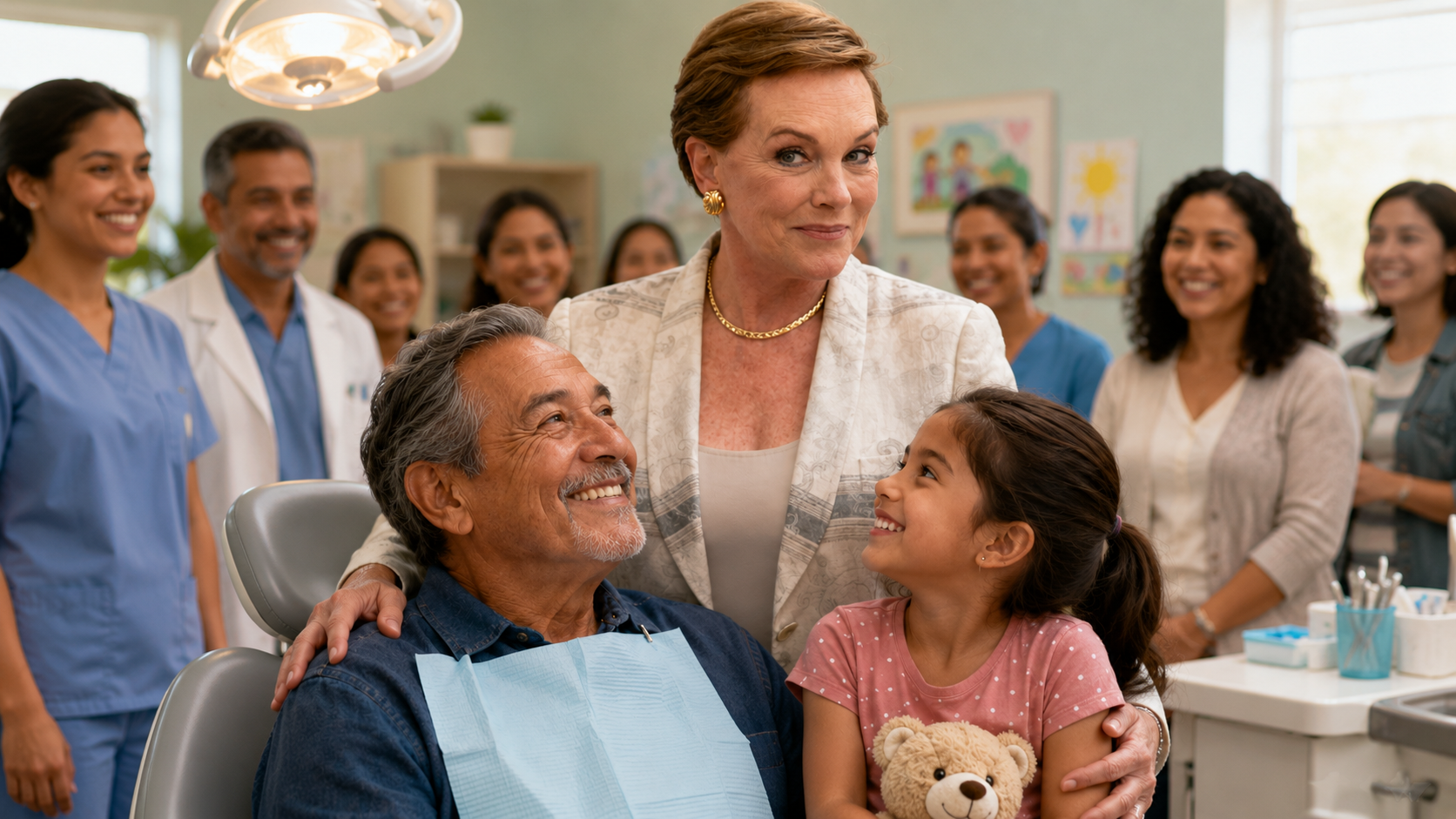
Part 1 — The Smile She Had Learned to Hide
For most of her life, Dr. Emily Carter believed a smile could tell you almost everything about a person.
Joy.
Confidence.
Relief.
Sometimes even hope.
But after years of working as a dentist, Emily had also learned something else.
People could become very good at hiding their smiles.
She noticed it one rainy Tuesday afternoon when a woman named Maria stood outside Emily’s dental office with two young children.
Maria didn’t come inside.
She simply stared at the sign on the door, looked at a piece of paper in her hand, and then turned away.
Emily happened to be near the front desk.
“Excuse me,” she called gently. “Were you looking for someone?”
Maria stopped.
She seemed embarrassed.
“I was checking the price,” she said.
Her hand immediately rose to cover her mouth.
Emily recognized the gesture.
She had seen it hundreds of times.
“Are you having dental pain?”
Maria hesitated before nodding.
“For a while.”
“How long?”
Maria looked down.
“Almost a year.”
Emily’s expression changed.
“A year?”
Maria explained that she had been working two jobs while raising her children. Every time she managed to save a little money, something else happened.
The car needed repairs.
Her son’s school shoes needed replacing.
The electricity bill increased.
Then her daughter became sick.
Dental care kept moving farther down the list.
“I can live with the pain,” Maria said. “My children can’t live without groceries.”
That sentence stayed with Emily.
She arranged to examine Maria that afternoon and treated the immediate problem at no charge.
But Maria wasn’t the only one.
Over the following months, Emily began noticing how many people in her community were delaying dental treatment because they couldn’t afford it.
A restaurant worker had been living with a broken tooth for six months.
A grandfather avoided solid food because chewing hurt.
A teenage boy stopped smiling in school photographs because he was embarrassed by his teeth.
One mother admitted she had been cutting her pain medication in half because she couldn’t afford another dental appointment.
Emily began keeping a notebook.
Not of medical cases.
Of stories.
Soon, the notebook contained dozens.
And one idea kept appearing in her mind.
What if there were a place where money didn’t determine whether someone could smile without pain?
The idea seemed impossible.
Emily was already working long hours.
Dental equipment was expensive.
Rent was expensive.
Supplies were expensive.
She would need volunteer dentists, hygienists, assistants, receptionists, and people willing to help with administration.
She needed a building.
She needed funding.
Most of all, she needed people to believe the idea could work.
For nearly two years, Emily carried the dream quietly.
Then an unexpected meeting changed everything.
Emily had admired Julie Andrews since childhood.
Her grandmother had introduced her to Julie’s films, and Emily remembered sitting beside her on a faded sofa, singing along even when she didn’t know all the words.
Years later, when Emily learned Julie would be attending a small charitable arts event nearby, she bought a ticket.
She wasn’t expecting to meet her.
But after the program, Emily found herself in a short reception line.
When her turn arrived, she shook Julie’s hand.
“Your work meant a great deal to my grandmother,” Emily said.
Julie smiled warmly.
“Then I’m very glad you came.”
They exchanged a few words.
Emily could have left it there.
Instead, Julie noticed the worn notebook Emily was carrying.
“That looks important,” she said.
Emily laughed nervously.
“It’s probably a dream that’s too big for me.”
Julie glanced at the notebook.
“Those are often the interesting ones.”
Emily hesitated.
Then she told her.
She explained the families.
The workers enduring toothaches because rent came first.
The parents choosing between groceries and dental treatment.
The children learning to cover their mouths when they laughed.
Finally, Emily told Julie about the clinic she wanted to create.
“I’ve planned almost everything,” Emily admitted. “I just don’t know how to make people care enough to help.”
Julie was quiet for a moment.
Then she asked a simple question.
“Have you told them the stories?”
Emily looked confused.
“I’ve shown people the numbers.”
“Numbers tell us how large a problem is,” Julie replied. “Stories remind us who the problem belongs to.”
Emily looked down at her notebook.
Julie gently continued.
“Perhaps you don’t need to convince everyone at once. Perhaps you only need to help the first person—and allow others to see why it matters.”
Those words followed Emily home.
That night, she opened her notebook again.
For the first time, the clinic didn’t feel impossible.
It simply felt unfinished.
Over the next several months, Emily began speaking publicly about her idea.
She contacted local dentists.
Some said no.
Others said maybe.
A retired dentist named Dr. Howard offered to volunteer twice a month.
A dental hygienist named Priya offered Saturdays.
A local contractor volunteered to renovate an unused storefront at cost.
A pharmacy donated basic supplies.
Then Julie quietly helped Emily connect with people experienced in charitable fundraising and community programs.
She never tried to make the clinic about herself.
Whenever someone praised her involvement, Julie redirected the attention.
“This is Emily’s dream,” she would say. “I’m simply helping people hear about it.”
Slowly, the impossible began becoming real.
An empty storefront became a clinic.
Volunteers painted the walls.
Someone donated waiting-room chairs.
A local dentist contributed an older but reliable examination chair.
Families donated children’s books.
A retired receptionist volunteered to answer phones.
Someone placed a handwritten sign near the entrance:
EVERYONE DESERVES TO SMILE WITHOUT PAIN.
Emily cried when she saw it.
Six months after that rainy afternoon outside her dental office, the free clinic was finally ready.
On opening morning, Emily arrived before sunrise.
She walked through the quiet rooms checking everything repeatedly.
Gloves.
Instruments.
Paperwork.
Supplies.
Everything was ready.
Julie arrived quietly before the doors opened.
“You’ve done it,” she said.
Emily shook her head.
“We’ve started it.”
At 8:00 a.m., Emily unlocked the front door.
Several families were already waiting.
But the first person in line wasn’t who Emily expected.
He was an elderly man wearing a faded blue jacket.
His name was Samuel Bennett.
He was seventy-four.
He had driven an old delivery truck for most of his working life and had recently become the full-time caregiver for his eight-year-old granddaughter, Lily.
Samuel sat carefully in the examination chair.
Emily noticed immediately that he needed significant treatment.
“How long have you been hurting?” she asked.
Samuel smiled awkwardly.
“Three years.”
Emily stopped.
“Three years?”
Samuel nodded.
“Maybe a little longer.”
“Why didn’t you get treatment?”
Samuel looked through the open doorway.
His granddaughter was sitting in the waiting room coloring a picture.
Then he answered.
“Because Lily needed me more.”
After his daughter died unexpectedly, Samuel had taken responsibility for Lily.
His retirement savings were small.
Every dollar had a purpose.
Food.
Rent.
School supplies.
Clothes.
Medicine.
Whenever Samuel considered spending money on himself, he imagined something Lily might need later.
So he endured the pain.
He stopped eating certain foods.
He learned to chew on one side.
Eventually, he stopped smiling in photographs.
“I figured at my age,” Samuel said quietly, “a smile wasn’t something I needed anymore.”
Emily had to look away for a moment.
Julie, who had been helping greet families, heard him.
She walked closer.
“I don’t think smiles have an expiration date,” she said softly.
Samuel chuckled.
Then he covered his mouth.
It was instinctive.
Emily saw it.
So did Julie.
That morning, Emily and the volunteer team began Samuel’s treatment.
When they finished the first stage, Samuel looked into a small mirror.
For several seconds, he said nothing.
Then Lily entered the room.
“Grandpa?”
Samuel turned toward her.
And smiled.
Not carefully.
Not with his hand covering his mouth.
A real smile.
Lily froze.
Then she ran toward him.
“Grandpa! You’re smiling!”
Samuel wrapped his arms around her.
“I suppose I am.”
Lily began crying.
Samuel did too.
Soon Emily was wiping her eyes.
Even Julie struggled to hold back tears.
But Lily hadn’t finished.
She reached into her little backpack and pulled out a folded piece of paper.
It was the picture she had been coloring in the waiting room.
She handed it to Emily.
There were several stick figures standing beside a building.
Across the top, Lily had written in uneven letters:
THE PLACE THAT FIXED GRANDPA’S SMILE.
Emily stared at it.
But underneath was another sentence.
One that made the entire room go quiet.
WHEN I GROW UP, I WANT TO WORK HERE SO GRANDPAS DON’T HAVE TO HURT.
Julie placed a hand over her heart.
Emily crouched beside Lily.
“You’d like to help people someday?”
Lily nodded.
“Because Grandpa always helps me.”
Samuel lowered his head as tears filled his eyes again.
Nobody in that room realized it yet.
But Samuel and Lily’s story was about to travel far beyond those clinic walls.
A volunteer shared the story with a local community newsletter—with Samuel’s permission.
Within days, people began talking about it.
Then something extraordinary happened.
A carpenter walked into the clinic carrying his toolbox.
“I heard about Samuel,” he said. “What needs fixing?”
The next morning, a woman arrived carrying boxes of children’s toothbrushes.
Then a restaurant owner appeared.
Then a teacher.
Then a college student.
Then an envelope arrived with no return address.
Inside was a donation and a short handwritten message:
For the next grandfather who thinks his smile doesn’t matter.
Emily stared at the note.
Julie smiled beside her.
The clinic had opened to provide dental care.
But something much bigger was beginning.
The community wasn’t simply donating money.
People were asking the same question:
“What can I do?”
And within a few weeks, Emily would discover that Samuel wasn’t the only person whose life was about to change.
Because one morning, she arrived at the clinic and found dozens of people waiting outside.
They weren’t waiting for treatment.
They had come to volunteer.
And standing at the front of them was Samuel.
This time, he wasn’t covering his mouth.
He was smiling.
And in his hands was something that would give Emily an idea capable of changing the clinic forever…
Part 2 — The Smile That Brought a Town Together
When Emily arrived at the clinic that morning, she thought there had been a mistake.
People filled the sidewalk.
Some carried boxes.
Some held tools.
Others had clipboards, bags of supplies, or trays of food.
Emily stepped from her car and stared.
“What’s happening?”
Samuel stood at the front of the group.
He was wearing the same faded blue jacket from his first appointment.
But there was one obvious difference.
He was smiling.
Fully.
Confidently.
Beside him stood Lily, clutching a handmade sign.
It read:
WE CAN ALL HELP SOMEONE SMILE.
Samuel walked toward Emily.
“I told a few people what this place did for me,” he said. “Turns out they wanted to do something too.”
Emily looked past him.
There were nearly forty people.
A plumber.
Two teachers.
Three university students.
A retired nurse.
A grocery store manager.
Several parents.
Two local dentists Emily had never met.
Even a mechanic still wearing his work shirt.
Emily covered her mouth.
“I don’t know what to say.”
Samuel smiled.
“Then don’t say anything yet. Just put us to work.”
Julie arrived a few minutes later.
When she saw the crowd, she paused on the pavement.
Then she looked at Emily.
“This,” Julie said softly, “is what happens when one story becomes everyone’s story.”
The clinic had originally planned to open three days a week.
Within a month, the growing number of volunteers made a fourth day possible.
Then something even more surprising happened.
A local business owner offered to pay for an additional treatment room.
A dental supply company donated equipment.
A nearby college created a volunteer program for students studying dental hygiene.
A bakery began sending breakfast for families waiting during early appointments.
A supermarket placed a donation box near its entrance.
People who couldn’t give money offered time.
People who couldn’t offer time donated supplies.
People who had neither simply told others about the clinic.
Everyone found a way to contribute.
And Lily became one of its most enthusiastic helpers.
Every Saturday morning, Samuel brought her to the clinic.
She organized crayons in the children’s corner.
She helped restock toothbrushes.
She drew colorful pictures for nervous young patients.
Eventually, she created something Emily placed beside the front desk.
It was a jar filled with small pieces of paper.
On each piece, Lily had written a simple message.
You are brave.
Your smile matters.
You are not alone.
Children could take one before their appointment.
Soon adults began taking them too.
One afternoon, Emily watched a middle-aged man quietly unfold one.
He read it twice.
Then slipped it carefully into his wallet.
That was when Emily realized the clinic was becoming more than a place for dental treatment.
For many people, it was the first place in a long time where they didn’t feel judged for struggling.
Months passed.
Samuel completed his treatment.
His health improved.
He began eating foods he had avoided for years.
But the biggest change was something smaller.
He started appearing in photographs again.
Lily made sure of it.
Every time someone raised a camera, she would shout,
“Grandpa, show your teeth!”
And Samuel would laugh.
One Saturday, Emily found Samuel fixing a loose cabinet door in the supply room.
“You know you don’t have to work every weekend,” she told him.
Samuel tightened the final screw.
“I know.”
“Then why do you?”
He looked toward the waiting room.
A young father was sitting there with his daughter.
The man held his jaw carefully, obviously in pain.
Samuel nodded toward him.
“Because somebody helped me when I thought I had run out of options.”
He placed the screwdriver down.
“I want the next person to feel that too.”
Emily smiled.
That sentence stayed with her.
So she wrote it on the staff noticeboard.
Soon volunteers began adding their own reasons for helping.
Because my mother once had to choose between medicine and dental care.
Because nobody should be ashamed to ask for help.
Because pain makes life smaller.
Because kindness should travel forward.
The wall became known as the “Why We Help” wall.
Julie loved it.
Whenever she visited, she stopped to read the newest messages.
She never announced her visits.
Sometimes she simply sat with nervous families.
Sometimes she helped hand out care packages.
Other times, she listened.
Emily noticed that Julie had an unusual gift.
People often told her things they had never planned to say.
One elderly woman confessed that she hadn’t smiled in ten years because she was embarrassed by missing teeth.
A teenage boy explained that he had been bullied at school.
A single mother admitted she had been pretending her toothache wasn’t serious because she couldn’t miss work.
Julie never rushed them.
She simply listened.
Afterward, she often reminded Emily,
“People remember being heard almost as much as being helped.”
Nearly one year after the clinic opened, Emily received an envelope from the city council.
She assumed it was paperwork.
Instead, it contained an invitation.
The clinic was being recognized for outstanding community service.
Emily immediately tried to decline the attention.
“This belongs to everyone,” she told Julie.
“Exactly,” Julie replied.
“So let everyone stand beside you.”
At the ceremony, the hall was packed.
Volunteers filled several rows.
Families who had received treatment came too.
Samuel and Lily sat near the front.
When Emily walked to the microphone, she carried Lily’s original drawing.
The one from opening day.
The place that fixed Grandpa’s smile.
Emily held it up.
“This clinic began because too many families were quietly living with pain.”
She looked across the room.
“But it grew because one patient reminded us that helping one person can awaken kindness in hundreds more.”
Samuel lowered his head.
Lily squeezed his hand.
Emily continued.
“Samuel came to us after years of putting someone else first.”
She smiled toward Lily.
“And when his granddaughter saw him smile again, she told us she wanted to grow up and help people too.”
The room grew quiet.
Emily’s voice softened.
“That was the moment I understood something.”
“We weren’t only treating teeth.”
“We were showing people that their lives still mattered.”
Applause filled the room.
But Emily wasn’t finished.
She looked toward Julie.
“There is someone else who taught me something important.”
Julie immediately shook her head.
Emily smiled.
“She told me that numbers explain a problem, but stories make us care.”
Julie lowered her gaze.
“So tonight, I want to tell you what those stories have created.”
Emily revealed the numbers.
Hundreds of people had received free treatment.
Dozens of volunteers had contributed time.
Local businesses had donated supplies.
Several dentists had joined the program.
And the clinic had recently received enough support to begin offering preventive dental visits for children.
The room erupted again.
Then Emily revealed one final surprise.
A new fund was being created.
It would help train young people from low-income families who wanted careers in dental care.
Emily turned toward Lily.
“And the first scholarship will be named after our very first patient.”
Samuel looked stunned.
Emily smiled.
“The Samuel Bennett Community Care Scholarship.”
Samuel’s eyes immediately filled with tears.
“No,” he whispered.
Lily threw her arms around him.
Everyone stood.
Samuel covered his face for a moment.
Then he remembered something.
Slowly, he lowered his hands.
And smiled.
Several years passed.
The clinic continued growing.
A second location opened in a neighboring community.
Then a mobile dental unit began visiting schools and rural areas.
But Emily kept the original drawing from Lily framed inside her office.
Whenever she felt tired, she looked at it.
Whenever funding became uncertain, she looked at it.
Whenever someone told her the problem was too big, she looked at it.
One afternoon, many years later, Emily was reviewing patient files when someone knocked on her door.
A young woman stepped inside.
She wore pale blue scrubs.
Emily stared.
There was something familiar about her smile.
“Lily?”
Lily laughed.
“You remembered.”
Emily stood so quickly that her chair rolled backward.
“You’re grown up.”
“Apparently.”
Emily hugged her.
“What are you doing here?”
Lily took a folded piece of paper from her bag.
It was worn around the edges.
Emily recognized it immediately.
The original drawing.
“The place that fixed Grandpa’s smile.”
Emily looked at her.
Lily’s eyes filled with tears.
“Grandpa kept a copy beside his bed until the day he died.”
Emily’s smile faded gently.
“I’m sorry.”
“He had a good life,” Lily said. “And he smiled through the rest of it.”
Then Lily handed Emily another piece of paper.
It was a certificate.
Emily read it.
Lily had graduated from dental school.
“I start my residency next month,” she said.
Emily covered her mouth.
Lily smiled.
“But I wanted my first day helping patients to be here.”
Emily couldn’t speak.
Years earlier, an eight-year-old girl had written that she wanted to work at the clinic so other grandfathers wouldn’t have to hurt.
Now she had returned.
Emily stepped forward and hugged her again.
A few minutes later, Julie joined them through a video call.
Age had made her voice softer, but her warmth remained unmistakable.
When Lily appeared on the screen wearing scrubs, Julie smiled.
“Well,” she said, “it appears somebody kept her promise.”
Lily laughed through tears.
“I tried.”
Julie shook her head gently.
“No.”
“You did.”
Then she added something Lily would remember for the rest of her life.
“The wonderful thing about kindness is that you rarely get to see how far it travels.”
She paused.
“But every once in a while, you’re lucky enough to watch it come home.”
Lily wiped her eyes.
Emily looked through the clinic window.
The waiting room was full.
Children were reading books.
Volunteers were preparing supplies.
A nervous father was speaking with Samuel’s old friend from the volunteer team.
On the wall remained hundreds of messages explaining why people helped.
And above them hung Lily’s childhood drawing.
The clinic had started with one woman’s dream.
Julie had helped give that dream courage.
Samuel had given it a story.
Lily had given it a future.
And an entire community had given it life.
All because one man who thought his smile no longer mattered was given a reason to use it again.
Sometimes changing a community doesn’t begin with a grand plan.
Sometimes it begins with one person deciding that someone else’s pain matters.
One chair.
One volunteer.
One patient.
One smile.
And one act of kindness that refuses to stop traveling.
The End.


