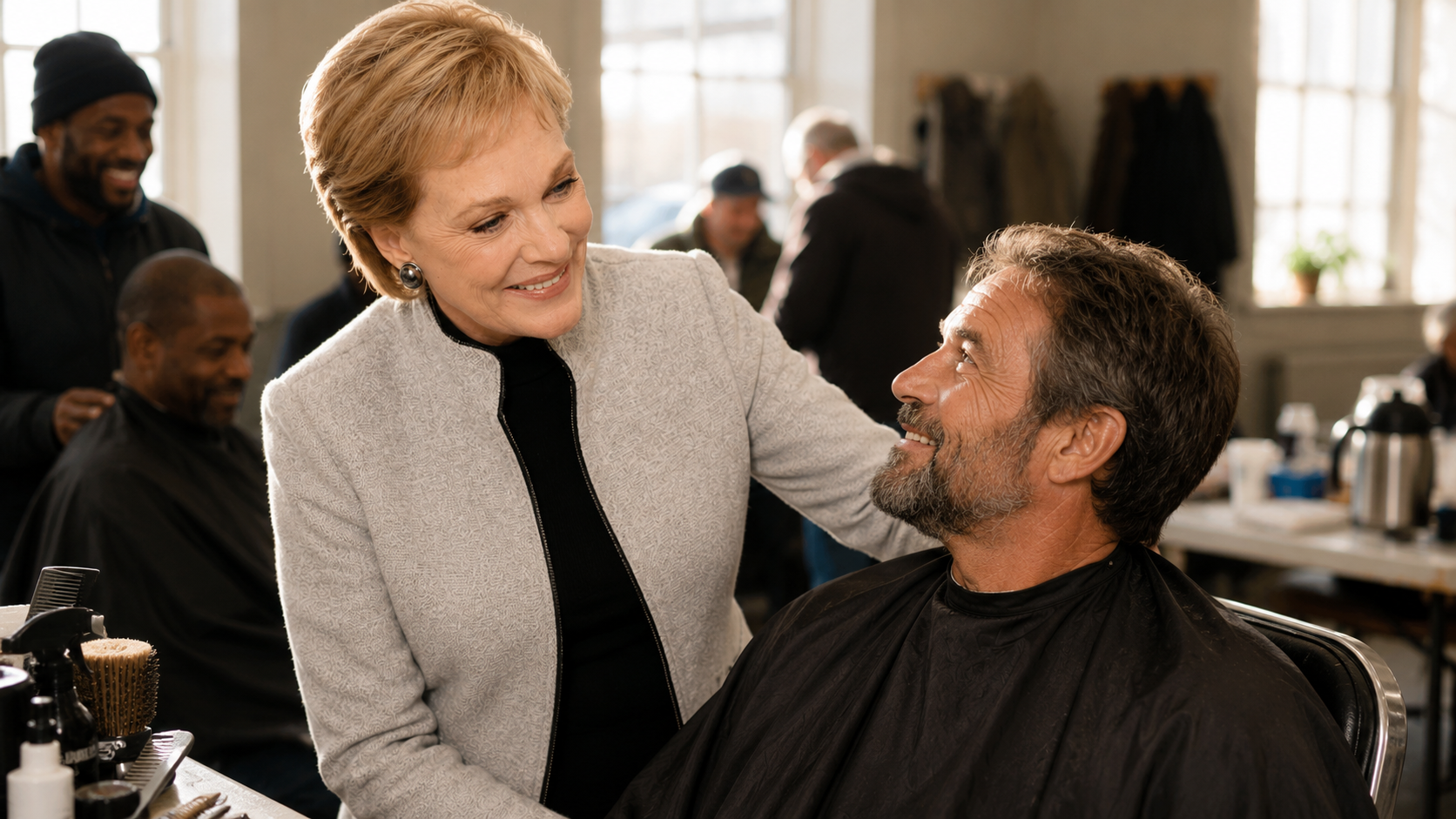
Part 1 — The Sunday Chair
Every Sunday morning, while most of the city was still waking up, Daniel Mercer packed an old black case into the trunk of his car.
Inside were scissors, clippers, combs, clean towels, disposable capes, a small mirror, and bottles of hair products.
Daniel was a barber.
During the week, he worked at a modest neighborhood barbershop, cutting hair from morning until evening. He wasn’t wealthy, and his little apartment was nothing fancy.
But Sundays belonged to people who couldn’t afford to sit in his regular chair.
For nearly three years, Daniel had been giving free haircuts to people experiencing homelessness.
He usually set up beneath a covered area beside a community center that served breakfast on Sunday mornings.
He brought a folding chair.
Sometimes twenty people waited.
Sometimes only four.
Daniel never cared about the number.
“If one person leaves feeling better than when they arrived,” he often said, “then I didn’t waste my Sunday.”
But Daniel offered something beyond haircuts.
He remembered names.
He listened.
He shook people’s hands.
And he never treated anyone as though they were a problem that needed fixing.
Whenever someone sat in his chair, Daniel asked the same question.
“How would you like your hair today?”
It sounded ordinary.
But for someone who had spent months being ignored, being asked what they wanted could mean more than Daniel realized.
One Sunday, a quiet man named Thomas sat in the chair.
He appeared to be in his early fifties.
His coat was worn, his beard had grown unevenly, and he carried everything he owned in a faded backpack.
“Just make me look respectable,” Thomas said quietly.
Daniel placed the cape around him.
“You already are respectable,” he replied. “We’re just giving you a fresh haircut.”
Thomas looked down.
For several minutes, he didn’t speak.
Then Daniel noticed Thomas was holding a folded piece of paper.
“Big day coming up?” Daniel asked.
Thomas hesitated.
“Job interview tomorrow.”
Daniel stopped cutting for a moment.
“That’s great.”
Thomas gave a nervous laugh.
“I don’t know about that.”
He explained that he’d once worked in building maintenance. After losing his wife, his life had slowly fallen apart.
Grief became isolation.
Isolation became missed work.
Then came unpaid bills.
Eventually, he lost his apartment.
For almost a year, Thomas had moved between shelters, temporary rooms, and the street.
Recently, a volunteer had helped him apply for a maintenance position at a retirement community.
The interview was Monday morning.
“I haven’t interviewed for anything in years,” Thomas admitted.
Daniel continued trimming carefully.
“Then tomorrow isn’t about everything that’s happened,” he said. “It’s about what you can do next.”
Thomas looked at him through the mirror.
“What if they look at me and know?”
“Know what?”
“That I’m homeless.”
Daniel gently brushed loose hair from Thomas’s shoulders.
“They might know you’ve had a hard year. That doesn’t tell them what kind of employee you’ll be.”
Daniel spent nearly forty minutes on him.
He trimmed Thomas’s beard.
Cleaned the edges.
Styled his hair.
Then he handed Thomas the mirror.
For several seconds, Thomas simply stared.
The man reflected back at him looked different.
But the change wasn’t really the haircut.
Thomas sat straighter.
He touched his hair and smiled.
“I haven’t looked like myself in a long time.”
Daniel smiled.
“Maybe you’ve been there the whole time.”
Thomas stood and carefully folded the cape.
Then he reached into his pocket.
He pulled out three crumpled dollar bills.
Daniel shook his head.
“No.”
“Please.”
“Keep it.”
“But you worked on me for almost an hour.”
Daniel closed Thomas’s hand around the money.
“Then when things get better, do something kind for somebody else.”
Thomas looked at him for a long moment.
Finally, he nodded.
“I’ll remember that.”
What neither man knew was that someone nearby had heard part of their conversation.
A woman visiting the community center had stopped several feet away.
She had come quietly, accompanied by only a small number of people.
Daniel was busy cleaning his clippers and didn’t notice her at first.
Then one of the volunteers whispered his name.
“Daniel?”
He turned.
And froze.
Standing beside his folding chair was Julie Andrews.
For a moment, Daniel couldn’t find any words.
Julie smiled warmly.
“I hope I’m not interrupting.”
Daniel stared at her.
“No. I mean—yes. I mean, no, you’re definitely not.”
She laughed softly.
Daniel had admired Julie since childhood.
His mother loved classic musicals, and some of his happiest memories were sitting beside her watching them together.
His mother had died several years earlier.
Seeing Julie standing there suddenly brought those memories rushing back.
“I heard about what you do here on Sundays,” Julie said.
Daniel glanced around almost self-consciously.
“It’s just haircuts.”
Julie looked toward the line of people waiting.
“I don’t think it’s just haircuts.”
She had noticed the way Daniel spoke to Thomas.
No pity.
No judgment.
Just respect.
Julie asked how the Sunday project had begun.
Daniel explained that three years earlier, a homeless man had walked into his barbershop and asked how much a haircut cost.
When Daniel told him, the man quietly thanked him and walked away.
Something about that moment stayed with Daniel.
“I kept thinking about how normal it is for most of us to get a haircut,” Daniel said. “But if you don’t have enough money for food or a place to sleep, something that ordinary becomes a luxury.”
So Daniel bought a folding chair.
The following Sunday, he offered free haircuts outside the community center.
Then he returned the next week.
And the week after that.
Julie looked at the worn chair.
“You’ve done this every Sunday?”
“Almost every Sunday.”
“For three years?”
Daniel nodded.
“Why?”
He thought for a moment.
“Because people talk about dignity like it’s something you have to earn.”
He looked toward the people waiting.
“I don’t think you do.”
Julie became quiet.
Then she smiled.
“May I help?”
Daniel laughed, assuming she was joking.
But she wasn’t.
Julie couldn’t exactly take over the clippers, so she began greeting people as they waited.
She poured coffee.
She handed Daniel clean towels.
Mostly, she listened.
People shared stories about lost jobs, broken relationships, illnesses in their families, and dreams they hadn’t completely abandoned.
Before leaving, Julie pulled Daniel aside.
“What would make this easier for you?”
Daniel initially refused to ask for anything.
Eventually, however, he admitted that supplies were expensive and that bad weather often forced him to cancel.
Julie arranged for the community center to receive support for a proper indoor grooming space.
A few weeks later, Daniel arrived to find two professional barber chairs, mirrors, storage cabinets, new equipment, and enough supplies to continue the program.
A small group of local barbers had also volunteered to help.
Daniel stood inside the room speechless.
Julie had left him a handwritten note.
It read:
“Dear Daniel,
You reminded me that kindness often begins with something beautifully simple: seeing another person and treating them as though they matter.
Please keep offering people that chair.
With admiration,
Julie”
Daniel framed the note.
But he continued doing exactly what he’d always done.
Every Sunday, the doors opened.
Every Sunday, people came.
And every Sunday, Daniel kept one question in mind:
What if this small act helps someone believe in tomorrow?
Weeks passed.
Then months.
Daniel often wondered about Thomas.
He remembered the job interview.
He hoped it had gone well.
But Thomas never returned.
Daniel eventually assumed he’d never learn what happened.
Then, nearly six months after that first haircut, Daniel was sweeping the floor one Sunday afternoon when someone appeared in the doorway.
“Still giving away haircuts?”
Daniel recognized the voice.
He looked up.
Thomas stood there.
But this time, there was no faded backpack.
He wore clean work trousers, sturdy boots, and a blue maintenance jacket.
His hair was neatly combed.
And beside him stood a young woman holding the hand of a little girl.
Daniel slowly lowered the broom.
“Thomas?”
Thomas smiled.
“I told you I’d remember.”
Daniel walked toward him.
“Did you get the job?”
Thomas’s smile grew.
“I got more than the job.”
Then he reached into his jacket and pulled out an envelope.
“I came back because I have some news.”
Daniel noticed Thomas’s hands were trembling.
“What happened?”
Thomas looked at the woman and little girl beside him.
Then his eyes filled with tears.
“The haircut you gave me that Sunday was the beginning.”
He handed Daniel the envelope.
“And what happened afterward changed my entire life.”
Part 2 — The News Thomas Came Back to Share
Daniel looked down at the envelope in his hands.
For a moment, he didn’t open it.
Thomas stood in front of him with a smile that seemed almost impossible compared with the exhausted man Daniel remembered from six months earlier.
The young woman beside Thomas squeezed his arm.
The little girl held tightly to his hand.
Daniel finally looked up.
“Before I open this,” he said, “tell me what happened after the interview.”
Thomas took a slow breath.
“I almost didn’t go.”
Daniel frowned.
“What stopped you?”
Thomas smiled.
“You did.”
That Monday morning, Thomas had stood outside the retirement community for nearly ten minutes.
He had been terrified.
Every doubt from the previous year came rushing back.
He worried that the manager would notice the address on his application belonged to a shelter.
He worried someone would ask about the gap in his work history.
Most of all, he worried that one bad year had somehow erased all the good years that came before it.
Then he caught his reflection in the glass doors.
Fresh haircut.
Trimmed beard.
Clean shirt donated by the shelter.
For the first time in months, he saw someone who looked ready to begin again.
“So I walked inside,” Thomas said.
The interview lasted nearly an hour.
Thomas answered honestly.
He explained his experience in maintenance.
He talked about repairing heating systems, fixing plumbing, painting rooms, and helping elderly residents.
When the manager asked about the gap in his employment, Thomas paused.
Then he told the truth.
“My wife died,” he said. “I fell apart for a while. But I’m trying to rebuild.”
The manager didn’t judge him.
Instead, he asked one simple question.
“Are you ready to work?”
Thomas answered immediately.
“Yes.”
Two days later, the retirement community called.
Thomas had the job.
Daniel grinned.
“I knew it.”
Thomas laughed.
“But that wasn’t the wonderful news.”
There was more.
During his first few months, Thomas arrived early every morning.
He stayed late when repairs needed finishing.
He helped residents carry groceries.
He fixed things that weren’t even on his work list.
Slowly, his confidence returned.
Then came his first paycheck.
Then his second.
After several weeks, he moved out of the shelter and into a small rented room.
It wasn’t much.
Just one bedroom, a tiny kitchen, and an old table beside the window.
But Thomas said he slept better that first night than he had in years.
“No street noise,” he said softly.
“No wondering where I’d sleep the next evening.”
Daniel nodded, deeply moved.
But Thomas’s life was changing in another way too.
The young woman beside him stepped forward.
“My name is Rebecca,” she said.
Daniel shook her hand.
Thomas looked at her with emotion in his eyes.
“This is my daughter.”
Daniel’s smile disappeared for a second.
Not from sadness.
From surprise.
Thomas explained that after losing his wife, he had slowly withdrawn from almost everyone.
That included Rebecca.
She had tried repeatedly to help him.
But Thomas had been ashamed.
He didn’t want his daughter to see him struggling.
So he stopped answering calls.
Then he changed shelters.
For nearly a year, Rebecca barely knew where her father was.
“I thought pushing everyone away would protect them from my problems,” Thomas said.
“It only made everyone hurt more.”
After getting the job, Thomas finally called Rebecca.
Their first conversation lasted six minutes.
The second lasted nearly an hour.
Then she visited him.
Weeks later, Thomas met his granddaughter, Lily, again for the first time in almost two years.
The little girl standing beside him looked up at Daniel and smiled.
“Grandpa fixes everything,” she announced proudly.
Thomas laughed through tears.
“Not everything.”
Rebecca leaned closer to her father.
“More than you think.”
Daniel felt his throat tighten.
Now he understood.
The wonderful news wasn’t only about employment.
Thomas had rebuilt his family.
But Thomas still hadn’t explained the envelope.
Daniel finally opened it.
Inside was a photograph.
Thomas stood outside a small apartment building with Rebecca and Lily.
All three were smiling.
Behind them was a door with a little welcome mat.
There was also a handwritten note.
Daniel read it silently.
Daniel,
Six months ago, I sat in your chair because I wanted to look respectable for a job interview.
What I didn’t understand was that you treated me like I was respectable before the haircut even began.
That mattered more than the haircut.
I got the job.
I found a home.
I got my daughter back.
I got my granddaughter back.
And next month, I’m moving into a permanent apartment.
You told me that when things got better, I should do something kind for someone else.
I haven’t forgotten.
Daniel looked up.
Thomas was already reaching into his pocket.
He pulled out an envelope containing several gift cards for meals, transportation passes, and basic supplies.
“I’ve been putting a little aside from every paycheck,” Thomas said.
“I want you to give these to people who come here.”
Daniel shook his head.
“Thomas, you don’t have to do that.”
“I know.”
Thomas smiled.
“That’s why I want to.”
Daniel hugged him.
For several seconds, neither man spoke.
Then applause came from behind them.
Daniel turned.
A few volunteers had gathered near the door.
And standing among them was someone Daniel instantly recognized.
Julie Andrews.
Daniel laughed in disbelief.
“You again?”
Julie smiled.
“I was invited.”
Thomas looked completely stunned.
Rebecca covered her mouth.
Julie walked toward Thomas and held out her hand.
“I’ve heard quite a bit about you.”
Thomas shook her hand nervously.
“I never expected to meet you.”
Julie smiled.
“Apparently this room has a habit of creating unexpected Sundays.”
Everyone laughed.
Daniel explained Thomas’s story.
The interview.
The job.
The apartment.
The reunion with his daughter.
His granddaughter.
The envelope.
Julie listened quietly.
When Daniel finished, she looked at Thomas.
“You know what I find most beautiful about all of this?”
Thomas shook his head.
“You received kindness when you needed it.”
She glanced at the gift cards.
“And the moment you were able, you turned around and offered kindness to someone else.”
Thomas looked down.
“Daniel told me to.”
Julie smiled.
“Daniel reminded you. You chose to do it.”
That afternoon, Thomas stayed.
He helped sweep hair.
He handed out coffee.
He talked with several men waiting for haircuts.
One young man admitted he had a job interview coming up.
Thomas sat beside him.
“Nervous?”
“Terrified.”
Thomas smiled.
“Good.”
The young man looked confused.
Thomas laughed.
“It means you care.”
Then he told him something Daniel had once told him.
“Tomorrow isn’t about everything that happened before. It’s about what you can do next.”
Daniel overheard the words from across the room.
He smiled.
The kindness was already traveling.
Months later, the Sunday haircut program became bigger than Daniel ever imagined.
Other barbers joined.
A local clothing shop donated interview clothes.
Volunteers helped people prepare résumés.
A nearby café provided free breakfast.
The community center added showers and laundry services.
Julie continued quietly supporting the effort, but she insisted the attention remain on the volunteers and the people rebuilding their lives.
Daniel eventually placed another chair beside his.
Then another.
But he kept his original folding chair in the corner.
The old one.
The scratched one.
The chair Thomas had sat in before his interview.
Whenever new volunteers asked why he kept it, Daniel told them:
“That chair reminds me that you never really know what someone is carrying when they sit down.”
Years later, Daniel would still remember Thomas walking through the doorway in his blue maintenance jacket.
Not because Thomas had become wealthy.
Not because everything suddenly became easy.
But because he had returned with proof that sometimes a person doesn’t need someone else to completely change their life.
Sometimes they just need one person to remind them that their life is still worth changing.
And that was what Daniel had offered every Sunday.
Not just haircuts.
A fresh start.
A little confidence.
A conversation without judgment.
And sometimes, one simple chair where a person could sit down feeling invisible…
and stand up believing they mattered again.
The End.


