Part 1
Nine-year-old Lily Carter had been saving for months.
Every Saturday morning, her father gave her a small allowance for helping around the house.
She made her bed.
She watered the plants.
She helped fold laundry.
And whenever a few dollars landed in her hand, Lily carefully placed them inside a glass jar on her bedroom shelf.
Her parents assumed she was saving for something special.
Maybe a new bicycle.
Maybe a toy she had been talking about.
Maybe tickets to the little amusement park outside town.
But Lily had another plan.
At the bottom of the jar was a handwritten label:
FOR THE ANIMALS.
Lily loved animals more than almost anything.
She often stopped outside the local shelter after school just to look through the fence.
Sometimes she could hear dogs barking inside.
Other times, a volunteer would walk past with an older dog whose tail barely moved.
Those were the ones Lily worried about most.
“The puppies always get picked first,” she once told her father.
“What about the old ones?”
Her father had no good answer.
So Lily started saving.
She skipped buying candy at the corner store.
She passed on stickers her friends collected.
When her grandmother gave her $10 for helping clean the garage, Lily added every dollar to the jar.
By early autumn, she had saved $87.
To Lily, it felt like a fortune.
One Saturday morning, she carried the jar into the kitchen.
Her mother looked surprised.
“What are you doing with that?”
“I’m ready,” Lily said.
“For what?”
Lily smiled.
“To help.”
Her parents drove her to Willow Creek Animal Shelter.
The shelter was small and struggling.
Its paint was faded.
Some of the kennels were old.
A handwritten board near the entrance listed items they desperately needed:
Dog food.
Cat litter.
Blankets.
Medicine.
Cleaning supplies.
When Lily walked inside holding the jar with both hands, the shelter director, a kind woman named Maria, came over.
“Can I help you?”
Lily placed the jar on the counter.
“This is for the animals.”
Maria looked down.
Then back at Lily.
“All of it?”
Lily nodded.
“I was going to buy something for myself. But they need things more than I do.”
Maria’s expression changed.
She slowly unscrewed the lid.
Inside were crumpled dollar bills, quarters, dimes, nickels, and pennies.
Months of tiny sacrifices.
Maria covered her mouth.
“Oh, sweetheart.”
Lily became nervous.
“Is it enough to help?”
Maria crouched beside her.
“It’s more than enough to matter.”
She explained that the money could help buy special food and medication for one of their oldest dogs.
His name was Charlie.
Charlie was a twelve-year-old golden retriever who had been at the shelter for nearly seven months.
He had cloudy eyes, gray fur around his face, and arthritis that made walking difficult.
Families often smiled at Charlie.
But they usually left with younger dogs.
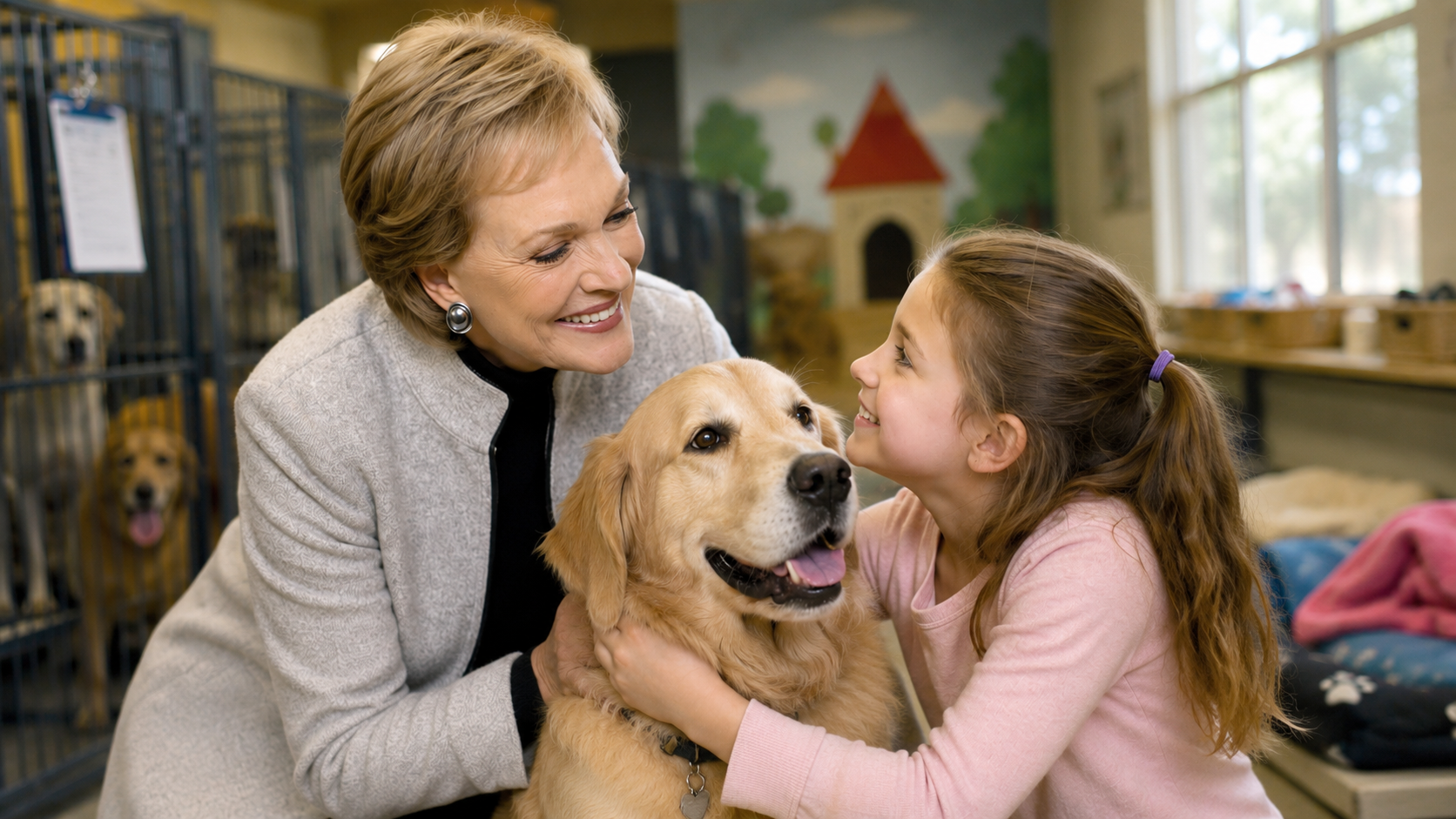
When Maria brought him out, Charlie slowly walked toward Lily.
His tail gave one soft wag.
Then another.
Lily sat on the floor.
Charlie rested his head in her lap.
“Oh,” Lily whispered.
For almost half an hour, she gently stroked his ears.
When it was time to leave, Charlie tried to follow her.
Lily’s smile disappeared.
“He thinks I’m taking him home.”
Maria looked away.
Lily hugged Charlie tightly.
“I’m sorry,” she whispered. “We already have two dogs, and Mom says our house is full.”
Before leaving, Lily turned back one final time.
Charlie was still standing at the gate.
Watching her.
That night, Lily could not stop thinking about him.
The next morning, she made a small poster with crayons.
At the top she wrote:
PLEASE GIVE CHARLIE A CHANCE.
She drew a picture of a golden dog underneath.
Then she asked her father to help her print Charlie’s shelter information.
Lily began showing the poster to neighbors.
She brought copies to school.
She asked the librarian if she could hang one near the entrance.
She even stood outside her father’s grocery store for an hour telling anyone who would listen about an old dog who “just needed someone to see how good he was.”
Word slowly spread.
A local newspaper heard about the little girl who had donated her allowance.
They wrote a small article.
Then a teacher shared the article online.
Within days, donations began arriving at the shelter.
$5.
$10.
$25.
Boxes of blankets appeared.
Bags of food were dropped at the door.
Children from Lily’s school began collecting coins in jars of their own.
Maria called Lily one evening.
“You started something beautiful,” she said.
Lily smiled.
“But did Charlie get adopted?”
There was a pause.
“Not yet.”
Lily’s smile faded.
Meanwhile, something else had happened.
Someone unexpected had read the newspaper article.
Julie Andrews was visiting the area quietly to support a literacy event at a nearby community center.
That morning, while having tea, she noticed the small story about Lily.
She read every word.
Then she read it again.
The part that stayed with her was Lily’s simple explanation for donating the money:
“I already have people who love me. I wanted the animals to know someone loved them too.”
Julie gently folded the newspaper.
“What a remarkable child,” she said.
Later that afternoon, Julie made a quiet phone call to Willow Creek Animal Shelter.
Maria nearly dropped the phone when she realized who was speaking.
Julie asked only one thing.
“Please don’t tell Lily I’m coming.”
Two days later, Lily returned to the shelter carrying another jar.
This one contained only $12.
But she looked proud.
“I started again,” she told Maria.
Maria smiled.
Then she glanced toward the back room.
“Lily, there’s someone here who would like to meet you.”
Lily looked confused.
The door slowly opened.
Julie Andrews stepped into the room.
For several seconds, Lily simply stared.
Her eyes widened.
Her mouth fell open.
“Are you…?”
Julie smiled warmly.
“I believe I’m the person who came to meet a very extraordinary young lady.”
Lily looked at her parents.
Then back at Julie.
“Me?”
“Yes,” Julie said.
“You.”
Julie knelt beside her.
“I heard what you did for Charlie and the other animals.”
Lily looked embarrassed.
“It wasn’t that much money.”
Julie shook her head.
“Kindness is rarely measured by how much we give.”
She gently touched the little jar.
“It is measured by how much heart we put behind it.”
Lily smiled.
But then she remembered Charlie.
“Can you help him get adopted?”
Julie glanced at Maria.
A mysterious smile appeared on Maria’s face.
“That,” Julie said, “is actually why we’re here.”
Maria walked toward the shelter’s front doors.
“Come with us.”
Outside, several people were waiting.
Lily saw volunteers.
Her teacher.
Some classmates.
A local reporter.
And beside Julie stood a family Lily had never seen before.
The mother was crying.
The father held a new red dog leash.
Their teenage son carried a soft dog bed.
Lily looked around.
“What’s happening?”
Then the shelter doors opened again.
Charlie appeared.
His tail began wagging immediately when he saw Lily.
But instead of walking toward her, Maria gently guided him toward the waiting family.
The mother knelt down.
Charlie rested his head against her chest.
She began crying harder.
Julie turned to Lily.
“They came here because of your poster.”
Lily’s eyes filled with tears.
“Charlie has a home?”
Julie smiled.
“Yes.”
But before Lily could speak, the father stepped forward.
“There’s something else you should know.”
He reached into his coat pocket.
“We didn’t come here only to adopt Charlie.”
He handed Lily a small envelope.
Lily looked at Julie.
Then at her parents.
“What is it?”
Julie smiled softly.
“Open it.”
Lily slowly lifted the flap.
Inside was a card.
And when she read the first line, she stopped breathing for a moment.
Because the unexpected reward waiting inside wasn’t money.
It was something far bigger.
And it was about to change the shelter forever.
Part 2
Lily stared at the card in her hands.
At the top, written in careful blue ink, were the words:
“The Lily Carter Kindness Fund.”
She blinked.
Then she read it again.
“What is this?” she whispered.
The man who was adopting Charlie smiled.
“My name is Daniel,” he said. “My family owns a small building company here in town. When we saw your poster about Charlie, we came to meet him.”
He looked down at the old golden retriever, who was now leaning happily against his wife’s legs.
“But then we heard the rest of your story.”
Daniel explained that his family had planned to make a small donation to the shelter.
But after learning that Lily had saved her allowance for months, they decided a small donation did not feel like enough.
So they spoke with several other local businesses.
One offered money.
Another offered building materials.
A veterinarian promised discounted treatment.
A pet store offered food.
A carpenter volunteered his weekends.
By the end of the week, they had created something nobody expected.
A community fund dedicated to helping older and harder-to-adopt animals.
Lily looked at Maria.
“You mean… for dogs like Charlie?”
“And cats,” Maria said.
“And injured animals.”
“And the ones that need medicine.”
“And the ones people sometimes overlook.”
Lily’s eyes filled with tears.
“How much money is in it?”
Daniel smiled.
“Enough to keep helping for a very long time.”
But Julie Andrews gently stepped closer.
“The amount isn’t the important part.”
Lily looked up at her.
Julie pointed toward the little jar still sitting inside the shelter.
“You started this with $87.”
Lily nodded.
“Most people would have looked at that amount and thought it was too small to matter.”
Julie paused.
“But you didn’t.”
Lily looked toward Charlie.
“I just wanted him to be okay.”
“And because you cared about one animal,” Julie said, “many more will now be helped.”
Lily wiped her eyes.
Charlie suddenly pulled gently against his new leash and walked toward her.
He pressed his nose into her hand.
Lily dropped to her knees and wrapped both arms around him.
“You got your family,” she whispered.
Charlie wagged his tail.
Daniel’s wife crouched beside Lily.
“You can visit him anytime.”
Lily looked surprised.
“Really?”
“Absolutely.”
She smiled through her tears.
“Then I’m going to visit a lot.”
Everyone laughed.
But the surprises were not finished.
Maria asked Lily to follow her around the side of the shelter.
Behind the building was an old fenced area that had been unusable for years.
The grass was overgrown.
The benches were broken.
One section of fencing leaned badly to one side.
Lily had seen it many times.
Maria stopped in front of it.
“This is going to become a new outdoor play area.”
Lily looked around.
“For the dogs?”
Maria nodded.
“The volunteers have been dreaming about fixing it for years, but we never had enough money.”
Daniel smiled.
“Now we do.”
Within days, work began.
Parents arrived carrying tools.
Teenagers painted benches.
Children planted flowers.
Local stores donated fencing and shade coverings.
A retired carpenter built small ramps for older dogs with stiff joints.
The veterinarian donated a special washing station.
Someone even painted a cheerful mural on the shelter wall.
Every afternoon after school, Lily came to help.
Sometimes Julie joined her.
She never made the project about herself.
She simply worked beside everyone else.
She carried small boxes.
She greeted volunteers.
She sat quietly with frightened animals.
One afternoon, Lily found Julie brushing an elderly terrier named Daisy.
Daisy had been abandoned beside a highway and was still nervous around strangers.
But with Julie, she seemed peaceful.
Lily sat beside them.
“Do you think every animal gets a happy ending?”
Julie looked thoughtful.
“I think we hope for that.”
“But sometimes they don’t.”
“No,” Julie said softly. “Sometimes life is unfair.”
Lily looked down.
“Then how do we know helping matters?”
Julie placed the brush aside.
“Because kindness is never wasted.”
Lily listened carefully.
“You may not always get to see what your kindness becomes,” Julie continued. “You might help someone today, and years later they may help someone else because they remember how you made them feel.”
Lily smiled.
“Like my jar?”
Julie smiled back.
“Exactly like your jar.”
Three weeks later, the new play area was finished.
The shelter held a small opening celebration.
Families filled the parking lot.
Children carried bags of food and blankets.
Local businesses set up donation tables.
Several animals were adopted that morning.
But Maria had one more announcement.
She stood in front of the crowd with Lily beside her.
“When Lily first came here,” Maria said, “she asked me one question.”
Lily remembered immediately.
Is it enough to help?
Maria looked at her.
“The answer was yes.”
The crowd applauded.
Lily became shy and tried to step behind her father.
But Julie gently took her hand.
Maria continued.
“Because of Lily’s example, this community has donated more supplies and volunteer hours in the last few weeks than we received during the previous several months.”
People cheered.
“And we have decided that the new outdoor area will be called the Kindness Garden.”
Lily’s mouth opened.
Julie leaned down.
“That seems very fitting.”
A wooden sign was revealed near the gate.
It showed small painted paw prints around the words:
Kindness Garden
Lily touched the sign.
“But I didn’t build all this.”
“No,” Maria said.
“We all did.”
She smiled.
“But you reminded us to start.”
Then Lily noticed a familiar car pulling into the parking lot.
Daniel stepped out.
Charlie was beside him.
The moment Charlie saw Lily, he pulled excitedly at his leash.
“Charlie!”
Lily ran toward him.
Charlie was still slow.
Still gray around the face.
Still an old dog.
But now he wore a bright red collar.
His coat looked healthier.
And his tail would not stop wagging.
Lily hugged him tightly.
Daniel laughed.
“He knows exactly who you are.”
Then Daniel’s son handed Lily a small photograph.
It showed Charlie asleep on a sofa with his head resting on a pillow.
A blanket covered him.
Lily stared at it.
“He sleeps there every night,” the boy said.
“He snores too.”
Lily laughed.
Julie watched from nearby.
For her, that photograph seemed to capture everything.
One small act of generosity.
One overlooked animal.
One child who believed a few dollars could still matter.
And a chain of kindness that had traveled far beyond anything Lily could have imagined.
As the celebration ended, Julie gave Lily a small envelope of her own.
Lily opened it carefully.
Inside was a handwritten note.
It read:
Dear Lily,
Never let anyone convince you that you are too young, too small, or have too little to make a difference.
The world changes whenever someone chooses kindness when they could have chosen convenience instead.
Your jar did not simply contain money.
It contained compassion.
And compassion has a wonderful habit of multiplying.
With love,
Julie
Lily kept that note beside her bed for years.
But she kept something else there too.
Another glass jar.
Whenever she earned allowance, she continued placing a little inside.
Sometimes it went to the shelter.
Sometimes to a family who needed groceries.
Sometimes to a school fundraiser.
Sometimes to people she never met.
Years later, when someone asked Lily why she kept doing it, she would always give the same answer.
“Because once, I thought $87 wasn’t enough to matter.”
She would smile.
“And then it changed everything.”
The Lily Carter Kindness Fund continued long after that first day.
Hundreds of animals received medicine.
Older dogs found homes.
Injured cats received treatment.
Families who could not afford emergency veterinary bills received help.
And every year, the shelter invited local children to fill small jars with whatever they could spare.
Some jars held $3.
Some held $20.
Some held only coins.
Nobody ever told a child their contribution was too small.
Because everyone at Willow Creek had learned the same lesson Lily had taught them:
Kindness does not become powerful only when it is large.
It becomes powerful the moment someone decides to give it.
And sometimes the smallest gift becomes the beginning of something much bigger than anyone expected.
The End.


