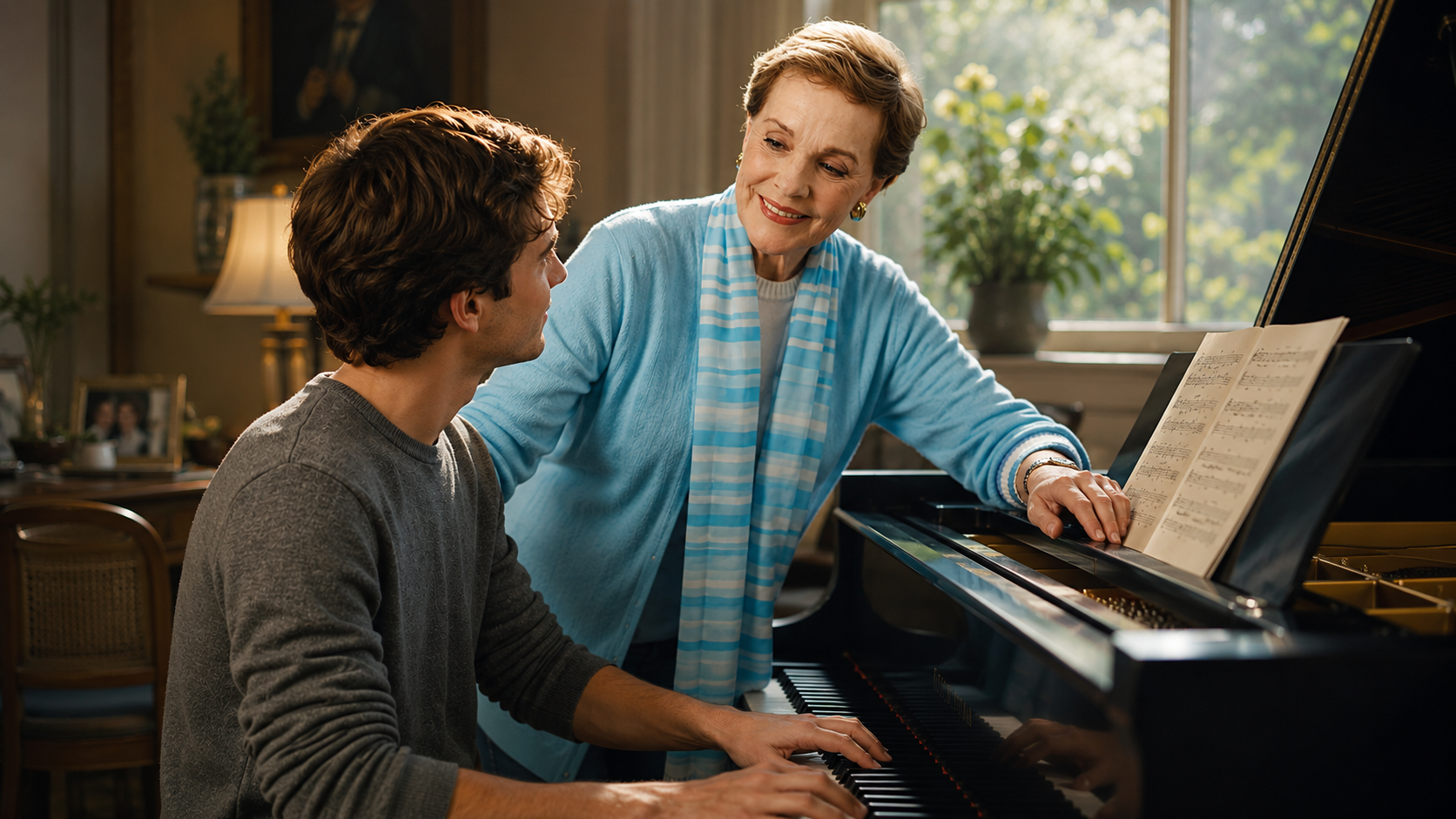
Part 1 — The Last Song
By the time Daniel Mercer turned twenty-two, he had become very good at opening rejection letters.
He knew the language before he even finished the first sentence.
We regret to inform you…
After careful consideration…
We received many talented applicants…
We encourage you to apply again…
At first, Daniel had saved every letter.
He kept them in a small wooden box beside the piano in his bedroom, telling himself that one day he would look back at them and smile.
They would become proof that he had refused to quit.
But after the twelfth rejection, he stopped saving them.
After the eighteenth, he stopped telling his family when another arrived.
And after the twenty-third, Daniel began wondering whether everyone else could see something he couldn’t.
Maybe he simply wasn’t good enough.
Daniel had loved the piano since childhood.
His grandmother, Margaret, had owned an old upright piano with several scratched keys and a pedal that squeaked whenever it was pressed.
When Daniel was six, she would sit beside him and teach him simple melodies.
“You don’t have to play perfectly,” she always said.
“You only have to make someone feel something.”
Those words stayed with him.
By thirteen, Daniel was practicing before school.
By sixteen, he was performing at community events.
By eighteen, his teachers were encouraging him to audition for conservatories, competitions, scholarships, and professional programs.
Everyone seemed certain that Daniel had a future in music.
For a while, Daniel believed them.
Then came the rejections.
One conservatory said his technique needed development.
Another praised his musicality but selected someone else.
A competition eliminated him in the first round after months of preparation.
He auditioned for a summer program and didn’t receive a place.
Then came perhaps the hardest rejection of all.
Daniel auditioned for a prestigious young musicians’ fellowship.
He practiced the same pieces for nearly five months.
He woke before sunrise.
He practiced scales until his fingers ached.
He recorded himself repeatedly, listening for every tiny mistake.
When audition day arrived, Daniel walked onto the stage believing this might finally be his chance.
Three weeks later, an email appeared.
He wasn’t selected.
Daniel stared at the screen for several minutes.
Then he quietly closed his laptop.
That evening, his mother found him sitting beside the piano without playing.
“Another rejection?” she asked gently.
Daniel nodded.
She sat beside him.
“You’ll try again.”
For the first time, Daniel shook his head.
“No.”
His mother looked surprised.
“I think I’m finished.”
Daniel closed the piano lid.
“I’ve spent years trying to convince people that I belong in rooms they keep telling me I don’t belong in.”
His voice cracked.
“Maybe I should finally listen.”
Within days, Daniel packed his sheet music into boxes.
He cancelled two upcoming auditions.
He even began looking for jobs that had nothing to do with music.
The piano remained silent.
Then, one rainy Tuesday afternoon, his former teacher called.
Her name was Eleanor Price, and she had taught Daniel during his teenage years.
“I need a favor,” she said.
Daniel almost laughed.
“If it involves a piano, I’m probably the wrong person.”
“It involves carrying chairs.”
That sounded harmless.
Eleanor volunteered at a small community arts center that offered inexpensive music lessons to children whose families couldn’t afford private instruction.
They were preparing for a fundraising gathering.
Daniel agreed to help.
He arrived shortly after noon wearing jeans, an old sweater, and absolutely no intention of touching a piano.
For two hours, he moved chairs, arranged programs, and helped carry boxes.
Then Eleanor asked him to check the piano in the rehearsal room.
“One key has been sticking,” she explained.
“You’ll know whether it’s serious.”
Daniel hesitated.
Still, he walked inside.
The room was empty.
An aging grand piano stood near the windows.
Daniel lifted the lid.
For several seconds, he simply stared at the keys.
Then he pressed one.
The sound filled the quiet room.
Another followed.
Then another.
Without thinking, Daniel sat down.
He began playing the melody his grandmother had taught him when he was six.
His fingers remembered what his confidence had forgotten.
Daniel closed his eyes.
For the first time in weeks, there were no judges.
No applications.
No rankings.
No rejection letters.
There was only music.
Daniel didn’t hear the rehearsal-room door open.
He didn’t notice the woman who stopped in the hallway.
And he certainly didn’t realize that the woman listening quietly behind him was Julie Andrews.
Julie had been invited to visit the arts center privately that afternoon after hearing about its work with young musicians.
She had arrived earlier than expected.
As she walked through the building with Eleanor, she heard Daniel playing.
Julie stopped.
“Who is that?” she asked.
Eleanor smiled sadly.
“That is someone who doesn’t believe he’s a pianist anymore.”
Julie looked toward the open doorway.
“Why?”
“Because other people kept telling him no.”
Julie listened for another moment.
Daniel wasn’t performing something flashy.
He wasn’t trying to impress anyone.
He was simply playing.
Yet there was tenderness in every phrase.
Julie understood something Daniel had forgotten.
A rejection could determine whether someone received an opportunity.
It could not determine whether that person had something meaningful to give.
When Daniel finished, the final note slowly disappeared.
Then he heard a voice behind him.
“That was beautiful.”
Daniel turned.
For a moment, he couldn’t speak.
Julie Andrews was standing near the doorway.
Daniel immediately stood.
“I—I’m sorry. I didn’t know anyone was listening.”
Julie smiled.
“I’m rather glad you didn’t.”
Daniel looked confused.
“Why?”
“Because you weren’t performing for approval.”
She walked closer to the piano.
“You were telling the truth.”
Daniel looked down.
Normally, meeting someone he admired would have thrilled him.
Instead, embarrassment rushed through him.
“You probably heard plenty of mistakes.”
Julie didn’t answer immediately.
Instead, she pulled a chair closer.
“May I sit?”
Daniel nodded.
Julie sat beside the piano.
“I’ve been told you’ve had a difficult few months.”
Daniel glanced toward Eleanor, who had discreetly disappeared from the doorway.
He gave a small, uncomfortable laugh.
“That’s one way of putting it.”
“How many rejections?”
“Twenty-three.”
Julie raised her eyebrows.
Daniel continued.
“Conservatories. Competitions. Fellowships. Programs.”
He swallowed.
“I kept thinking the next audition would be different.”
“And now?”
“Now I think they were probably right.”
Julie studied him.
“Who?”
“All of them.”
Daniel gestured toward the piano.
“Maybe wanting something badly doesn’t mean you’re supposed to have it.”
Julie nodded thoughtfully.
“That can sometimes be true.”
Daniel hadn’t expected that answer.
Then Julie continued.
“But rejection and ability are not the same thing.”
Daniel remained silent.
Julie placed one hand gently on the piano.
“Do you know how many talented people spend years hearing no?”
Daniel shrugged.
“Probably a lot.”
“More than you imagine.”
She looked at him.
“An audition measures what happened in one room, on one day, according to a handful of people making a particular decision.”
She paused.
“It does not measure everything you might become.”
Daniel wanted to believe her.
But twenty-three rejection letters felt heavier than one encouraging conversation.
“I don’t know if I can keep doing this,” he admitted.
Julie nodded.
“Then don’t think about twenty-three auditions.”
Daniel looked at her.
“Think about one afternoon.”
She pointed toward the keys.
“This one.”
Daniel didn’t understand.
Julie smiled.
“Would you play something for me?”
His stomach tightened.
“I don’t think I could.”
“You were playing beautifully five minutes ago.”
“That was before I knew Julie Andrews was listening.”
Julie laughed warmly.
“Then forget Julie Andrews is listening.”
“That seems difficult.”
“Fair enough.”
She leaned closer.
“Then imagine your grandmother is listening.”
Daniel froze.
“How did you know about her?”
“Eleanor told me she taught you.”
Daniel looked at the piano.
His grandmother had died three years earlier.
She had never seen the rejection letters.
Whenever Daniel became nervous before performing, he still remembered her voice.
You only have to make someone feel something.
Julie seemed to notice the change in his expression.
“What would you play for her?”
Daniel slowly sat down.
His hands hovered above the keys.
Then he began.
The first few notes were uncertain.
But Julie didn’t move.
Daniel continued.
Gradually, something changed.
His shoulders relaxed.
The room disappeared.
He stopped wondering whether his technique was impressive enough.
He stopped imagining judges writing notes.
He simply played.
When the piece ended, Daniel kept his hands resting on the keys.
Julie remained silent for several seconds.
Then she said something Daniel would remember for the rest of his life.
“You’ve spent so much time asking whether they will choose you that you’ve forgotten to ask whether you still choose music.”
Daniel looked at her.
The words struck somewhere deeper than encouragement.
Julie continued.
“If nobody promised you a career…”
She paused.
“If nobody promised applause…”
Daniel listened.
“If nobody promised you would ever become famous…”
Her voice softened.
“Would you still want to play?”
Daniel looked toward the rain running down the windows.
For months, he’d believed he was fighting for a career.
But suddenly he remembered the six-year-old boy sitting beside his grandmother at an old piano.
That boy hadn’t known what a conservatory was.
He hadn’t wanted trophies.
He hadn’t dreamed about applause.
He simply loved making music.
Daniel’s eyes filled with tears.
“Yes,” he whispered.
Julie smiled.
“Then perhaps you haven’t lost as much as you thought.”
Daniel wiped his eyes.
For the next hour, they talked.
Not about fame.
Not about success.
They talked about disappointment.
Fear.
Patience.
The strange danger of allowing strangers’ decisions to become your definition of yourself.
Eventually, Julie stood to leave.
Before she did, she turned toward Daniel.
“I’d like you to promise me something.”
“What?”
“Don’t decide today whether you’ll become a professional pianist.”
Daniel nodded slowly.
“Decide something smaller.”
She pointed toward the piano.
“Come back tomorrow and play for one hour.”
Daniel almost smiled.
“One hour?”
“One hour.”
“And after that?”
“Come back the next day.”
Daniel looked at her.
Julie smiled.
“Confidence doesn’t always return dramatically, Daniel. Sometimes it returns one ordinary day at a time.”
Then she left.
Daniel remained alone in the rehearsal room.
Rain continued tapping against the windows.
He looked at the piano.
And for the first time in weeks, he didn’t see twenty-three failures.
He saw eighty-eight keys.
The next morning, Daniel returned.
He played for one hour.
He returned the day after that.
Then again.
A week passed.
Something inside him slowly began waking up.
But Daniel still hadn’t changed his mind about auditions.
He wasn’t ready.
Until Eleanor approached him after rehearsal one afternoon.
“There is something happening here Saturday,” she said.
Daniel frowned.
“What?”
“A small concert for the children’s program.”
“I can help set up.”
Eleanor shook her head.
“I don’t need you to move chairs.”
She handed him a folded piece of paper.
“We need a pianist.”
Daniel stared at it.
His first instinct was to refuse.
Then he noticed a handwritten message at the bottom.
It was from Julie.
Just one sentence.
Play for the people who need the music—not the people deciding whether you’re good enough.
Daniel read it twice.
Then a third time.
What he didn’t know was that Saturday’s small concert would lead to an unexpected moment involving one child in the audience, another opportunity Daniel never intended to pursue, and a reunion with Julie Andrews that would show him just how much that rainy afternoon had changed his life.
Part 2 — The Audience That Changed Everything
Saturday arrived much faster than Daniel wanted.
By late afternoon, the community arts center was already filling with families.
Children hurried through the hallways carrying violins, clarinets, sheet music, and nervous expressions.
Parents unfolded chairs.
Volunteers arranged cups of juice and plates of biscuits near the back wall.
Daniel stood alone in the rehearsal room.
The piano waited in front of him.
His hands felt cold.
For the first time since Julie’s visit, doubt returned in full force.
He could almost hear the old thoughts.
What if you make a mistake?
What if everyone realizes you aren’t good enough?
What if this proves the rejection letters were right?
Daniel closed his eyes.
Then he remembered Julie’s note.
Play for the people who need the music—not the people deciding whether you’re good enough.
He folded the note carefully and placed it inside his jacket pocket.
Then he walked onto the small stage.
There were perhaps seventy people in the room.
No judges.
No score sheets.
No competition numbers.
Just families.
Teachers.
Children.
And a few elderly neighbors who supported the center.
Daniel sat at the piano.
He took a breath.
Then he began.
His first piece was gentle.
A few children whispered in the back.
Someone coughed.
A chair scraped against the floor.
Months earlier, those sounds might have distracted Daniel.
Now they reminded him that this was not an audition.
This was real life.
He continued playing.
Halfway through the piece, Daniel noticed a boy sitting in the second row.
He looked about nine years old.
He wore a blue sweater several sizes too large and held both hands tightly in his lap.
Unlike the other children, he wasn’t watching Daniel’s face.
He was watching Daniel’s hands.
Every movement.
Every note.
When the first piece ended, the room applauded.
Daniel smiled nervously.
Then he played again.
The second piece was the melody his grandmother had taught him.
The same one Julie had heard that rainy afternoon.
This time, Daniel didn’t think about technique.
He thought about his grandmother’s small living room.
The scratched piano.
Her patient smile.
And the sentence that had followed him through childhood.
You only have to make someone feel something.
When Daniel finished, the applause was softer.
But something about it felt deeper.
After the concert, families gathered near the stage.
Children ran toward their teachers.
Parents took photographs.
Daniel was packing his music when he heard a quiet voice behind him.
“Mister?”
Daniel turned.
It was the boy in the blue sweater.
“Hello.”
The boy looked at the piano.
“Can I ask you something?”
“Of course.”
“Were you scared?”
Daniel smiled.
“Yes.”
The boy looked surprised.
“But you looked like you weren’t.”
“I was.”
The boy thought about this.
Then he asked, “Were you ever bad at piano?”
Daniel almost laughed.
“Absolutely.”
“How bad?”
“Very bad.”
The boy finally smiled.
Daniel crouched slightly so they were closer to eye level.
“Do you play?”
The boy shook his head.
“I want to.”
“Then why don’t you?”
The boy looked toward the floor.
“My hands don’t work fast.”
His mother had walked over by then.
She gently placed a hand on his shoulder.
“This is Noah,” she explained. “He started lessons here a few months ago.”
Daniel nodded.
Noah’s mother continued.
“He has a condition that makes fine hand movements difficult.”
Noah stared at his shoes.
“The other kids learn faster.”
Daniel understood immediately.
Different problem.
Same feeling.
He pulled a chair beside the piano.
“Can I show you something?”
Noah nodded.
Daniel sat down.
He played a simple five-note pattern.
Slowly.
Then he played it again.
Even slower.
“Do you know what’s important about that?”
Noah shook his head.
“I played it.”
Daniel smiled.
“I didn’t race anyone.”
He played the five notes again.
“I didn’t ask whether another pianist could do it faster.”
Again.
“I just played the notes I could play.”
Noah watched carefully.
Daniel moved aside.
“Your turn.”
The boy hesitated.
Then sat down.
His fingers trembled slightly.
He pressed one key.
Then another.
The third note came late.
Noah frowned.
“Wrong.”
Daniel shook his head.
“Again.”
Noah tried.
The same thing happened.
Again.
Again.
On the fifth attempt, the five notes came together.
Slowly.
Unevenly.
But clearly.
Noah’s face changed.
“I did it.”
Daniel smiled.
“You did.”
Noah’s mother covered her mouth.
Her eyes filled with tears.
Noah tried again.
This time, when the final note sounded, he laughed.
Daniel looked around.
Several people had stopped packing chairs.
They were watching.
Not because Noah’s playing was extraordinary.
Because his joy was.
And suddenly Daniel understood something.
For months, he had believed music mattered only if it led somewhere.
A school.
A fellowship.
A career.
A stage.
But here was a nine-year-old boy playing five notes as though they were the most important music in the world.
Daniel felt something inside him settle.
Maybe the value of music wasn’t always measured by how far it carried the musician.
Sometimes it was measured by who it reached.
That evening, Eleanor found Daniel in the hallway.
“You were good with Noah.”
Daniel shrugged.
“He did the difficult part.”
Eleanor handed him another envelope.
Daniel stared at it.
“What is this?”
“Before you panic, it isn’t a rejection.”
He smiled.
“What is it?”
“A local music foundation is starting a mentorship program.”
Daniel immediately shook his head.
“No auditions.”
Eleanor raised a hand.
“Listen first.”
The foundation needed young musicians to teach and perform in community programs.
Not glamorous work.
Not prestigious.
But meaningful.
“They heard you tonight,” Eleanor said.
“Who?”
“Two people from the foundation were in the audience.”
Daniel’s stomach tightened.
He felt the old pressure returning.
“They want to meet you.”
Daniel stared at the envelope.
Three months earlier, he would have opened it immediately.
Now he hesitated.
“Do I have to prove anything?”
Eleanor smiled.
“No.”
She pointed toward the piano.
“You already did what mattered.”
Daniel opened the envelope.
Inside was an invitation.
Not to audition.
To talk.
A week later, Daniel met the program director.
They spoke for nearly an hour.
About music education.
Access.
Confidence.
Children who often stopped learning because they believed talent should appear instantly.
The director finally asked Daniel one question.
“Why do you want to be part of this?”
Daniel thought of Noah.
Then he answered honestly.
“Because somebody reminded me that music doesn’t belong only to the people who win.”
He was accepted.
For the next several months, Daniel spent two afternoons each week at the community center.
He taught beginners.
Helped nervous teenagers prepare for performances.
Played accompaniment for children who had never stood on a stage before.
And somewhere along the way, his own playing improved.
Not because he was chasing perfection.
Because he had started enjoying music again.
He even began practicing pieces he had abandoned months earlier.
One evening, Daniel found the wooden box containing his old rejection letters.
He sat on the floor beside it.
Twenty-three letters.
He read the first.
Then the second.
By the fifth, something unexpected happened.
He smiled.
They no longer looked like evidence that he had failed.
They looked like pages from a chapter he had survived.
Daniel returned them to the box.
Then he opened his laptop.
There was one application deadline still available.
A small postgraduate performance program.
Months earlier, he had planned to apply.
After the fellowship rejection, he had deleted the application.
Now he opened it again.
He didn’t tell anyone.
He filled in his details.
Uploaded his recordings.
Wrote his personal statement.
And before he could change his mind, he clicked submit.
Then he returned to teaching.
Six weeks later, Daniel received an email.
He almost didn’t open it.
The subject line made his stomach drop.
Application Decision.
Daniel stared at the screen.
Then he laughed nervously.
“No,” he whispered.
Not alone.
He walked to the community center.
Eleanor was there.
Noah was practicing in the rehearsal room.
Daniel sat beside them.
“I have something I need to open.”
Eleanor understood immediately.
“Do it.”
Daniel clicked.
His eyes moved across the screen.
Then stopped.
For several seconds, he said nothing.
Noah leaned closer.
“Is it bad?”
Daniel covered his mouth.
Eleanor stood.
“Daniel?”
He looked up.
“I got in.”
Noah shouted before Daniel could say anything else.
Eleanor hugged him.
Daniel laughed and cried at the same time.
But the strangest part was what he felt afterward.
Relief.
Joy.
Gratitude.
But not validation.
The acceptance didn’t suddenly prove he was worthy.
He had already learned that.
It was simply a door opening.
And for once, Daniel was ready to walk through it without needing the door to define him.
Three months later, the community center held another fundraising concert.
Daniel returned as a guest performer.
Noah played too.
His piece lasted only forty seconds.
Five months earlier, he had struggled with five notes.
Now he played an entire melody.
Slowly.
Carefully.
Beautifully.
The room erupted in applause.
Noah practically ran from the piano.
Then Eleanor stepped onto the stage.
“We have one more guest today.”
Daniel looked confused.
He hadn’t heard about another performer.
The side door opened.
Julie Andrews walked in.
Daniel froze.
The audience immediately recognized her.
But Julie’s attention went straight to Daniel.
She smiled.
“Well?”
Daniel laughed.
“Well what?”
“Did you come back the next day?”
He nodded.
“And the day after that?”
“Yes.”
Julie looked toward Noah.
“I see you found something useful to do while you were here.”
Daniel smiled.
“You were right.”
Julie shook her head.
“No.”
Daniel frowned.
“You were.”
“I only asked you a question.”
She looked at him warmly.
“You found your own answer.”
Later, the two of them sat again beside the same piano where they had first spoken.
Daniel told her about the program.
The acceptance.
The teaching.
Noah.
Then he pulled something from his jacket.
Julie recognized it immediately.
Her handwritten note.
The edges were worn now.
Daniel had carried it for months.
“I kept this.”
Julie smiled.
“I hoped you might.”
Daniel looked down at the paper.
“I thought that afternoon you were helping me become confident enough to audition again.”
Julie waited.
“But that’s not what happened.”
“No?”
Daniel shook his head.
“You helped me remember why I played before auditions mattered.”
Julie smiled.
“That sounds much more useful.”
Daniel laughed.
Then he became serious.
“I don’t think I’ll ever stop being afraid of rejection.”
“Probably not.”
“That isn’t very comforting.”
Julie smiled.
“Courage isn’t the absence of that feeling.”
She looked toward the piano.
“It is deciding the feeling doesn’t get the final word.”
Before Julie left, Noah approached them carrying sheet music.
“Daniel?”
“Yes?”
“I’m learning a new piece.”
Daniel smiled.
“Is it difficult?”
Noah nodded proudly.
“Very.”
Daniel looked at Julie.
She raised an eyebrow.
“Well,” Daniel said, “then we should probably start slowly.”
Noah sat at the piano.
Daniel sat beside him.
Julie remained nearby.
The boy played the opening note.
Then another.
He missed the third.
Noah stopped.
Daniel waited.
The boy took a breath.
And started again.
Julie watched quietly.
Daniel suddenly understood why that rainy afternoon had changed him forever.
It wasn’t because someone famous had told him he was talented.
It wasn’t because every rejection had suddenly disappeared.
And it wasn’t because success had finally arrived.
It was because someone had reminded him that a closed door could disappoint him without defining him.
That confidence wasn’t something judges handed out.
It was something rebuilt through small acts of courage.
One hour of practice.
One performance.
One application.
One more attempt.
And sometimes, one person believing in you long enough for you to believe in yourself again.
Years later, Daniel would perform on larger stages.
He would teach hundreds of students.
He would experience more successes.
And more rejection.
But he kept Julie’s note inside the same wooden box that once held twenty-three rejection letters.
Whenever a student came to him convinced that one failure meant the end, Daniel would tell them about a rainy afternoon when he nearly walked away from music forever.
Then he would sit beside them at the piano and say:
“Don’t worry about proving yourself today.”
He would point toward the keys.
“Just play the next note.”
Because sometimes a dream doesn’t survive because everything suddenly becomes easier.
Sometimes it survives because someone helps you find the courage to begin again.
The End.


