Part 1
For eight-year-old Noah, having a bed of his own sounded like the greatest luxury in the world.
For nearly a year, he and his mother, Rachel, had moved from one temporary place to another.
A shelter.
A church basement.
A motel room paid for by a local charity.
Sometimes they slept on borrowed couches.
Other nights, Noah curled up beside his mother on a blanket spread across the floor.
Rachel did everything she could to make those difficult months feel less frightening.
“This is only temporary,” she would tell him.
“Someday we’ll have our own place again.”
Noah always believed her.
Then, one rainy Tuesday afternoon, that day finally came.
Rachel received the keys to a small two-bedroom apartment.
There wasn’t much inside.
No sofa.
No dining table.
No curtains.
And no beds.
But when Noah stepped through the doorway, he ran from room to room as though he had entered a palace.
“Which room is mine?” he asked.
Rachel pointed toward the smaller bedroom.
“That one.”
Noah stood silently in the doorway.
The room contained nothing except a window overlooking a parking lot.
Still, he smiled.
“My own room?”
“Your own room.”
That night, they slept on blankets on the floor.
And that was where another person’s story was about to become connected to theirs.
Several miles away lived a woman named Claire Bennett.
Claire had been a devoted admirer of Julie Andrews since childhood.
But the thing she admired most wasn’t fame.
It was the sense of warmth and dignity Julie seemed to represent.
Claire had spent fifteen years working as a receptionist at a community housing organization.
Every week, she watched families celebrate receiving keys to apartments after experiencing homelessness.
Everyone celebrated the keys.
But Claire noticed what happened afterward.
Many families walked into completely empty homes.
Children who had spent months sleeping in shelters finally had bedrooms—but nothing to sleep on.
Some slept on coats.
Some slept on borrowed blankets.
Others shared inflatable mattresses that slowly lost air during the night.
Claire couldn’t stop thinking about them.
So she started something small.
She called it Dream Again Beds.
Her idea was simple:
When a family moved from homelessness into permanent housing, volunteers would provide each child with a new bed, mattress, pillow, sheets, and blanket.
Claire began with her own savings.
She purchased two inexpensive bed frames and asked friends to help assemble them.
Then a local furniture store donated three mattresses.
A church donated sheets.
A retired carpenter began building simple wooden frames in his garage.
Within months, Claire’s tiny project had provided twenty-seven children with beds.
But demand grew faster than donations.
Her waiting list eventually reached sixty-three children.
Claire didn’t know how she could continue.
Then something completely unexpected happened.
Through a fictional chain of mutual acquaintances, Julie Andrews heard about Claire’s project.
She was especially moved by one detail.
Claire personally placed a small handwritten card on every new pillow.
It read:
“Tonight, you have a safe place to dream.”
Julie asked if she could visit.
Claire initially thought someone was joking.
But several weeks later, a quiet car pulled outside the small warehouse where volunteers stored mattresses and wooden frames.
Julie stepped inside.
Claire froze.
Julie smiled.
“I hear you’re helping children dream again.”
Claire immediately became emotional.
“I’m trying,” she said. “But there are so many families.”
Julie looked around the warehouse.
There were stacks of blankets, donated pillows, boxes of screws and several unfinished wooden bed frames.
“Then perhaps,” Julie said gently, “you shouldn’t have to do it alone.”
Rather than simply offering money, Julie asked to spend the day with the volunteers.
She helped sort bedding.
She wrote cards.
She listened to parents describe what receiving a bed meant for their children.
Then Claire showed her the waiting list.
At the very top were two names.
Rachel — mother.
Noah — age eight.
They had moved into their apartment three days earlier.
Noah still slept on the floor.
“We can deliver his bed tomorrow,” Claire said.
Julie looked at her.
“May I come?”
The next afternoon, a small group of volunteers carried a wooden bed frame up two flights of stairs.
Rachel opened the apartment door.
She knew Claire was coming.
She did not know Julie Andrews would be standing beside her.
For several seconds, Rachel couldn’t speak.
But Julie immediately shifted attention away from herself.
“We’ve brought something for Noah.”
Noah appeared around the corner.
When he saw the mattress being carried inside, his eyes widened.
“Is that ours?”
Claire smiled.
“Actually, Noah, it’s yours.”
The boy followed the volunteers into his bedroom.
Piece by piece, they assembled the frame.
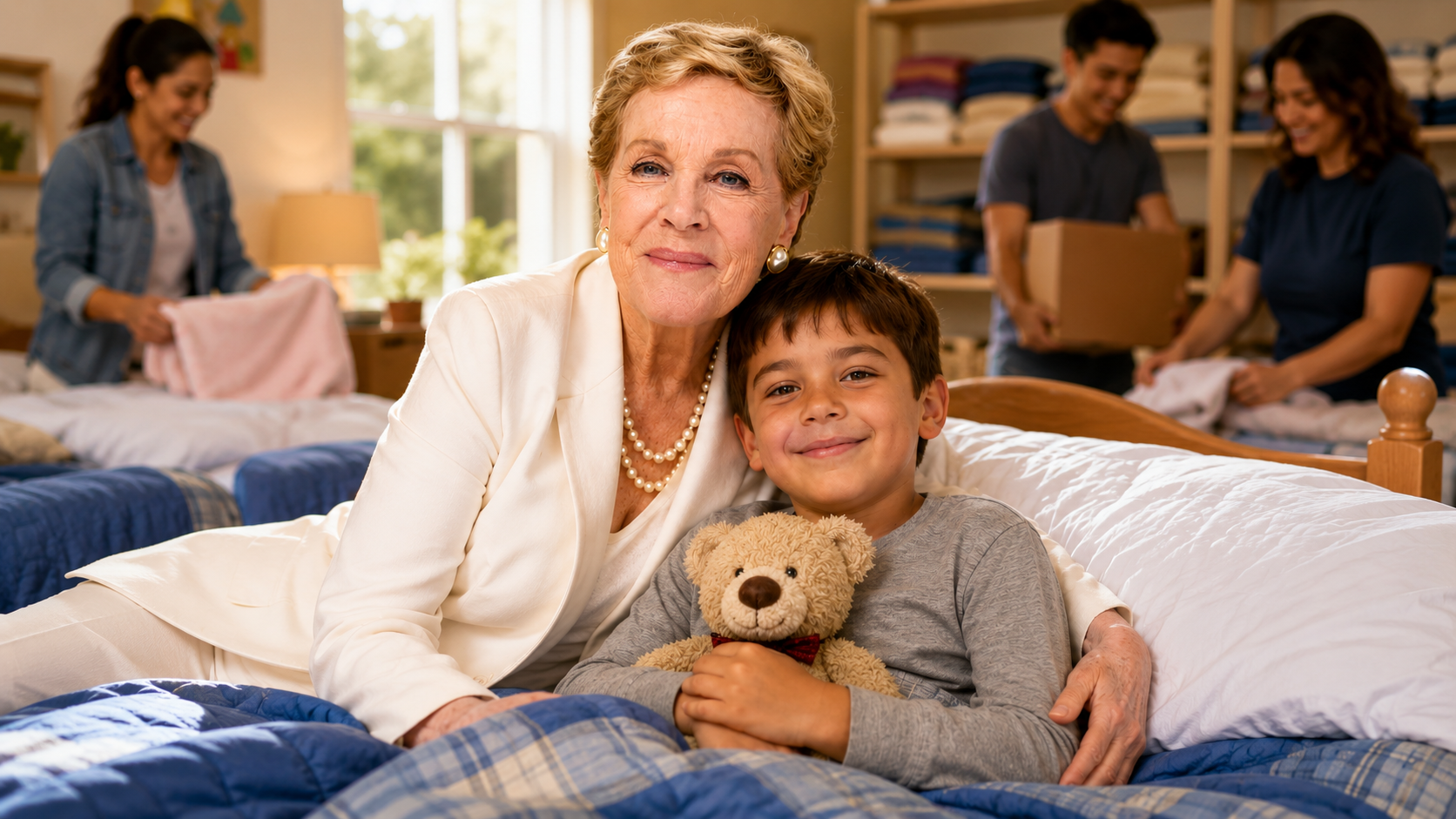
Julie helped place blue sheets over the mattress.
Claire added a warm quilt donated by an elderly woman who had sewn it by hand.
Finally, they placed a pillow at the top.
Noah climbed onto the mattress.
He bounced once.
Then twice.
Everyone laughed.
But suddenly Noah became very still.
He ran his hands across the blanket.
Rachel stood near the doorway wiping tears from her cheeks.
“You like it?” she asked.
Noah nodded.
“I’ve never had my own bed before.”
The room fell quiet.
Julie sat beside him.
“What do you think you’ll dream about tonight?”
Noah considered the question carefully.
Then he said something nobody in that room expected.
“I don’t want to dream about anything for me.”
Julie tilted her head.
“What would you like to dream about?”
Noah looked toward the volunteers standing around his new bed.
“I want every kid from the shelter to have one too.”
Rachel covered her mouth.
Claire looked down.
Noah continued.
“There was a little girl named Mia who slept beside her mom near us. She always asked if we’d have beds when we got houses.”
He looked at Claire.
“Does Mia have one yet?”
Claire knew the name.
Mia was number thirty-eight on the waiting list.
She shook her head gently.
“Not yet.”
Noah looked at his beautiful new bed.
Then he asked:
“Could you give mine to her?”
Nobody answered.
Rachel began crying openly.
Julie took Noah’s small hand.
“This bed belongs to you,” she said softly.
“But what if,” she continued, “we find another way to get Mia hers?”
Noah looked hopeful.
“Tomorrow?”
Claire’s heart sank.
There simply wasn’t enough money.
They couldn’t promise tomorrow.
Julie looked around the room.
Perhaps she saw the disappointment on Claire’s face.
Perhaps she understood that Noah’s question was bigger than one little girl’s bed.
She squeezed his hand.
“We’ll see what kindness can do.”
Before leaving, Julie asked Rachel’s permission to share Noah’s wish with people who might want to help.
Rachel agreed.
That evening, Claire wrote a short message about the visit.
She didn’t focus on Julie.
She didn’t focus on the charity.
She simply told people what Noah had said:
An eight-year-old boy who had spent months without a bed finally received one—and his first wish was that another child could have one too.
Julie shared the message through the fictional community surrounding the project.
Claire hoped perhaps enough donations would arrive to buy Mia a mattress.
By bedtime, seventeen people had offered to help.
By midnight, there were hundreds.
The next morning, Claire arrived at the warehouse and stopped outside.
Cars filled the parking lot.
People were carrying mattresses.
Others brought pillows.
A furniture company had sent a truck.
A carpenter had arrived with six workers.
Students were unloading boxes of sheets.
And taped to the warehouse door was a child’s handwritten sign:
“NO KID SHOULD SLEEP ON THE FLOOR.”
Claire stood staring at it.
Julie arrived moments later.
“How many children are on your waiting list?” she asked.
Claire looked down at the paper in her hands.
“Sixty-three.”
Julie smiled toward the crowd gathering outside.
“Then I think we’d better get started.”
But neither woman yet understood how far Noah’s bedtime wish was about to travel.
Because among the volunteers arriving that morning was someone Claire had never met—a man carrying an old photograph and a letter he had kept for nearly twenty years.
And what he was about to reveal would transform Dream Again Beds from a small neighborhood project into something none of them had imagined.
Part 2
The man standing outside the warehouse looked to be in his late forties.
His name was Daniel Harris.
He carried no mattress.
No toolbox.
No bags of bedding.
Only a worn envelope and a faded photograph.
Claire noticed him because he had been standing near the entrance for nearly twenty minutes, watching volunteers move in and out.
Finally, she approached him.
“Can I help you?”
Daniel nodded.
“I think I’m here because of that little boy.”
Claire understood immediately.
“Noah?”
Daniel looked down at the photograph in his hand.
“Yes.”
Then he gave her the picture.
Claire studied it.
It showed two children sitting on the floor of an almost-empty apartment.
One was a boy around ten.
The other was a little girl wrapped in a blanket.
There were no beds.
No furniture.
Only two pillows pushed against the wall.
“That’s me,” Daniel said.
Claire looked up.
“And that’s my younger sister, Emily.”
He took a breath.
“When I was ten, my mother got us out of a shelter and into an apartment. It looked almost exactly like the one you described in the story.”
Claire listened quietly.
“We slept on the floor for almost six months.”
Daniel smiled faintly.
“I remember telling my mother I didn’t mind. But I did.”
His voice weakened.
“I hated nighttime.”
Julie had walked closer and was listening now too.
Daniel continued.
“Then one December, a woman from a church brought us two used bed frames, two mattresses, and blankets.”
He held out the old envelope.
“She also gave me this.”
Inside was a yellowed card.
The handwriting had faded, but the words were still readable.
Every child deserves a safe place to rest.
Daniel swallowed.
“I kept it all these years.”
Claire felt a chill.
The sentence was so similar to the message she placed on the pillows at Dream Again Beds.
“Did you ever find the woman who gave you the beds?” Claire asked.
Daniel nodded.
“Once.”
His eyes filled with tears.
“She died years ago.”
Then he smiled.
“Her name was Margaret Bennett.”
Claire stopped breathing.
“Bennett?”
Daniel nodded.
“Yes.”
Claire slowly sat down on a nearby box.
Margaret Bennett had been her grandmother.
Claire had grown up hearing stories about her grandmother’s kindness.
Margaret had delivered groceries to struggling families.
She had paid utility bills anonymously.
She had spent winters collecting coats and blankets.
But Claire had never known about the beds.
“My grandmother did that?” she whispered.
Daniel nodded.
“She told my mother something I never forgot.”
Claire looked at him.
“What?”
Daniel smiled.
“She said, ‘A home doesn’t begin with furniture. It begins when someone inside finally feels safe.'”
Claire covered her face.
For years, she had wondered why the idea of children sleeping on floors bothered her so deeply.
Why she couldn’t simply walk away.
Now she understood.
Perhaps kindness had quietly traveled through her family without anyone realizing it.
Julie rested a hand gently on Claire’s shoulder.
“Sometimes,” she said, “the good we inherit isn’t something we can put in a bank.”
Claire laughed through her tears.
Daniel reached into his coat.
“I didn’t only come to tell you this.”
He handed Claire another envelope.
Inside was a check.
Claire stared at the amount.
It was enough to purchase dozens of mattresses.
“I own a construction company now,” Daniel explained.
“We build apartment complexes.”
He looked around the warehouse.
“And from today onward, every time one of our developments is completed, my company will donate beds to this program.”
Claire couldn’t speak.
Daniel smiled.
“Your grandmother helped me stand up when my family had nothing.”
He looked toward the volunteers.
“I think it’s my turn.”
The news spread quickly.
But again, it wasn’t Julie’s presence that inspired people most.
It was the chain.
Margaret had helped Daniel.
Daniel had grown up and helped Claire.
Claire had helped Noah.
Noah had wished for a bed for Mia.
And suddenly hundreds of strangers wanted to become the next link.
A local mattress company pledged fifty new mattresses.
A furniture warehouse donated frames.
A textile company offered sheets and blankets.
A group of high school students began assembling bedside tables.
Retired carpenters volunteered every Saturday.
A laundromat owner offered to wash donated blankets for free.
A delivery company provided trucks.
And families who had once received beds returned to help deliver them to others.
Within two weeks, Claire’s waiting list had disappeared.
Every child had a bed.
Including Mia.
On the afternoon Mia’s bed arrived, Noah came along.
He carried a small stuffed rabbit.
It had belonged to him since he was five.
Rachel had asked twice whether he was certain he wanted to give it away.
Noah had nodded both times.
“Mia needs someone to sleep beside her.”
They reached a small apartment on the other side of town.
Mia’s mother opened the door.
When Mia saw Noah, she screamed his name.
“Noah!”
They hugged like old friends.
Then volunteers carried the bed into her room.
Mia followed every piece.
The frame.
The mattress.
The sheets.
The pillow.
Finally, Claire placed a card on top.
Tonight, you have a safe place to dream.
Mia climbed onto the bed and hugged the stuffed rabbit Noah had brought.
“You remembered me,” she said.
Noah shrugged.
“You were my friend.”
As the adults watched from the doorway, Mia looked at Julie.
“Did Noah buy this bed?”
Julie smiled.
“No.”
“Did you?”
Julie shook her head.
“Not exactly.”
Mia looked confused.
“Then who did?”
Julie glanced around the room at Noah, Rachel, Claire, Daniel, and the volunteers.
“A lot of people.”
Mia thought about that.
Then she asked:
“Why?”
Julie knelt beside the bed.
“Because Noah reminded them that children shouldn’t have to worry about where they’re going to sleep.”
Mia looked at Noah.
“You’re famous now?”
Everyone laughed.
Noah shook his head quickly.
“No.”
Then he pointed to her new bed.
“I just wanted you to have this.”
Months passed.
Dream Again Beds outgrew its warehouse.
The city offered an unused community building at a reduced rent.
Volunteers painted the walls.
Local businesses donated shelving.
Someone created an online system connecting families, housing organizations, and donors.
Soon, neighboring towns began asking how they could start programs of their own.
Claire created a simple guide.
It explained how to find families.
How to source safe new mattresses.
How to organize volunteers.
How to partner with shelters.
Most importantly, it emphasized dignity.
Families were never photographed without permission.
Children were never treated like charity projects.
Every delivery was meant to feel like a welcome home.
Julie remained involved quietly.
She occasionally visited volunteer days.
She wrote thank-you notes.
She encouraged supporters.
But she repeatedly insisted that the story belonged to Claire, Noah, and the community.
One afternoon, a reporter asked her why she had become involved.
Julie replied:
“I didn’t create this kindness. I simply had the privilege of witnessing it.”
Then she pointed toward a group of volunteers assembling beds.
“Look around. That’s what happens when one person’s compassion gives another person permission to care.”
One year after Noah received his first bed, Claire organized a community dinner.
Hundreds attended.
Families who had received beds sat beside volunteers who had built them.
Daniel came with his wife and children.
Mia came carrying the same stuffed rabbit Noah had given her.
And Noah arrived wearing a shirt that was slightly too big for him because he was growing quickly.
Claire stood at the front of the room.
Behind her was a simple board containing numbers from the previous year.
1,214 beds delivered.
37 community partners.
More than 900 volunteers.
But Claire said the numbers weren’t the most important thing.
She invited Noah forward.
He looked terrified.
Julie whispered something to him before he walked onto the small stage.
Whatever she said made him smile.
Claire handed him the microphone.
“Do you remember what you wished for the first night you got your bed?”
Noah nodded.
“I wanted the kids from the shelter to have beds too.”
“Did you think all this would happen?”
He looked around at the crowded room.
“No.”
Everyone laughed.
Claire smiled.
“What do you think now?”
Noah thought for a moment.
Then he said:
“I think wishes work better when lots of people help.”
The room became silent.
Julie looked down, smiling.
Daniel wiped his eyes.
Rachel pressed both hands over her heart.
Then Noah added something else.
“I used to think having your own bed meant you weren’t homeless anymore.”
He paused.
“But now I think having people care about you is part of having a home too.”
Claire stepped toward him and hugged him.
The audience rose to its feet.
Not for Julie.
Not for Claire.
Not even for Noah alone.
They stood for every person who had chosen to become part of the chain.
Later that evening, Julie found Noah sitting quietly near the edge of the room.
“Are you tired?” she asked.
“A little.”
“Big day.”
He nodded.
Then he looked at her.
“Do you remember asking what I wanted to dream about?”
“I do.”
Noah smiled.
“I know now.”
“What?”
He looked across the room.
Mia was laughing with other children.
Volunteers were exchanging phone numbers.
Families were signing up to help with future deliveries.
Daniel was showing Claire plans for a larger workshop.
Noah pointed toward them.
“That.”
Julie looked around.
“All of this?”
Noah nodded.
“I think that’s what I wanted.”
Julie smiled.
“Then perhaps you weren’t dreaming after all.”
That night, Noah went home and climbed into the same bed that had started everything.
The sheets were different now.
The quilt had been washed many times.
The stuffed rabbit was gone.
But the handwritten card still sat inside the drawer beside him.
Tonight, you have a safe place to dream.
Rachel turned off the light.
“Goodnight, sweetheart.”
“Goodnight, Mom.”
As she began closing the door, Noah called out.
“Mom?”
“Yes?”
“Do you think Grandma Margaret knew what would happen when she gave those kids beds?”
Rachel smiled.
“Probably not.”
Noah thought about that.
Then he pulled the blanket closer.
“That’s kind of cool.”
“What is?”
“You can do something good and not even know how far it’ll go.”
Rachel stood quietly in the doorway.
“Yes,” she said. “That’s exactly right.”
And somewhere across the city, another child climbed into a new bed for the very first time.
Then another.
And another.
All because one child, after finally receiving something he desperately needed, looked beyond himself and asked a simple question:
What about the others?
Sometimes a community doesn’t need a complicated plan to begin changing lives.
Sometimes it only needs one person willing to notice.
One person willing to help.
And one small wish generous enough to remind everyone else that kindness is meant to be passed on.
The End.


