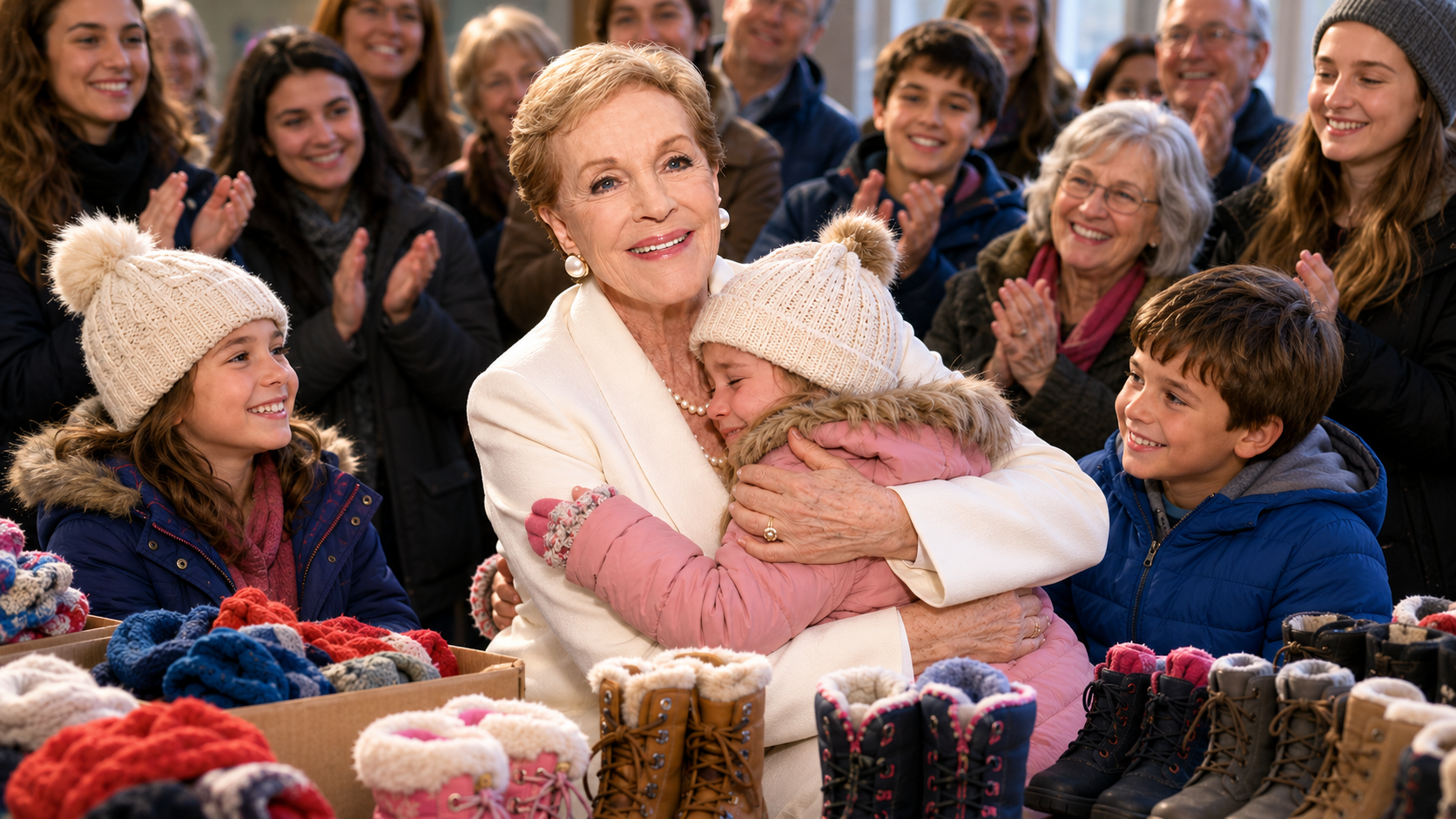
Part 1: The Woman Who Never Let a Child Walk in the Cold
Every winter, Margaret Ellis made the same promise to herself.
No child in her town should have to walk to school with freezing feet.
Margaret was seventy-six years old and lived alone in a modest little house at the edge of a small English town. She had spent more than thirty years working as a primary school secretary.
She had never earned much.
Her retirement pension was modest.
And yet, every November, Margaret opened the little notebook she kept beside her kitchen table and began doing the same calculations.
Heating.
Electricity.
Food.
Medicine.
Bus fare.
And then, at the bottom of the page, she wrote one final word.
Boots.
That was the expense Margaret cared about most.
It had begun nearly twenty years earlier.
One bitter December morning, Margaret had been helping children into school when she noticed an eight-year-old boy named Daniel standing near a radiator.
His trousers were wet around the ankles.
His shoes were soaked through.
Margaret crouched beside him.
“Daniel, where are your boots?”
The boy looked embarrassed.
“Mum says these are still good.”
Margaret looked down.
The soles were separating from the shoes.
One of his socks was visible through a hole.
That afternoon, Margaret quietly went into town and bought Daniel a pair of warm winter boots.
She placed them in a plain paper bag.
When she handed them to him the following morning, Daniel stared inside.
Then he looked at Margaret.
“Are these really mine?”
“They are.”
Daniel hugged the boots against his chest.
Margaret expected him to smile.
Instead, he began crying.
She immediately knelt beside him.
“What is it?”
Daniel wiped his face with his sleeve.
“My little sister needs some too.”
Margaret never forgot those words.
The following weekend, she bought another pair.
Then a teacher mentioned two other children who needed proper shoes.
Margaret bought theirs too.
Word slowly spread among the staff.
But Margaret insisted on one rule.
No child should ever be made to feel like a charity case.
The boots were never presented publicly.
There were no photographs.
No announcements.
No names posted on noticeboards.
Sometimes a teacher quietly slipped a box beneath a child’s desk.
Sometimes Margaret left a bag beside a family’s front door.
Sometimes she simply told a child that a local shop had “an extra pair.”
The children didn’t need to know where the money came from.
Margaret believed dignity was part of the gift.
Years passed.
She retired.
But the boots continued.
Every autumn, Margaret called local schools.
“Any little feet we need to keep warm this year?”
Teachers knew exactly what she meant.
By then, Margaret was living on her pension.
Her daughter, Claire, occasionally worried about her.
“Mum, you need that money too.”
“I have enough.”
“You say that every year.”
Margaret would smile.
“I have a roof. I have food. I have warm slippers. What more do I need?”
Claire once discovered that Margaret had turned the heating down slightly so she could afford four additional pairs of children’s boots.
That finally caused an argument.
“You cannot sit here cold so somebody else’s child can be warm.”
Margaret looked at her daughter for a moment.
Then she said quietly:
“I know what cold feet feel like.”
Claire stopped.
Margaret rarely spoke about her childhood.
But that evening, she finally explained.
She had grown up in a struggling family.
One winter, when Margaret was nine, her only shoes had cracked across the soles.
Her mother stuffed newspaper inside them to block the snow.
Every morning, Margaret walked almost two miles to school.
By the time she arrived, her socks were wet.
Her toes hurt so badly she sometimes cried in the bathroom where nobody could see her.
Then one morning, a pair of boots appeared beside her classroom chair.
Brand new.
Brown leather.
Warm lining.
No note.
No explanation.
Margaret never discovered who had bought them.
“I remember putting my feet inside,” she told Claire, “and thinking somebody in the world had noticed me.”
Her voice trembled.
“I’ve spent my life trying to be that somebody for another child.”
Claire never argued about the boots again.
Instead, she started helping.
Over the years, Margaret became known quietly among teachers as the Boot Grandmother.
But outside those schools, almost nobody knew.
Certainly not Julie Andrews.
That changed because of a letter.
A teacher named Rebecca had learned about Margaret’s work and decided that someone should know what this elderly woman had been doing.
She wrote to Julie Andrews, explaining that Margaret had adored her films and music for decades.
Rebecca didn’t ask for money.
She didn’t ask for publicity.
She simply wrote:
“Margaret believes kindness should be quiet. But after nearly twenty years, I think someone should remind her that quiet kindness still echoes.”
The letter eventually reached Julie.
She read it twice.
Then she asked one question.
“How many children?”
Nobody knew exactly.
Teachers began checking old records.
Former staff members searched notebooks.
Claire found receipts Margaret had saved in envelopes.
The estimate stunned everyone.
Over nearly twenty years, Margaret had helped provide winter footwear to more than 600 children.
Some years she bought five pairs.
Other years, twenty.
Occasionally local shopkeepers secretly added discounts when they realized what she was doing.
But Margaret never stopped.
Julie wanted to meet her.
There was one problem.
Margaret hated attention.
So they devised a surprise.
Rebecca told Margaret that the town hall was holding a small winter charity afternoon for retired school staff.
Margaret reluctantly agreed to attend.
When she arrived, there were perhaps thirty people inside.
Tea was served.
Children sang two songs.
Margaret sat quietly near the back.
Then the room suddenly became silent.
Someone walked through a side door.
Margaret stared.
Her hand rose slowly toward her mouth.
Julie Andrews was standing there.
For several seconds, Margaret didn’t move.
Julie crossed the room and took her hands.
“I’ve heard,” Julie said softly, “that you’ve spent many years making sure children could walk through winter without being cold.”
Margaret’s eyes filled with tears.
“Oh, goodness,” she whispered. “Who told you?”
Laughter moved gently through the room.
Julie smiled.
“Apparently, quite a few people.”
Margaret shook her head.
“It wasn’t anything extraordinary.”
Julie looked at her.
“Perhaps extraordinary things don’t always look extraordinary to the person doing them.”
Margaret tried to change the subject.
But Julie had another surprise.
She asked Margaret to come to the front.
Behind the stage curtain stood a large display containing dozens of new children’s winter boots donated by local businesses.
Margaret covered her face.
Julie explained that enough boots had been donated to help children across several nearby schools that winter.
Margaret could barely speak.
“This means I can keep my heating on,” she finally joked through tears.
Everyone laughed.
Claire cried.
Julie hugged Margaret.
But that wasn’t the real surprise.
Not yet.
Julie turned toward her.
“Margaret, there is something else.”
The doors at the back of the hall opened.
A man in his thirties stepped inside.
Then a woman carrying a baby.
Then another man.
Then two sisters.
Then a young teacher.
Then a firefighter.
Margaret looked confused.
More people entered.
Dozens.
Then scores.
People began filling every available chair.
Others stood along the walls.
Margaret turned toward Julie.
“Who are they?”
Julie smiled but didn’t answer.
A man near the front stepped forward.
He was tall now, with streaks of gray beginning near his temples.
But when Margaret looked into his face, something changed.
She recognized his eyes.
The man smiled.
“Hello, Mrs. Ellis.”
Margaret’s lips parted.
“Daniel?”
He nodded.
The little boy with the broken shoes was now a grown man.
And he was holding something in his hands.
An old pair of brown children’s boots.
Margaret began to cry.
Daniel walked toward her.
“I kept them,” he said.
Then he looked toward the crowded hall.
Margaret followed his gaze.
Hundreds of people were now standing.
Some held photographs.
Some held old thank-you cards.
A few were holding worn children’s boots their parents had saved.
Daniel turned back to Margaret.
“These people aren’t here because they heard about what you did.”
He paused.
“They’re here because they’re the children you did it for.”
Margaret stared across the hall.
Faces from twenty winters.
Children who had once arrived at school with wet socks and worn-out shoes were now adults.
Parents.
Teachers.
Nurses.
Builders.
Shopkeepers.
Students.
And they had all returned for one reason.
To thank the grandmother who had once made them feel noticed.
But as Daniel reached into his coat and removed a folded piece of paper, Julie realized the reunion had one final surprise.
A surprise even Margaret’s daughter didn’t know about.
Daniel looked at the woman who had bought his first warm boots nearly twenty years earlier.
“Mrs. Ellis,” he said, his voice breaking, “we didn’t come here only to say thank you.”
He unfolded the paper.
“We came to tell you what your kindness became.”
Part 2: What Her Kindness Became
Daniel stood at the front of the crowded hall with the folded paper trembling slightly in his hands.
Margaret sat beside Julie Andrews, still trying to understand what she was seeing.
Hundreds of former children.
Hundreds of lives.
All connected by something as simple as a warm pair of boots.
Daniel took a breath.
“Mrs. Ellis,” he began, “when I was eight years old, I thought you gave me shoes.”
He looked down at the little brown boots he had carried into the hall.
“But you gave me something much bigger.”
Margaret wiped her eyes.
Daniel continued.
“My family was struggling badly that winter. My mum was working two jobs. Some nights, she skipped dinner so my sister and I could eat.”
The room became completely still.
“At school, I was embarrassed all the time. I thought everybody could tell we had no money.”
He looked toward Margaret.
“Then you gave me those boots without asking me questions. You never made me stand in front of anyone. You never made me explain why I needed help.”
His voice cracked.
“You made me feel normal.”
Margaret covered her mouth.
Daniel smiled through his tears.
“That mattered more than you probably ever knew.”
He unfolded the paper.
“After Rebecca contacted some of us, we started looking for other people who remembered receiving boots from you.”
One former student found another.
Then another.
Messages spread through old school groups.
Teachers contacted families.
Parents searched through photographs.
Within weeks, they had found hundreds.
And when people began sharing their memories, something unexpected happened.
They discovered that many had carried Margaret’s kindness into their own lives.
Daniel pointed toward a woman standing near the aisle.
“That is Sarah.”
Sarah stepped forward.
“When I was eleven, Mrs. Ellis gave me black school boots,” she said. “Now I run a small children’s clothing shop.”
She smiled at Margaret.
“For the last six years, I’ve quietly kept a shelf in the back for families who can’t afford coats or shoes.”
Margaret stared at her.
“I never knew.”
Sarah smiled.
“That was the point.”
Soft laughter moved through the room.
Then another man stepped forward.
His name was Thomas.
Margaret vaguely remembered him as a quiet boy who always carried library books.
Thomas was now a paramedic.
“When I received boots from you, my dad had just lost his job,” he said.
He paused.
“Years later, I started putting a little money aside every month to help families I meet through community programs.”
A teacher named Emily spoke next.
Then a mechanic.
Then a nurse.
Then a father of three.
Again and again, the stories followed the same pattern.
Someone had once helped them quietly.
So years later, they had helped someone else.
Margaret began shaking her head.
“I only bought boots.”
Julie turned toward her.
“No,” she said gently.
“You started a chain.”
Margaret looked across the hall.
For the first time, she understood.
Her kindness had not ended when the boots wore out.
It had traveled.
One child became an adult who helped another family.
That family helped someone else.
A small act performed quietly twenty years earlier had moved through people Margaret had never met.
Daniel raised the paper again.
“That is why we created something.”
Two volunteers brought a wooden sign onto the stage.
Margaret read the words.
THE WARM STEPS FUND
Her eyes widened.
Daniel explained.
Former recipients had contributed whatever they could.
Some gave $10.
Some gave $20.
Others donated more.
Local businesses joined them.
A shoe manufacturer offered discounted winter footwear.
Several schools agreed to identify children who needed help discreetly.
By the evening of the surprise, the fund had raised enough money to provide thousands of pairs of winter shoes over the coming years.
Margaret began crying again.
“No,” she whispered.
Daniel knelt beside her.
“Yes.”
“But my name shouldn’t be on anything.”
“It isn’t.”
Margaret looked confused.
Daniel smiled.
“You taught us that the child matters more than the person giving.”
So the program would follow Margaret’s old rule.
No public photographs of children receiving help.
No embarrassing announcements.
No labels.
No child would ever be asked to stand in front of classmates and say thank you.
The shoes would simply arrive.
Quietly.
With dignity.
Margaret squeezed Daniel’s hand.
“That’s exactly right.”
Julie watched the exchange with tears in her own eyes.
Then Daniel reached into his coat again.
“There is one more thing.”
Margaret laughed through her tears.
“Oh, please. I don’t think my heart can manage another thing.”
Everyone laughed.
But Daniel’s expression became serious.
“Do you remember telling Claire about the boots you received when you were nine?”
Margaret froze.
Claire looked toward Daniel.
“How do you know about that?”
Daniel explained that while organizing the surprise, he had become curious.
Margaret had spent her whole life helping children because someone had once helped her.
But she had never known who.
So Daniel began searching.
It wasn’t easy.
More than sixty years had passed.
The old school building had closed.
Several teachers had died.
Records were incomplete.
Still, Daniel refused to stop.
Eventually, he found an elderly woman named Patricia living in a retirement home about forty miles away.
Patricia had once been a young classroom assistant at Margaret’s school.
Daniel visited her.
He asked whether she remembered a nine-year-old girl arriving at school with newspaper stuffed inside broken shoes.
Patricia remembered immediately.
Margaret leaned forward.
Daniel’s voice became quieter.
“Patricia told me that one morning, the head teacher noticed you crying because your socks were soaked.”
Margaret’s eyes filled with tears.
“The head teacher wanted to help, but she knew your mother would have been embarrassed if charity was offered openly.”
So someone bought a pair of boots.
Margaret whispered.
“Who?”
Daniel looked toward the entrance.
The doors opened.
An elderly woman in a wheelchair was gently brought into the room.
Margaret stared.
The woman was ninety-two years old.
She smiled warmly.
Margaret didn’t recognize her.
Daniel explained.
“This is Patricia.”
Patricia held a small envelope in her lap.
Julie helped Margaret stand.
Slowly, Margaret walked toward her.
Patricia reached for Margaret’s hand.
“I wasn’t the one who bought your boots,” she said.
Margaret nodded.
“I understand.”
“But I know who did.”
Patricia opened the envelope.
Inside was an old black-and-white photograph.
It showed several teachers standing outside Margaret’s childhood school.
Patricia pointed toward a young woman near the center.
“Her name was Miss Eleanor Price.”
Margaret stared at the photograph.
The name returned from somewhere deep inside her memory.
“She taught music.”
Patricia smiled.
“Yes.”
Margaret remembered her.
Miss Price had been gentle.
Quiet.
Always encouraging children who were shy.
“She bought the boots,” Patricia said.
Margaret began crying.
“But why didn’t she tell me?”
Patricia smiled.
“Because she said something I’ve remembered my entire life.”
Everyone leaned closer.
Patricia continued.
“She said, ‘A child should remember the warmth, not the charity.’”
Margaret closed her eyes.
Those were almost the same words she had lived by for decades.
Without realizing it, she had copied the kindness of a teacher whose identity she never knew.
Julie placed a hand gently on Margaret’s shoulder.
Margaret looked around the hall.
For a moment, nobody spoke.
Then she laughed softly.
“All these years…”
She looked at the photograph again.
“I thought I invented my little rule.”
Patricia squeezed her hand.
“No, dear.”
“You inherited it.”
That sentence brought Margaret to tears again.
Daniel stepped closer.
“There is something else you should know.”
After Miss Price died, Daniel discovered that she had left no children of her own.
But according to Patricia, she had quietly bought coats, lunches, books, and shoes for struggling pupils throughout her teaching career.
Margaret stared at the photograph.
Suddenly everything felt connected.
Miss Price had helped Margaret.
Margaret had helped Daniel.
Daniel had helped others.
Hundreds of former recipients had now created the Warm Steps Fund.
One act of kindness had traveled across generations.
Nobody knew where the chain might end.
Perhaps it never would.
Julie looked at the people gathered in the hall.
“I think we sometimes imagine that changing the world requires something enormous,” she said.
“But perhaps the world changes most often through small things repeated with love.”
Margaret looked embarrassed by the attention.
“I still think they’re only boots.”
Daniel smiled.
“Maybe that’s why it worked.”
Over the following years, the Warm Steps Fund quietly expanded.
Schools joined.
Local shops participated.
Former recipients volunteered.
And every winter, boxes appeared where they were needed.
No cameras.
No ceremonies.
Just warm shoes waiting for children who needed them.
Margaret continued helping too.
Although everyone insisted she stop spending her pension.
She finally agreed.
Mostly.
Claire occasionally discovered a mysterious pair of gloves or a scarf hidden in Margaret’s shopping bag.
“Mum.”
Margaret would smile innocently.
“They were on sale.”
On Margaret’s eightieth birthday, dozens of letters arrived.
One was from a ten-year-old girl.
It contained only a few sentences.
Margaret read them several times.
Dear Warm Steps,
Thank you for my boots.
I don’t know who bought them.
But now I don’t hate walking to school when it rains.
When I grow up, I want to help somebody too.
Margaret folded the letter carefully.
Then she placed it inside the old photograph of Miss Eleanor Price.
She sat beside her window for a long time.
Outside, children were walking home from school.
Some wore bright red boots.
Some blue.
Some black.
Margaret couldn’t know which ones had come from the fund.
And that made her smile.
Because that was exactly how kindness was supposed to work.
Quietly.
Without demanding credit.
Without asking for applause.
Simply moving from one person to another.
Julie Andrews would later remember Margaret not because of how much money she gave.
Margaret never had much.
She remembered her because Margaret demonstrated something far more powerful.
You don’t need to be wealthy to make a difference.
You don’t need a large organization.
You don’t even need to know how far your kindness will travel.
Sometimes you simply notice the person standing in front of you.
And do what you can.
Because somewhere, perhaps decades later, the person you help may remember.
And they may become the person who notices someone else.
That was Margaret’s real legacy.
Not six hundred pairs of boots.
Not a charity fund.
Not a crowded hall full of people saying thank you.
Her legacy was hundreds of people who had learned one simple lesson:
When someone makes your road a little warmer, you can do the same for the next person walking behind you.
And somewhere each winter, another child opened a box containing a brand-new pair of boots.
They never knew Margaret Ellis.
They never knew Miss Eleanor Price.
They never knew the long chain of kindness that had placed those boots in front of them.
They only knew one thing.
Someone had noticed.
And for Margaret, that had always been enough.
The End.


