Part 1 — Seven No’s
Emily Carter knew the walk from the theater doors to the bus stop better than she knew some streets in her own neighborhood.
She had made that walk seven times.
And every time, she carried the same worn black folder beneath her arm.
Inside were sheet music, a résumé, a faded photograph, and seven audition notices.
Seven chances.
Seven disappointments.
Seven times she had stood beneath bright stage lights, taken a breath, and tried to prove that she belonged there.
And seven times, the answer had been no.
The latest rejection came on a rainy Thursday afternoon.
Emily was twenty-six, worked mornings at a small bakery, and spent nearly every spare dollar she had on singing lessons and transportation to auditions.
For years, performing had been the one dream she refused to give up.
But that afternoon felt different.
When the casting assistant stepped into the hallway and read the names of those invited back, Emily waited until the very end.
Her name never came.
Around her, some performers celebrated.
Others quietly collected their bags.
Emily simply stared at the floor.
She had auditioned for this particular production every year since she was nineteen.
The first time, she had been told she lacked experience.
The second time, she was told her voice needed more control.
The third time, the casting team wanted someone older.
The fourth time, someone younger.
The fifth time, they said she had improved enormously but still was not quite right.
The sixth time, she reached the final round before losing the role.
And now came number seven.
This time there was almost no explanation at all.
“Thank you for coming.”
Four words.
Emily walked outside into the rain.
She didn’t open her umbrella.
For several blocks, she simply walked.
By the time she reached a little café near the theater district, her coat was soaked and the edges of her audition folder were curling.
She ordered tea she barely touched and sat at a small table near the window.
For the first time in seven years, Emily admitted something to herself.
Maybe everyone else had been right.
Maybe determination wasn’t enough.
Maybe some dreams weren’t meant to happen.
She pulled a folded piece of paper from her bag.
It was the announcement for next year’s audition.
She had printed it weeks earlier.
Emily stared at it for several seconds.
Then she quietly tore it in half.
“Seven times is enough,” she whispered.
A woman seated at a nearby table happened to hear her.
Emily didn’t notice at first.
She was too busy gathering the torn pieces of paper.
Then a gentle voice spoke.
“Seven times?”
Emily looked up.
For a moment, she couldn’t answer.
Sitting only a few feet away was someone whose face she recognized instantly.
Julie Andrews.
Emily blinked several times, wondering whether exhaustion was playing some strange trick on her.
Julie smiled warmly.
“I hope you’ll forgive me,” she said. “I didn’t mean to overhear.”
Emily suddenly became embarrassed.
“I’m sorry. I was talking to myself.”
“I’ve done that plenty of times,” Julie replied with a small laugh. “Sometimes we’re the only people who will listen.”
Emily smiled despite herself.
Julie glanced toward the torn paper.
“Was it an audition?”
Emily nodded.
“The same one.”
“For the seventh time?”
Another nod.
Julie was silent for a moment.
She didn’t immediately offer advice.
She didn’t tell Emily that everything happened for a reason.
She didn’t promise that success was around the corner.
Instead, she asked a simple question.
“Why did you come back the second time?”
Emily hadn’t expected that.
She thought carefully.
“Because I knew I could do better.”
“And the third?”
“Because I’d improved.”
“The fourth?”
Emily smiled faintly.
“Because I’m stubborn.”
Julie laughed.
“That can occasionally be useful.”
Emily looked down at her hands.
“After that, I suppose I kept thinking that maybe the next time would be different.”
Julie leaned forward slightly.
“And was it?”
Emily started to say no.
Then she stopped.
The first audition had lasted less than two minutes.
By the fifth, casting directors remembered her name.
At the sixth, she had reached the final round.
Her voice teacher had repeatedly told her that she was becoming stronger.
Even today, she’d sung better than she ever had before.
She simply hadn’t been chosen.
“I guess I’m different,” Emily admitted.
Julie nodded.
“That matters.”
Emily looked toward the rain outside.
“But I’m tired of getting rejected.”
“I imagine you are.”
“Seven times feels ridiculous.”
“Perhaps.”
Emily looked surprised.
She had expected encouragement, not agreement.
Julie continued gently.
“But sometimes the question isn’t whether you’ve failed seven times. The question is whether those seven attempts have made you better than the person who tried the first time.”
Emily didn’t speak.
Julie pointed toward the torn audition notice.
“You don’t have to try again.”
Emily looked at her.
“You really mean that?”
“Of course. Dreams shouldn’t become prisons. There is no shame in changing direction.”
Then Julie paused.
“But before you walk away, make certain you’re leaving because the dream no longer belongs to you—not simply because someone else hasn’t said yes yet.”
Those words stayed in the air between them.
Emily felt something inside her shift.
Not dramatically.
Not magically.
Just enough.
She told Julie about working at the bakery.
About practicing after exhausting shifts.
About the tiny apartment where she sang softly because the neighbors complained.
About the years she had spent wondering whether talent was something you either possessed or didn’t.
Then she admitted what frightened her most.
“What if I try an eighth time and fail again?”
Julie smiled.
“Then you’ll know you were brave enough to try eight times.”
Emily laughed nervously.
“That doesn’t sound very comforting.”
“It isn’t supposed to be.”
Julie reached for her tea.
“Courage isn’t knowing you’ll succeed. Courage is deciding that the possibility of failure isn’t going to make the decision for you.”
Emily looked again at the torn pieces of paper.
Julie continued.
“People sometimes tell stories about successful performers as though one wonderful opportunity appeared and everything changed overnight.”
She shook her head.
“Real lives are rarely so tidy.”
Emily listened closely.
“You will hear no more often than yes,” Julie said. “And sometimes the hardest rejection comes just before you’re ready to become the person who can handle the opportunity you’ve been asking for.”
Emily carefully placed the two torn pieces of the audition announcement together.
They no longer matched perfectly.
But the date could still be read.
The next audition was eleven months away.
“I don’t know whether I can do another year of this,” Emily admitted.
“Then don’t think about another year.”
Julie smiled.
“Think about tomorrow.”
“What do I do tomorrow?”
“Sing.”
Emily looked at her.
“That’s all?”
“That’s enough.”
Before leaving the café, Julie asked Emily for the torn audition notice.
Emily handed it over.
Julie borrowed a pen from the waiter and wrote something across the back.
Then she folded the pieces together and returned them.
Emily waited until Julie had walked away before opening them.
Across the torn page were eight handwritten words:
You are more than the answer you received today.
Below it, Julie had written:
Try once more—if the dream is still yours.
For the first time that afternoon, Emily cried.
But they weren’t the same tears she had shed outside the theater.
That evening, she placed the torn audition notice above the little piano in her apartment.
The next morning, she woke before sunrise.
She went to work.
She baked bread.
She served coffee.
She smiled at customers.
And that night, after her shift, she did exactly what Julie had told her.
She sang.
Over the next eleven months, Emily changed the way she prepared.
She stopped trying to imitate performers she admired.
She stopped choosing songs simply because she thought casting directors wanted to hear them.
She worked on telling a story rather than proving how powerful her voice could be.
She began exercising.
She took acting classes whenever she could afford them.
She practiced standing still on stage instead of nervously moving her hands.
And whenever doubt returned, she looked at the torn paper above her piano.
Still, as the eighth audition approached, fear returned stronger than ever.
Three days before the audition, Emily almost canceled.
The night before, she packed away her music twice.
Then she unpacked it again.
On the morning of the audition, she stood outside the same theater where she had been rejected seven times.
The same doors.
The same hallway.
The same stage somewhere beyond them.
Emily could hear performers warming up inside.
For several minutes, she couldn’t move.
Then she reached into her folder.
Julie Andrews’s message was still there.
The paper was soft from being unfolded so many times.
Emily read the final sentence once more.
Try once more—if the dream is still yours.
She closed her eyes.
It was.
Emily opened the theater door.
She signed her name at the registration desk.
Beside it, someone wrote:
Audition No. 8.
Several hours later, Emily walked onto the stage.
Three casting directors looked up from behind a long table.
One of them immediately recognized her.
“Emily Carter,” he said.
He glanced at the papers in front of him.
“You’ve been here before.”
Emily smiled.
“Yes.”
“How many times?”
She took a breath.
“Seven.”
The casting director raised his eyebrows.
“And you came back again?”
Emily thought about the rainy café.
The torn paper.
The woman who had reminded her that rejection wasn’t the same thing as worth.
“Yes,” Emily said.
Then the pianist placed his hands on the keys.
The room grew quiet.
Emily began to sing.
And before she reached the final note, something happened that had never happened during any of her previous seven auditions.
The casting director in the center slowly lowered his pen.
He wasn’t taking notes anymore.
He was simply listening.
When Emily finished, there was a long silence.
Then one of the judges leaned forward.
“Emily,” she said, “could you stay for a few minutes?”
Emily’s heart began pounding.
Because after seven years of hearing the same answer, she suddenly realized this audition was not going to end the way the others had.
Part 2 — The Eighth Time
Emily stood beneath the stage lights, trying not to read too much into the casting director’s words.
“Could you stay for a few minutes?”
It could mean anything.
Perhaps they wanted her to sing again.
Perhaps they needed clarification on her résumé.
Perhaps they were simply being polite before sending her home.
Seven rejections had trained Emily not to hope too quickly.
She stepped into the hallway and sat on the same wooden bench where she had waited so many times before.
Around her, performers came and went.
Some looked excited.
Others looked disappointed.
Emily stared at the black audition folder resting on her knees.
Inside was Julie Andrews’s message.
You are more than the answer you received today.
She repeated those words silently.
Twenty minutes passed.
Then thirty.
Finally, an assistant appeared.
“Emily?”
She stood immediately.
“The directors would like to see you again.”
Emily followed her back into the theater.
This time, only two people remained behind the long table.
The director in the center smiled.
“We’d like you to sing the final section again.”
Emily nodded.
The pianist began.
She sang.
When she finished, the director asked her to perform a short scene.
Then another.
Then he asked her to read with an actor who had already been called back.
By the time Emily finally left the stage, nearly two hours had passed.
No one had offered her a role.
But no one had rejected her either.
That alone felt different.
The next morning, Emily was slicing bread at the bakery when her phone rang.
She almost ignored it.
Then she noticed the theater’s number.
Her hands began shaking.
“Hello?”
“Emily Carter?”
“Yes.”
“This is Margaret Lewis from the production team.”
Emily gripped the counter.
“We’d like to invite you to the final callback tomorrow morning.”
For several seconds, Emily couldn’t speak.
“Emily?”
“I’m here.”
Margaret laughed gently.
“Can you make it?”
Emily looked around the bakery.
Her manager was watching from across the room.
He could somehow tell from her expression what had happened.
He pointed toward the door and mouthed:
Go.
Emily smiled.
“Yes,” she said into the phone. “I’ll be there.”
That evening, she barely slept.
The final callback was harder than anything she had done before.
The directors asked her to sing three songs.
She performed scenes with multiple actors.
She learned new choreography in less than an hour.
At one point, she forgot a line.
For a split second, panic took over.
Seven old failures seemed to rush back at once.
Then she remembered Julie’s words.
Courage was not knowing you would succeed.
It was refusing to let fear make the decision.
Emily took a breath.
She stayed in the scene.
She recovered.
And something surprising happened.
Instead of apologizing afterward, she simply smiled and continued.
By late afternoon, only four performers remained.
The director thanked them and said the final decision would be made that evening.
Emily went home.
She placed her phone on the kitchen table.
Then she paced.
She made tea.
She forgot to drink it.
She tried reading.
She read the same paragraph six times.
At 7:14 p.m., the phone rang.
Emily froze.
She answered on the second ring.
“Hello?”
“Emily?”
The director’s voice.
“Yes.”
There was a brief pause.
Then he said the words she had imagined hearing for seven years.
“We’d like to offer you the role.”
Emily covered her mouth.
She didn’t trust herself to speak.
“Emily?”
A laugh escaped through her tears.
“Yes.”
“Is that a yes?”
“Yes!”
The director laughed.
“Good. Rehearsals begin Monday.”
Emily sat down on the kitchen floor.
After the call ended, she stayed there for several minutes.
Then she cried harder than she ever had after any rejection.
Only this time, the tears were different.
Her first phone call was to her mother.
Her second was to her voice teacher.
Her third was to the bakery manager who had covered countless shifts for her.
But there was one person Emily desperately wanted to tell.
She had no phone number.
No address.
No way of knowing whether they would ever meet again.
So she wrote a letter.
It began:
Dear Julie,
You probably don’t remember me. We met in a café on a rainy afternoon. I had just failed my seventh audition. You told me to try again if the dream still belonged to me.
Emily paused.
Then she added:
It did.
She explained everything.
The eighth audition.
The callback.
The forgotten line.
The phone call.
At the bottom, she wrote:
Thank you for not promising me I would succeed. Thank you for reminding me that trying was still my choice.
She mailed the letter through Julie’s public correspondence address and expected nothing in return.
Rehearsals began.
Emily worked harder than she ever had.
She arrived early.
Stayed late.
Took notes.
Asked questions.
She knew getting the role did not mean the struggle was over.
It meant a new kind of work had begun.
Opening night came six weeks later.
Backstage, Emily stood in costume listening to the audience settle into their seats.
She felt terrified.
Then the stage manager approached.
“There’s something for you.”
He handed her a small cream-colored envelope.
Emily recognized the handwriting immediately.
Her hands trembled.
She opened it.
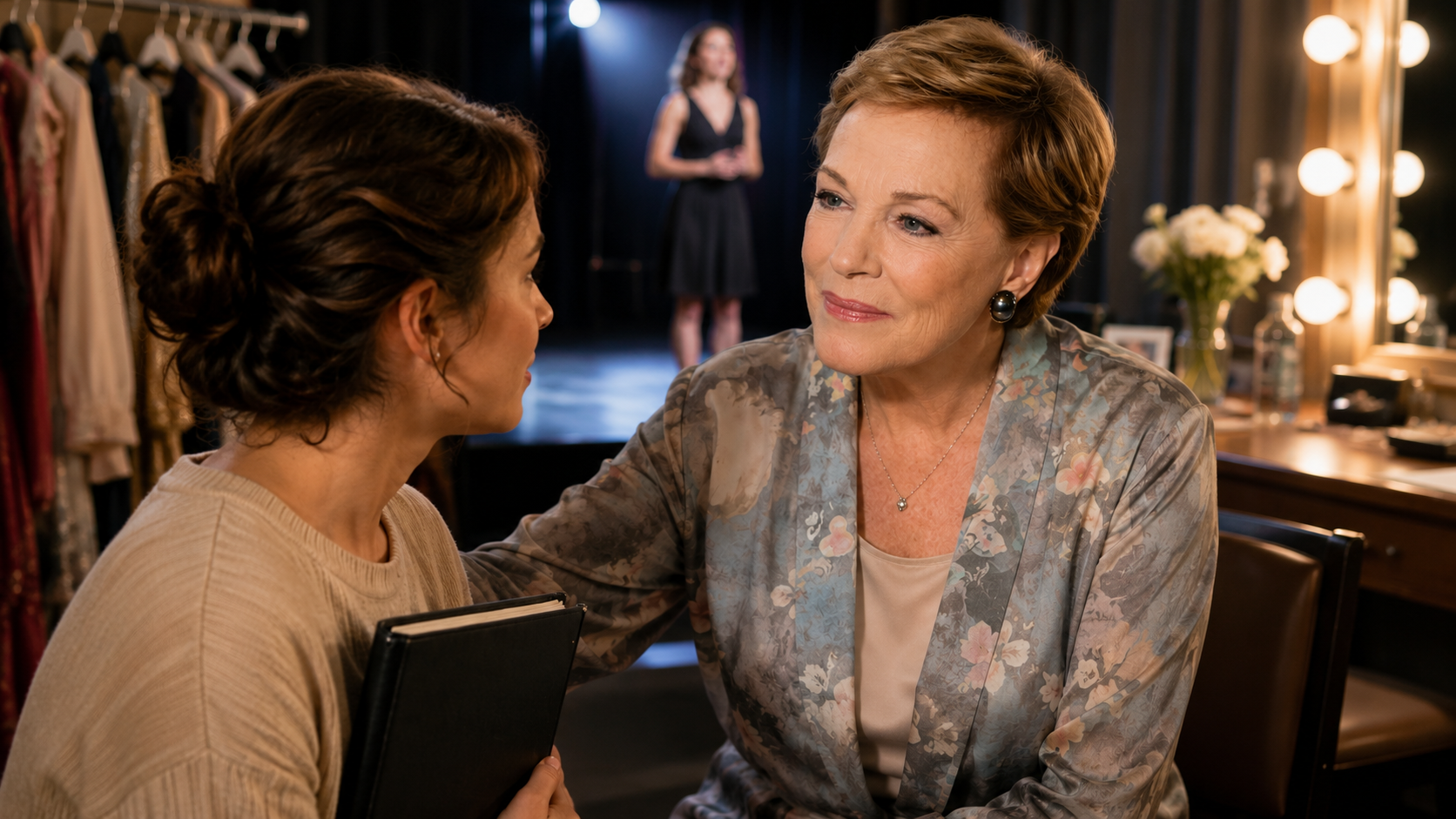
Inside was a short note.
Dear Emily,
Of course I remember you.
Emily stopped breathing for a moment.
She continued reading.
I was delighted to receive your letter. But please remember something important: I did not get you onto that stage. You did.
Seven disappointments prepared you. The eighth attempt revealed what you had already become.
Enjoy tonight. You earned the chance to stand there.
At the bottom were three final words:
Keep choosing courage.
Emily pressed the letter to her chest.
Then someone called:
“Places!”
She tucked the note inside her dressing-room mirror and walked toward the stage.
The curtain rose.
Emily stepped into the light.
This time, she wasn’t trying to prove that she belonged there.
She simply performed.
And for the first time in years, she enjoyed every second.
The production became a modest success.
Emily’s role wasn’t enormous.
Her name wasn’t above the title.
No newspapers called her an overnight star.
But something far more important happened.
She finally had a beginning.
One production led to another.
Then another.
She earned small television roles.
She performed in regional theaters.
She began helping younger performers prepare for auditions.
And whenever one of them became discouraged, Emily never said:
“You’ll definitely get it next time.”
Instead, she would ask:
“Do you still love it?”
When the answer was yes, she would smile.
“Then perhaps you aren’t finished yet.”
Three years later, Emily attended a charity event supporting arts programs for young performers.
Halfway through the evening, she heard a familiar voice behind her.
“Eight times, was it?”
Emily turned.
Julie Andrews stood there smiling.
For a moment, Emily was once again the frightened young woman sitting inside that rainy café.
Then she laughed.
“Eight.”
Julie opened her arms.
Emily hugged her.
“I’ve wanted to thank you properly for years,” Emily said.
Julie shook her head.
“You already did.”
“I don’t understand.”
“You went back.”
Julie smiled.
“That was thanks enough.”
Emily reached into her handbag.
She carried the torn audition notice with her whenever she attended an important performance.
The edges were nearly worn away.
Julie looked at it and laughed softly.
“You kept that?”
“I think I’ll keep it forever.”
They stood together quietly for a moment.
Then Emily said something Julie never forgot.
“I spent years thinking success meant finally hearing yes.”
Julie listened.
Emily continued.
“But now I think the most important moment happened before anyone said yes.”
“When?”
“When I decided that seven no’s weren’t going to become my answer for the rest of my life.”
Julie smiled.
“That sounds like something worth remembering.”
Years later, Emily framed three things together on the wall of her home.
Her first professional playbill.
Julie’s handwritten note.
And the torn announcement for the eighth audition.
Underneath, she placed one sentence of her own:
Sometimes the attempt that changes your life comes immediately after the one that almost convinced you to stop.
And whenever someone asked Emily how she finally succeeded, she never pretended it had been easy.
She told them about the rejection.
The doubt.
The embarrassment.
The rainy afternoon when she nearly walked away.
But she also told them about a quiet conversation with Julie Andrews.
A conversation that never promised fame.
Never promised applause.
Never promised success.
It simply reminded her that failure could close one door without deciding whether she was allowed to knock again.
And sometimes, Emily would smile and say:
“The eighth audition changed my career.
But choosing to walk through the door again changed me.”
The End.


