Part 1 — The Empty Storefront
For almost three years, the little storefront on Willow Street had stood empty.
Its windows were dusty. The old blue paint around the door was peeling, and a faded FOR RENT sign hung crookedly behind the glass.
Most people walked past without noticing it.
But every Saturday morning, a woman named Emily Carter stopped in front of it.
She would stand there for a few seconds, staring through the dusty window and imagining something completely different.
Not shelves filled with expensive products.
Not a fashionable boutique.
Not another café.
Emily imagined racks of children’s coats.
Shelves filled with shoes.
Boxes of clean socks and pajamas.
School uniforms arranged carefully by size.
And above the door, she imagined a simple sign:
THE LITTLE CLOSET
A place where struggling families could choose children’s clothing completely free.
It was a dream Emily had carried quietly for years.
And it had begun with a little red coat.
Emily worked as an assistant at an elementary school.
She wasn’t wealthy. She lived in a modest apartment and drove a car that seemed to need a new repair every few months.
But she loved her job because she loved the children.
Over the years, however, Emily began noticing something that troubled her.
Some children arrived at school wearing shoes that were too small.
Others wore the same clothes almost every day.
One little boy wore his older brother’s winter coat even though the sleeves hung far beyond his hands.
Another child came to school during freezing weather wearing only a thin sweatshirt.
Emily quietly started keeping spare clothing in a cabinet near her desk.
Whenever she found children’s clothes at yard sales or charity shops, she bought what she could.
She washed everything at home.
Then she folded the clothes carefully and placed them in the cabinet.
She never called it charity.
If a child needed something, Emily simply said,
“I think I have something here that might fit you.”
That way, nobody had to feel embarrassed.
Then one December morning, an eight-year-old girl named Sophie arrived at school without a proper winter coat.
Emily found a beautiful red coat in her cabinet.
It was secondhand, but it looked almost new.
When Sophie put it on, she stared at herself in the classroom mirror.
“Is this really mine?”
Emily smiled.
“If you’d like it.”
Sophie touched the soft collar.
Then she asked something Emily never forgot.
“Can my little sister have it when I grow out of it?”
Emily felt her throat tighten.
“Of course.”
Sophie smiled.
“Good. Because she doesn’t have a coat either.”
That evening, Emily sat alone at her kitchen table thinking about those words.
One coat.
Two children.
And probably hundreds of other families facing the same problem.
That was when The Little Closet became more than an idea.
Emily wanted to create a place where parents could walk in and choose what their children needed without paying anything.
No complicated forms.
No judgment.
No questions about why they needed help.
Just dignity.
There was only one problem.
Emily couldn’t afford a building.
For almost two years, she collected donations anyway.
Her apartment slowly filled with boxes.
Friends donated clothes.
Teachers donated shoes.
Parents whose children had grown older brought bags of jackets, jeans and school uniforms.
Soon Emily’s spare bedroom disappeared behind mountains of neatly labeled boxes.
Then someone told her about the empty storefront on Willow Street.
Emily contacted the owner.
The rent was far beyond anything she could afford.
She thanked him and hung up.
For several weeks, she considered abandoning the idea.
Then something unexpected happened.
A friend persuaded Emily to write about her dream in a small community newsletter.
Emily almost refused.
She wasn’t comfortable asking strangers for help.
But eventually, she wrote a short letter.
She described the children she had seen at school.
She described the little red coat.
And she ended with one sentence:
“Sometimes a child’s confidence can begin with something as simple as having shoes that fit.”
The newsletter reached only a few thousand people.
But one copy traveled much farther than Emily expected.
It eventually reached someone connected to Julie Andrews.
Julie was deeply moved by the idea.
She had heard about enormous charities and international campaigns throughout her life.
But there was something powerful about Emily’s simple dream.
One empty storefront.
One ordinary woman.
And hundreds of children who might someday walk through its doors.
Julie asked if she could meet her.
Emily initially thought the message was a joke.
Then the telephone rang.
A warm, unmistakable voice greeted her.
“Emily?”
Emily froze.
“Yes?”
“This is Julie Andrews.”
There was silence.
Then Emily whispered,
“Oh my goodness.”
Julie laughed gently.
“I hope I’m not calling at a terrible time.”
Emily looked around her apartment.
Boxes of children’s clothing were stacked everywhere.
“No,” she said. “Actually, you’re calling at exactly the right time.”
A few weeks later, Julie visited Willow Street quietly.
There were no cameras.
No red carpet.
Just Julie, Emily and two volunteers standing outside the abandoned storefront.
Emily unlocked the door.
The inside looked worse than Julie expected.
Dust covered the floor.
Several ceiling tiles were damaged.
The walls needed painting.
One light flickered constantly.
Emily looked embarrassed.
“I know it doesn’t look like much.”
Julie walked slowly through the empty room.
Then she stopped near the front window.
“I think it looks like possibility.”
Emily smiled.
Julie turned toward her.
“Show me where everything goes.”
Emily’s eyes widened.
“What?”
“Your dream,” Julie said. “Show me.”
For the next twenty minutes, Emily described everything she had imagined.
Coats along the left wall.
Shoes along the back.
Baby clothes near the front.
A children’s corner with books and toys so parents could shop peacefully.
And one special area containing brand-new socks, underwear and pajamas.
Julie listened carefully.
Then she asked,
“What is stopping you?”
Emily laughed softly.
“Money. Repairs. Rent. Shelving. Volunteers. Probably another twenty things I haven’t discovered yet.”
Julie nodded.
“Then perhaps we start with the first thing.”
Within days, things began changing.
Julie helped connect Emily with people willing to donate materials.
A local carpenter offered to build shelves.
A painter volunteered his crew for a weekend.
A hardware shop donated supplies.
A retired electrician repaired the lights.
Parents washed and sorted hundreds of donated garments.
Teenagers from the local high school spent Saturdays organizing shoes.
Julie even rolled up her sleeves and helped paint one of the walls herself.
Someone jokingly told her she had missed a spot.
Julie looked at the wall.
“Then clearly my future as a professional decorator is in jeopardy.”
Everyone laughed.
But behind the laughter, something remarkable was happening.
The forgotten storefront was coming alive.
Six weeks later, the transformation was almost complete.
The walls were warm and bright.
Children’s clothes hung neatly according to size.
Shoes filled carefully organized shelves.
There were winter coats, school uniforms, baby blankets and backpacks.
Near the entrance stood a small table containing children’s books.
Everything was free.
Emily refused to put price tags anywhere.
Instead, a small sign near the entrance read:
Take what your children need. Leave knowing your community cares.
The evening before opening day, Emily and Julie stood alone inside the finished center.
Emily looked around silently.
Then tears appeared in her eyes.
“I used to imagine this room while standing outside.”
Julie placed a hand gently on her shoulder.
“And tomorrow families will stand inside it.”
Emily nodded.
“I just hope people come.”
Julie smiled.
“They will.”
Neither woman knew how quickly those words would prove true.
The following morning, volunteers arrived early.
A small line had already formed outside.
Some parents looked nervous.
Others held their children’s hands tightly.
Emily stood behind the front desk trying to control her emotions.
Julie had deliberately stayed away from the entrance because she didn’t want her presence to turn the opening into a celebrity event.
This day belonged to the families.
At exactly nine o’clock, Emily unlocked the door.
“Welcome to The Little Closet.”
The first family stepped inside.
It was a young mother named Rachel with two children.
Her son, Noah, looked about seven.
His little sister, Lily, was perhaps four.
Rachel appeared exhausted.
She kept apologizing.
“I’m sorry,” she whispered. “I’ve never had to ask for something like this before.”
Emily immediately walked around the desk.
“You don’t need to apologize.”
Rachel looked at the racks of clothing.
Then she covered her mouth.
“There isn’t a limit?”
“Take what they need.”
Rachel’s eyes filled with tears.
Noah immediately walked toward the winter coats.
He touched several of them carefully.
Then suddenly, he stopped.
His eyes fixed on one particular coat.
A small red coat.
Emily noticed.
“Would your sister like to try that one?”
Noah didn’t answer.
Instead, he stared at Emily.
Then he reached into his backpack.
“I brought something.”
Rachel looked confused.
“Noah?”
The boy pulled out a folded piece of paper.
“I was told to give this to the lady who started this place.”
Emily slowly accepted it.
Written across the front in a child’s handwriting were the words:
FOR THE LADY WHO GAVE MY SISTER THE RED COAT.
Emily’s face went pale.
Across the room, Julie noticed the sudden silence and walked closer.
Emily opened the letter.
She read the first sentence.
Then her hand began trembling.
Because Noah wasn’t simply the first child to enter The Little Closet.
And Rachel wasn’t simply a struggling mother looking for clothes.
Their family was connected to Emily’s little red coat in a way nobody in the room could possibly have expected.
Emily looked at Noah.
“Where did you get this letter?”
The boy pointed toward the doorway.
“From my aunt.”
Emily turned.
An adult woman was standing just outside.
She was crying.
And when Emily recognized her, the letter slipped from her hands.
Julie quietly picked it up.
What she read next explained why this family had been determined to be first through the door—and why one small act of kindness from years earlier had traveled much farther than Emily had ever known.
Part 2 — The Red Coat Comes Back
Emily stared toward the doorway.
For several seconds, she could not speak.
The woman standing there was older now, but Emily recognized her immediately.
It was Sophie.
The little girl who had once stood in front of a classroom mirror wearing a red coat that was slightly too big for her.
The little girl who had asked,
“Can my sister have it when I grow out of it?”
Emily slowly stepped forward.
“Sophie?”
Sophie nodded.
Then she smiled through her tears.
“I hoped you’d remember me.”
Emily crossed the room and hugged her.
Around them, the volunteers fell silent.
Julie stood nearby holding Noah’s letter.
Rachel looked confused.
“You know each other?”
Sophie wiped her eyes.
“Emily was my school assistant when I was little.”
Then she looked toward the red coat hanging on the rack.
“And she gave me something my family desperately needed.”
Sophie explained what had happened after that winter.
Her mother had been raising three children alone.
Money was always tight.
Some weeks, groceries came before electricity.
Other weeks, rent came before everything.
Sophie had never understood all the details.
She only knew her mother often whispered at night over unpaid bills.
When Emily gave her the red coat, Sophie wore it every day.
She wore it walking to school.
She wore it to the grocery store.
She wore it to her first school concert.
Then, two years later, she outgrew it.
And just as she had promised, she gave it to her younger sister, Rachel.
Emily turned toward the young mother standing beside Noah and Lily.
Rachel smiled.
“I was the little sister.”
Emily covered her mouth.
Rachel nodded.
“I wore that coat too.”
Suddenly, the first family through the door made sense.
Rachel had grown up wearing the same coat Emily had once given Sophie.
Years later, after becoming a mother herself, Rachel had faced struggles of her own.
Her husband had been injured at work.
Medical expenses had piled up.
Rachel began skipping meals so Noah and Lily could eat enough.
She had delayed replacing their clothes for months.
When Sophie saw an announcement about The Little Closet, she recognized Emily’s name immediately.
She called Rachel.
“We have to be there on opening day.”
Rachel resisted.
“I don’t want people thinking I’m taking advantage.”
Sophie answered,
“This isn’t taking advantage. This is exactly why Emily built it.”
So they came.
And before arriving, Sophie had helped Noah write the letter.
Julie unfolded it carefully.
“Would you like me to read it?” she asked.
Noah nodded.
Julie began.
“Dear Miss Emily,
My Aunt Sophie told me you gave her a red coat when she was little.
Then she gave it to my mom.
My mom said they shared it because their family didn’t have enough money for another one.
She said you never made them feel poor.
You just made them feel warm.
My mom says sometimes people forget exactly what you gave them, but they remember how you made them feel.
Thank you for helping my family before I was even born.
I’m glad you’re helping more children now.
From Noah.”
By the time Julie finished, several volunteers were crying.
Emily sat beside Noah.
“You wrote this?”
He nodded.
“My aunt helped with some words.”
Emily smiled.
“Those are very important words.”
Then Noah pointed at the small red coat hanging nearby.
“Can Lily have that one?”
Emily looked toward Rachel.
Rachel nodded.
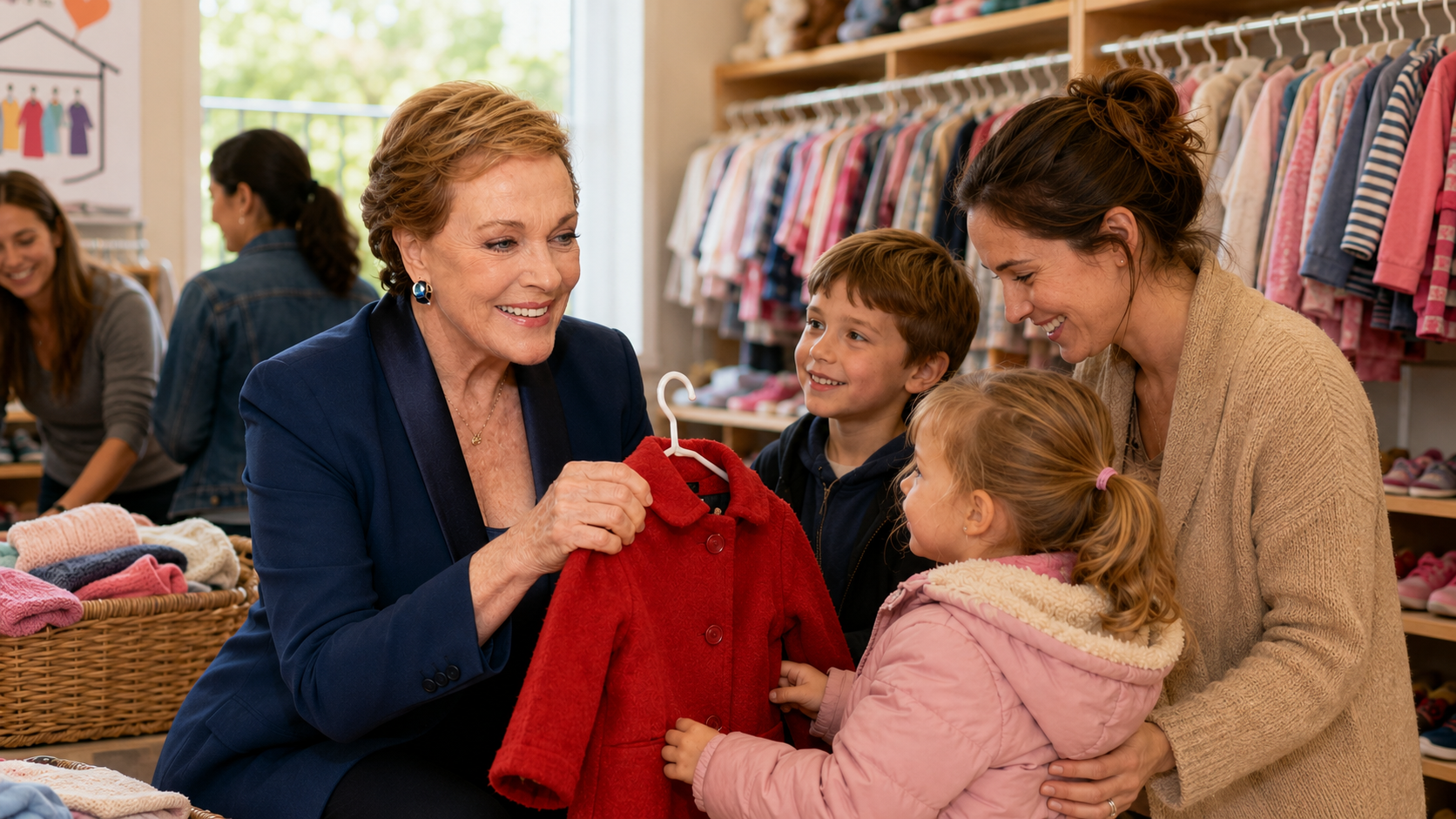
Emily took the coat from the rack and helped Lily put it on.
It fit perfectly.
For a moment, Emily saw Sophie again.
A little girl standing in front of a classroom mirror.
Lily looked down at the sleeves.
Then she spun around.
“Mommy, look!”
Rachel laughed through her tears.
“It’s beautiful.”
That was the moment everyone in the room lost their composure.
Even Julie quietly wiped her eyes.
Years earlier, one donated coat had warmed two sisters.
Now, another red coat was beginning a new chapter for the next generation.
But the surprise wasn’t finished.
Sophie reached into her car and returned carrying a plastic storage box.
“I brought something else.”
Inside was the original red coat.
It was smaller than Emily remembered.
The fabric was worn around the sleeves.
One button had been replaced.
But it was unmistakably the same coat.
Emily touched it carefully.
“You kept it?”
Rachel nodded.
“Our mother couldn’t throw it away.”
Sophie smiled.
“She said it reminded her of the winter someone helped us without making us feel ashamed.”
When their mother passed away, Sophie had found the coat carefully folded inside a box.
Beside it was a handwritten note.
Sophie handed the note to Emily.
It said:
This coat carried more kindness than fabric. Never forget the woman who gave it without asking us to explain ourselves.
Emily began crying again.
Julie put an arm around her.
“You built this place because of one coat,” Julie said softly.
Emily nodded.
“And now it came back.”
Julie smiled.
“Not quite.”
Emily looked at her.
“What do you mean?”
“The coat came back,” Julie said, “but the kindness never left.”
That afternoon, word spread quickly.
Not about Julie Andrews.
Not even about the opening.
People began sharing the story of the red coat.
By evening, donations filled three additional tables.
A local shoe store promised new children’s shoes every month.
A supermarket offered gift cards for families who needed emergency groceries.
Several nearby businesses volunteered to cover part of the rent.
A children’s dentist offered free checkups to families referred through the center.
Then someone suggested something Emily had never considered.
“What about families who don’t have transportation?”
That question changed everything.
Within months, The Little Closet began a delivery program.
Volunteers packed clothes by size and brought them to families throughout the county.
Julie helped quietly behind the scenes.
She never wanted the project to become about her.
Whenever someone praised her involvement, she redirected the attention.
“This was Emily’s dream,” she would say.
But Emily always disagreed.
“No,” she insisted. “It became everybody’s dream.”
One year later, The Little Closet had served more than a thousand children.
Two years later, another location opened.
Then another.
Soon, neighboring towns began creating similar programs.
Emily developed one rule that every location had to follow.
No family would be asked to prove how poor they were.
No child would ever hear the words,
“You can’t afford that.”
Instead, volunteers were trained to say,
“Let’s find something you love.”
Emily understood something that statistics could never fully explain.
Poverty doesn’t only take away money.
Sometimes it takes away choices.
Sometimes dignity.
Sometimes confidence.
The Little Closet tried to return a little of all three.
On the fifth anniversary, Emily invited Sophie, Rachel, Noah and Lily back.
Noah was taller.
Lily had long since outgrown the red coat.
She had passed it to another child through the center.
Julie also attended quietly.
During the celebration, Emily stood in front of the volunteers holding the original red coat.
She had placed it inside a simple glass display near the entrance.
Below it was a small plaque.
It read:
THE RED COAT
One child wore it.
Then another.
And because kindness was passed forward, thousands more were clothed.
Emily looked across the room.
“This place was never really about clothes.”
Everyone grew quiet.
“It was about what happens when someone notices.”
She looked toward Sophie.
“A child without a coat.”
Then toward Rachel.
“A mother who needs help.”
Then toward the volunteers.
“A neighbor who has something to give.”
Finally, she looked at Julie.
“And sometimes a stranger who believes your impossible little dream deserves a chance.”
Julie shook her head gently.
“You already believed in it.”
Emily smiled.
“I did.”
Then she looked around the room.
“But all of you helped make it real.”
Years later, people would remember the opening of The Little Closet for many reasons.
They remembered the crowded racks.
The volunteers.
The laughter.
The nervous parents who eventually relaxed.
Some remembered seeing Julie Andrews quietly folding children’s sweaters in the corner.
But Emily remembered something much simpler.
A small red coat.
A boy holding a letter.
And a family whose story had traveled across generations.
She had once believed that kindness disappeared after the moment it was given.
A coat passed from one child to another.
A meal delivered.
A bill quietly paid.
A comforting word spoken.
Then life moved on.
But Sophie and Rachel taught her something different.
Kindness doesn’t always disappear.
Sometimes it keeps moving quietly through people’s lives.
It becomes a memory.
Then gratitude.
Then generosity.
Then another act of kindness somewhere else.
And sometimes, years later, it walks back through your door.
On a small child.
Wearing a red coat.
The End.


