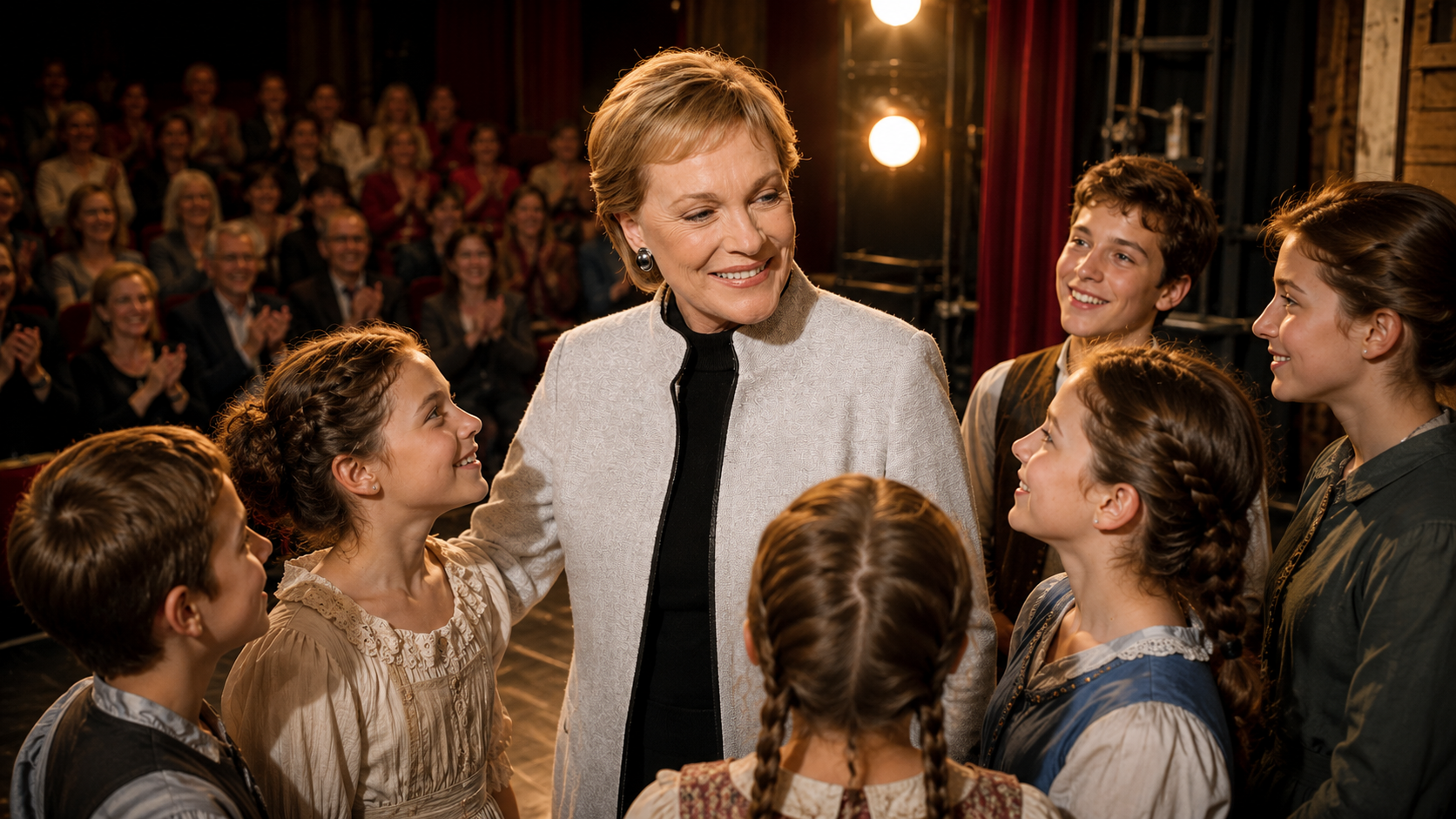
Part 1 — The Theater With Only One More Night
For nearly fifty years, the Willow Lane Community Theater had stood at the end of a quiet little street.
It was not impressive from the outside.
The red bricks had faded. The wooden sign above the entrance leaned slightly to one side. On rainy evenings, two buckets had to be placed backstage because the roof leaked.
But to the people who loved it, Willow Lane was something special.
It was where children performed their first lines in front of an audience.
It was where nervous teenagers discovered they could sing.
It was where retired teachers painted scenery, parents sewed costumes, and grandparents sat proudly in the front row.
For generations, the theater had given ordinary people a place to dream.
But now, it was about to disappear.
The theater’s director, Margaret Ellis, had tried everything.
She organized bake sales.
She asked local businesses for donations.
She reduced ticket prices.
She even stopped taking a salary.
Still, the numbers would not work.
Repairs were becoming more expensive, audiences had become smaller, and the theater owed several months of bills.
One cold Monday morning, Margaret gathered the young performers onstage.
There were twelve of them, ranging in age from nine to seventeen.
Some were sitting on wooden boxes.
Others stood beneath the old stage lights.
Margaret held a piece of paper in her trembling hands.
“I have something difficult to tell you,” she said.
The room immediately became quiet.
Fourteen-year-old Sophie Bennett looked toward her best friend, Daniel.
They had both grown up in the theater.
Sophie had joined when she was eight because she was painfully shy.
Back then, she could barely introduce herself to strangers.
But onstage, something changed.
She discovered that when she was pretending to be someone else, she somehow became brave enough to be herself.
Daniel had a different reason for being there.
His father had died two years earlier.
Afterward, Daniel stopped talking very much.
He quit soccer.
He avoided friends.
Then Margaret gave him a small role in a Christmas play.
He had only three lines.
But those three lines brought him back.
Little by little, the theater became a second home for him.
Now Margaret looked at all of them and struggled to continue.
“We have enough money for one final performance,” she said.
Sophie frowned.
“What do you mean, final?”
Margaret swallowed.
“Unless something changes, Willow Lane will close at the end of the month.”
No one spoke.
Nine-year-old Ellie Harris began crying quietly.
“But we’re rehearsing the spring show,” she whispered.
“I know, sweetheart.”
“Where will we perform?”
Margaret had no answer.
Daniel stared at the floor.
Then Sophie asked the question everyone was thinking.
“Can’t we save it?”
Margaret forced a smile.
“We’re going to try.”
And they did.
For the next two weeks, the young performers worked harder than ever.
They created posters.
They handed out flyers in grocery stores.
They recorded little videos asking people to attend their final show.
Parents shared the event online.
Former actors were contacted.
Old photographs were placed in shop windows around town.
The final performance would not be a normal play.
Instead, Margaret decided to create an evening called One More Song.
Each generation of performers would return to present something from the theater’s history.
Children would sing.
Teenagers would perform scenes.
Former members would tell stories.
Margaret hoped that perhaps enough people would come to remind the town why Willow Lane mattered.
But three days before the performance, only 74 tickets had been sold.
The theater held 280 people.
Margaret sat alone in the box office that evening staring at the empty seating chart.
She thought about all the children who had walked through those doors.
She remembered marriage proposals after performances.
She remembered a boy with a speech difficulty successfully finishing an entire monologue while his mother cried in the audience.
She remembered a lonely widower who volunteered to build sets because he said the theater gave him a reason to leave his house.
How could a place containing so many memories simply disappear?
That night, Sophie went home and wrote a letter.
She did not tell Margaret.
She did not tell her parents.
She simply sat at her desk, took out a sheet of paper, and began writing.
At the top, she wrote:
Dear Dame Julie Andrews,
Sophie had admired Julie Andrews for years.
Her grandmother had introduced her to Mary Poppins and The Sound of Music when she was little.
But Sophie did not write asking for an autograph.
She wrote about Willow Lane.
She described its broken seats.
Its leaking roof.
Its tiny dressing rooms.
She wrote about Daniel finding his confidence again after losing his father.
She wrote about Ellie, who wanted to become an actress.
Then she wrote about herself.
“Before this theater, I was afraid to speak where people could hear me. Now I can stand under a spotlight and tell a story. I think places like this save people in ways nobody notices.”
She ended the letter with one simple sentence.
“We’re performing one final time on Saturday, and I just wish someone could remind everyone that little theaters still matter.”
Sophie placed the letter in an envelope.
She knew there was almost no chance Julie Andrews would ever see it.
Still, sending it made her feel slightly better.
Saturday arrived.
Snow began falling before sunset.
At six o’clock, Margaret stood in the lobby watching people enter.
The turnout was better than expected.
Former performers had returned.
Families arrived carrying flowers.
Old volunteers hugged one another near the entrance.
By 6:45, approximately 190 seats were filled.
It was not enough to solve the theater’s problems.
But Margaret decided not to think about that.
Tonight would be about gratitude.
Backstage, Sophie adjusted her costume.
Daniel peeked through the curtain.
“Pretty full,” he said.
Sophie smiled.
“Not completely.”
“Still better than seventy-four.”
Margaret called everyone together.
“This may be our last evening here,” she said softly, “but I don’t want anyone performing like they’re saying goodbye.”
She looked around the circle.
“Perform like you’re showing people why this place deserves tomorrow.”
They placed their hands together.
Then the lights dimmed.
The performance began.
For the first hour, everything went beautifully.
Children sang songs from old productions.
Former actors performed scenes they had first performed decades earlier.
A seventy-six-year-old man walked onto the stage and described meeting his wife during a Willow Lane production in 1973.
The audience laughed.
Then cried.
Then applauded.
Backstage, Margaret heard someone knocking at the side entrance.
She almost ignored it.
Everyone was busy.
But the knocking came again.
Margaret hurried down the hallway and opened the door.
A woman stood outside wearing a long winter coat.
Beside her was another woman carrying an umbrella.
For one second, Margaret simply stared.
She knew that face.
Everyone did.
The visitor smiled warmly.
“I’m terribly sorry we’re late,” she said.
Margaret’s hand flew to her mouth.
“Julie Andrews?”
Julie gave a small nod.
“I understand there’s a theater here that needs a little encouragement.”
Margaret could not speak.
Julie looked past her toward the sound of children singing onstage.
“May we come in?”
Margaret stepped aside.
A few minutes later, Sophie finished her scene and rushed backstage.
Daniel grabbed her arm.
“You’re not going to believe who’s here.”
“What?”
Before he could answer, Sophie looked toward the hallway.
Julie Andrews was standing there.
For several seconds, Sophie forgot how to breathe.
Julie walked toward her.
“Are you Sophie?”
Sophie nodded slowly.
Julie reached into her handbag.
She was holding a folded letter.
Sophie’s letter.
“I thought what you wrote was very beautiful,” Julie said.
Sophie’s eyes immediately filled with tears.
“You actually read it?”
“I did.”
“But how did you—”
Julie smiled.
“Sometimes letters arrive exactly where they’re supposed to.”
Margaret approached.
“We’re halfway through the program,” she said nervously.
Julie looked toward the stage.
“Then perhaps there’s still time for one more small addition.”
Margaret stared at her.
“What did you have in mind?”
Julie glanced at Sophie.
“Nothing complicated.”
Then she smiled.
“Perhaps we simply remind everyone why they’re here.”
A few minutes later, Margaret walked onto the stage.
The audience quieted.
She gripped the microphone with both hands.
“Ladies and gentlemen,” she said, “something rather extraordinary has just happened.”
Whispers moved through the room.
Margaret looked toward the curtain.
“We have an unexpected guest.”
Julie Andrews stepped onto the stage.
For several seconds, the audience appeared frozen.
Then the entire theater erupted.
People stood.
Some gasped.
Others immediately began crying.
The applause became so loud that Sophie could feel the backstage floor vibrating beneath her feet.
Julie waited patiently.
Eventually, the room became quiet again.
She looked around the small theater.
At its worn curtains.
Its patched walls.
Its old wooden seats.
Then she smiled.
“I’ve performed in some very large theaters during my life,” she began.
“But I learned long ago that the importance of a stage is not measured by the number of seats in front of it.”
The room became completely silent.
Julie continued.
“A stage matters because of what happens to people when they step onto it.”
She spoke about courage.
About imagination.
About young performers learning to trust their voices.
She spoke about communities needing places where people of different ages could create something together.
Then she held up Sophie’s letter.
“A young woman wrote to me this week,” she said.
Sophie covered her face backstage.
Julie did not reveal her name.
“She told me that this theater helped her find the courage to speak.”
Julie looked toward the audience.
“And she wrote something I haven’t forgotten.”
She paused.
“She said little theaters save people in ways nobody notices.”
Margaret began crying.
Across the room, parents reached for their children’s hands.
Julie glanced toward the wings.
“Sophie, would you join me?”
Sophie froze.
Daniel gently pushed her forward.
“Go.”
Slowly, Sophie stepped onto the stage.
The audience applauded.
Julie offered her hand.
Sophie took it.
“You asked someone to remind people that little theaters matter,” Julie said.
Then she turned toward the audience.
“But perhaps the person who needed to remind them was you.”
Sophie looked across the room.
She saw her parents.
Margaret.
Daniel.
Ellie.
People who had performed there forty years earlier.
She took the microphone.
Her hands were shaking.
A few years ago, she would never have been able to speak.
Tonight, she did.
“This theater taught me that being scared doesn’t mean you have to stay silent,” Sophie said.
She looked toward Margaret.
“It gave us somewhere to belong.”
Then she looked at the audience.
“And I don’t think we’re ready to lose it.”
For a moment, nobody moved.
Then one person stood.
Then another.
Within seconds, nearly the entire audience was standing.
The applause continued for several minutes.
But something even more unexpected was happening.
Near the back of the theater, a local business owner quietly spoke to his wife.
A former performer pulled out her phone.
Another man whispered something to Margaret’s assistant.
People were beginning to ask the same question.
Not, “When does the theater close?”
But:
“What would it take to save it?”
Julie looked toward Margaret.
Margaret looked stunned.
And before the evening ended, one announcement from the audience would completely change the future of Willow Lane Community Theater.
Part 2 — The Night That Became a Beginning
The applause had barely faded when a man near the back of the theater stood up.
His name was Thomas Reed.
He owned a small construction company in town and had performed at Willow Lane when he was a teenager.
Margaret recognized him immediately.
Thomas looked toward the stage.
“I haven’t been inside this theater in almost thirty years,” he said.
His voice cracked slightly.
“But this place gave me confidence when I had none.”
He paused.
“When I was sixteen, I was terrified of speaking in front of people. Margaret’s predecessor gave me a role with four lines.”
The audience laughed softly.
Thomas smiled.
“I forgot three of them.”
More laughter.
“But nobody laughed at me. They encouraged me.”
He looked around the old theater.
“I don’t want my children growing up in a town where places like this disappear.”
Then he made an announcement that stunned everyone.
“My company will donate the labor needed to repair the leaking roof.”
Margaret covered her mouth.
The audience erupted again.
Before she could respond, a woman in the third row stood.
“I own the fabric shop on Market Street,” she said. “I can provide materials for costumes for the next year.”
Another person stood.
“I can help with the electrical repairs.”
Then another.
“Our bakery can sponsor the children’s summer production.”
The offers started coming from every corner of the room.
One former performer promised to organize a fundraiser.
A retired accountant offered to help restructure the theater’s finances.
A local teacher volunteered to create an after-school drama program.
The evening that had been planned as a farewell was suddenly turning into something completely different.
Backstage, Daniel stared through the curtain.
“Are they actually saving it?” he whispered.
Sophie was crying too hard to answer.
Julie Andrews stood quietly beside them.
She did not interrupt.
She simply watched.
That was when Margaret stepped forward.
“I don’t even know what to say.”
Julie smiled.
“Perhaps don’t say goodbye just yet.”
The audience laughed.
Then Julie turned serious.
“Tonight is wonderful,” she said. “But one evening of generosity cannot be the end of the story.”
Everyone listened.
“If you truly believe this theater matters, then it must belong to the community not only emotionally, but through action.”
She looked toward the young performers waiting near the wings.
“Support it when there isn’t a famous visitor here.”
A gentle laugh moved through the room.
“Buy tickets. Volunteer. Bring your children. Encourage your neighbors. Fill the seats.”
Then Julie said something Sophie would remember for the rest of her life.
“Dreams rarely survive because one person rescues them.”
She paused.
“They survive because many people decide they are worth carrying together.”
The room became still.
Then Thomas raised his hand again.
“What if we create a permanent community fund?”
The accountant immediately nodded.
The business owners began discussing it.
Within thirty minutes, a plan was forming.
They called it the Willow Lane Future Fund.
Instead of trying to raise one enormous amount once, residents and local businesses could contribute small monthly donations.
Five dollars.
Ten dollars.
Twenty-five dollars.
Whatever they could afford.
The money would support repairs, youth programs, scholarships, and productions.
By midnight, more than 120 people had signed up.
Someone created an online fundraiser.
Within the first night, thousands of dollars were pledged.
By the following afternoon, the number had grown even larger.
But something mattered more than the money.
People came back.
On Monday morning, volunteers arrived carrying ladders and paintbrushes.
Teenagers cleaned the storage rooms.
Parents repaired seats.
Retired performers sorted decades of costumes.
Children carried boxes of old programs into the lobby.
Even people who had never attended a performance before stopped by to ask how they could help.
For the first time in years, Willow Lane felt crowded before a show had even begun.
Julie stayed in town for only a short time.
Before leaving, she returned to the theater one final morning.
Sophie found her sitting alone in the front row.
The stage lights were off.
Dust floated through the sunlight.
Sophie sat beside her.
“Thank you,” she said.
Julie looked toward her.
“For what?”
“For saving the theater.”
Julie shook her head.
“I didn’t save it.”
Sophie looked confused.
“You came here.”
“Yes.”
“You spoke.”
“Yes.”
“Everyone started helping because of you.”
Julie smiled gently.
“Perhaps I helped them remember something.”
Then she pointed toward the stage.
“But the reason they chose to save this place was already here.”
Sophie followed her gaze.
Daniel was helping Ellie rehearse a scene.
Margaret was discussing repairs with Thomas.
Two parents were repainting scenery.
Children were laughing backstage.
Julie looked back at Sophie.
“That letter you wrote mattered because it was honest.”
Sophie smiled.
“I almost didn’t send it.”
“That happens with many important things.”
“What do you mean?”
“We wait because we think our voice isn’t important enough.”
Julie rested her hands gently in her lap.
“But sometimes one voice begins something much larger.”
Sophie looked down.
“Do you think I could really become an actress someday?”
Julie did not answer immediately.
Instead she said, “Do you love performing?”
“Yes.”
“Enough to work at it even when nobody is applauding?”
Sophie thought.
“Yes.”
“Enough to fail sometimes?”
Sophie hesitated.
Then nodded.
Julie smiled.
“Then you already understand more about being a performer than many people do.”
Sophie laughed.
Before Julie left, Margaret asked everyone to gather onstage.
There were no television cameras.
No reporters.
No formal ceremony.
Just the people who had spent the previous days saving their theater.
Julie stood among them rather than in front.
A volunteer took a photograph.
Then Julie hugged Margaret.
“Keep the lights on,” she said.
Margaret smiled through tears.
“We will.”
And they did.
Over the following year, Willow Lane changed.
The roof was repaired.
Several dangerous electrical systems were replaced.
The seats were restored.
A new youth scholarship program allowed children from families with limited incomes to participate without paying fees.
The theater also began offering free Saturday workshops.
And something unexpected happened.
Attendance grew.
People who had donated wanted to see what they had helped protect.
Performances began selling out.
Families brought friends.
Former members returned.
The little theater became busy again.
But Margaret kept one thing exactly the same.
Sophie’s original letter.
She framed a copy and hung it backstage.
Beneath it was a small plaque:
“Little theaters save people in ways nobody notices.”
Years passed.
Ellie grew into a confident performer.
Daniel eventually became a drama teacher.
He specialized in working with quiet children who struggled to express themselves.
Whenever one of them was afraid to step onto a stage, he told them about the three lines that once helped him find his way back after losing his father.
And Sophie?
She continued performing.
There were disappointments.
Auditions she failed.
Roles she wanted but did not receive.
Days when she wondered whether she had chosen the wrong dream.
Whenever that happened, she remembered Julie’s question.
Do you love it enough to continue when nobody is applauding?
The answer remained yes.
Years later, Sophie began working professionally.
She never became someone who expected crowds to recognize her on the street.
But she built a life doing what she loved.
She performed.
She taught.
She directed children’s productions.
And every summer, no matter how busy she became, Sophie returned to Willow Lane.
One particular summer, she walked into the theater and discovered a nervous eleven-year-old girl standing alone backstage.
The girl was supposed to perform her first speaking role.
She was trembling.
“I can’t do it,” she whispered.
Sophie crouched beside her.
“Yes, you can.”
“What if I forget everything?”
“Then we’ll help you.”
“What if people laugh?”
“They won’t.”
The girl looked toward the curtain.
“Were you ever scared?”
Sophie smiled.
“Terrified.”
“Really?”
“Really.”
Then Sophie pointed toward the framed letter on the wall.
“I once wrote that letter because I thought this theater was going to disappear.”
The girl read the sentence underneath it.
“Did Julie Andrews really come here?”
“She did.”
“Did she save the theater?”
Sophie paused.
She remembered the conversation in the empty auditorium many years earlier.
Then she gave the same answer Julie had given her.
“No.”
The girl looked surprised.
“Everyone saved it.”
From the stage, Margaret’s successor called for the young performers to prepare.
The girl took a deep breath.
Sophie held out her hand.
“Ready?”
The girl slowly nodded.
They walked toward the curtain together.
Outside, every seat was filled.
Parents whispered excitedly.
Grandparents held programs.
Children waited for the lights to rise.
And on the wall near the entrance hung a photograph from that unforgettable night long ago.
Julie Andrews stood among a group of young performers.
Beside her was a shy fourteen-year-old girl who had once been afraid to speak.
Underneath the photograph were the words:
One More Song — The Night Willow Lane Began Again.
The lights dimmed.
The curtain opened.
And another generation stepped onto the little stage.
Willow Lane had survived.
Not because one famous person arrived and performed a miracle.
But because one young girl found the courage to write a letter.
One visitor took the time to listen.
And an entire community remembered that some places are worth saving not because they are grand…
but because they give ordinary people somewhere to discover that their dreams might not be ordinary at all.
The End.


