Part 1
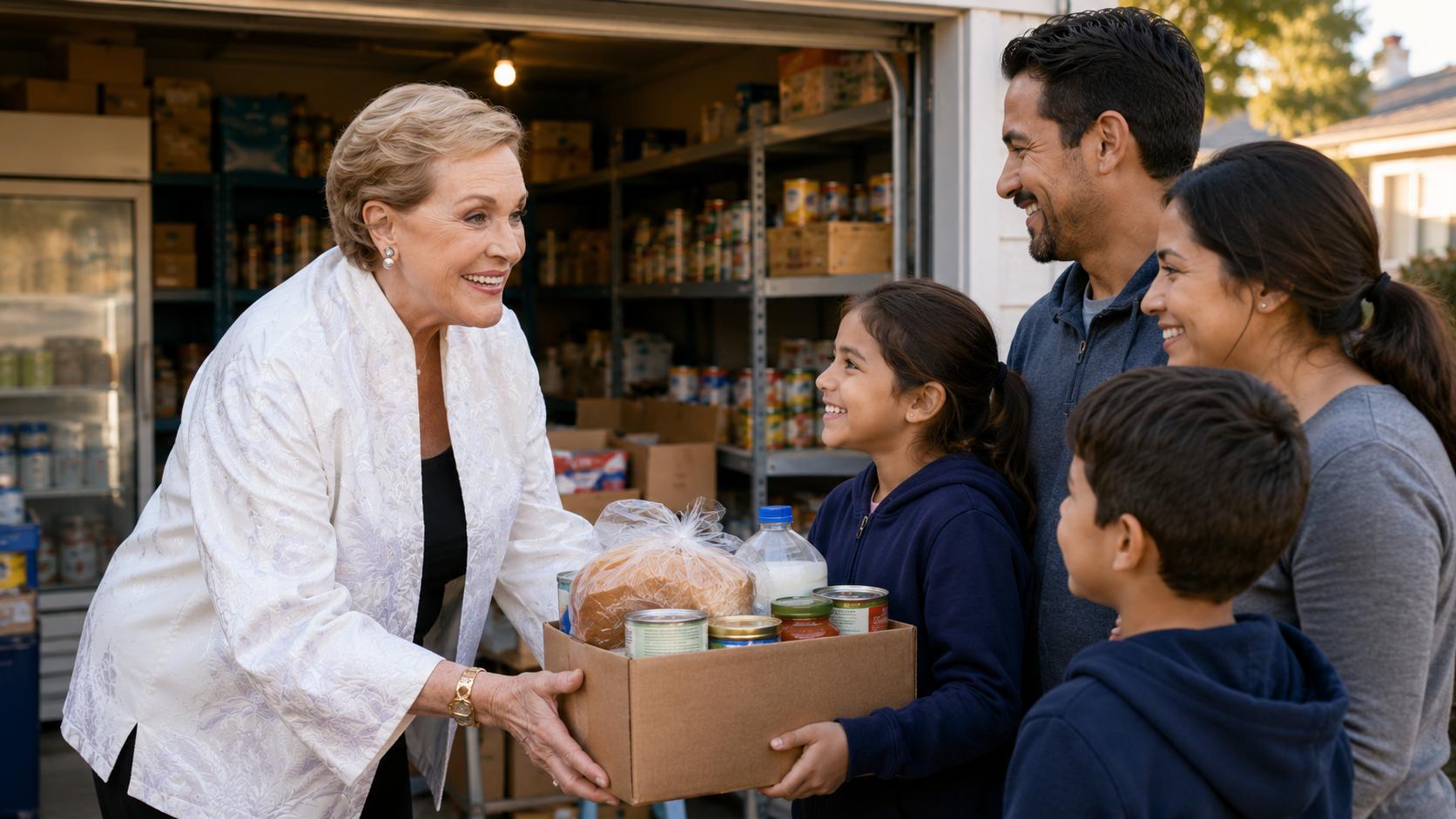
On a quiet street lined with modest houses and old maple trees, there was one garage that never seemed to hold a car.
Instead, its shelves were filled with canned soup, rice, pasta, cereal, diapers, bread, and jars of peanut butter.
A handwritten sign hung beside the open door:
“Take what you need. Leave what you can. No questions asked.”
The garage belonged to a woman named Margaret Ellis.
Margaret was sixty-three, recently retired, and had spent most of her life working as a school secretary. She had never considered herself wealthy or extraordinary.
But she had always noticed people.
She noticed the child who came to school without lunch.
The father who quietly asked whether there were any leftover snacks after a school event.
The grandmother who counted coins before buying milk.
And she never forgot them.
Years earlier, Margaret had gone through her own difficult season after her husband became ill.
Medical bills piled up.
Her savings disappeared faster than she expected.
For several months, every grocery trip required careful calculation.
She remembered standing in a supermarket aisle one evening, holding a carton of eggs in one hand and a loaf of bread in the other, realizing she could not afford both.
A stranger standing nearby noticed.
Without embarrassing her, the woman quietly placed a grocery gift card into Margaret’s basket.
“I think you dropped this,” she whispered.
Margaret knew she had not.
But she accepted it.
She never learned the woman’s name.
That small act stayed with her for years.
So after retirement, when Margaret cleaned out her garage, she looked at the empty space and suddenly knew what she wanted to do with it.
She bought several wooden shelves.
Then she filled them with $200 worth of groceries.
She posted a message in a neighborhood group:
“If your family is going through a hard week, my garage pantry is open Saturday mornings. Take whatever helps.”
Margaret expected perhaps two or three people.
Twenty-seven came.
Some apologized when they arrived.
Some tried to explain why they needed help.
Margaret always interrupted gently.
“You don’t owe me your story,” she would say. “Just take what your family needs.”
Within a few months, neighbors began leaving groceries on her porch.
A local bakery donated unsold bread.
Teenagers helped organize cans.
A farmer dropped off vegetables every Friday.
Margaret called the pantry The Open Door.
But despite its growing popularity, she insisted on one rule.
Nobody should ever feel ashamed for coming.
There were no applications.
No interviews.
No proof of income.
No names written down.
“You can lose your job on Monday and need groceries by Friday,” Margaret often said. “Hunger doesn’t wait for paperwork.”
One person who quietly admired Margaret’s work was Julie Andrews.
Margaret had been a fan of Julie’s for more than fifty years.
She had watched Mary Poppins as a girl, listened to Julie’s recordings while raising her children, and later shared The Sound of Music with her grandchildren.
Julie’s voice had accompanied some of Margaret’s happiest memories.
But Margaret never imagined that Julie would ever hear about The Open Door.
Then one of Margaret’s teenage volunteers, Sophie, wrote a letter.
Sophie described Margaret’s pantry and explained how Margaret treated every visitor like a neighbor rather than a charity case.
At the end, Sophie wrote:
“Margaret always says kindness should protect someone’s dignity, not take it away. I thought you might understand that.”
Weeks passed.
Then months.
Sophie assumed the letter had disappeared among thousands of others.
Until one Saturday morning.
Margaret was arranging canned vegetables when a volunteer rushed into the garage.
“Margaret,” he whispered, staring toward the driveway, “there’s someone here to see you.”
Margaret wiped her hands on her apron.
“Who?”
Before he could answer, a familiar voice came from behind her.
“I hope I’m not too early.”
Margaret froze.
She turned slowly.
Julie Andrews was standing near the garage door, smiling.
For several seconds, Margaret said absolutely nothing.
Then she put both hands over her mouth.
“Oh my goodness.”
Julie laughed softly.
“I’ve been told there’s something rather wonderful happening in this garage.”
Margaret immediately began crying.
Julie stepped forward and hugged her.
“I don’t understand,” Margaret whispered. “How did you even know?”
Julie looked toward Sophie.
“I received a very thoughtful letter.”
Sophie began crying too.
That morning, Julie did not simply visit.
She worked.
She carried boxes.
She organized shelves.
She handed bread to visitors.
Most importantly, she followed Margaret’s rule.
No one was photographed without permission.
No one was asked why they needed food.
No family was turned into a spectacle.
When a nervous mother apologized for taking several cans of formula, Julie gently replied:
“You’re caring for your child. There’s nothing to apologize for.”
Word spread quickly, but Margaret refused to let the pantry become chaotic.
“This isn’t about meeting someone famous,” she reminded volunteers. “This is about feeding people.”
Julie agreed completely.
Later that afternoon, after the final visitor had left, Julie and Margaret sat on two folding chairs inside the garage.
Nearly every shelf was empty.
Julie looked around.
“How many families come each week?”
“Usually seventy or eighty now,” Margaret said.
Julie raised her eyebrows.
“From a garage?”
Margaret smiled.
“You’d be surprised how much a garage can hold.”
Then her expression became serious.
“But every week, we run out.”
Julie looked at the empty shelves.
“What happens then?”
Margaret sighed.
“We close.”
“What if someone comes afterward?”
Margaret hesitated.
“That is the part I hate most.”
Julie said nothing for a moment.
Then she asked quietly:
“What would you do if you had more space?”
Margaret laughed.
“That question could get dangerous.”
“Good,” Julie replied. “Dangerous questions sometimes lead somewhere useful.”
The two women spent the next hour imagining possibilities.
A larger pantry.
Refrigerators for milk and fresh food.
School lunch supplies.
Emergency grocery deliveries for seniors.
Maybe even partnerships with nearby stores.
Before leaving, Julie promised to stay in touch.
But Margaret expected nothing more.
The visit itself already felt unbelievable.
Then, three weeks later, a delivery truck pulled into Margaret’s driveway.
Inside were two commercial refrigerators, new shelving, storage containers, and enough groceries to refill the pantry several times.
Julie had quietly arranged it.
A note was attached.
It read:
“For the doors that should stay open a little longer.”
Margaret cried when she read it.
The Open Door expanded.
Saturday hours became longer.
Then Wednesday evenings were added.
Volunteers multiplied.
Local businesses joined.
For the first time, Margaret stopped worrying that the shelves would be empty before everyone had been served.
She thought the pantry’s biggest transformation had already happened.
She was wrong.
Several months later, on a freezing winter evening, Margaret closed the garage at seven o’clock.
Snow was falling heavily.
The volunteers had gone home.
Margaret was carrying the last empty box into the house when she heard something near the driveway.
A car engine.
Then a door closing.
She looked outside.
An old sedan had stopped beneath the streetlight.
A man stepped out.
Then a woman.
Three children followed.
The youngest was wearing a coat far too large for him.
The father approached slowly.
“I’m sorry,” he called. “We know you’re closed.”
Margaret glanced at the dark garage.
Then at the children.
“It’s all right,” she said. “Come inside.”
The father shook his head.
“We don’t want to cause trouble.”
“You aren’t.”
Margaret unlocked the garage.
The family entered quietly.
The children stared at the shelves.
Margaret noticed something immediately.
They were almost empty again.
She found bread.
Soup.
Rice.
Cereal.
Milk.
A few vegetables.
She packed everything she could into bags.
Then she noticed the mother crying.
Margaret approached her.
“Are you all right?”
The woman nodded quickly.
“It’s just been a difficult week.”
Margaret remembered her own rule.
No questions.
No explanations required.
So she simply touched the woman’s arm.
“You’re welcome here.”
Then the oldest child, a girl of about ten, looked at Margaret.
“Can I ask you something?”
“Of course.”
The girl glanced toward the sign beside the garage.
Take what you need. Leave what you can.
She reached into her pocket.
Then she placed something on the table.
It wasn’t money.
It was a folded piece of paper.
On it, she had drawn a picture of the garage.
People stood in front of it holding grocery bags.
Above them was a large yellow sun.
At the bottom, in uneven handwriting, she had written:
“Someday we will come back and help.”
Margaret stared at the picture.
The little girl continued.
“My dad says we’re only having a bad time right now.”
Margaret swallowed hard.
“He’s right.”
Then the girl asked the question that Margaret would remember for the rest of her life.
“What happens to people who come after you go to sleep?”
Margaret looked toward the dark street.
And suddenly, the problem felt much bigger than empty shelves.
Some families worked late.
Some had no transportation.
Some were too embarrassed to come during busy hours.
Some might be hungry at midnight.
Closing the garage did not mean hunger stopped.
Margaret barely slept that night.
The next morning, she called Julie.
“I think we’ve been solving the wrong problem,” Margaret said.
Julie listened carefully.
“What happened?”
Margaret told her about the family.
The little girl’s drawing.
And the question.
When Margaret finished, Julie was silent.
Then she said:
“Perhaps The Open Door needs a door that never closes.”
Margaret looked toward her garage.
“How would we possibly do that?”
Julie paused.
“I don’t know yet.”
Then her voice brightened.
“But I think we should find out.”
Neither woman realized it then, but that late-night visit was about to turn one neighborhood garage into something far larger than either of them had imagined.
And months later, when that same struggling family returned, they would bring something with them that changed The Open Door forever.
Part 2
Margaret kept the little girl’s drawing on her kitchen table for three days.
Every time she walked past it, she stopped.
The picture was simple.
A garage.
A bright sun.
A few people holding grocery bags.
And one sentence:
“Someday we will come back and help.”
But it was the girl’s question that Margaret could not forget.
“What happens to people who come after you go to sleep?”
The Open Door had helped hundreds of families.
Yet Margaret suddenly realized something.
A pantry could be full of food and still be unavailable to someone who needed it most.
Some parents worked night shifts.
Some seniors could not leave home until a neighbor was available to drive them.
Some people were too embarrassed to arrive while dozens of others were watching.
And sometimes emergencies happened after closing.
When Julie Andrews called Margaret a few days later, Margaret had already filled a notebook with ideas.
“I’ve been thinking,” Margaret said.
Julie laughed gently.
“That usually means something ambitious is coming.”
Margaret smiled.
“What if we created a pantry people could use anytime?”
“Anytime?”
“Day or night.”
Julie paused.
“I like it.”
Margaret explained her idea.
Beside the garage stood an old wooden shed that Margaret had used for garden tools.
She wanted to transform it into a small, secure self-service pantry.
Families would not need an appointment.
They would not need to explain anything.
They could simply enter, take a few groceries, and leave.
Julie loved the idea immediately.
But there were problems.
The shed needed insulation.
Electricity.
Lighting.
Shelving.
A refrigerator.
A safer entrance.
And someone needed to keep it stocked.
Margaret estimated the project would cost several thousand dollars.
She did not have that kind of money.
So she decided to start small.
She posted the little girl’s drawing in the neighborhood group.
Underneath it she wrote:
“A child asked us what happens when hungry families arrive after closing. We don’t have a good answer yet. But we’re working on one.”
The response was overwhelming.
A local electrician volunteered his time.
A carpenter donated wood.
A hardware store supplied locks, lights, and insulation.
A restaurant owner offered a refrigerator.
Teenagers painted the inside.
Retired neighbors assembled shelves.
Then Julie quietly made several calls of her own.
A regional grocery company agreed to provide weekly surplus food.
A local foundation donated funds for construction.
And Julie contributed privately, asking Margaret not to tell anyone how much.
“People are already giving because they believe in this,” Julie said. “I don’t want my name to become the reason.”
Margaret understood.
Within six weeks, the old garden shed had become something entirely different.
It was small.
But warm.
Bright.
Clean.
And stocked with food.
Above the entrance hung a new sign:
THE OPEN DOOR — ALWAYS OPEN
There was no camera pointed at visitors.
No clipboard.
No form.
No one asking questions.
Just shelves.
Food.
And dignity.
On the first night, Margaret sat by her front window until almost midnight.
At 10:17 p.m., a woman arrived.
She entered the pantry.
Five minutes later, she left carrying two bags.
At 11:42 p.m., an older man came.
The next morning, Margaret checked the shelves.
Several cans were missing.
A loaf of bread was gone.
So were eggs and milk.
But someone had left something behind.
A small bag containing two cans of beans and a handwritten note.
“I needed help last month. Tonight I had extra.”
Margaret immediately called Julie.
“It works,” she whispered.
Julie could hear the emotion in her voice.
“It sounds like more than that.”
“It feels different,” Margaret said. “People aren’t just receiving anymore. They’re becoming part of it.”
That idea changed everything.
The pantry slowly stopped feeling like charity.
It became a community exchange built on trust.
One family donated baby food after their child outgrew it.
A retired teacher left school snacks.
A farmer delivered potatoes before sunrise.
A teenager used money from his first job to buy cereal.
Sometimes people who had once taken groceries returned months later carrying boxes.
Margaret began placing little cards near the entrance.
They read:
“If today you need help, take it. If someday you can help, give it. Both belong here.”
The words spread.
Other neighborhoods asked how they could create similar pantries.
Julie helped Margaret put together a simple guide.
Within a year, six nearby communities had opened their own small after-hours food stations.
But Margaret still wondered about the family who had started it all.
She did not know their last name.
She did not know where they lived.
She only knew the father’s first name was Daniel and the little girl’s name was Lily.
Months passed.
Then a full year.
One Saturday morning, Margaret was sorting donated fruit when a pickup truck stopped in front of the house.
A man stepped out.
Margaret recognized him immediately.
Daniel.
The father who had arrived after closing.
But he looked different.
His shoulders were straighter.
His face was healthier.
Then a woman climbed out.
Three children followed.
And behind them was Lily.
Margaret dropped the apple she was holding.
“Lily?”
The girl smiled.
She was taller now.
The oversized winter coat was gone.
Daniel walked toward Margaret.
“I’ve been hoping we’d find you here.”
Margaret hugged him before he could say anything else.
Julie happened to be visiting that weekend.
She stepped out of the garage just as the family approached.
Margaret introduced them.
“This is the family I told you about.”
Julie looked at Lily.
“The drawing?”
Lily blushed.
“You kept it?”
Margaret pointed toward the garage wall.
The original drawing had been framed.
Lily stared at it.
Then she smiled.
Daniel opened the back of his truck.
It was packed with boxes.
Canned vegetables.
Rice.
Cereal.
Pasta.
Soap.
Baby supplies.
Margaret looked stunned.
“What is all this?”
Daniel swallowed.
“A promise.”
Lily stepped beside him.
“I told you we’d come back.”
Margaret’s eyes filled with tears.
Daniel explained what had happened after that winter night.
He had lost his construction job just before Christmas.
His wife, Elena, had been working part-time while caring for the children.
For several weeks, they had survived on whatever small amount they could afford.
The night they reached Margaret’s garage, they had less than $20 left.
“The groceries you gave us lasted almost a week,” Daniel said.
But more important than the food was something Margaret had said.
“You’re welcome here.”
Daniel remembered those words.
“When you’re struggling,” he said, “you start believing you’re a failure. You think everyone can see it.”
He looked toward his children.
“You didn’t make us feel like failures.”
A few weeks after visiting the pantry, Daniel found another job.
Then another company offered him a permanent position.
Their finances slowly stabilized.
They paid their overdue bills.
They rebuilt their savings.
And every month, Lily reminded him of the promise she had written.
So the family began saving something else.
One box of groceries at a time.
When their local church heard the story, members joined them.
Then Daniel’s coworkers contributed.
The boxes in the truck were the result.
Margaret covered her mouth.
“I don’t know what to say.”
Lily smiled.
“You don’t have to say anything.”
Julie quietly wiped a tear from her cheek.
But Daniel had brought something else.
He reached into the truck and pulled out a large wooden sign.
He had made it himself.
Carved into the wood were the words:
NO ONE EATS ALONE
Margaret stared at it.
Daniel explained.
“When we were going through that hard time, food wasn’t the only problem.”
He looked at Elena.
“We felt alone.”
Elena nodded.
“You can give someone a bag of groceries and still have them go home feeling frightened.”
Margaret listened carefully.
Daniel continued.
“What if this place didn’t only give food?”
He pointed toward the driveway.
“What if people could sit down together once in a while? Have dinner. Talk. Meet someone who’s been through the same thing.”
Margaret looked at Julie.
Julie already knew what she was thinking.
Julie smiled.
“That,” she said, “sounds like another dangerous question.”
Within months, The Open Door expanded again.
A local community center offered its kitchen every Thursday evening.
Anyone could come.
There was no separate table for people receiving help.
Volunteers ate beside families.
Seniors sat with teenagers.
People who donated food shared meals with people who had once needed it.
They called the dinners The Long Table.
Daniel became one of the regular volunteers.
Elena helped organize children’s supplies.
And Lily created a small corner where children could draw pictures and write encouraging notes for other families.
The very first drawing displayed there was a copy of hers.
“Someday we will come back and help.”
Years later, The Open Door was no longer simply Margaret’s garage pantry.
There were twenty-three small food stations across nearby communities.
Hundreds of volunteers participated.
Local stores donated food.
Families received emergency groceries at all hours.
And every week, people gathered around tables to eat together.
Margaret refused to take credit.
Whenever reporters asked how it began, she pointed to the framed drawing.
“It began because a little girl asked a question we couldn’t ignore.”
Julie remained quietly involved.
She visited when she could.
Sometimes she helped serve food.
Sometimes she simply sat with families and listened.
During the fifth anniversary celebration, Margaret stood beside Julie, Daniel, Elena, and Lily.
Lily was now fifteen.
The original garage was decorated with photographs showing years of volunteers and families.
Julie looked at the shelves.
“You know,” she said softly, “when I first came here, I thought Margaret had created a food pantry.”
Margaret laughed.
“So did I.”
Julie turned toward the crowd.
“But food was only the beginning.”
She pointed toward the wooden sign Daniel had made.
NO ONE EATS ALONE
“This place gives people something harder to put in a box,” Julie said.
“It reminds them that needing help does not make them less worthy.”
Margaret looked across the driveway.
Some people were carrying groceries.
Others were bringing donations.
Children were laughing.
Daniel was unloading boxes.
Elena was setting tables.
Lily was helping a nervous mother find baby formula.
For a moment, Margaret remembered the stranger in the supermarket years earlier.
The woman who had quietly placed a grocery gift card into her basket.
Margaret had never learned her name.
She had often wondered how she could repay that kindness.
Now she finally understood.
Kindness was never really repaid.
It was passed forward.
One stranger helped Margaret.
Margaret helped a family.
That family returned to help hundreds more.
And a little girl arriving after closing had transformed a garage pantry into a promise:
Whenever someone knocked on the door hungry, frightened, embarrassed, or alone—
someone would be there to open it.
Because sometimes the greatest gift isn’t simply giving someone enough to eat.
It’s reminding them that they still belong.
THE END.


