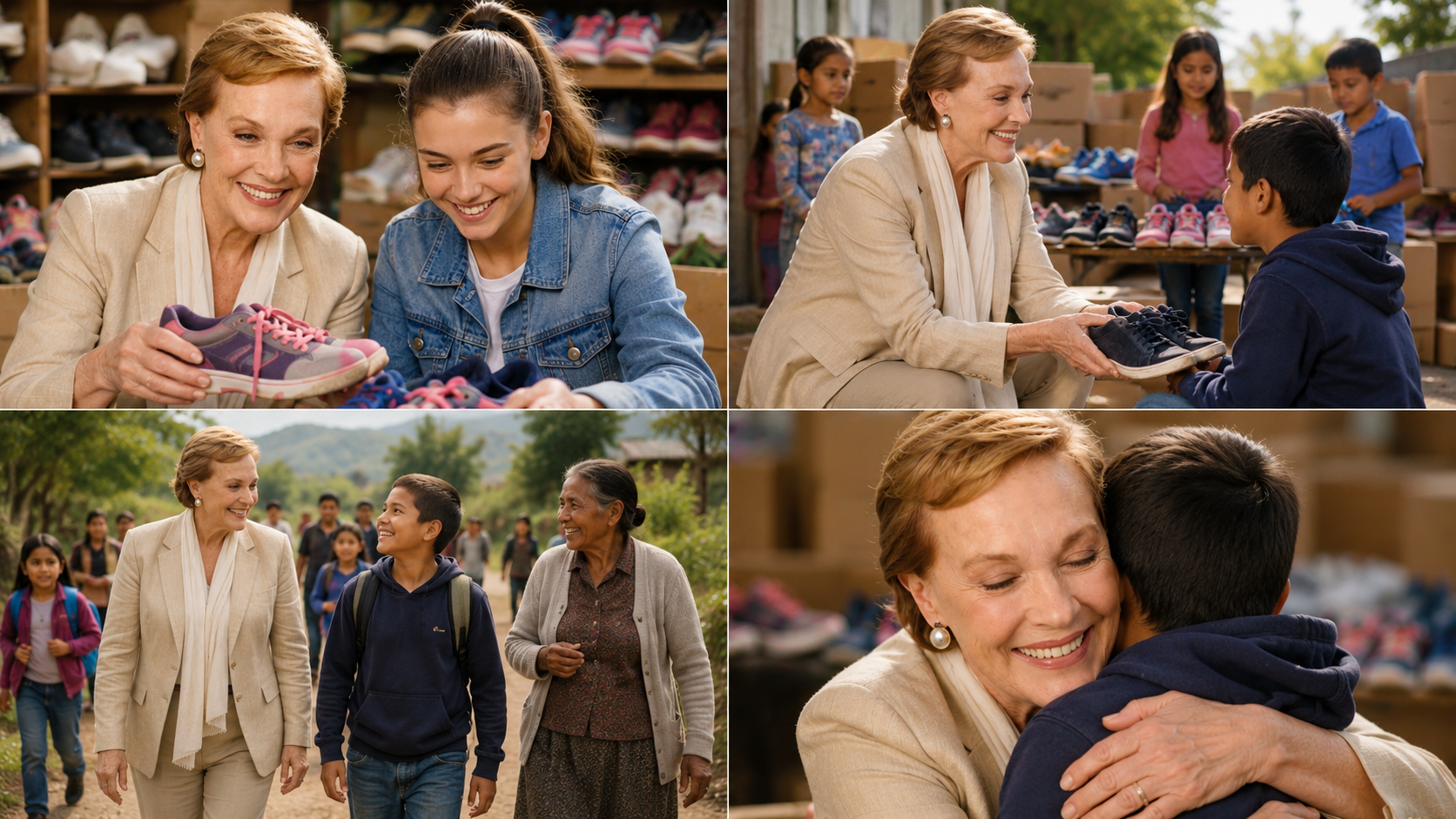
Part 1 — The Shoes We Take for Granted
At sixteen, Sophie Carter had never considered a pair of shoes a luxury.
Shoes were simply something she put on before school.
Sneakers for ordinary days. Boots when it rained. Dress shoes for special occasions.
Then one rainy Tuesday changed the way she saw them forever.
Sophie was helping her mother sort donations at a small community center outside London. Boxes of coats, books, toys, and school supplies covered the floor.
Near the entrance stood a quiet little girl named Mia.
She was perhaps eight years old.
While the other children looked through books and toys, Mia kept staring at a cardboard box filled with secondhand shoes.
Sophie walked over.
“Would you like to try some?”
Mia nodded.
She removed her old shoes, and Sophie immediately noticed something.
There was a hole through one sole.
The girl’s sock was wet.
Sophie found a clean pair of trainers that fit almost perfectly.
Mia stood and took several careful steps.
Then she smiled.
“Now my feet won’t hurt when I walk to school.”
The words stayed with Sophie long after she went home.
That evening, she counted the shoes in her bedroom.
Seven pairs.
Seven.
And somewhere nearby, children were walking to school in shoes that hurt their feet—or without proper shoes at all.
Sophie decided to do something.
She called her idea Steps of Kindness.
The plan was simple: collect good-quality new and gently used children’s shoes, clean them, sort them by size, and distribute them through local charities and schools.
Her first goal was fifty pairs.
But collecting them proved harder than she expected.
She made posters.
She spoke at school.
She contacted sports clubs and local shops.
For the first week, only eleven pairs arrived.
Some classmates told her the project was pointless.
“You’re sixteen,” one boy said. “How many people can you really help?”
Sophie didn’t know.
But she remembered Mia’s wet sock.
“If I can help one,” she replied, “that’s better than helping none.”
Two weeks later, Sophie received an unexpected letter.
It came through the community center.
The handwriting on the envelope was elegant, and Sophie nearly dropped it when she saw the name at the bottom.
Julie Andrews.
Sophie read the note twice.
Julie had heard about Steps of Kindness through a volunteer connected with the center. She praised Sophie not for having a large campaign, but for noticing a small need that others might overlook.
One sentence became Sophie’s motivation:
Kindness rarely begins with having everything we need. It begins with noticing what someone else needs.
Sophie placed the letter above her desk.
Then something even more surprising happened.
Julie offered to visit.
There were no television cameras and no grand announcement.
She simply arrived one Saturday morning while Sophie and several volunteers were sorting shoes.
Sophie froze when Julie walked through the door.
Julie smiled.
“I hear you have quite a few shoes that need sorting.”
Sophie laughed nervously.
“More than quite a few.”
“Then we’d better get started.”
For the next two hours, Julie worked beside the volunteers.
She tied shoelaces together.
She checked sizes.
She placed children’s trainers into boxes.
And most importantly, she listened.
Sophie explained how difficult the first weeks had been.
“I almost stopped,” she admitted.
Julie looked at the growing rows of boxes.
“And what kept you going?”
“One little girl.”
Sometimes, Sophie explained, she wondered whether helping one person could really matter when millions needed help.
Julie picked up a tiny pair of red shoes.
“To the person receiving these,” she said gently, “it matters completely.”
Those words changed Sophie’s understanding of charity.
The project didn’t need to solve every problem.
It simply needed to solve the problem directly in front of them.
Soon, Julie quietly helped Sophie contact community organizations, schools, and supporters who might contribute.
The response grew beyond anything Sophie expected.
Fifty pairs became one hundred.
Then three hundred.
Then five hundred.
A sporting-goods shop donated boxes of new trainers.
A retired teacher collected shoes throughout her neighborhood.
Children began bringing pairs they had outgrown.
One little boy donated the football boots he loved.
“They’re still good,” he told Sophie. “Someone else should score goals in them.”
Within several months, Steps of Kindness had collected more than a thousand pairs.
But Sophie insisted on one rule.
Every pair had to be clean, safe, and something they would be proud to wear themselves.
“We aren’t giving people what we don’t want,” she told the volunteers.
“We’re giving them something we’d be happy to receive.”
Julie loved that rule.
Eventually, the project partnered with organizations supporting children in rural communities where some families struggled to afford school uniforms, supplies, and sturdy footwear.
That was how Sophie learned about twelve-year-old Daniel.
Daniel lived with his grandmother and younger sister in a small village far from his school.
His grandmother had little money, but Daniel loved learning.
So every morning, he woke before sunrise.
He packed his books into an old backpack.
Then he walked.
And walked.
And walked.
Several miles each way.
Rain or sunshine.
Some mornings were cold enough that his fingers hurt.
But the worst problem was his shoes.
They were old.
The soles were nearly smooth, and one side had split open.
His grandmother had repaired them repeatedly with glue and patches.
Daniel never complained.
When a teacher asked why, he simply said:
“My grandmother already worries about enough things.”
One afternoon, Daniel’s teacher secretly sent his shoe size to the charity working with Sophie’s project.
Sophie read the message while Julie sat beside her.
“We have his size,” Sophie said.
They searched through the remaining boxes.
Nothing.
They checked again.
There were children’s shoes everywhere—but not one suitable pair in Daniel’s exact size.
Then Sophie noticed something else.
Nearly every pair had already been assigned.
Only one final delivery box remained unfinished.
Julie watched Sophie’s face fall.
“We’ve collected more than a thousand pairs,” Sophie whispered, “and somehow we don’t have the pair this boy needs.”
For several seconds, Julie said nothing.
Then she picked up Daniel’s information sheet.
At the bottom, his teacher had added a handwritten note:
Daniel has perfect attendance. He has never missed school because of the walk. He says education is the one thing no distance can take away from him.
Julie read the sentence again.
Then she looked at Sophie.
“We’re not finished yet.”
The next morning, Sophie received a telephone call.
Julie had found a small shoe shop willing to help.
But when Sophie arrived, she discovered something she hadn’t expected.
There was exactly one pair remaining in Daniel’s size.
New.
Sturdy.
Weather-resistant.
Perfect for the long road to school.
Sophie held the shoes against her chest.
“We found them.”
Julie smiled.
“No,” she said softly. “I think perhaps they found us.”
Several days later, Sophie and Julie traveled with volunteers to deliver the final boxes.
By late afternoon, hundreds of pairs had been distributed.
Children ran around comparing their new shoes.
Parents thanked volunteers.
Boxes slowly disappeared.
Finally, only one remained.
Daniel’s.
But Daniel wasn’t there.
His teacher looked worried.
“He should have arrived by now.”
Sophie checked the road.
Nothing.
Then someone pointed toward the distance.
A small figure was coming around the bend.
A boy carrying a worn backpack.
Walking slowly.
When he reached them, Sophie understood why.
One of his shoes had finally broken apart during the journey.
He had tied the sole against his foot with a piece of string.
Daniel apologized for being late.
Julie looked at Sophie.
Sophie looked down at the final shoebox in her hands.
After more than a thousand pairs, this was the last one.
And suddenly Sophie understood exactly why this pair mattered so much.
She stepped toward Daniel and held out the box.
But what Daniel said when he opened it would turn one teenage girl’s small charity project into something much bigger than anyone had imagined.
Part 2 — The Final Pair
Daniel stared at the shoebox in Sophie’s hands.
For a moment, he didn’t reach for it.
His old shoe was still held together with string, and dust covered the bottoms of his trousers from the long walk.
“These are for me?” he finally asked.
Sophie smiled.
“They’re yours.”
Daniel slowly lifted the lid.
Inside was the new pair of sturdy shoes they had searched so hard to find.
He touched one carefully.
Then he looked at Julie Andrews, Sophie, and his teacher.
“Are they really new?”
“They are,” Julie said.
Daniel’s eyes widened.
He sat on a nearby bench and untied the string around his broken shoe.
Sophie helped him remove it.
The sole nearly fell away completely.
When Daniel slipped his feet into the new shoes, he stood and walked several steps.
Then he walked a few more.
Everyone expected him to smile.
Instead, Daniel became very quiet.
He looked down at his feet.
Then he asked a question nobody expected.
“Do you have another pair?”
Sophie felt her heart sink.
“Are they uncomfortable?”
Daniel quickly shook his head.
“No. They’re perfect.”
“Then why do you need another pair?”
Daniel looked toward the road he had just walked.
“My friend Samuel walks farther than I do.”
The volunteers fell silent.
Daniel explained that Samuel lived beyond his village.
Every morning, the two boys met beside an old tree and walked part of the journey to school together.
Samuel’s family couldn’t afford proper shoes either.
Some days, Samuel walked in thin sandals.
When it rained, his feet became covered in mud.
“He needs shoes more than me,” Daniel said.
Then he began removing his new pair.
“I can keep using mine.”
Sophie immediately crouched beside him.
“No, Daniel. Those belong to you.”
“But Samuel—”
“We’ll find Samuel another pair.”
Daniel looked doubtful.
Sophie glanced at the empty boxes around them.
The project had distributed everything.
There were no shoes left.
Still, she repeated the promise.
“We’ll find them.”
Julie had been listening quietly.
She walked toward Daniel and placed a hand gently on his shoulder.
“You’ve just received something you desperately needed,” she said, “and your first thought was about your friend.”
Daniel shrugged.
“We walk the same road.”
Those five words stayed with everyone.
We walk the same road.
Julie looked toward Sophie.
Months earlier, Sophie had started Steps of Kindness because one little girl had said her feet wouldn’t hurt anymore.
Now another child was reminding them that kindness should never end with the person receiving it.
A Promise Becomes a Mission
Sophie returned home unable to stop thinking about Samuel.
She posted an update about the shoe drive, carefully protecting the children’s privacy.
She explained that they had delivered their final pair to a boy who walked miles to school.
Then she shared what he had done.
He had immediately tried to give them away to another child.
At the end, Sophie wrote:
“We collected shoes for children. Today, one child taught us what generosity really means.”
The story spread.
Parents shared it.
Teachers shared it.
Community organizations contacted Sophie.
Shoe shops offered donations.
Schools asked if their students could organize collections.
Within a week, hundreds of additional pairs had been promised.
Samuel received sturdy shoes in his size.
But it didn’t stop there.
Sophie began receiving messages about other children.
A girl who walked to school in shoes two sizes too small.
Two brothers who shared one good pair depending on who needed to leave the house.
A teenager who had stopped participating in sports because his family couldn’t afford trainers.
Sophie realized something important.
The first thousand pairs hadn’t completed the project.
They had only revealed how much work remained.
Julie’s Quiet Advice
As Steps of Kindness grew, Sophie became overwhelmed.
She was still a student.
She had homework, exams, family responsibilities, and friends.
Now there were donation requests, volunteers, transportation arrangements, storage problems, and messages arriving every day.
One afternoon, Sophie admitted to Julie that she was frightened.
“What if this becomes too big for me?”
Julie smiled.
“Then don’t carry it alone.”
Sophie looked confused.
“You started the idea,” Julie continued. “That doesn’t mean you must personally do everything.”
Together, they created teams.
Students managed school collections.
Adults handled transportation.
Local businesses offered storage.
Teachers identified families who needed support.
Volunteers cleaned and inspected donated shoes.
The project became a community effort rather than Sophie’s burden.
Julie refused to make herself the center of it.
Whenever someone praised her involvement, she redirected attention toward Sophie and the volunteers.
“This began because a teenager noticed someone’s wet feet,” she reminded them.
That message became central to the project.
You didn’t need fame.
You didn’t need enormous wealth.
You didn’t need to wait until you were older.
You simply needed to notice.
One Year Later
On the anniversary of the first collection, Sophie returned to Daniel’s community.
This time, she arrived with a truck filled with shoes.
Daniel was waiting outside the school.
He had grown taller.
And the shoes from the previous year?
They were scratched and worn.
But they were still holding together.
Daniel had cared for them carefully.
Then another boy came running toward Sophie.
It was Samuel.
He proudly pointed toward his own shoes.
“Daniel told you about me.”
Sophie laughed.
“He certainly did.”
Nearby stood Daniel’s grandmother.
She hugged Sophie tightly.
“You gave my grandson more than shoes,” she said.
Sophie shook her head.
“Daniel gave us more.”
His grandmother smiled.
“He told me what happened.”
She explained that Daniel had begun helping younger children with their schoolwork.
He wanted to become a teacher someday.
When Sophie asked why, Daniel gave a simple answer.
“Because somebody helped me keep walking to school. Maybe someday I can help somebody else keep going.”
Sophie struggled to hold back tears.
Julie, standing nearby, smiled quietly.
The Pair Behind Glass
Years passed.
Steps of Kindness continued growing.
Thousands of children eventually received shoes through the project and the organizations it inspired.
Sophie went to university, but she remained involved.
Daniel continued studying.
Samuel did too.
And Julie remained a friend and supporter, always reminding Sophie that the most meaningful work rarely begins with a grand plan.
It begins with noticing one person.
Eventually, the community center created a small display about the project’s beginning.
There were photographs of volunteers.
Sophie’s original handwritten poster.
A copy of Julie’s first letter.
And behind a small glass panel sat something unusual.
An old pair of children’s shoes.
One sole was almost completely detached.
A faded piece of string was still wrapped around it.
Daniel had donated them.
Beneath the shoes was a simple card:
THE LAST PAIR WAS NEVER THE END.
Years later, Sophie visited the display with a group of teenage volunteers.
One girl stared at Daniel’s old shoes.
“Did he really walk miles in those?”
“He did.”
“Why didn’t he stop going to school?”
Sophie thought about Daniel’s teacher.
His grandmother.
Samuel.
The dusty road.
And the boy who had opened a brand-new shoebox only to ask whether someone else could have a pair too.
“Because he knew where he wanted to go,” Sophie replied.
The teenager looked toward the hundreds of donated shoes waiting to be sorted.
“Do you think something small like this really changes lives?”
Before Sophie could answer, Julie’s words from years earlier returned to her.
She smiled.
“To the person receiving that pair, it can change everything.”
Then Sophie picked up another shoebox.
The teenager picked up one too.
And together, they returned to work.
Because kindness wasn’t measured by how many people one person could save.
Sometimes it was measured by one pair of shoes.
One child who kept walking.
One teenager who noticed.
And one simple decision to make sure nobody had to walk the road alone.
The End.


