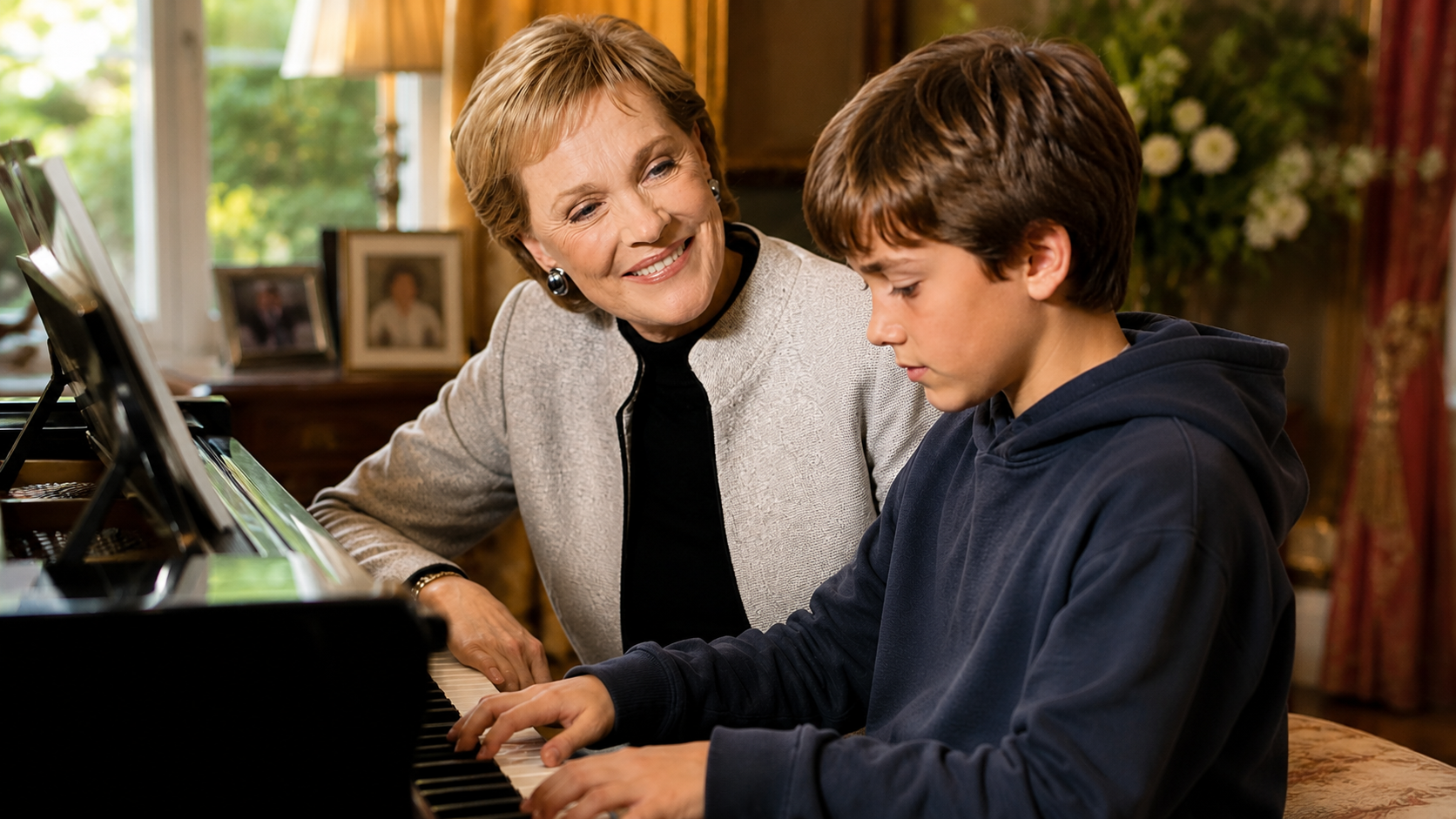
Part 1: The Notes Between the Broken Keys
Every afternoon at exactly four o’clock, twelve-year-old Daniel Carter sat beside a battered electronic keyboard in the corner of his family’s tiny apartment.
Three of its keys no longer worked.
Another made a strange buzzing sound whenever he pressed it.
The plastic casing had cracked near the speaker, and someone had repaired the power cord with layers of black tape.
But to Daniel, it was beautiful.
It was the closest thing he had to a piano.
He had discovered the keyboard two years earlier at a neighborhood yard sale. The woman selling it wanted twenty dollars, but Daniel had only seven dollars saved from helping an elderly neighbor carry groceries.
When she learned why he wanted it, she handed it to him anyway.
“Promise me you’ll play something beautiful on it someday,” she had said.
Daniel had never forgotten.
His mother, Rachel, worked long hours at a small bakery. Since Daniel’s father had died several years earlier, money had always been tight.
Music lessons were impossible.
A real piano was unimaginable.
So Daniel taught himself.
He borrowed beginner music books from the public library.
He watched free instructional videos whenever the apartment’s internet connection worked.
When he could not understand a lesson, he simply tried again.
Sometimes for hours.
The broken keys forced him to become creative.
If a song required one of the missing notes, Daniel moved the melody to a different octave.
If that did not work, he changed the arrangement entirely.
His music teacher at school, Mrs. Bennett, first noticed his unusual ability during a rainy Wednesday afternoon.
The school music room was empty except for Daniel.
He thought everyone had already gone home.
Mrs. Bennett had returned to collect her umbrella when she heard someone playing the old upright piano.
She stopped in the hallway.
Daniel was playing a piece far beyond anything she had taught in class.
It was not perfect.
But there was something deeply sincere about the way he played.
Mrs. Bennett stood silently until he finished.
“Daniel?”
He jumped.
“I’m sorry,” he said quickly. “I wasn’t supposed to use it.”
Mrs. Bennett smiled.
“That isn’t what I was going to say.”
She walked toward the piano.
“Where did you learn to play like that?”
Daniel shrugged.
“Mostly at home.”
“Do you have a piano?”
He laughed softly.
“Not exactly.”
The next afternoon, Mrs. Bennett visited Rachel and Daniel’s apartment.
When Daniel proudly showed her the old keyboard, she stared at it in disbelief.
“You learned on this?”
Daniel nodded.
Mrs. Bennett pressed one of the broken keys.
Nothing happened.
She tried another.
A loud buzz filled the room.
Daniel looked embarrassed.
“I know it’s not very good.”
Mrs. Bennett turned toward him.
“No, Daniel.”
She placed a hand gently on his shoulder.
“The keyboard isn’t very good.”
Then she smiled.
“But you are.”
From that day forward, Mrs. Bennett allowed Daniel to practice on the school piano after classes.
For Daniel, those extra hours felt like stepping into another world.
Every working key seemed like a luxury.
Yet there was still one problem.
His school was preparing for a regional youth music festival.
Students from dozens of schools would perform before professional musicians and teachers.
Mrs. Bennett wanted Daniel to enter.
Daniel refused immediately.
“I can’t.”
“Why?”
Daniel looked down.
“Everyone there will have private teachers.”
“That doesn’t matter.”
“They’ll have expensive instruments.”
“That doesn’t matter either.”
Daniel hesitated.
Then he finally said what frightened him most.
“What happens when they realize I don’t belong there?”
Mrs. Bennett’s expression softened.
She sat beside him on the piano bench.
“Talent doesn’t ask where you live before it arrives, Daniel.”
He remained silent.
“And opportunity,” she continued, “sometimes appears only after you are brave enough to walk toward it.”
Eventually, Daniel agreed.
He spent the next six weeks practicing a piece he had arranged himself.
It began quietly.
Then slowly grew into something hopeful and powerful.
He called it The Open Window.
The title came from the small window beside his keyboard at home.
Whenever life felt too difficult, Daniel would look through it and imagine another future somewhere beyond the rooftops.
On the morning of the festival, he almost changed his mind.
His mother noticed him standing beside the apartment door, holding his sheet music.
“You’re scared,” she said.
Daniel nodded.
Rachel hugged him.
“So am I.”
Daniel looked surprised.
“You are?”
“Of course. Mothers are allowed to be scared too.”
She smiled.
“But courage isn’t about not being afraid.”
She straightened his shirt collar.
“It’s about deciding that something matters more than your fear.”
At the festival, Daniel sat backstage listening to the other performers.
They were extraordinary.
One girl had studied piano since she was four.
Another boy had recently performed with a youth orchestra.
Daniel’s confidence disappeared.
He whispered to Mrs. Bennett, “I shouldn’t be here.”
Before she could answer, the auditorium suddenly became unusually quiet.
Someone important had arrived.
A woman stepped into the hall surrounded by several organizers.
Daniel recognized her immediately.
Julie Andrews.
She had been invited as a special guest to support the youth arts program.
Daniel had seen her in movies with his mother.
He had heard her sing.
He had even watched interviews in which she spoke about the importance of encouraging young performers.
But seeing her only a few feet away felt impossible.
Julie spent time speaking with students before the concert.
She asked about their instruments.
Their favorite songs.
Their dreams.
When she reached Daniel, he became so nervous that he almost forgot his own name.
“And what will you be playing?” Julie asked kindly.
“A piece I wrote.”
“You wrote it yourself?”
Daniel nodded.
“What is it called?”
“The Open Window.”
Julie smiled.
“That’s a wonderful title.”
Then she noticed the folded sheet of paper in his hands.
The corners were worn from weeks of practice.
“You’ve worked very hard, haven’t you?”
Daniel looked down.
“I try.”
Mrs. Bennett, standing nearby, could not resist.
“You should hear what he practices on at home.”
Daniel’s face immediately turned red.
Julie looked curious.
“What do you practice on?”
Daniel hesitated.
“Just an old keyboard.”
Mrs. Bennett added gently, “Several of the keys are broken.”
Julie looked back at Daniel.
“How many?”
“Three.”
“And you still practice every day?”
“Usually.”
“Usually?”
Daniel smiled shyly.
“Sometimes my mother has to make me stop so the neighbors can sleep.”
Julie laughed.
Then something in her expression changed.
She looked thoughtful.
Almost moved.
“Well,” she said quietly, “I’m very glad you didn’t let three broken keys stop you.”
A few minutes later, Daniel’s name was announced.
His hands trembled as he walked onto the stage.
Hundreds of people filled the auditorium.
For one terrible second, he wanted to run.
Then he looked toward the front row.
His mother was there.
Mrs. Bennett sat beside her.
And a few seats away sat Julie Andrews.
Daniel placed his hands over the piano.
He thought about the old keyboard.
The cracked casing.
The buzzing key.
The hours spent practicing alone.
Then he played.
The first notes were soft.
The auditorium became completely silent.
Slowly, the melody grew.
There were imperfect moments.
A slight hesitation.
A note struck harder than he intended.
But Daniel kept going.
By the final section, he forgot about the audience.
He forgot about the competition.
He simply told his story through the piano.
When the final note faded, there was a moment of silence.
Then the audience rose.
Daniel stared in disbelief.
His mother was crying.
Mrs. Bennett was clapping harder than anyone.
And Julie Andrews was standing too.
After the concert, Daniel did not win first place.
He received a special recognition award for original composition.
To him, it felt like winning everything.
But the strangest moment came later.
As Daniel and his mother were preparing to leave, one of the organizers approached them.
“Daniel?”
“Yes?”
“Ms. Andrews would like to speak with you before you go.”
Daniel looked at his mother.
Rachel looked equally surprised.
They were taken to a quiet room near the backstage area.
Julie was waiting inside.
“You played beautifully,” she told him.
Daniel swallowed nervously.
“Thank you.”
“But I especially liked something else.”
Daniel looked confused.
“What?”
“The fact that you adapted instead of giving up.”
Julie explained that Mrs. Bennett had told her more about the broken keyboard.
“You know,” Julie said, “sometimes we spend so much time wishing the obstacle would disappear that we forget how much we’ve learned by climbing over it.”
Daniel smiled.
Then Julie handed him a small envelope.
“For you.”
Daniel opened it carefully.
Inside was a handwritten note.
It read:
Keep playing. The world has not heard your best music yet.
Daniel stared at the words.
“Thank you,” he whispered.
He thought that was the entire surprise.
It wasn’t.
Two mornings later, a delivery truck stopped outside Daniel’s apartment building.
Rachel looked through the window.
“Daniel?”
He ran beside her.
Two men were unloading a large wooden crate.
Mrs. Bennett was standing on the sidewalk.
And beside her was the festival director.
Daniel rushed downstairs.
“What is that?”
Mrs. Bennett was smiling so widely that she could barely answer.
The delivery team opened the crate.
Inside was a beautiful digital piano.
Full-sized weighted keys.
A proper bench.
Headphones.
Pedals.
Everything Daniel had dreamed of but never expected to own.
Attached to the piano was another small card.
Daniel recognized the handwriting immediately.
Dear Daniel,
Every musician deserves the chance to hear what is possible when all the keys work.
But never forget—the broken ones helped teach you who you are.
With warmest wishes,
Julie
Daniel covered his mouth.
His mother began crying.
For several seconds, nobody spoke.
Then Daniel slowly sat on the new bench.
He placed his fingers on the keys.
For the first time in his life, every note answered.
He played one simple chord.
The sound filled the apartment.
Daniel looked at his mother.
“I didn’t know it could sound like this.”
Rachel kissed the top of his head.
“You haven’t heard anything yet.”
None of them knew how true those words would become.
Because the piano was only the beginning.
Within months, Daniel would receive an invitation that seemed impossible.
Within years, he would walk onto stages far larger than the little school auditorium.
And one day, long after that battered keyboard had been placed safely in storage, Daniel would find himself standing before another child who believed a dream was too expensive to pursue.
That child would ask him one question.
And Daniel’s answer would bring him all the way back to the afternoon Julie Andrews changed his life.
Part 2: The Door That Stayed Open
The new piano changed the sound of Daniel’s apartment.
But more importantly, it changed the way Daniel saw himself.
Before, every practice session had been an act of determination.
Now, for the first time, it also felt like possibility.
He still practiced after school.
He still borrowed music books.
He still made mistakes.
But the frustration of missing notes was gone.
He could finally hear a piece the way he had imagined it.
Mrs. Bennett immediately noticed the difference.
Daniel’s playing became more confident.
More expressive.
More complete.
Then, three months after the festival, she arrived at his apartment holding an envelope.
“This came to the school,” she said.
Daniel opened it.
He read the first line twice.
Then a third time.
He had been invited to audition for a summer music program for gifted young students.
The program offered professional instruction, ensemble training, and composition classes.
There was only one problem.
Daniel stared at the tuition fee printed at the bottom of the page.
His excitement disappeared.
“We can’t afford this.”
Rachel looked over his shoulder.
She knew he was right.
Even with months of saving, the amount was impossible.
Mrs. Bennett, however, pointed to another paragraph.
“Keep reading.”
Daniel did.
A scholarship was available.
Full tuition.
But only for a small number of students.
He would have to audition.
Daniel’s old fear returned immediately.
“What if I’m not good enough?”
Mrs. Bennett smiled.
“I believe we’ve had this conversation before.”
Daniel looked toward the piano Julie had given him.
On the music stand was her handwritten note.
Keep playing. The world has not heard your best music yet.
Daniel took a breath.
“I’ll audition.”
For the next six weeks, he worked harder than ever.
Some evenings he practiced until his hands ached.
Rachel would appear in the doorway with a sandwich and tell him to rest.
Daniel would promise.
Then five minutes later, she would hear the piano again.
The audition took place in a large conservatory.
Daniel had never seen so many pianos in one building.
Students filled the hallways carrying music folders.
Parents discussed private teachers and competitions.
Daniel began feeling small again.
But when his name was called, he remembered something Julie had told him.
The broken keys had helped teach him who he was.
He walked into the audition room.
He played.
Not perfectly.
Honestly.
Two weeks later, the letter arrived.
Daniel had received the scholarship.
His mother screamed so loudly that their upstairs neighbor came down to see what had happened.
That summer became the beginning of a new world.
Daniel studied composition.
He learned music theory.
He played beside students who were better than him.
At first, that frightened him.
Then it inspired him.
He stopped asking, “Am I good enough?”
Instead, he began asking, “What can I learn?”
Years passed.
Daniel continued receiving scholarships.
He eventually entered a respected music conservatory.
By nineteen, one of his original compositions was performed by a youth orchestra.
By twenty-two, he was writing music for small theater productions.
By twenty-five, his work was being performed in concert halls he had once only seen in photographs.
Through all of it, Daniel kept two things.
Julie’s handwritten note.
And the old keyboard with the broken keys.
His mother once asked why he refused to throw it away.
Daniel smiled.
“Because that keyboard never told me to quit.”
Then came the night that changed everything again.
Daniel had been invited to perform at a charity concert supporting music education for children from low-income families.
Hundreds of people filled the hall.
Before the concert, Daniel visited one of the small rehearsal rooms backstage.
There he found a boy sitting alone.
The boy could not have been older than eleven.
His name was Marcus.
He was supposed to perform in a student showcase before the main concert.
But Marcus looked terrified.
Daniel sat beside him.
“Nervous?”
Marcus nodded.
“What do you play?”
“Piano.”
Daniel smiled.
“So do I.”
Marcus looked at him and laughed.
“I know.”
Then Daniel noticed Marcus was holding a photograph.
It showed a tiny keyboard sitting on a kitchen table.
Several keys were missing.
Daniel froze.
“What happened to your keyboard?”
Marcus shrugged.
“It was my uncle’s. He gave it to us.”
“Does it still work?”
“Mostly.”
“How many broken keys?”
Marcus counted silently.
“Four.”
Daniel stared at him.
For a moment, it felt as though he were looking at himself twenty years earlier.
Marcus continued.
“My mom says maybe one day we can buy a better one.”
Daniel asked, “Do you practice every day?”
Marcus nodded.
“Even with the broken keys?”
“Yeah.”
Then Marcus said something Daniel never forgot.
“I just move the song somewhere else when I can’t play the note.”
Daniel nearly laughed.
That was exactly what he had done.
Marcus looked down at his hands.
“I don’t think I’m supposed to be here.”
Daniel felt a chill.
Those words too.
He remembered them perfectly.
Years earlier, he had said the same thing to Mrs. Bennett.
So Daniel leaned closer.
“Let me tell you something somebody once taught me.”
Marcus looked up.
“Talent doesn’t ask how much money your family has before it arrives.”
The boy listened carefully.
“And a broken instrument doesn’t mean you have a broken dream.”
Marcus smiled.
Later that evening, he performed.
He missed several notes.
His hands shook.
But he finished.
Daniel stood at the side of the stage applauding.
The next morning, Daniel made a phone call.
Then another.
Three days later, Marcus and his mother received a delivery.
A new digital piano.
Full-sized keys.
A bench.
Headphones.
Everything Daniel had once received.
Attached was a handwritten card.
Dear Marcus,
Every musician deserves the chance to discover what is possible when all the keys work.
But never forget what the broken ones taught you.
Keep playing.
Daniel
When Marcus called to thank him, he was crying.
Daniel was too.
After the call ended, Daniel went to his closet.
He removed an old box.
Inside was Julie Andrews’ note.
The paper had yellowed slightly over the years.
But the words were still clear.
Keep playing. The world has not heard your best music yet.
Daniel finally understood something.
Julie’s greatest gift had never really been the piano.
It was belief.
She had looked at a frightened twelve-year-old boy and treated his dream as if it mattered.
And that belief had traveled farther than either of them could have imagined.
Several years later, Daniel created a small charitable program called The Open Window Project.
Its purpose was simple.
Find children with musical talent but limited resources.
Give them instruments.
Give them lessons.
Give them opportunities.
And most importantly, give them encouragement.
The project began with six children.
Then twenty.
Then fifty.
Eventually, supporters from around the country joined.
Music stores donated instruments.
Teachers volunteered lessons.
Former students became mentors.
One afternoon, Daniel received a letter from an elderly woman.
He recognized the name immediately.
Julie Andrews.
She had heard about The Open Window Project.
The letter was brief.
But one sentence made Daniel sit silently for several minutes.
It seems the piano found exactly the right home.
Daniel smiled.
Then he looked across the rehearsal room.
Dozens of children were practicing.
Violins.
Guitars.
Flutes.
Pianos.
The room was filled with imperfect notes.
Wrong notes.
Beautiful notes.
Hopeful notes.
And near the doorway stood Marcus.
No longer eleven years old.
Now a young man studying music education.
He was helping a little girl learn her first piano piece.
She became frustrated and stopped.
Marcus leaned beside her.
“Don’t worry.”
He pointed toward the keys.
“We’ll find another way.”
Daniel watched quietly.
Kindness, he realized, rarely ends where it begins.
Sometimes it moves through generations.
One person opens a door.
Another holds it open.
And eventually, someone who once needed help becomes the person helping someone else walk through.
Daniel still kept the old broken keyboard.
Years later, The Open Window Project displayed it in its main rehearsal building.
Beside it was a small plaque.
It did not mention awards.
It did not mention concerts.
It did not even mention Daniel’s career.
It simply read:
Three broken keys could not stop one boy from dreaming.
One act of kindness made sure he never had to stop.
And beneath those words was one final sentence:
Never underestimate what can happen when someone believes in you before you fully believe in yourself.
The End.


