Part 1 — The Woman With the Extra Grocery Bags
Every Thursday morning, just after eight, Margaret Ellis walked into the same little grocery store carrying a folded shopping list in her coat pocket.
At seventy-one, Margaret moved more slowly than she once had. Her silver hair was usually tucked beneath a simple knitted hat, and she always brought the same faded canvas shopping bags.
To anyone watching, she looked like an ordinary grandmother buying groceries for herself.
But Margaret rarely shopped only for Margaret.
Her cart would gradually fill with milk, bread, eggs, soup, fruit, tea, oatmeal, vegetables, and sometimes a small box of biscuits.
Then she would separate everything carefully at the checkout.
“This bag is Mrs. Harris.”
“This one is for Mr. Collins.”
“And those apples go to Edith.”
The cashier, a young woman named Sophie, eventually became curious.
“Margaret,” she asked one morning, “how many people are you shopping for today?”
Margaret smiled.
“Only five.”
“Only five?”
Margaret laughed softly.
“Some weeks there are more.”
What Sophie didn’t know was that Margaret had been doing this for fifteen years.
It had started with one elderly neighbor.
Her name was Dorothy Harris.
Dorothy had broken her hip and could no longer walk comfortably to the grocery store. Her daughter lived several hours away, and although Dorothy never complained, Margaret noticed that her refrigerator was nearly empty.
So Margaret bought her some groceries.
Dorothy tried to pay her.
Margaret refused.
“Next time you see somebody who needs help,” she said, “help them instead.”
That should have been the end of it.
Instead, it became the beginning.
A few months later, Margaret discovered that another neighbor, Arthur Collins, had stopped buying fresh fruit because his pension barely covered his medication.
Margaret began leaving oranges and bananas on his porch.
Then there was Edith, an eighty-six-year-old widow who had stopped driving.
Then Mr. Bennett.
Then Mrs. Lawson.
Year after year, Margaret quietly added names to her Thursday list.
She never created a charity.
She never posted photographs online.
She never asked for donations.
Most people in the neighborhood didn’t even realize she was paying for the groceries herself.
Whenever anyone thanked her, Margaret would simply say, “We all need someone eventually.”
There was a reason she believed that so deeply.
Fifteen years earlier, Margaret’s husband, Peter, had become seriously ill.
During his final months, Margaret rarely left his side.
Neighbors appeared at their door carrying casseroles, bread, flowers, and groceries.
One evening, Margaret opened the front door and discovered two bags filled with food.
There was no name attached.
Only a small handwritten note:
“You have enough to carry right now. Let us carry this.”
Margaret kept that note.
After Peter died, she placed it inside a little wooden box beside photographs from their forty-three years together.
She never discovered who had left those groceries.
So she decided the best way to repay the kindness was to pass it forward.
And she never stopped.
A Letter About Julie
There was one thing Margaret allowed herself to collect over the years: old films and recordings featuring Julie Andrews.
Peter had taken Margaret to see The Sound of Music shortly after they were married.
Whenever life became difficult, they would watch it together.
Margaret loved Julie not simply because of her performances, but because she associated that voice with some of the happiest moments of her life.
Her granddaughter, Lily, knew this.
She also knew something else.
Margaret’s grocery tradition was becoming harder.
Prices had risen.
Margaret’s knees hurt.
And although she never admitted it, Lily noticed her grandmother quietly removing things from her own shopping list so she could continue buying food for others.
One Thursday, Lily found Margaret putting back a packet of coffee.
“I thought that’s your favorite.”
“It is.”
“Then why aren’t you buying it?”
Margaret glanced at the groceries filling her cart.
“Mr. Collins needs his soup.”
That answer stayed with Lily.
That evening, she wrote a letter.
Not to a television station.
Not to a newspaper.
She wrote it to representatives connected with Julie Andrews.
She described her grandmother.
Fifteen years.
Hundreds of grocery bags.
No recognition.
No photographs.
No expectation of anything in return.
At the end, Lily wrote:
“Grandma thinks nobody notices what she does. But an entire street is healthier, less lonely, and kinder because of her.”
She expected nothing.
Weeks passed.
Then one afternoon, Lily received a phone call.
She listened silently for several seconds.
Then she covered her mouth with her hand.
“Are you serious?”
The person on the other end laughed.
“Yes.”
Lily immediately began crying.
Because Julie Andrews had heard about Margaret.
And she wanted to help create a surprise.
A Neighborhood Secret
Suddenly, nearly everyone knew except Margaret.
The grocery store manager joined the plan.
So did Sophie.
So did Margaret’s neighbors.
People Margaret had helped years earlier contacted their children and grandchildren.
Some traveled from other towns.
Everyone was given one instruction:
Don’t tell Margaret.
The following Thursday, Lily offered to drive her grandmother to the store.
Margaret became suspicious immediately.
“You never volunteer to grocery shop at eight in the morning.”
“I’ve changed.”
“Since yesterday?”
Lily smiled.
“Apparently.”
Margaret shook her head and climbed into the car.
When they reached the store, everything looked normal.
Margaret collected a cart.
She checked her list.
Milk for Edith.
Soup for Arthur.
Bread for Dorothy.
But something strange happened.
Every item Margaret reached for already had a small paper heart beside its price tag.
She noticed the first one beside a carton of milk.
Then another beside the bread.
Then another near the apples.
“What are these?” Margaret asked Sophie.
Sophie struggled not to smile.
“Maybe someone likes hearts.”
Margaret narrowed her eyes.
“Sophie.”
“I know nothing.”
Margaret continued shopping.
When she reached the checkout, the cashier scanned every item.
Margaret opened her purse.
But the register displayed:
BALANCE: $0.00
Margaret stared.
“There must be a mistake.”
“There isn’t,” Sophie said.
Margaret looked around.
The store had suddenly become strangely quiet.
Then the manager appeared.
“Margaret, would you come with us for a moment?”
“What’s happening?”
Lily took her hand.
“Just trust me, Grandma.”
They led Margaret toward the store’s community room.
Behind the closed doors, Margaret could hear people whispering.
Then everything became silent.
The doors opened.
Margaret stopped.
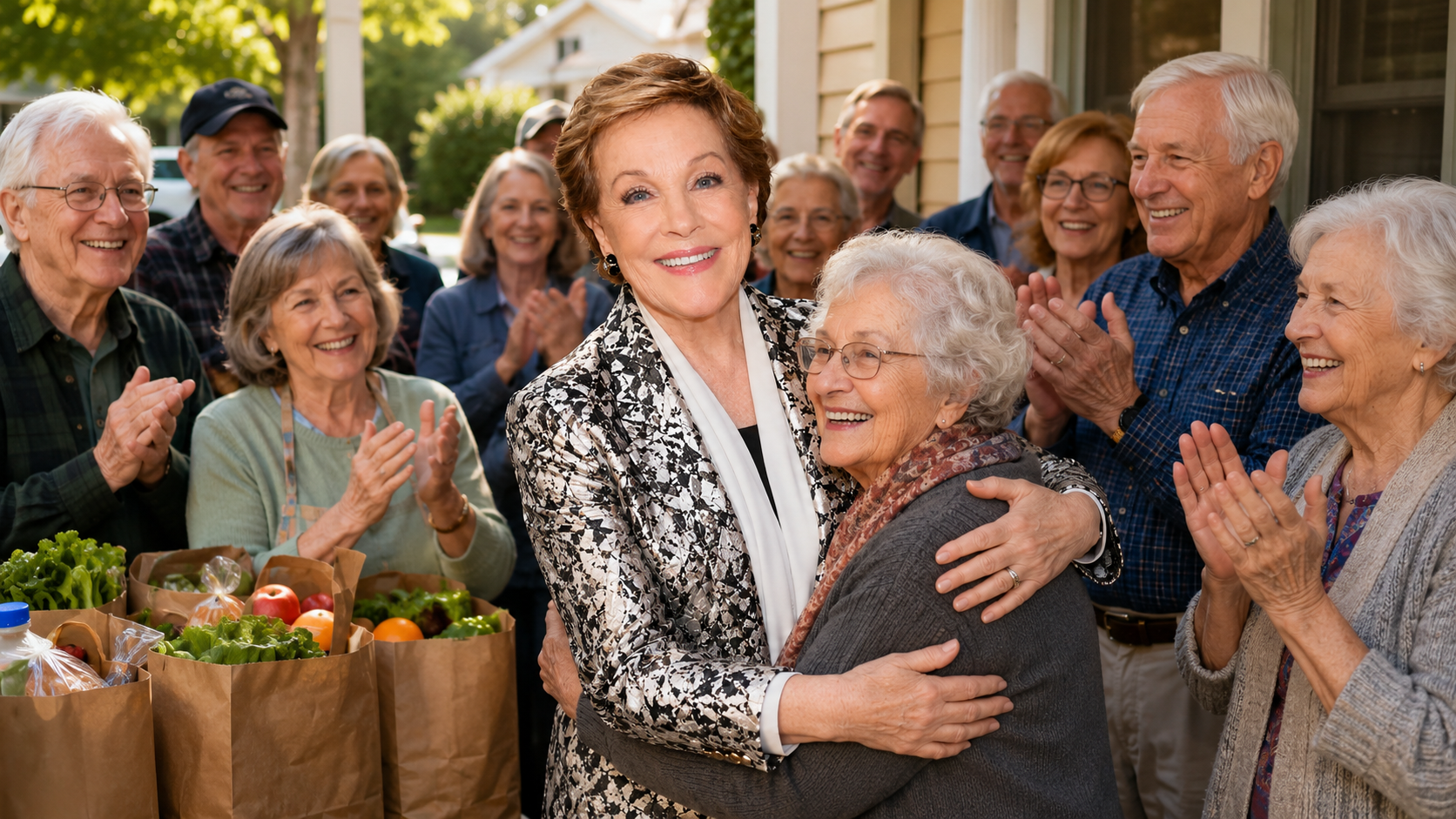
Nearly sixty people were standing inside.
Some she recognized immediately.
Others she hadn’t seen in years.
On the walls hung hundreds of small paper grocery bags.
Each carried a handwritten message.
You helped my mother when she couldn’t drive.
You made sure Grandpa never ate dinner alone.
You brought groceries when Dad couldn’t afford them.
You reminded us what neighbors are supposed to be.
Margaret covered her mouth.
“Oh…”
Then everyone began applauding.
Margaret shook her head as tears filled her eyes.
“You shouldn’t have done all this.”
Arthur Collins stepped forward.
For years, Margaret had quietly bought his soup.
He smiled.
“You’ve been saying that for fifteen years.”
Everyone laughed.
But Lily was still watching the doorway.
Because the biggest surprise had not arrived yet.
Then a familiar voice came gently from behind Margaret.
“I believe they’ve waited quite long enough to thank you.”
Margaret froze.
She knew that voice.
Slowly, she turned around.
And when she saw who was standing there, the grocery list slipped from her hand.
Julie Andrews smiled at her.
Margaret could only whisper one word.
“Julie?”
Julie stepped closer and held out both hands.
“Yes, Margaret.”
Margaret began crying.
Julie took her hands.
Then she said something that made the entire room fall silent.
“I heard you’ve spent fifteen years making sure your neighbors never felt forgotten.”
Margaret tried to answer.
“I only bought groceries.”
Julie smiled.
“No, my dear. I think you did something much bigger than that.”
But even Julie didn’t yet know about the wooden box Margaret had kept for fifteen years.
Or the anonymous note inside it.
And before the afternoon was over, the neighborhood would finally discover who had written it.
Part 2 — The Kindness That Came Back Home
Margaret stood in the middle of the grocery store’s community room with Julie Andrews holding both of her hands.
For several seconds, she could not speak.
Around them, neighbors wiped away tears.
Lily stood near the wall, crying openly now.
Margaret finally gave a nervous little laugh.
“I’m sorry,” she whispered. “I had a much better sentence prepared in case I ever met you.”
Julie smiled warmly.
“I think this one is perfect.”
The room laughed.
Margaret looked around at all the familiar faces.
Arthur.
Dorothy.
Edith.
Sophie.
Children and grandchildren of people she had helped.
Some had traveled hours just to be there.
Margaret shook her head.
“I really didn’t do anything extraordinary.”
Julie glanced toward the paper grocery bags hanging on the walls.
“Margaret, sometimes extraordinary things look very ordinary while they’re happening.”
The room became quiet.
Julie continued.
“A loaf of bread can look ordinary.”
“A carton of milk can look ordinary.”
“Knocking on someone’s door can look ordinary.”
“But when someone is lonely, frightened, sick, or struggling, those small things can mean everything.”
Margaret lowered her eyes.
She was trying not to cry again.
Then Lily stepped forward.
“Grandma, there’s something else.”
Margaret looked at her suspiciously.
“There’s more?”
Everyone laughed.
Lily nodded.
“We need you to tell them about the note.”
Margaret’s expression changed.
“What note?”
“The one you kept from when Grandpa Peter was sick.”
Margaret became still.
Julie looked gently at her.
Lily explained to the room.
“Fifteen years ago, when Grandpa was very ill, someone left groceries outside Grandma’s door.”
Margaret slowly nodded.
“There was a note inside.”
“What did it say?” Sophie asked.
Margaret looked toward Julie.
Then she repeated the words she had memorized long ago.
“‘You have enough to carry right now. Let us carry this.’”
Several people in the room sighed softly.
Margaret continued.
“I never found out who left the groceries.”
Julie’s eyes softened.
“And that kindness inspired what you did afterward?”
“Yes.”
Margaret smiled through her tears.
“I suppose it did.”
She told them how she had kept the note inside a wooden box beside photographs of Peter.
How she would sometimes read it on difficult days.
How it reminded her that receiving help had once saved her from feeling completely alone.
“I never managed to thank whoever wrote it,” Margaret said.
A voice suddenly came from the back of the room.
“You did.”
Margaret turned.
An elderly woman was standing beside the doorway.
She was small, with white hair and a blue cardigan.
Margaret stared at her.
“Rose?”
Rose Turner had lived three houses away from Margaret many years earlier.
She had moved to another town after her husband died.
Margaret had not seen her in nearly a decade.
Rose slowly walked forward.
“I wrote the note.”
Margaret’s face changed completely.
“You?”
Rose nodded.
“The groceries were from several of us.”
She pointed toward two other elderly neighbors.
“But I wrote those words.”
Margaret pressed a hand against her chest.
For fifteen years, she had wondered.
“Why didn’t you sign it?”
Rose smiled.
“Because you wouldn’t have accepted them if you knew who bought them.”
Margaret laughed through her tears.
“That sounds like me.”
“It certainly does.”
The room filled with soft laughter.
Then Rose’s expression became more serious.
“Peter had been sick for months. Every time someone asked whether you needed help, you said no.”
Margaret looked down.
Rose continued.
“So we stopped asking.”
“We simply started helping.”
Margaret walked toward her.
Rose opened her arms.
They embraced.
And suddenly, the room understood something beautiful.
Margaret had spent fifteen years repaying one anonymous act of kindness.
But the people who started that kindness had been standing nearby all along.
Julie watched them embrace.
Then she said quietly, “And now the circle is complete.”
Rose shook her head.
“No.”
Everyone looked at her.
Rose smiled.
“I don’t think kindness makes circles.”
Julie raised an eyebrow.
“What does it make?”
Rose looked around the room.
“Ripples.”
That single word seemed to settle over everyone.
Because she was right.
One bag of groceries had become hundreds.
One note had reached dozens of families.
One person’s difficult season had eventually changed an entire neighborhood.
The Neighborhood’s Gift
After everyone settled down, the grocery store manager stepped forward carrying a large envelope.
“Margaret, we have something for you.”
Margaret immediately protested.
“No.”
He laughed.
“You don’t even know what it is.”
“I know that face. It means expense.”
Everyone laughed.
The manager opened the envelope.
“Over the last few weeks, people in this neighborhood donated money.”
Margaret shook her head.
“I won’t take it.”
“You aren’t.”
Margaret paused.
The manager smiled.
“We used it to create something called the Margaret Ellis Neighbor Fund.”
Margaret stared at him.
“The what?”
“A permanent community grocery fund.”
Sophie continued the explanation.
“Anyone in the neighborhood who is elderly, sick, struggling financially, or temporarily unable to shop can receive groceries.”
Margaret looked around.
“And nobody has to feel embarrassed asking?”
“Exactly.”
Arthur smiled.
“And you don’t have to pay for everything anymore.”
Margaret gave him a look.
“I never paid for everything.”
Arthur raised an eyebrow.
“Margaret.”
“Fine. Most things.”
Everyone laughed again.
Lily handed her grandmother a small folder.
Inside were pages explaining the program.
Local families had volunteered to shop.
Teenagers had signed up to deliver groceries.
The store agreed to provide discounts.
Nearby restaurants promised food donations.
A local pharmacy offered free delivery for elderly residents who were receiving groceries.
It was no longer one woman carrying bags from house to house.
The entire neighborhood was carrying them together.
Margaret closed the folder.
She could not speak.
Julie moved beside her.
“Do you see what you started?”
Margaret looked at the people around her.
“I thought I was only helping a few neighbors.”
Julie smiled.
“That’s often how these things begin.”
Julie’s Personal Surprise
Then Julie lifted a small paper bag from a nearby table.
“This one is from me.”
Margaret laughed.
“Please tell me you didn’t buy groceries.”
“As a matter of fact, I did.”
She reached inside.
Tea.
Biscuits.
Coffee.
Margaret stared at the coffee.
Lily smiled knowingly.
Julie had heard about the coffee Margaret had put back on the shelf so Mr. Collins could have his soup.
Margaret picked it up.
“You really didn’t need to do this.”
Julie smiled.
“I know.”
Margaret laughed.
“That’s exactly what I always say.”
“Which is precisely why everyone enjoyed doing it.”
The room erupted in laughter.
Then Julie handed her one final item.
It was a small framed card.
On it were the words:
“Let someone else carry the bag sometimes.”
Margaret stared at the sentence.
Her eyes filled again.
Julie spoke gently.
“You have spent fifteen years giving.”
“Perhaps it is time to practice receiving, too.”
Margaret looked at Lily.
Then at Rose.
Then at Arthur.
Finally, she nodded.
“I’ll try.”
Arthur called from across the room.
“We’ll supervise.”
The First Thursday After
One week later, Thursday morning arrived.
Margaret woke automatically at seven.
For fifteen years, Thursdays had meant grocery lists.
She made tea.
Put on her knitted hat.
Picked up her canvas bags.
Then someone knocked on the door.
It was Lily.
Behind her stood Sophie and two teenagers from the neighborhood.
They were carrying grocery bags.
Margaret blinked.
“What are you doing?”
“Delivering groceries.”
“To whom?”
Lily smiled.
“You.”
Margaret began protesting immediately.
But everyone simply walked inside.
On the kitchen table they placed bread, milk, fruit, vegetables, soup, tea, and one packet of Margaret’s favorite coffee.
There was also an envelope.
Margaret opened it.
Inside were photographs from the previous week.
Julie laughing with Rose.
Arthur holding one of the paper grocery bags.
Margaret hugging Lily.
And one photograph of nearly sixty neighbors standing together.
On the back, someone had written:
“You made us neighbors again.”
Margaret sat down.
For a long moment, she simply held the photograph.
Then Lily noticed something on the counter.
Grandma’s old grocery list.
But this Thursday, there were no names written beside items.
Instead, Margaret had written one sentence across the top.
Remember to let people help.
Lily smiled.
“That might be the hardest thing you’ve ever done.”
Margaret laughed.
“You have no idea.”
One Year Later
The Margaret Ellis Neighbor Fund grew.
What began on one street spread into several neighborhoods.
Children collected canned food at school.
Families donated extra groceries.
Teenagers delivered bags after class.
Retired residents volunteered to call elderly neighbors who lived alone.
And every grocery bag carried a small card.
On one side were Rose’s words:
“You have enough to carry right now. Let us carry this.”
On the other were Julie’s:
“Let someone else carry the bag sometimes.”
Margaret continued helping.
Of course she did.
Nobody could stop her completely.
But now she had company.
Sometimes she shopped.
Sometimes she delivered.
Sometimes she simply sat with an elderly neighbor and shared a cup of tea.
And occasionally, she allowed someone else to bring groceries to her door.
Which everyone agreed was enormous progress.
Julie stayed in touch through occasional letters.
One arrived on Margaret’s seventy-second birthday.
Margaret opened it while Lily sat beside her.
Inside was a short handwritten message.
Dear Margaret,
I hope your neighborhood is still carrying one another’s bags.
The world will always need grand gestures. But I suspect it survives because of smaller ones.
A loaf of bread.
A knock at the door.
A neighbor who notices.
Thank you for noticing.
With love,
Julie
Margaret read it twice.
Then she placed it inside the old wooden box.
Right beside Rose’s note from fifteen years earlier.
Two messages.
Two acts of kindness.
Two reminders that nobody should have to carry everything alone.
That evening, Margaret sat by the window watching volunteers deliver groceries along the street.
A teenage boy carried two bags toward Arthur’s house.
A mother and her daughter walked toward Edith’s.
Across the road, Rose was talking with Lily.
Margaret smiled.
She had once believed kindness was something you gave away.
Now she understood differently.
Kindness travels.
It moves from hand to hand.
From one doorstep to another.
Sometimes it disappears for years.
And then, when you least expect it, it finds its way home.
The End.


