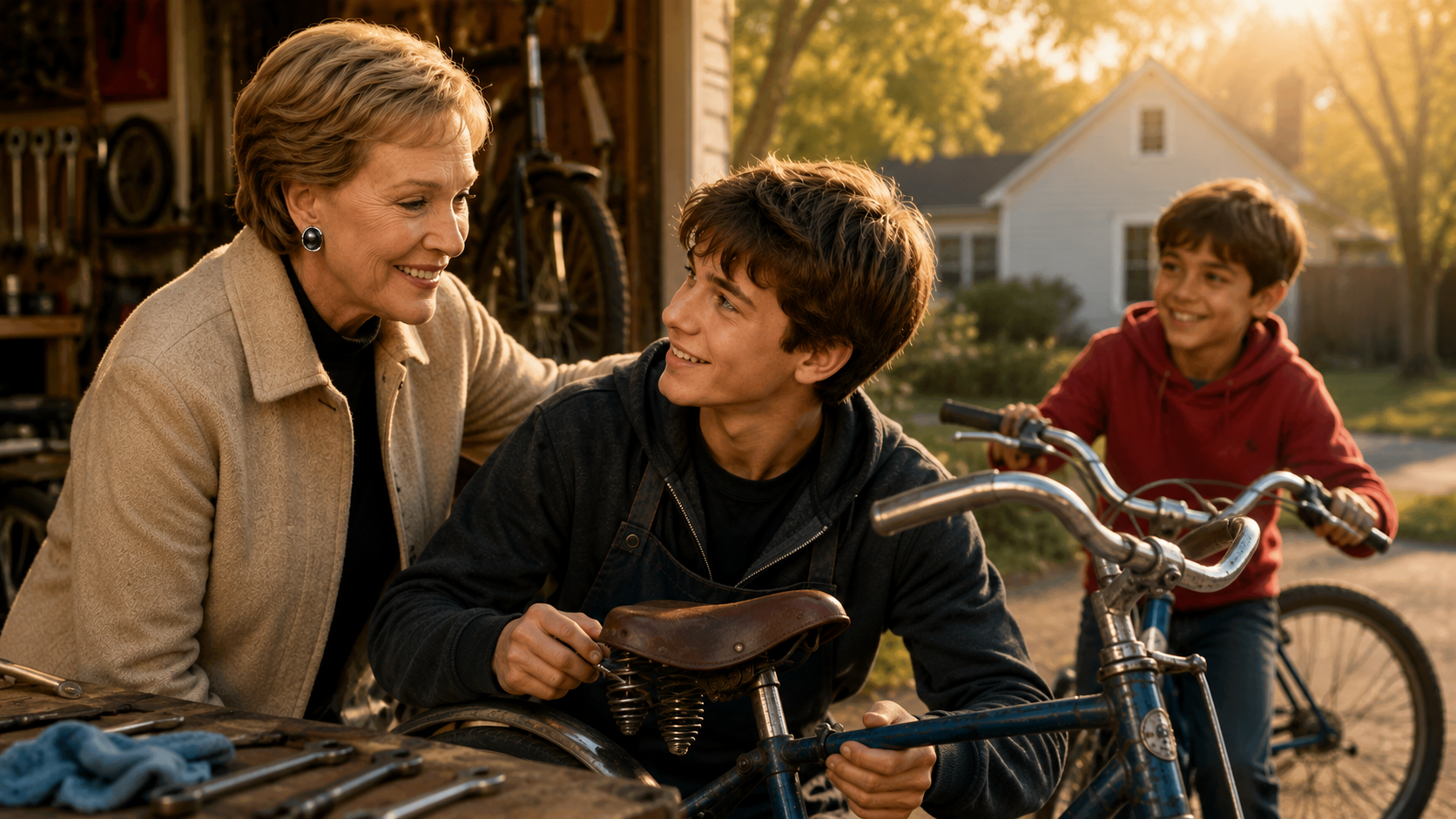
Part 1 — The Boy Who Gave Old Bicycles New Lives
Every Saturday morning, while most teenagers in his neighborhood were sleeping late or meeting friends, sixteen-year-old Ethan Parker opened the doors of a small wooden garage behind his grandmother’s house.
Inside were bicycles most people had already given up on.
Some had flat tires.
Others had rusty chains, broken pedals, bent handlebars, or seats held together with tape.
To Ethan, however, they weren’t junk.
They were possibilities.
“Someone could still ride this,” he would say whenever his grandmother suggested that a bicycle looked beyond saving.
And somehow, Ethan usually proved her wrong.
He had learned bicycle repair from his grandfather, Thomas.
When Ethan was eight, Grandpa Thomas had found an old blue bicycle at a neighborhood yard sale.
It was scratched, rusty, and missing one pedal.
Instead of buying Ethan a new bicycle, Thomas brought the old one home.
“We could buy something perfect,” he told his grandson. “Or we could learn how to make something useful again.”
For three weekends, they worked together.
Thomas taught Ethan how to clean a chain, replace brake cables, straighten a wheel, and carefully remove rust.
When they finally finished, the bicycle looked completely different.
Ethan rode it down the driveway while his grandfather applauded.
Years later, Ethan still remembered what Thomas told him that afternoon.
“Never judge something only by how it looks when you find it.”
That lesson stayed with Ethan.
Then, when Ethan was thirteen, his grandfather died unexpectedly.
The garage became painfully quiet.
For months, Ethan barely entered it.
The tools remained exactly where Thomas had left them.
Then one afternoon, Ethan saw a little boy named Noah standing outside the neighborhood community center.
Several children were riding bicycles around the parking lot.
Noah simply watched.
Ethan asked why he wasn’t joining them.
“I don’t have a bike,” Noah replied.
That evening, Ethan went home and opened his grandfather’s garage.
In the corner stood an abandoned red bicycle a neighbor had thrown away.
Ethan worked on it for four days.
He replaced the tires.
Fixed the brakes.
Cleaned the chain.
Adjusted the seat.
Then he wheeled it to Noah’s house.
When Noah realized the bicycle was his, he stared at Ethan as though someone had handed him treasure.
“For me?”
Ethan nodded.
Noah rode up and down the sidewalk until sunset.
That smile changed everything.
Soon Ethan began collecting unwanted bicycles from neighbors.
He posted a handwritten sign at the community center:
OLD BICYCLES WANTED. I’LL FIX THEM FOR CHILDREN WHO NEED ONE.
At first, only three bicycles arrived.
Then ten.
Then twenty.
Parents began leaving bicycles beside Ethan’s garage.
A local hardware shop donated tubes, brake cables, and tools.
His grandmother started making sandwiches for the teenagers who occasionally came to help.
Ethan never charged anyone.
Every repaired bicycle went to a child whose family couldn’t afford one.
By sixteen, Ethan had repaired seventy-three bicycles.
But there was something almost nobody knew.
Above his workbench hung a small photograph of his grandfather.
Whenever Ethan finished a bicycle, he looked toward it and quietly said:
“One more, Grandpa.”
Then something extraordinary happened.
A local newspaper wrote a small article about Ethan.
The headline called him “The Bicycle Boy Who Gives Childhood Back.”
The article traveled farther than anyone expected.
A teacher shared it.
Then a charity volunteer shared it again.
Eventually, a copy reached someone Ethan had admired since childhood.
Julie Andrews.
Ethan’s grandmother had introduced him to Julie’s films when he was young.
Whenever he was sick, they watched Mary Poppins together.
Whenever Grandma cooked Sunday dinner, music from The Sound of Music often played in the kitchen.
Ethan loved Julie not simply because she was famous.
His grandmother had always told him that grace was measured by how someone treated people who could offer nothing in return.
So when a black car stopped outside Ethan’s house one Saturday morning, he barely noticed.
He was kneeling beside a small yellow bicycle, struggling with a stubborn brake cable.
His hands were covered in grease.
Then his grandmother appeared in the garage doorway.
“Ethan,” she whispered.
He looked up.
She seemed unable to finish her sentence.
Someone stepped into the garage behind her.
Ethan froze.
Julie Andrews smiled warmly.
“I hope I’m not interrupting.”
Ethan stared at her.
Then at his grandmother.
Then back at Julie.
For several seconds, the teenager who could repair almost anything couldn’t find a single word.
Finally, he looked down at his greasy hands.
“I probably shouldn’t shake your hand.”
Julie laughed softly.
“I’ve met plenty of clean hands. I think hardworking ones are far more interesting.”
Ethan smiled nervously.
Julie walked around the garage, looking at the bicycles waiting for repair.
Some were hanging from hooks.
Others were lined against the wall.
Then she noticed the photograph above the workbench.
“Your grandfather?”
Ethan nodded.
“He taught me everything.”
Julie studied the photograph for a moment.
“I suspect he taught you more than bicycle repair.”
Ethan looked surprised.
Julie smiled.
“He taught you to notice what other people overlook.”
Those words hit Ethan harder than he expected.
He quickly turned toward the bicycle so Julie wouldn’t notice his eyes filling with tears.
Julie had not come merely to meet him.
She had heard that Ethan was approaching a milestone.
His one-hundredth bicycle.
A local children’s charity had quietly gathered enough donated parts for Ethan to repair twenty-seven additional bicycles.
Julie wanted to help him finish them.
“You repair bicycles?” Ethan asked, astonished.
“No,” Julie admitted.
“Then what are you going to do?”
“Follow instructions extremely carefully.”
Ethan laughed.
And for the next several hours, one of the world’s most recognizable performers sat inside a teenager’s garage sorting bolts, cleaning bicycle bells, organizing tools, and handing Ethan whatever he needed.
There were no cameras inside.
No stage.
No audience.
Just an elderly star, a teenage boy, and a garage filled with broken bicycles waiting for another chance.
By late afternoon, bicycle number ninety-nine was finished.
Only one remained.
Number one hundred.
It was different from all the others.
An old blue bicycle.
Ethan had deliberately saved it for last.
The paint was faded.
The handlebars were scratched.
But when Julie saw Ethan staring at it, she sensed there was a story behind it.
“Why this one?” she asked.
Ethan slowly ran his fingers along the frame.
“My grandfather found my first bicycle at a yard sale. It looked almost exactly like this.”
He smiled.
“I thought number one hundred should remind me where everything started.”
Together, they began restoring it.
They worked until the evening light disappeared.
Finally, Ethan tightened the last bolt.
He stepped backward.
The blue bicycle stood shining beneath the garage light.
“One hundred,” Julie whispered.
Ethan looked toward his grandfather’s photograph.
His voice became quiet.
“One more, Grandpa.”
His grandmother wiped away a tear.
Julie placed a gentle hand on Ethan’s shoulder.
But the story wasn’t finished.
Normally, Ethan knew exactly which child would receive each bicycle.
This time, however, the charity organizer had refused to tell him.
“All we can say,” she explained, “is that the final bicycle has already been promised to someone.”
The next morning, Ethan and Julie loaded the blue bicycle into a van.
Ethan expected they would drive toward one of the poorer neighborhoods nearby.
Instead, the van headed outside town.
Twenty minutes passed.
Then thirty.
Finally, they turned onto a narrow country road.
Ethan looked confused.
“Where are we going?”
Julie knew the answer.
But she had promised not to tell him.
The van eventually stopped beside a small white house surrounded by tall trees.
Someone was waiting on the porch.
Ethan climbed out.
Then he froze.
The person standing there was holding an old photograph.
A photograph Ethan recognized immediately.
It showed his grandfather Thomas as a young man, standing beside that very house.
Ethan stared at the stranger.
“How do you know my grandfather?”
The person smiled through tears.
And then said something Ethan never expected to hear.
“Because your grandfather once gave me my first bicycle.”
Ethan looked at the restored blue bicycle beside him.
Suddenly, he understood that bicycle number one hundred had never been chosen by accident.
But the biggest surprise was still waiting inside the house.
Part 2 — The Bicycle That Came Full Circle
Ethan stood beside the van, staring at the stranger on the porch.
The man looked to be in his late sixties.
His hair was silver, his shoulders slightly bent, but his eyes were bright.
He held the old photograph carefully with both hands.
Julie stayed a few steps behind Ethan.
She knew this moment belonged to him.
“My name is Samuel Reed,” the man said.
Ethan looked again at the photograph.
His grandfather, Thomas, was no older than twenty in the picture.
Beside him stood a thin boy holding a bicycle.
“That’s you?” Ethan asked.
Samuel nodded.
“I was twelve.”
Ethan looked at the restored blue bicycle.
Then back at Samuel.
“I don’t understand.”
Samuel invited them inside.
The little house was simple and warm.
On one wall were family photographs.
On another hung an old wooden shelf filled with books, trophies, and small keepsakes.
Samuel sat slowly in an armchair.
Ethan and Julie sat across from him.
Then Samuel began telling a story that Ethan had never heard.
When Samuel was a child, his family had almost nothing.
His father had been injured at work.
His mother cleaned houses to keep food on the table.
Samuel walked several miles to school every day.
He loved school, but the long journey often made him late.
One afternoon, a teenage boy named Thomas noticed him walking home.
Thomas asked why Samuel never rode the bus.
“My family couldn’t afford the fare every day,” Samuel explained.
Thomas didn’t say much.
But a week later, he appeared outside Samuel’s house pushing an old blue bicycle.
It had been repaired by hand.
“He told me somebody had thrown it away,” Samuel said.
“He said he fixed it and thought I might use it.”
Samuel smiled.
“That bicycle changed my life.”
Ethan listened silently.
Samuel rode it to school.
Then to his first job.
Later, he used it to deliver newspapers.
He saved the money and eventually became the first person in his family to attend college.
He became a teacher.
For forty-two years, Samuel taught children in small rural communities.
But he never forgot Thomas.
“I asked your grandfather once why he helped me,” Samuel said.
“He told me, ‘Because sometimes people don’t need something new. They just need someone to believe the old thing still has a future.’”
Ethan’s eyes filled with tears.
Those words sounded exactly like his grandfather.
Samuel looked at him gently.
“Your grandfather gave me more than a bicycle, Ethan. He gave me time. And sometimes time is the gift that changes everything.”
Julie quietly wiped at the corner of her eye.
Then Samuel stood.
“There’s someone I want you to meet.”
He opened a door leading to the back room.
A small boy came out.
He looked about ten years old.
He wore a red sweatshirt and carried a schoolbook under one arm.
“This is Mateo,” Samuel said.
Mateo smiled shyly.
Samuel explained that Mateo lived with his mother a few houses away.
His mother worked two jobs.
Mateo walked almost three miles to school.
Samuel had been tutoring him after class.
When the charity asked Samuel whether there was a child nearby who needed a bicycle, he immediately thought of Mateo.
Ethan finally understood.
The final bicycle wasn’t meant for Samuel.
It was meant for another child whose life might be changed the same way Samuel’s had been.
Ethan wheeled the blue bicycle toward Mateo.
Mateo stared at it.
“Is that really mine?”
Ethan smiled.
“Every part of it.”
Mateo slowly touched the handlebars.
Then he looked at Samuel.
“Can I ride it?”
Samuel laughed.
“I think that’s the idea.”
Everyone stepped outside.
Mateo climbed onto the seat.
His feet barely reached the pedals at first, so Ethan adjusted the seat.
Then Mateo pushed off.
He wobbled.
Recovered.
And began riding down the road.
Samuel watched him go.
For a moment, nobody spoke.
Then Samuel whispered,
“Just like I did.”
Ethan looked at Julie.
She was smiling.
But tears were running down her cheeks.
Mateo turned around at the end of the road and came riding back, laughing loudly.
He passed them once.
Then twice.
Then three times.
It was the happiest sound Ethan had heard all year.
Samuel placed a hand on Ethan’s shoulder.
“Your grandfather would be proud.”
Ethan swallowed hard.
“I hope so.”
Samuel shook his head.
“No. I know so.”
Then Julie revealed something Ethan did not know.
She had helped arrange the entire meeting.
After reading about Ethan, Julie had contacted the charity.
The organizers began researching Thomas’s old community work.
That was how they found Samuel.
But Julie hadn’t stopped there.
She had quietly spoken with several local businesses.
A bicycle shop agreed to donate spare parts.
A hardware company offered tools.
A community center offered storage space.
And a local school agreed to host monthly bicycle-repair workshops.
Ethan stared at her.
“What does that mean?”
Julie smiled.
“It means your garage may be getting a little crowded.”
Ethan laughed.
Julie continued.
“We thought maybe your hundredth bicycle should not be the ending.”
Ethan looked confused.
Samuel smiled.
Julie handed Ethan a folder.
Inside were plans for a small community workshop.
On the first page was a name.
Thomas Parker Bicycle Project
Ethan stopped breathing for a second.
“You named it after Grandpa?”
“We hoped you might approve,” Julie said.
Ethan couldn’t answer.
He looked down at the papers.
Then he covered his face.
His grandmother hugged him.
For months, Ethan had been worried about what would happen when he left for college.
He feared the bicycle project would disappear.
Now it could continue.
Other teenagers could learn repair skills.
Families could donate old bicycles.
Children could receive them for free.
And every repaired bicycle would carry a small metal tag near the seat.
It would read:
Someone believed this bicycle still had a future.
The workshop opened three months later.
Ethan taught the first class himself.
Seven teenagers arrived.
Then twelve.
Then twenty.
Samuel visited often.
Mateo became one of the youngest helpers.
He learned to patch tires and clean chains.
Julie could not attend every event, of course, but she wrote Ethan regularly.
One note stayed pinned above his workbench.
It said:
“Kindness rarely stops where we leave it. It travels through people.”
Years later, that sentence proved true.
The Thomas Parker Bicycle Project expanded to several neighboring communities.
Hundreds of bicycles were repaired.
Then thousands.
Some went to children.
Others went to parents who needed transportation to work.
Some were given to teenagers who needed a way to reach after-school jobs.
Every bicycle carried the same small message.
And Ethan never forgot bicycle number one hundred.
The old blue bicycle became Mateo’s favorite possession.
He rode it for years.
When he finally outgrew it, Ethan expected him to keep it as a memory.
Instead, Mateo brought it back to the workshop.
Ethan smiled when he saw it.
“You sure?”
Mateo nodded.
“Someone else needs it now.”
Together, they repaired it again.
New tires.
New brake cables.
Fresh paint.
A stronger chain.
Then they gave it to an eight-year-old girl whose mother could not afford a bicycle.
The girl climbed onto the seat and rode circles around the parking lot.
Mateo watched her.
Then he quietly said,
“Now I understand.”
Ethan looked at him.
“Understand what?”
Mateo smiled.
“Why you keep doing this.”
Ethan looked toward the photograph of his grandfather hanging inside the workshop.
For years, he had believed he was continuing Thomas’s work.
But now he realized something bigger.
Thomas had not simply repaired one bicycle for Samuel.
He had started a chain of kindness that had traveled through decades.
Thomas helped Samuel.
Samuel became a teacher.
Samuel helped Mateo.
Ethan repaired bicycles for children.
Julie helped turn one garage project into something the whole community could share.
And now Mateo was giving his bicycle to someone else.
One act had become another.
Then another.
And another.
On the fifth anniversary of the workshop, Ethan stood beside Julie Andrews during a small community celebration.
Children rode bicycles across the parking lot.
Parents applauded.
Teenagers worked inside the repair shop.
Ethan looked at Julie.
“Do you remember what you said the first time you came into my garage?”
Julie smiled.
“I’ve said many things in my life. You may have to remind me.”
“You said Grandpa taught me to notice what other people overlook.”
Julie nodded.
Ethan watched a little boy choose a repaired bicycle.
“I think I finally understand what you meant.”
Julie looked toward the workshop.
“Tell me.”
Ethan smiled.
“Sometimes people overlook broken things.”
He paused.
“But sometimes they overlook people too.”
Julie’s expression softened.
“And what should we do about that?”
Ethan watched Mateo help a younger child fasten his helmet.
“We remind them they still have a future.”
Julie smiled.
“That sounds like something your grandfather might say.”
Ethan looked toward the old photograph inside the workshop.
Then quietly, almost to himself, he said the words he had repeated after every bicycle he repaired.
“One more, Grandpa.”
But this time, dozens of young volunteers were working around him.
And Ethan knew there would be many more.
Because the greatest gift his grandfather had given him was never a bicycle.
It was the understanding that kindness does not have to be grand to change a life.
Sometimes it begins with a rusty chain.
A forgotten bicycle.
A few hours of someone’s time.
And the simple decision to believe that something—or someone—is still worth repairing.
The End.


