Part 1
For nearly three years, Margaret Ellis had kept a small photograph pinned above her kitchen table.
It showed a little boy named Noah holding a bright red balloon.
He was smiling at the camera, but Margaret remembered something the photograph could never show.
At the time it was taken, Noah could barely hear his mother calling his name.
That little boy was the reason Margaret had started Hear Their World, a small community fundraiser that helped families afford hearing aids for their children.
Margaret wasn’t wealthy.
She wasn’t the head of a large charity.
She was a retired librarian living in a modest English town, and most of the money she raised came from cake sales, secondhand book fairs, handmade crafts, and donation jars placed in local shops.
Her mission had begun after she met Noah’s mother at the library.
The woman had been quietly crying between the shelves.
When Margaret asked if she needed help, the mother explained that her son’s hearing loss had recently worsened.
There were treatment options and devices that might help, but the family was facing expenses they couldn’t manage alone.
Margaret went home that evening unable to stop thinking about them.
The following Saturday, she placed a handwritten sign outside the library:
COMMUNITY BOOK SALE — HELP A CHILD HEAR.
She hoped to raise a few hundred pounds.
Instead, neighbors arrived carrying boxes of books.
A baker donated cupcakes.
Children emptied coins from their piggy banks.
One elderly gentleman quietly placed an envelope on Margaret’s table and walked away.
By sunset, Margaret realized something important.
People wanted to help.
They simply needed someone to begin.
Over the next three years, her little fundraiser grew.
She organized concerts, afternoon teas and sponsored walks.
Eventually, enough money was raised to help Noah and several other children.
But Margaret kept going.
There were always more families waiting.
One afternoon, while preparing invitations for another charity event, Margaret’s granddaughter Sophie asked a playful question.
“If you could invite anyone in the world, Grandma, who would you invite?”
Margaret laughed.
“Julie Andrews.”
Sophie smiled.
“Then invite her.”
Margaret nearly dropped her pen.
“Darling, people like Julie Andrews don’t simply appear because someone sends them a letter.”
“Maybe not,” Sophie replied. “But she definitely won’t come if you don’t ask.”
So Margaret wrote one.
She didn’t ask for money.
She didn’t ask for publicity.
Instead, she told Julie about Noah.
She described the mothers and fathers who had sat across from her worrying about whether their children would ever clearly hear their voices.
At the bottom she wrote:
“Sometimes we think hearing is about sound. But I have learned that it is really about connection. A child hearing ‘I love you’ clearly for the first time is something no family should have to put a price on.”
Margaret mailed the letter and forgot about it.
Weeks passed.
Then, one rainy Tuesday morning, her telephone rang.
A woman introduced herself and said she was calling regarding Margaret’s letter.
Margaret assumed they were politely declining the invitation.
Instead, the woman said:
“Ms. Andrews was deeply moved by what you’ve been doing.”
Margaret sat down.
“She read it?”
“She did.”
There was a short pause.
“And she would like to help.”
Margaret covered her mouth.
The plan was kept deliberately simple.
Julie Andrews would attend the next fundraising gathering without a large announcement.
Margaret was told only a handful of people should know.
The event was held in a community hall decorated with children’s drawings of musical notes, birds, bells and families holding hands.
On the morning of the fundraiser, Margaret was arranging chairs when a quiet excitement moved through the entrance.
She turned.
Julie Andrews had arrived.
For several seconds, Margaret simply stared.
Julie walked toward her with a warm smile.
“You must be Margaret.”
Margaret laughed through sudden tears.
“And you must be the reason I’ve forgotten every sensible thing I planned to say.”
Julie laughed and took both of Margaret’s hands.
“I think you’ve already said everything important in your letter.”
Families began arriving.
When they recognized Julie, expressions of disbelief spread across the room.
But Julie didn’t stand apart.
She helped arrange donated cakes.
She spoke with parents.
She knelt beside children and admired their drawings.
When one shy boy showed her a picture of a giant ear surrounded by stars, Julie studied it carefully.
“What are the stars?” she asked.
The boy shrugged.
“Sounds.”
Julie smiled.
“I think that’s a wonderful way to draw them.”
The fundraiser soon became the most successful Margaret had ever organized.
Local businesses offered matching donations.
People who had heard Julie was attending began contributing online.
By late afternoon, they had raised enough money to help several more children.
Margaret thought that would be the emotional high point of the day.
She was wrong.
Near the back of the hall sat a six-year-old girl named Emily Carter.
Emily had severe hearing loss.
Beside her sat her mother, Rachel, who had spent years communicating with her daughter through a mixture of sign language, lip reading and touch.
Emily was scheduled to receive newly fitted hearing aids that afternoon.
The equipment had been funded partly through Margaret’s campaign.
A hearing specialist had arranged a quiet room inside the community center where Emily’s devices could be activated and adjusted.
Rachel was nervous.
Emily was excited.
Margaret stood near the doorway with Julie as the specialist carefully placed the hearing aids.
“Ready?” he asked.
Emily watched his lips and nodded.
He activated them.
At first, Emily’s expression didn’t change.
Then she blinked.
Her eyes moved toward the faint rustling of paper on the table.
She turned toward the hum of the room’s ventilation.
Then someone’s chair scraped softly against the floor.
Emily’s eyes widened.
Rachel’s hands began trembling.
“Emily?” she whispered.
The little girl turned.
For years, Emily had understood her mother’s words mostly by watching her face.
But this time something was different.
She wasn’t looking at Rachel’s lips.
She was listening.
Rachel’s eyes filled with tears.
She leaned closer.
“Can you hear me?”
Emily stared at her.
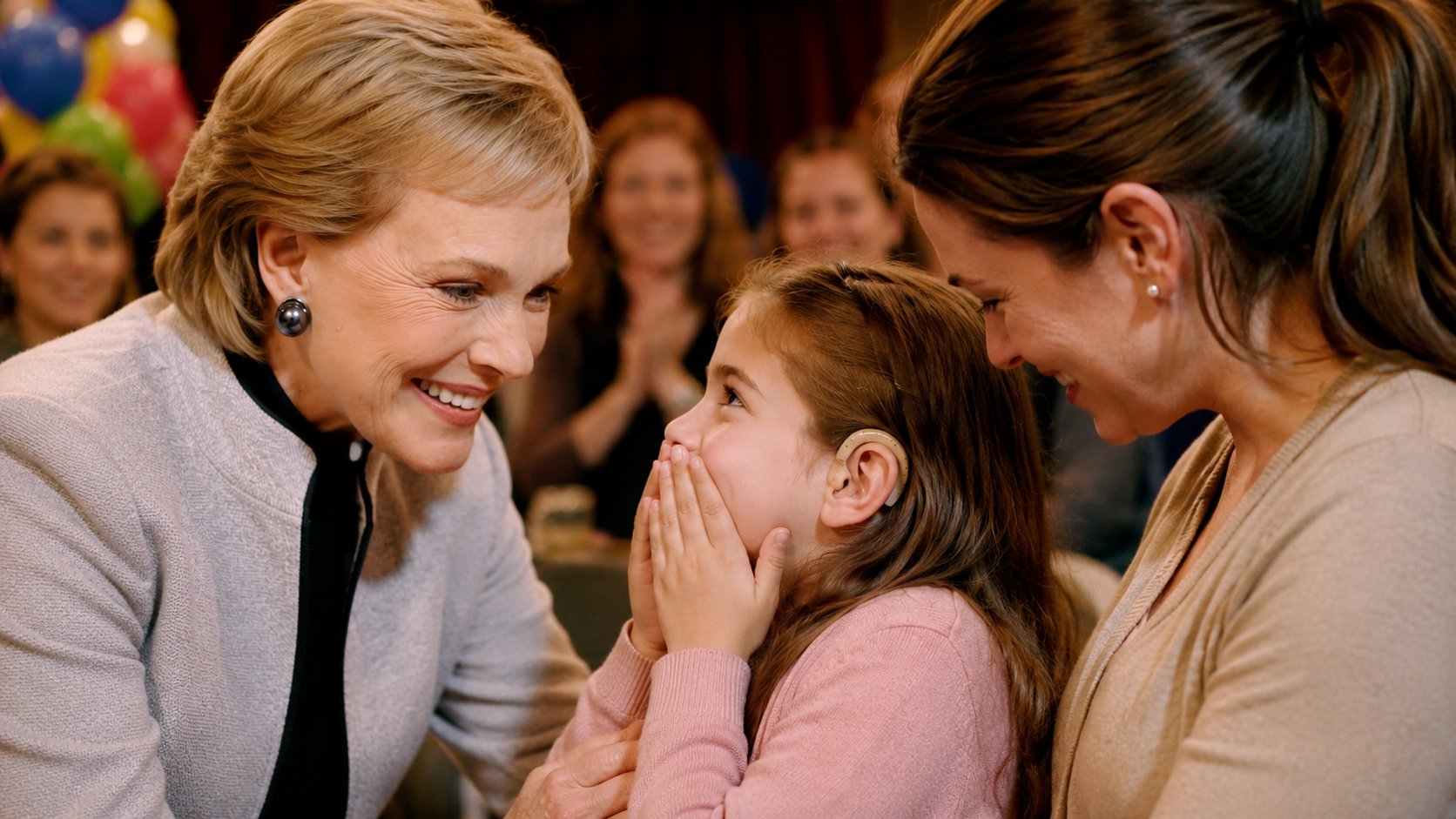
Then slowly, a smile appeared.
“Mummy.”
Rachel covered her mouth.
Julie lowered her head, already fighting tears.
The room became completely still.
Rachel reached for her daughter’s hands.
There was one thing she had dreamed of saying when this moment finally came.
She moved closer and spoke softly.
“I love you, Emily.”
The little girl’s expression suddenly changed.
And what Emily did next left everyone in the room unable to speak.
Part 2
Emily did not answer right away.
She simply stared at her mother.
Rachel’s voice had always been familiar through movement, expression and touch. Emily knew the shape of her mother’s smile. She knew the gentle pressure of her hand. She knew the way Rachel signed I love you every night before bed.
But now those words had reached her in a new way.
As sound.
Emily’s eyes suddenly filled with tears.
She placed both hands against her hearing aids as if she was afraid the moment might disappear.
Then she looked at Rachel and whispered,
“I heard you.”
Rachel broke down.
She pulled her daughter into her arms, laughing and crying at the same time.
Emily hugged her tightly.
“I heard you, Mummy.”
Everyone in the room seemed to forget how to breathe.
Margaret pressed a hand over her heart.
The hearing specialist quietly looked away.
And Julie Andrews wiped tears from her cheeks.
For several seconds, nobody spoke.
There was no applause.
No cameras flashing.
No grand speech.
Only a mother holding her daughter while the little girl listened to the sound of her mother’s crying for the first time.
Then Emily pulled back.
“Say it again.”
Rachel smiled through her tears.
“I love you.”
Emily laughed.
Again.
“I love you.”
Again.
Rachel repeated it.
This time Emily closed her eyes.
She wanted only to listen.
Julie later said quietly to Margaret, “I don’t think anyone in this building will ever forget that.”
Margaret shook her head.
“Neither will I.”
But the day was not finished.
When Emily returned to the main hall, she began discovering sounds everywhere.
She noticed the tapping of shoes against the wooden floor.
The rustling of wrapping paper.
The clinking of spoons against teacups.
A dog barking somewhere outside.
Each new sound made her turn with wonder.
Then she heard something she couldn’t identify.
Music.
A volunteer had begun playing softly on the old piano near the stage.
Emily stopped walking.
She listened.
The melody was simple and gentle.
She looked at her mother.
“What is that?”
Rachel smiled.
“That’s a piano.”
Emily slowly moved closer.
Julie was standing nearby.
She watched the child place one small hand against the side of the instrument, feeling the vibration while hearing the notes.
Then Emily looked at Julie.
“Can you sing?”
Julie smiled.
“I can try.”
People nearby laughed softly.
Julie sat beside the piano.
There was no performance planned.
No microphone.
No spotlight.
She simply began singing a gentle melody.
Emily stood only a few feet away.
Her eyes never left Julie’s face.
She was hearing a human voice rise and fall with music in a way she had never experienced so clearly before.
Rachel stood behind her daughter with tears running silently down her cheeks.
Margaret watched from across the room.
She had spent three years organizing raffles, baking cakes, asking businesses for donations and carrying boxes of books into charity sales.
There had been days when she wondered whether her small efforts mattered.
At that moment, she had her answer.
Every donation had mattered.
Every coin.
Every cake.
Every book.
Every volunteer.
Every person who had stopped for five minutes and decided to help.
When Julie finished singing, the hall remained silent for a moment.
Emily smiled.
“Again?”
Everyone laughed.
Julie laughed too.
“That,” she said, “may be the finest review I’ve ever received.”
Later that afternoon, Julie asked Margaret whether she could speak to the crowd.
She stood at the front of the community hall.
“I came here today because Margaret wrote me a letter,” she began.
“She described children who were waiting to hear the people they loved.”
Julie looked toward Emily and Rachel.
“But I think what we’ve witnessed today reminds us of something larger.”
She paused.
“Kindness doesn’t have to begin with a large organization or an enormous donation.”
She turned toward Margaret.
“Sometimes it begins with one person putting a handwritten sign outside a library.”
Margaret immediately started crying.
Julie continued.
“Margaret didn’t wait until she had enough money.
She didn’t wait until she had enough influence.
She simply started.”
People applauded.
Margaret shook her head, embarrassed.
But Julie wasn’t finished.
“And because she started, other people joined her.”
Julie pointed gently around the hall.
“That is how communities change lives.”
Then something unexpected happened.
A local businessman stood.
His company had already donated earlier that day.
But after witnessing Emily’s moment with her mother, he made another announcement.
His company would fund hearing equipment for five additional children.
Applause erupted.
Then a woman who owned a restaurant offered to organize a charity dinner.
A schoolteacher volunteered to create an annual fundraising concert.
A local football club offered to host a sponsored family day.
Margaret stared around the room in disbelief.
Her little fundraiser suddenly had volunteers everywhere.
Over the following weeks, photographs and stories from the event spread throughout the community.
But Margaret refused to let the campaign become about celebrities.
Whenever someone mentioned Julie’s visit, Margaret immediately talked about Emily.
“The important person that day was a six-year-old girl,” she would say.
“And a mother who had waited years to hear her daughter respond to her voice.”
Julie quietly remained involved.
She sent letters of encouragement.
She helped introduce Margaret to people who could support the campaign.
Most importantly, she kept reminding everyone that the project belonged to the community.
Within a year, Hear Their World had helped dozens of families.
Margaret’s kitchen table became covered with letters.
Some were from parents.
Others came from children.
One boy wrote that the first sound he remembered clearly was rain against his bedroom window.
Another child said she loved hearing her father’s laugh.
One little girl wrote only five words:
“I can hear my dog.”
Margaret kept every letter.
But one remained her favorite.
It arrived almost exactly one year after Julie’s visit.
Inside was a photograph of Emily.
She was standing beside Rachel.
Both were smiling.
Emily had drawn musical notes around the edges.
Below the photograph, Rachel had written:
“Emily still asks me to say ‘I love you’ before she goes to sleep.
Sometimes she asks twice.
She says she likes hearing it.”
Margaret cried when she read the letter.
She made a copy and sent it to Julie.
A week later, Julie replied.
Her note was brief.
“Dear Margaret,
That is what all your work was for.
One child.
One voice.
One moment of love heard clearly.
Never underestimate what kindness can make possible.”
Margaret framed those words beside Noah’s photograph above her kitchen table.
Years later, when people asked her what moment she remembered most from all the children they had helped, Margaret never mentioned fundraising totals.
She never mentioned newspaper articles.
She never even mentioned the moment Julie Andrews walked through the community hall doors.
She always remembered a small quiet room.
A mother leaning toward her daughter.
Three simple words.
“I love you.”
And a little girl touching her hearing aids before whispering,
“I heard you.”
That was the moment everyone understood.
They weren’t simply helping children hear sounds.
They were helping them hear laughter.
Music.
Rain.
Bedtime stories.
Their own names.
And the voices of the people who loved them most.
And sometimes, Margaret would say, changing a life begins with something very small.
A book sale.
A donation jar.
A handwritten letter.
One person deciding to help.
Because kindness does not need to be loud to be heard.
Sometimes the quietest acts of love echo the longest.
THE END.


