Part 1 — The Room With Empty Shelves
At sixteen, Sophie Bennett understood something many adults around her had never considered.
Sometimes a child needed more than a safe place to sleep.
Sometimes they needed somewhere that felt like their own.
Sophie had learned this through her best friend, Maya.
Maya had spent several years moving between foster homes before finally joining a permanent family. She rarely spoke about those years, but one afternoon, while Sophie and Maya were studying together, Maya said something Sophie never forgot.
“The hardest part wasn’t packing my clothes. It was leaving my books.”
Sophie looked up.
“Your books?”
Maya nodded.
“Every house had different rules. Sometimes I couldn’t take everything. But books were the one thing that made a strange bedroom feel less strange.”
That sentence stayed with Sophie.
A few weeks later, she visited a local foster-family support center with her mother.
The center offered counseling, clothing, school supplies, and temporary meeting spaces for children and families.
At the end of a hallway was an unused storage room.
It had faded walls, two broken chairs, dusty boxes, and one small window.
Sophie stood in the doorway.
“What happens in here?”
“Nothing anymore,” a volunteer replied. “We haven’t had the money to fix it.”
Sophie immediately imagined something different.
Soft chairs.
Bright shelves.
Storybooks.
A rug where younger children could sit.
A quiet desk where teenagers could read or do homework.
She turned to her mother.
“I want to make this a reading room.”
Her mother smiled.
“That sounds expensive.”
“I know.”
“And difficult.”
“I know.”
“So you’re still going to try?”
Sophie looked into the empty room again.
“Yes.”
She called the project The Open Book Room.
Her idea was simple: every child who came through the center could choose a book, read it there, or take it with them when they left.
No due dates.
No library cards.
No questions.
The book would belong to the child.
Sophie started small.
She made flyers.
She asked neighbors for used books.
She held a weekend bake sale.
She convinced a hardware store to donate paint and persuaded a carpenter to repair several old shelves.
But progress was slow.
After six weeks, Sophie had raised only a fraction of what she needed.
Some people told her the project was too ambitious.
One afternoon, she sat alone inside the unfinished room.
The walls had been painted, but most of the shelves were still empty.
For the first time, Sophie wondered whether everyone else had been right.
Then Maya entered carrying an envelope.
“This came for you.”
There was no return address Sophie recognized.
Inside was a handwritten letter.
Sophie read the first line twice.
It was from Julie Andrews.
Several months earlier, Sophie had written to Julie after reading about her lifelong connection to children’s literature. Sophie hadn’t asked for money.
She had simply explained the reading room and why she believed stories could give children a sense of belonging.
Sophie had never expected an answer.
The letter was warm and encouraging.
Julie wrote about the extraordinary places stories could carry a child, especially during uncertain moments.
Near the bottom was one sentence Sophie underlined:
“A room does not become a library because of its shelves. It becomes one when a child discovers a story and realizes there is still a world waiting for them.”
Sophie wiped her eyes.
But underneath the letter was another note.
Julie wanted to help.
Not by simply writing a check.
She wanted to visit.
Two weeks later, a small car pulled outside the center.
Sophie was standing near the entrance when Julie Andrews stepped out.
For several seconds, Sophie couldn’t speak.
Julie smiled.
“You must be Sophie.”
Sophie finally nodded.
“And you,” Julie continued, “must show me this reading room I’ve heard so much about.”
They walked down the hallway together.
Julie entered the unfinished room and slowly looked around.
There were mismatched chairs, half-filled shelves and paint supplies stacked in one corner.
Sophie apologized.
“It doesn’t look like much yet.”
Julie turned toward her.
“It looks like a beginning.”
Over the following weeks, word spread.
Local families donated books.
A furniture shop provided cushions.
A retired teacher brought children’s classics she had collected over forty years.
Teenagers volunteered to paint stars and small clouds around the walls.
Julie quietly helped connect the center with literacy supporters who provided additional shelves, lamps, and hundreds of new books.
But Sophie insisted on one rule.
Every donated book had to be something a child might genuinely want to read.
“This isn’t supposed to look impressive,” she explained. “It’s supposed to feel welcoming.”
Julie agreed completely.
Finally, opening day arrived.
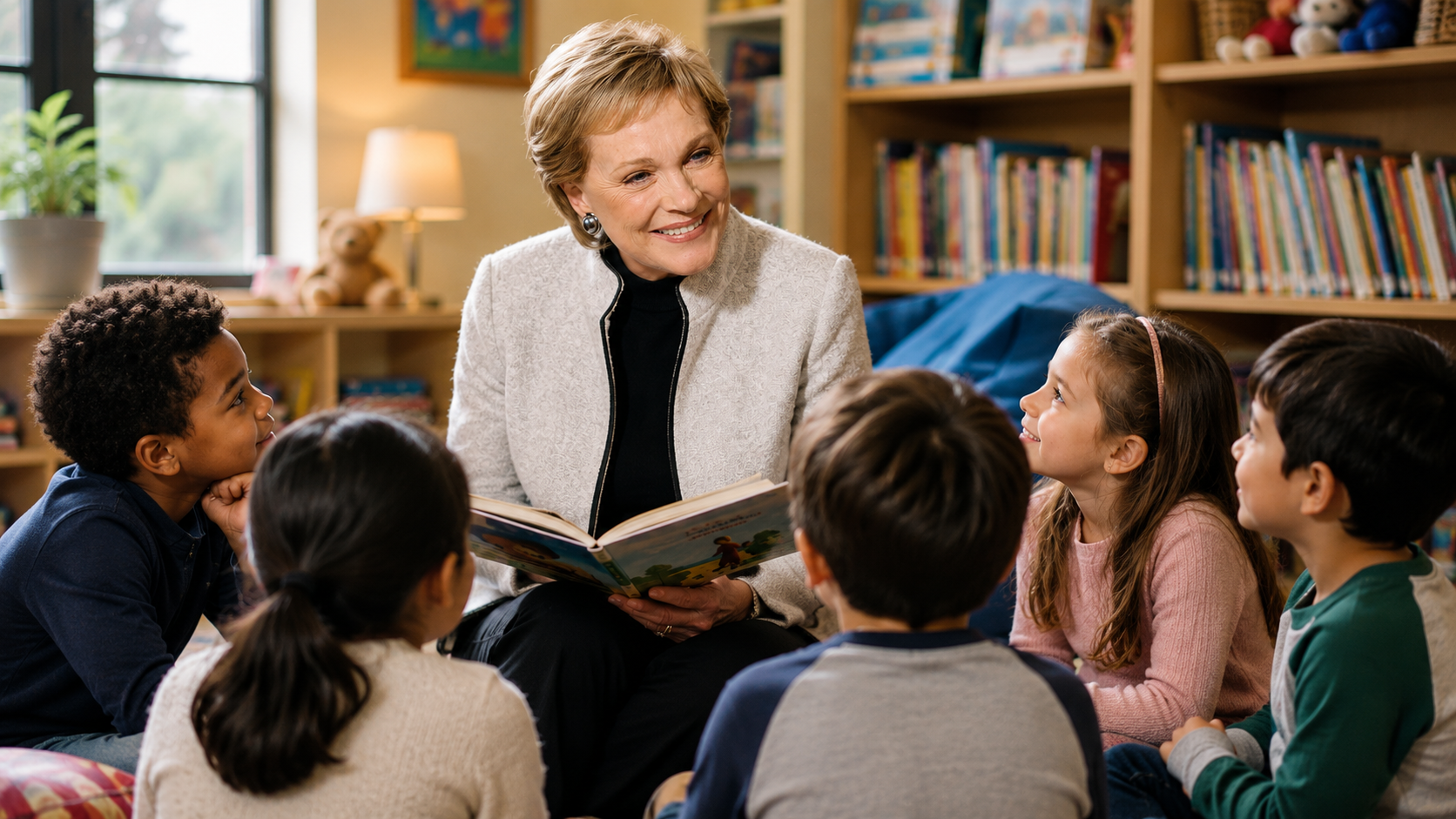
Children, foster parents, volunteers and community members gathered outside the room.
The once-empty space was now warm and inviting.
Hundreds of books filled the shelves.
Small lamps glowed beside comfortable chairs.
A wooden sign above the doorway read:
THE OPEN BOOK ROOM
But before anyone entered, Sophie noticed something unusual.
One shelf remained completely empty.
Julie had requested it.
In the center of that shelf sat a single wrapped package.
Sophie looked at her.
“What is that?”
Julie smiled gently.
“The first official donation.”
Everyone gathered around.
A young foster child named Noah was invited to unwrap it.
Inside was a beautifully illustrated children’s book.
Noah opened the cover.
Then he stopped.
There was handwriting on the first page.
He silently handed the book to Sophie.
She began reading the message aloud.
But after the first sentence, her voice broke.
Because the words weren’t written by Julie.
They had been written many years earlier by someone Sophie never expected.
And when Maya saw the signature at the bottom of the page, she covered her mouth and began to cry.
Part 2 — The Message Inside the First Book
For several seconds, nobody spoke.
Sophie stood in the middle of the reading room with the open book trembling slightly in her hands.
Maya stared at the signature.
Julie Andrews remained beside them, her expression gentle but serious.
Sophie looked down again and tried to continue.
The message read:
“To the child who finds this book someday: I hope you know that being moved from one home to another does not mean you are unwanted. It does not mean you are forgotten. Your story is still being written, and there are people you have not met yet who will love you more than you can imagine. Please keep turning the page.”
Below the message was a name.
Eleanor Bennett.
Sophie froze.
Bennett was her family name.
She looked toward her mother.
“Who was Eleanor?”
Her mother had tears in her eyes.
“My grandmother.”
Sophie stared at her.
“My great-grandmother?”
Her mother nodded.
Julie gently explained.
Years earlier, while supporters were helping gather books for the reading room, an elderly retired social worker had contacted her.
The woman had heard about Sophie’s project and recognized Sophie’s last name.
Decades earlier, she had worked alongside Eleanor Bennett.
Eleanor had volunteered with children who were moving through foster homes.
She often gave children books before they left for a new placement.
Inside each one, she wrote a message.
The book in Sophie’s hands had belonged to a little girl named Anna.
Anna had received it from Eleanor nearly fifty years earlier.
She had kept it her entire life.
When Anna heard about Sophie’s reading room, she decided the book should return to where its message belonged.
Sophie could barely believe what she was hearing.
“My great-grandmother helped foster children?”
Her mother nodded.
“She did. But she rarely talked about it.”
“Why didn’t I know?”
“Because she never believed kindness needed an audience.”
Julie smiled softly.
“Sometimes the quietest acts travel the farthest.”
Maya was still crying.
She looked at the handwritten message again.
“That sentence…”
Sophie turned toward her.
“Which one?”
“Being moved doesn’t mean you’re unwanted.”
Maya wiped her cheeks.
“I wish somebody had told me that when I was eight.”
The room became silent again.
Then little Noah, who had originally opened the package, stepped forward.
He was only nine.
He had been living with a foster family for three months.
“Can I ask something?”
Sophie knelt beside him.
“Of course.”
“Can kids write messages in books too?”
Sophie looked confused.
“What do you mean?”
Noah pointed toward Eleanor’s handwriting.
“Like that. For the next kid.”
The simplicity of the idea stopped everyone.
Julie looked at Sophie.
“I think Noah may have just discovered what this room is really supposed to become.”
That afternoon, they placed a small wooden box near the entrance.
Beside it were blank cards and pencils.
Any child could write an encouraging message for another child.
They didn’t have to sign their name.
Some messages were only a few words.
You are braver than you think.
I was scared too. It gets better.
This book made me laugh. I hope it makes you laugh too.
You deserve a family that listens to you.
Don’t give up on yourself.
Soon, the cards became one of the most important parts of the room.
Children began slipping them inside books before placing them back on the shelves.
A child might open a story about dragons and discover a note from someone who had once felt just as frightened.
A teenager might pick up a novel and find a message reminding them that their current circumstances did not define their future.
The reading room became more than Sophie had planned.
It became a conversation between children who might never meet.
Julie returned several months later.
By then, almost every shelf was full.
Hundreds of books had been donated.
Local foster agencies had begun bringing children from neighboring communities.
Some came to read.
Some came to do homework.
Some simply wanted somewhere quiet to sit.
Sophie showed Julie a large scrapbook filled with copies of the notes children had written.
Julie slowly turned the pages.
Then she stopped at one.
It had been written by Maya.
“I moved five times before I found my family. For a long time, I thought people kept sending me away because something was wrong with me. Nothing was wrong with me. And nothing is wrong with you.”
Julie reached across the table and held Maya’s hand.
“That message will find exactly the person who needs it.”
Maya smiled through tears.
A year later, Sophie graduated from high school.
On the morning of her graduation, she didn’t immediately go to the ceremony.
She first visited the reading room.
The center was quiet.
Sunlight came through the little window that had once looked into an abandoned storage space.
The shelves were full.
Children’s drawings covered one wall.
The original book from Eleanor remained in a glass case near the entrance.
Beside it was a copy children could actually read.
Sophie stood there thinking about everything that had happened.
Her project had started because of one sentence from Maya.
Then came one unused room.
One letter.
One unexpected visitor.
One old book.
And one message written almost fifty years earlier.
She heard footsteps behind her.
Julie had quietly entered.
“I thought I might find you here,” she said.
Sophie smiled.
“I can’t believe this started with empty shelves.”
Julie looked around.
“It didn’t.”
Sophie turned.
“What do you mean?”
“It started with someone caring enough to notice what was missing.”
Julie walked toward the shelf containing Eleanor’s book.
“Your great-grandmother noticed.”
“Maya noticed.”
“You noticed.”
“And now these children are noticing one another.”
Sophie looked around the room again.
A few minutes later, the first children of the day began arriving.
Noah was among them.
He was taller now.
And he wasn’t alone.
A younger boy stood nervously beside him.
“This is Caleb,” Noah explained. “It’s his first time.”
Caleb held tightly to his backpack.
Noah walked him toward the shelves.
“You can pick any book.”
“Do I have to bring it back?”
“No.”
Caleb looked surprised.
“Really?”
Noah nodded.
“It’s yours.”
Caleb slowly chose a book.
When he opened the cover, a folded card fell onto the floor.
He picked it up.
Sophie watched from across the room as he read it.
His nervous expression changed.
He smiled.
Nobody asked what the note said.
Some messages belonged only to the child who needed them.
Julie stood beside Sophie.
“That’s the wonderful thing about stories,” she whispered.
“What?”
“They keep traveling after we let them go.”
Years later, The Open Book Room would inspire similar reading spaces in foster centers across several communities.
Sophie eventually studied education and child development.
Maya became a social worker.
Noah returned as a teenage volunteer.
And on the first shelf of every new reading room created through the project, volunteers placed one special book.
Inside its cover were the same words Eleanor Bennett had written decades earlier:
Your story is still being written.
There are people you haven’t met yet who will love you more than you can imagine.
Please keep turning the page.
And beneath those words was a new sentence added by Sophie:
“When you find your safe place, leave a light on for the child coming after you.”
That became the heart of the project.
Not the famous visitor.
Not the donations.
Not even the books.
It was the belief that kindness could pass from one stranger to another until nobody had to feel completely alone.
And every time a child entered that little room, chose a book, and discovered a message hidden inside, Sophie’s dream began all over again.
THE END.


