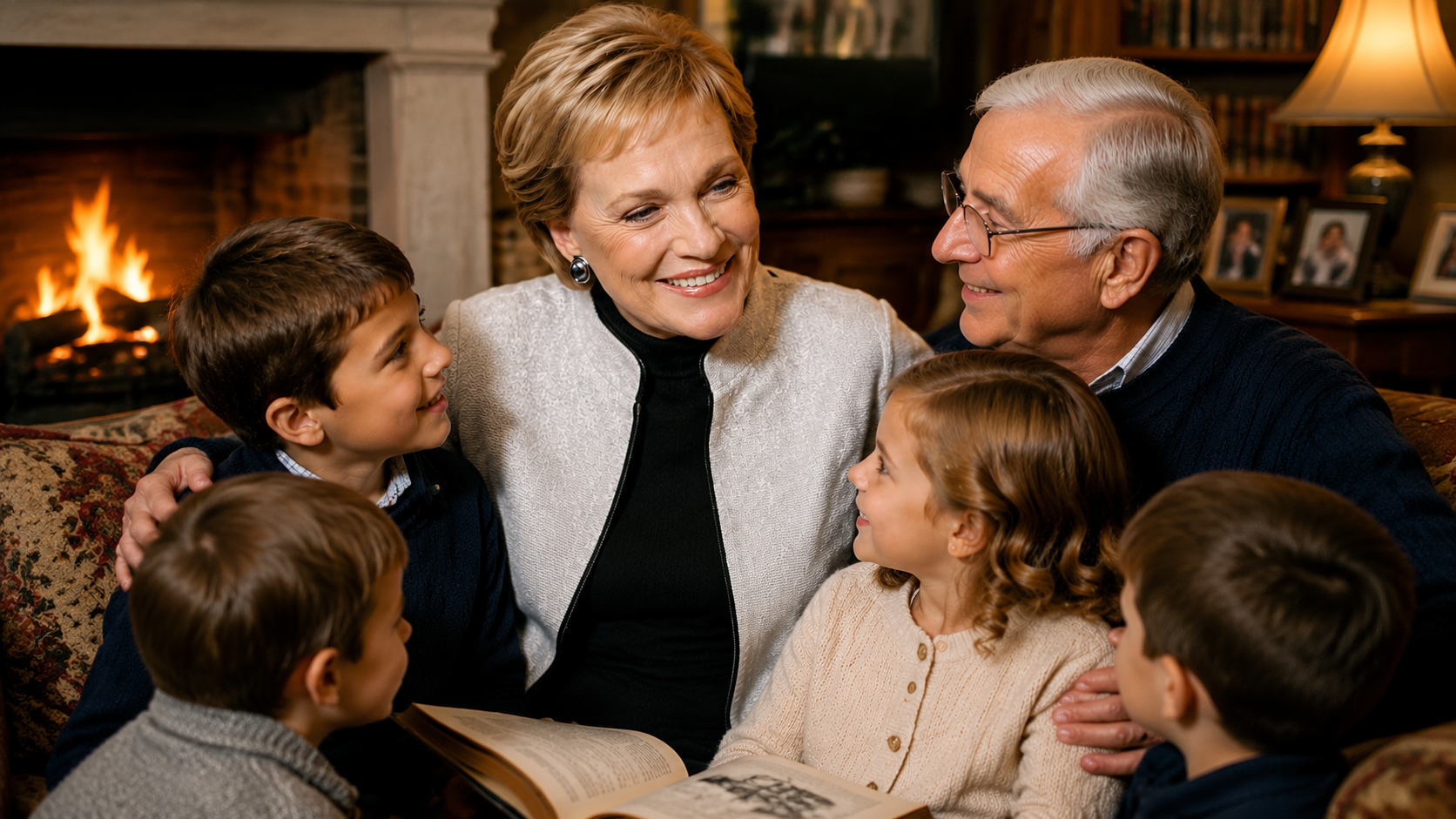
Part 1 — Grandpa’s Favorite Story
Every Sunday evening, no matter how busy the week had been, the grandchildren knew exactly where they would find Grandpa Thomas.
He would be sitting in the old wooden chair beside the fireplace, a faded book resting on his knees.
“Story time!” seven-year-old Lily would shout as she hurried into the room.
Her brother Noah usually followed more slowly, pretending that at eleven years old he was becoming too grown-up for Grandpa’s stories.
But he always sat down.
So did their younger cousin Ben whenever he was visiting.
The book was old.
Its corners were bent, several pages had small tears, and the cover had become soft from decades of being held.
Inside were stories and memories inspired by The Sound of Music, a film Thomas had loved since he was a young man.
But Thomas never simply read the words.
He brought them alive.
He would describe the mountains as though they were standing just outside the window.
He would tell the children about courage.
About family.
About singing when life became frightening.
About finding hope when the road ahead seemed uncertain.
And sometimes, when he reached his favorite parts, Grandpa Thomas would quietly sing.
His voice was not perfect.
It was soft and sometimes shaky.
But to his grandchildren, it was the most beautiful voice in the world.
Thomas had first seen The Sound of Music when he was nineteen.
He had gone to the cinema with the young woman who would later become his wife, Margaret.
They had been married for fifty-four years.
Margaret had passed away three years earlier.
After she died, Thomas struggled with the silence in the house.
For more than half a century, there had always been someone beside him.
Someone preparing tea.
Someone humming in the kitchen.
Someone reminding him where he had left his glasses.
Suddenly, those ordinary sounds disappeared.
The grandchildren became his greatest comfort.
And storytelling became the bridge between the life he once had and the family growing around him.
One evening, Lily noticed a photograph tucked between the pages of Grandpa’s book.
She pulled it out carefully.
It showed Thomas and Margaret when they were young.
They were standing outside an old movie theater.
Behind them was a poster for The Sound of Music.
“Was that Grandma?” Lily asked.
Thomas smiled.
“Yes.”
“She was pretty.”
“She certainly was.”
Noah studied the picture.
“Was that the first time you saw the movie?”
Thomas nodded.
“Your grandmother cried through half of it.”
“Was she sad?”
Thomas laughed.
“No. She cried whenever something was beautiful.”
Lily looked at the photograph again.
“Did Grandma like Julie Andrews?”
Grandpa Thomas became quiet.
“Very much.”
Then he smiled.
“So did I.”
“What would you say if you ever met her?” Noah asked.
Thomas chuckled.
“At my age? I suppose I would simply say thank you.”
“For what?”
Thomas looked around at his grandchildren.
“For giving our family something beautiful to share.”
The children forgot about the conversation a few minutes later.
Thomas did not.
Neither did his daughter, Emma, who had been standing quietly near the kitchen door.
That night, after the children went home, Emma sat at her computer.
She had an idea.
It felt impossible.
But she decided to try.
She wrote a letter.
She explained that her father had spent years sharing stories inspired by The Sound of Music with his grandchildren.
She described the worn book.
The Sunday gatherings.
The photograph of her parents outside the theater.
She wrote about Margaret’s passing.
And she explained how those stories had helped her father remain connected to both his memories and his grandchildren.
Emma ended the letter with one simple sentence:
“My father expects nothing. I simply thought someone should know how far one beautiful story can travel through a family.”
Then she sent it.
Weeks passed.
Nothing happened.
Thomas continued his Sunday storytelling.
Spring became summer.
Summer became autumn.
Emma eventually assumed the letter had disappeared among thousands of others.
Then, one Thursday afternoon, her phone rang.
At first, she thought it was a joke.
Then she realized the person on the other end was serious.
Emma sat down.
Her hand began trembling.
“Are you sure?” she whispered.
The answer made her cover her mouth.
Two weeks later, Emma told her father that she wanted to organize a special Sunday family lunch.
“No birthday,” Thomas complained.
“No anniversary.”
“Do we need a reason to have lunch together?” Emma asked.
Thomas narrowed his eyes suspiciously.
“You’re planning something.”
Emma smiled.
“Just be home Sunday.”
That Sunday, Lily, Noah, Ben and several other family members arrived early.
Thomas immediately noticed something strange.
Everyone seemed nervous.
Noah kept checking the window.
Emma kept checking her phone.
Lily had been told at least six times not to reveal the surprise, which made her look as though she might explode.
Grandpa Thomas finally laughed.
“What is going on?”
“Nothing,” Emma said too quickly.
Thomas shook his head.
“You were never good at secrets.”
Lunch was almost ready when a car stopped outside.
Emma froze.
Lily ran toward the window.
“Someone’s here!”
Thomas remained in his chair.
“Probably another relative you’ve invited without telling me.”
Emma walked toward the front door.
Her hands were shaking again.
She opened it.
A woman stood outside.
For several seconds, Emma simply stared.
Then she welcomed the visitor inside.
Thomas heard footsteps in the hallway.
He looked up.
The old book resting on his knees slipped slightly from his hands.
He stopped breathing.
Standing in the doorway was Julie Andrews.
Thomas stared at her.
Then at Emma.
Then back at Julie.
Nobody spoke.
Finally, Julie smiled.
“I believe,” she said gently, “you have been telling some wonderful stories.”
Grandpa Thomas covered his mouth with one trembling hand.
And suddenly, the room became completely silent.
Part 2 — The Story They Would Tell Forever
For several moments, Thomas could not move.
Julie Andrews stepped farther into the room.
Lily looked from Julie to her grandfather, confused by his silence.
“Grandpa,” she whispered, “say something.”
Everyone laughed softly.
Thomas finally stood.
His knees seemed less steady than usual.
Julie walked toward him.
Thomas held out his hand.
Then he stopped.
“I’ve imagined meeting you for more years than I care to admit,” he said, his voice shaking. “And now I’ve forgotten every sensible thing I planned to say.”
Julie smiled warmly.
“That happens to all of us sometimes.”
Thomas laughed.
Then his eyes filled with tears.
“My wife would never believe this.”
Julie glanced at the photograph Emma had placed on a nearby table.
“Margaret?”
Thomas looked surprised.
“You know her name?”
“Your daughter wrote a beautiful letter.”
Thomas slowly turned toward Emma.
“You wrote to her?”
Emma nodded.
“I only told the truth.”
Julie picked up the photograph.
Thomas and Margaret looked impossibly young in it.
“You saw the film together?” Julie asked.
“The first week we could,” Thomas replied.
He smiled.
“We didn’t have much money. I nearly spent our entire evening’s budget on those tickets.”
“Grandma said it was worth it,” Emma added.
Thomas nodded.
“She talked about it for weeks.”
Julie handed the photograph back.
“And then you continued sharing the story.”
Thomas looked at the grandchildren.
“I suppose we did.”
Noah brought the old book forward.
“This is Grandpa’s storytelling book.”
Julie carefully took it.
She opened the cover.
Inside were years of notes.
Little dates.
Children’s names.
Favorite quotes.
Small drawings made by grandchildren.
One page had a pressed flower that Margaret had placed there decades earlier.
Another contained a childish drawing Lily had made of a mountain surrounded by musical notes.
Julie slowly turned the pages.
“This is much more than a book,” she said.
Thomas nodded.
“It became a family history.”
Julie sat beside him.
The grandchildren gathered on the carpet as they did every Sunday.
“Would you read something for us?” Lily asked Grandpa.
Thomas looked horrified.
“With Julie Andrews sitting here?”
Julie laughed.
“I think Lily has an excellent idea.”
Thomas shook his head.
“My voice isn’t what it once was.”
“Stories don’t require perfect voices,” Julie said. “Only someone willing to tell them.”
That sentence seemed to calm him.
Thomas opened the book.
He began slowly.
At first, he was nervous.
Then something familiar returned.
The same rhythm.
The same warmth.
The same voice that had carried his grandchildren through hundreds of Sunday evenings.
He told them about a family discovering courage.
About music filling rooms that had known fear.
About choosing love when life became uncertain.
Julie listened quietly.
Occasionally, she looked toward Emma.
Emma could see tears forming in her eyes.
Then Thomas reached a place where he usually stopped reading and began telling the story in his own words.
“Your grandmother always believed something,” he told the children.
“She said happy memories aren’t only things we keep. They’re things we’re supposed to pass along.”
Lily leaned against his knee.
“Like your stories?”
“Exactly.”
Thomas looked around the room.
“I won’t be sitting in this chair forever.”
Emma lowered her eyes.
The grandchildren became unusually quiet.
“But the stories can stay,” Thomas continued. “One day, Noah might tell them to his children. Perhaps Lily will. Maybe Ben.”
“I will,” Lily promised immediately.
Thomas smiled.
Julie reached over and gently touched the cover of the book.
“And perhaps,” she said, “they’ll add some stories of their own.”
Thomas looked at her.
“That’s the hope.”
Emma disappeared into the kitchen for a moment.
When she returned, she was carrying something she had prepared secretly.
It was a new leather-bound book.
Embossed on the front were the words:
Our Family Stories
Thomas stared at it.
“I thought,” Emma said, “we could begin writing them down.”
She placed it beside the old book.
The first pages already contained memories.
Grandpa and Grandma’s first movie.
The Sunday storytelling tradition.
The grandchildren’s favorite moments.
Margaret’s sayings.
Family recipes.
Funny mistakes.
Christmas memories.
Little pieces of ordinary life that might otherwise disappear.
Julie slowly turned several pages.
Then she asked Emma for a pen.
Everyone watched.
On the next empty page, she wrote a short message.
She handed the book to Thomas.
He read the words silently.
His eyes filled again.
Emma leaned over his shoulder.
The message said:
“Dear Thomas and family, may you always keep telling the stories that bring you together. The greatest music is often found in the memories we create for one another.”
Thomas pressed his fingers against the page.
“Thank you,” he whispered.
But the afternoon was not finished.
Before Julie left, Lily made one final request.
“Can we take a picture?”
Everyone laughed.
They gathered around Grandpa’s chair.
Thomas held his old book.
Julie stood beside him.
The grandchildren crowded around them.
Emma set the camera timer and hurried into the frame.
At the last second, Lily shouted, “Everybody say mountains!”
The photograph captured everyone laughing.
It was not elegant.
No one was perfectly positioned.
Noah’s eyes were almost closed.
Ben was looking in the wrong direction.
Thomas was laughing so hard that his glasses had slipped down his nose.
And Julie was smiling beside him.
It became the family’s favorite photograph.
Years later, Grandpa Thomas’s old storytelling chair remained beside the fireplace.
Thomas was no longer there.
But every Sunday that the family could manage, someone still sat in it.
Sometimes Emma.
Sometimes Noah.
Sometimes Lily.
The leather book grew thicker with photographs, letters, recipes and memories.
And whenever a new child joined the family, someone eventually told the story of the extraordinary Sunday when Julie Andrews unexpectedly walked through Grandpa Thomas’s front door.
Lily eventually became the family’s most enthusiastic storyteller.
Whenever the younger children asked whether the story was really true, she would pull out the photograph.
“There,” she would say.
“That’s Grandpa.”
Then she would point to the smiling woman beside him.
“And that’s Julie Andrews.”
But Lily always explained that the famous visitor was not the most important part of the story.
The important part was what Grandpa had taught them before that day.
Stories could keep people close.
Memories could outlive the people who created them.
And sometimes the simplest family tradition—a grandfather, a worn book, a fireplace and a few listening children—could become something priceless.
The children never forgot Julie Andrews’s visit.
But even more importantly, they never stopped gathering to tell Grandpa’s stories.
Because Thomas had been right.
Happy memories were never meant to be kept by one person.
They were meant to be passed on.
Continued — The Promise Grandpa Left Behind
Ten years after Julie Andrews visited Grandpa Thomas, Lily returned to the old family house carrying a small cardboard box.
The house looked almost exactly the way she remembered it.
The fireplace was still there.
The family photographs still covered the hallway walls.
And in the corner of the living room stood Grandpa’s wooden chair.
Lily stopped when she saw it.
For a moment, she was seven years old again.
She could almost hear Grandpa saying, “Come closer. Stories are better when everyone listens.”
Lily was seventeen now.
Noah had moved away for university.
Ben was preparing to graduate from high school.
Emma still lived nearby, but the Sunday gatherings had become less frequent as everyone grew older and busier.
That worried Lily.
Grandpa had always feared that.
Not because he wanted people to remain unchanged.
He simply feared that someday everyone would become too busy to remember why they once gathered.
Lily placed the cardboard box on the table.
“What’s that?” Emma asked.
“Something I found in Grandpa’s old desk.”
Emma’s expression changed.
They had cleaned that desk years ago.
Or at least they thought they had.
Lily opened the box.
Inside were dozens of envelopes.
Each one had a name written across the front.
Emma.
Noah.
Lily.
Ben.
There were even envelopes labeled:
For the grandchildren I may never meet.
Emma covered her mouth.
“Oh, Dad.”
Lily picked up the envelope with her name.
“Should I open it?”
Emma smiled through tears.
“I think he wanted you to.”
Lily carefully broke the seal.
Inside was a handwritten letter.
The first line made her cry immediately.
Dear Lily,
If you are reading this, you are probably older than the little girl who once interrupted every story with a hundred questions. I hope you still ask questions.
Lily laughed through her tears.
She continued reading.
Grandpa wrote about the afternoon Julie Andrews visited.
But he did not describe it as the greatest day of his life.
Instead, he wrote something Lily had not expected.
Meeting someone you admire is wonderful. But never confuse a special visitor with the reason a memory matters. That afternoon mattered because everyone I loved was in one room.
Lily stopped reading.
Emma sat beside her.
“He understood everything,” Lily whispered.
Emma nodded.
“He usually did.”
The letter continued.
Grandpa reminded Lily about the leather book Julie had signed.
He asked her to keep adding stories.
Not famous stories.
Not extraordinary stories.
Ordinary ones.
Birthday cakes that collapsed.
Family arguments that ended in hugs.
First days of school.
Last days in old houses.
Broken hearts.
New beginnings.
Funny mistakes.
Kindness nobody else noticed.
Those are the stories people miss most when the years go by, Grandpa had written.
At the bottom of the page was one final request.
Please bring everyone together again someday. Not for me. For each other.
Lily looked at her mother.
“We stopped.”
Emma knew exactly what she meant.
The Sunday gatherings.
Life had slowly taken them away.
Jobs.
School.
Travel.
Relationships.
Responsibilities.
Nobody had intentionally abandoned the tradition.
It had simply faded.
Like so many family traditions do.
Lily stood.
“We’re bringing Sunday back.”
Emma smiled.
“Then you’d better call everyone.”
The following weekend, the house filled again.
Noah drove four hours.
Ben brought his girlfriend.
Aunts and uncles arrived carrying food.
Children ran through the hallway.
Someone burned the bread.
Someone complained about parking.
Someone else arrived late.
It was imperfect.
Grandpa would have loved it.
After dinner, everyone moved into the living room.
Lily sat in Grandpa’s chair.
She placed the old book on her lap.
Beside it rested the newer family book Julie Andrews had signed years earlier.
Noah smiled.
“You’re really doing this?”
Lily looked at him.
“Grandpa told me to.”
Nobody argued after that.
She opened the book.
The first story she read was not about mountains.
It was not about music.
It was about Grandpa Thomas meeting Grandma Margaret outside the movie theater when they were young.
Then Lily told the story of the Sunday Julie Andrews appeared at the door.
The younger children listened with wide eyes.
One little boy raised his hand.
“Was she really here?”
Lily smiled.
“She really was.”
“Did Grandpa cry?”
Everyone laughed.
“Very much.”
Then Emma brought out the old photograph.
The one where Noah’s eyes were half closed.
Ben was looking away.
Grandpa’s glasses had slipped down his nose.
And Julie Andrews was laughing beside him.
The children passed it around carefully.
Lily looked around the room.
For the first time in years, the house sounded exactly as it once had.
People talking.
Children laughing.
Someone humming in the kitchen.
Chairs scraping.
Teacups clinking.
Ordinary sounds.
Beautiful sounds.
The sounds Grandpa had missed after Margaret died.
The sounds he had worked so hard to preserve.
Lily opened the family book to a fresh page.
At the top, she wrote:
The Sunday We Started Again.
Then she passed the pen around.
Each person added one sentence.
Some wrote memories.
Others wrote jokes.
The youngest children drew pictures.
Emma wrote only six words:
Dad, we finally understood your lesson.
Years later, the tradition continued.
Sometimes only five people came.
Sometimes twenty.
Sometimes someone joined through a video call from another country.
But the family kept gathering.
And the book kept growing.
One day, Lily brought her own daughter to the house.
The little girl climbed into Grandpa Thomas’s old chair and touched the worn wooden arm.
“Whose chair was this?”
Lily sat beside her.
“It belonged to your great-grandfather.”
“Was he famous?”
Lily smiled.
“No.”
“Then why does everyone talk about him?”
Lily thought for a moment.
“Because he made people feel important.”
The little girl looked at the books.
“Did he tell stories?”
“All the time.”
“Can you tell me one?”
Lily looked toward the fireplace.
Then at the old photograph framed nearby.
Grandpa Thomas was laughing.
Julie Andrews stood beside him.
The grandchildren crowded around them.
Lily opened the book.
And once again, the story began.
Not because Grandpa Thomas had met someone famous.
Not because an unforgettable visitor had walked through the door.
But because one grandfather had spent years teaching his family that love becomes stronger when it is remembered together.
And somewhere between the stories, laughter and turning pages, another generation learned the same truth:
The most precious inheritance a family can leave behind is not money.
It is the memory of being loved.
THE END


