Part 1
This is a work of heartwarming fiction inspired by the public persona of Julie Andrews. The events and conversations in this story are entirely fictional.
The old yellow school bus had not carried children in years.
Its paint was faded.
Its tires were cracked.
One window was covered with cardboard after a storm had shattered the glass.
Most people driving past the abandoned vehicle saw nothing but scrap metal waiting for the junkyard.
Emma Carter saw a dream.
She was a twenty-nine-year-old elementary school teacher in a small countryside town where many children lived miles away from the nearest public library.
Every year she watched bright students struggle because books were hard to find.
Some families owned only one or two books.
Others had none at all.
Emma believed every child deserved shelves filled with stories.
But building a library required money the town simply didn’t have.
One rainy afternoon she noticed the forgotten school bus parked behind a retired mechanic’s garage.
“What are you planning to do with it?” she asked.
The mechanic laughed.
“If someone can haul it away, it’s theirs.”
Emma stared at the bus.
Instead of broken seats, she imagined bookshelves.
Instead of dusty windows, she pictured colorful murals painted by local children.
Instead of silence, she imagined laughter, questions, and the sound of pages turning.
That evening she told her closest friends.
“They’ll laugh at me,” she admitted.
“They’ll call it impossible.”
“But if we can bring the library to the children instead of waiting for children to come to the library, maybe everything changes.”
Her friends smiled.
Then one quietly said, “Let’s try.”
Within days volunteers appeared.
A carpenter donated leftover wood.
An artist offered to paint the outside.
Parents collected gently used books.
Teenagers spent weekends removing old seats.
Retired teachers sorted donated novels, picture books, science books, and history collections.
Little by little, the forgotten bus became something beautiful.
Still, the project had one enormous problem.
Money.
The engine barely worked.
The roof leaked whenever it rained.
Fuel, insurance, repairs, shelving, and safety inspections cost far more than Emma had expected.
After months of fundraising, they were still thousands of dollars short.
Emma never complained.
Instead, every evening she uploaded photos of volunteers working together.
One picture showed an elderly grandfather sanding wooden shelves.
Another showed children carefully placing donated books into labeled boxes.
The story slowly spread across social media.
One afternoon, Emma received an unexpected email.
It came from the office of Julie Andrews.
At first Emma assumed someone was playing a prank.
She read the message three times before believing it.
Julie Andrews had seen photographs of the community project through a charity organization supporting literacy programs.
The message explained that although Julie could not attend every wonderful cause she heard about, this project had deeply touched her heart.
Emma nearly cried.
A week later, another surprise arrived.
Julie Andrews herself stepped off a quiet van wearing simple clothes, a warm smile, and carrying several large boxes.
The volunteers froze.
Nobody spoke.
Julie laughed softly.
“I hope I’m not late.”
Emma finally found her voice.
“We… we never expected you to actually come.”
Julie smiled.
“I’ve spent much of my life believing stories help people discover courage.”
She gently touched one unfinished bookshelf.
“And this bus is going to carry courage wherever it travels.”
Everyone applauded.
Instead of making speeches, Julie picked up a paintbrush.
She helped children paint bright trees, birds, stars, and open books across the outside of the bus.
She listened as young volunteers described their favorite stories.
She signed donated copies of classic children’s books.
She thanked every volunteer individually.
When one teenager apologized because the shelves weren’t perfectly straight, Julie smiled.
“The most beautiful libraries aren’t built by perfect hands.”
“They’re built by caring ones.”
By sunset the entire town seemed transformed.
News crews arrived.
More donations poured in overnight.
A construction company offered free repairs.
A local fuel company promised a year’s worth of diesel.
Within two weeks the bus was fully restored.
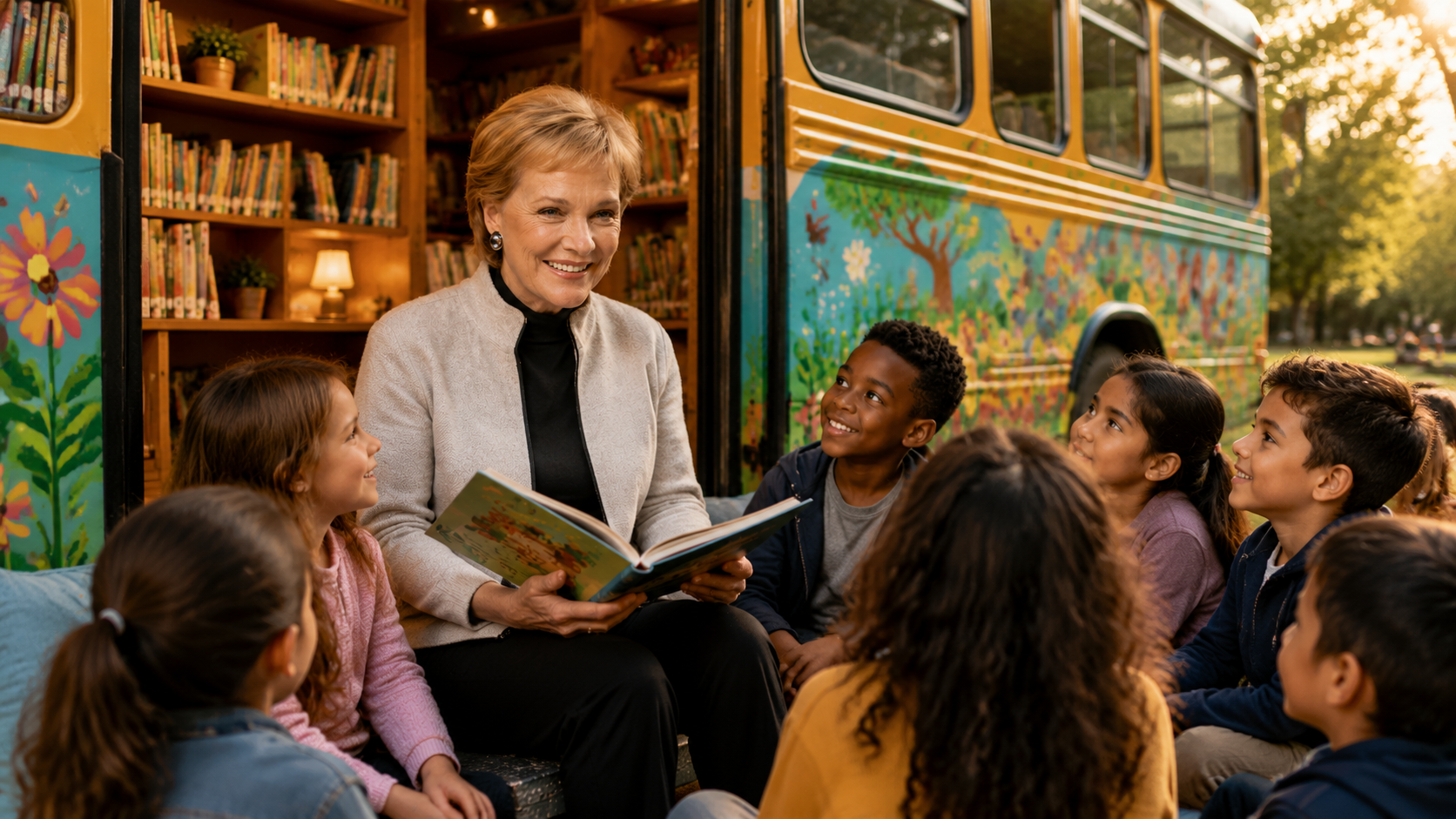
Bright blue shelves lined both sides.
Colorful reading cushions filled the middle.
Tiny lamps glowed warmly above every section.
Outside, painted across the side of the bus were simple words chosen by the children:
Every Story Finds a Home.
The town planned a grand opening.
Everyone assumed the first stop would be the town square.
Julie quietly asked Emma another question.
“Where is the one place children almost never receive visitors with books?”
Emma thought carefully.
Then her eyes widened.
“I know exactly where.”
Julie smiled.
“Then let’s begin there.”
No one outside the small planning committee knew where the bus would travel first.
On opening morning, hundreds of people gathered to watch.
Children cheered as the engine started.
Parents waved.
Reporters prepared their cameras.
Even the mayor looked excited.
But when Emma slowly turned the steering wheel away from the town center and headed down an old country road instead, the crowd exchanged confused looks.
No one understood why.
Not yet.
Part 2
Instead of stopping in the busy town square, the bright yellow library bus continued along a winding country road.
The pavement soon gave way to gravel.
Fields stretched in every direction.
The reporters followed in their cars, puzzled.
Parents whispered to one another.
“Where are they going?”
Emma smiled but kept her eyes on the road.
Julie Andrews sat beside her, watching the countryside roll past through the freshly polished windows.
Nearly forty minutes later, the bus turned onto a narrow lane leading to a small farming community that many people in town had almost forgotten.
Only a handful of families lived there.
The nearest library was over an hour away.
For many children, books came only through old hand-me-downs from relatives.
As the bus rounded the final bend, several children looked up from a dusty playground beside a tiny one-room schoolhouse.
They stopped running.
One little boy pointed excitedly.
“Look! A school bus!”
But it didn’t look like any school bus they had ever seen.
Its colorful murals sparkled in the morning sun.
Painted trees stretched across the sides.
Birds appeared to soar between painted books whose pages became clouds.
The words “Every Story Finds a Home” seemed to welcome everyone.
Emma parked beneath a large oak tree.
The doors folded open.
Instead of rows of seats, the children saw shelves overflowing with picture books, adventure novels, science guides, biographies, fairy tales, and atlases.
For a moment, no one moved.
Then a little girl, no older than seven, stepped carefully inside.
She reached out and gently touched the spine of a beautifully illustrated book.
“Can… can we really read these?” she whispered.
Emma knelt beside her.
“They’re here for you.”
The girl’s eyes filled with tears.
“I’ve never been inside a library before.”
Those words settled over everyone like a quiet breeze.
Several adults lowered their heads.
Julie Andrews walked over and took a well-loved copy of Charlotte’s Web from one of the shelves.
She smiled warmly.
“Would anyone like to hear a story?”
Within minutes, dozens of children gathered on colorful cushions outside beneath the oak tree.
Julie began reading in her gentle, expressive voice.
The children leaned forward, completely captivated.
Even the parents stopped their chores and wandered over to listen.
The reporters quietly lowered their cameras.
Some moments deserved simply to be experienced.
After the reading, each child was invited onto the bus to choose a book to borrow.
A shy boy named Noah stood near the back of the line.
He hesitated before selecting a book about planets and stars.
Julie noticed him smiling at its cover.
“Do you enjoy learning about space?” she asked.
He nodded.
“I want to build rockets someday.”
“But I’ve never had a book like this.”
Julie placed another astronomy book into his hands.
“Dreams grow stronger when they’re fed.”
“Keep reading.”
Noah hugged the books tightly as though they were priceless treasures.
Nearby, another little girl chose a book about animals.
She quietly admitted she hoped to become a veterinarian because she loved caring for injured birds.
A pair of brothers found books on building simple machines.
Their father laughed.
“I suppose my garage is about to become a workshop.”
Soon the little schoolyard buzzed with excitement.
Children exchanged recommendations.
Parents signed up for library cards.
Teachers created a weekly reading club on the spot.
Before leaving, Emma unveiled one final surprise.
A large wooden cabinet had been built into the back of the bus.
Inside were hundreds of brand-new books donated after Julie’s visit.
“We’re leaving these here,” Emma announced.
“The bus will keep coming back every month, but now you’ll also have your own permanent reading corner.”
The children erupted into cheers.
Volunteers carried the shelves into the schoolhouse, filling an empty classroom with books of every kind.
The room that had once been used for storage became the community’s first library.
Word of the visit spread far beyond the little farming village.
Other towns began asking how they could create mobile libraries of their own.
Retired buses were donated.
Local artists volunteered to paint them.
Teachers, mechanics, carpenters, and students worked side by side.
Book drives appeared in schools, bookstores, and community centers.
Within three years, more than twenty mobile libraries traveled to remote neighborhoods across the region.
Thousands of children discovered stories they might never have found otherwise.
Many of the first young readers grew into volunteers themselves.
Some became teachers.
Some became librarians.
Others became authors, determined to write stories for children who, like them, once believed books belonged somewhere else.
Years later, during the celebration of the program’s tenth anniversary, Emma received a handwritten letter.
It was from Noah—the quiet boy who had borrowed the astronomy books on that unforgettable first day.
He was now an aerospace engineer.
In his letter he wrote:
“I didn’t become who I am because someone handed me success. I became who I am because someone handed me a book. That mobile library showed me that dreams could travel all the way to my little town. Now I hope my work helps future generations reach even farther than the stars.”
Emma folded the letter carefully.
Julie Andrews, now unable to travel as often, smiled as Emma read it aloud during the anniversary celebration.
“There it is,” Julie said softly. “The real journey was never the bus.”
Emma nodded.
“It was the hope it carried.”
The audience rose in a standing ovation—not for fame, but for the simple idea that one restored school bus, filled with books and kindness, could help rewrite the futures of countless children.
And every time the bright yellow bus rolled down another quiet country road, children would run toward it with eager smiles, knowing that inside waited new adventures, bigger dreams, and the reminder that every story has the power to change a life.
The End.


