Part 1
Eight-year-old Lily Harper had spent more nights in a children’s hospital than in her own bedroom that year.
A rare heart condition had forced her to undergo treatment after treatment. Between doctor visits, medications, and endless tests, the days often felt long and lonely. The hospital staff did everything they could to brighten her room with colorful decorations and cheerful smiles, but nothing eased her fears quite like a good bedtime story.
Every evening, Lily’s mother, Emma, read aloud from the same stack of worn children’s books they had brought from home. The stories became their escape—a place where brave children sailed oceans, talking animals solved mysteries, and kindness always found a way to win.
One night, Lily quietly asked, “Mom… what about the children whose parents can’t bring books?”
Emma looked around the hospital ward.
Several children were alone.
Some families lived hours away.
Others couldn’t afford to buy books.
Some parents worked late into the night and could only visit for a few minutes.
That simple question stayed with Emma long after Lily had fallen asleep.
The following weekend, Emma placed a small cardboard box outside her neighborhood library.
A handwritten sign read:
“Donate a Children’s Book for a Hospital Child.”
She expected a handful of books.
Instead, by the end of the week, the box overflowed.
Neighbors donated picture books, fairy tales, chapter books, coloring books, and even handwritten notes wishing young readers strength and hope.
Local teachers joined in.
Bookstores offered discounts.
A retired librarian volunteered to organize every donation.
Soon Emma was delivering hundreds of books to the children’s hospital.
Nurses noticed something remarkable.
Children who were frightened before treatments smiled when they received a new story.
Parents who couldn’t afford gifts felt relief knowing their child had something special waiting beside the hospital bed.
Volunteers began reading aloud during evening hours.
Entire hallways grew quieter as children listened together.
One evening, a volunteer happened to read The Velveteen Rabbit.
A little boy receiving chemotherapy whispered afterward, “I forgot I was sick.”
Those words spread through the hospital faster than anyone expected.
A local newspaper featured Emma’s growing project under the headline:
“One Mother’s Book Box Brings Hope to Young Patients.”
Within days, donations arrived from neighboring towns.
Schools organized book drives.
Authors mailed signed copies.
Publishers contributed boxes of brand-new books.
The hospital soon needed an entire storage room.
One afternoon, Emma received an envelope with no return address.
Inside was a short handwritten letter.
Dear Emma,
I have heard about the beautiful kindness growing inside your hospital library. Stories have always had the power to heal hearts in ways medicine alone cannot. If you’ll allow me, I would love to visit and read to the children.
With warm wishes,
Julie Andrews
Emma read the letter three times before believing it.
She called the hospital director with trembling hands.
News quietly spread among the staff, but everyone agreed to keep it secret.
The visit wasn’t meant to become a publicity event.
It was simply about giving children one unforgettable evening.
Two weeks later, Julie Andrews walked through the hospital’s front entrance carrying only a canvas tote bag filled with storybooks.
She greeted every nurse by name after carefully reading their name badges.
She thanked volunteers individually.
Then she stopped outside Lily’s room.
Lily looked up from her hospital bed.
For a moment, she couldn’t speak.
Julie smiled gently.
“May I come in and borrow your imagination for a little while?”
Lily nodded, tears already forming.
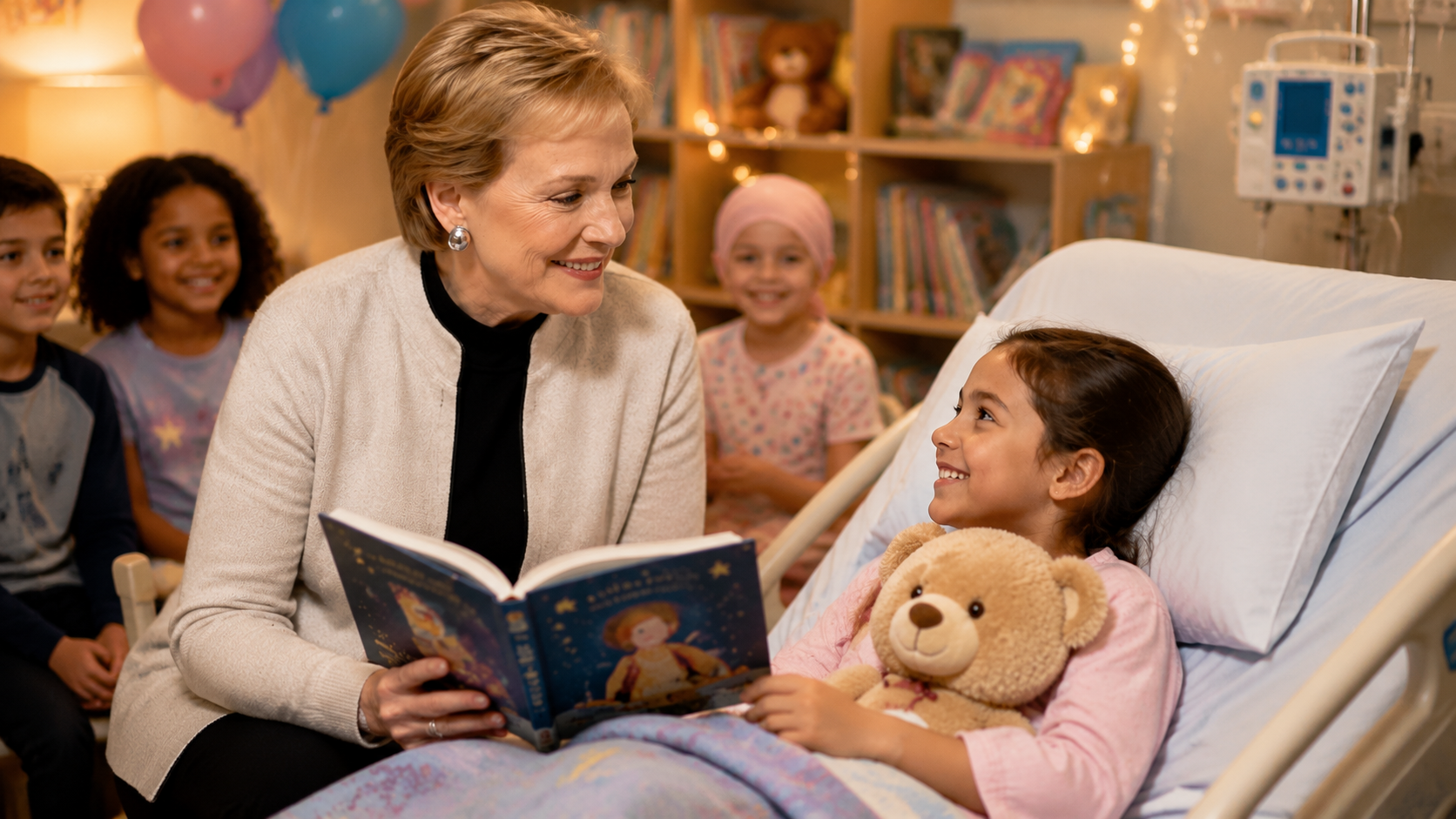
That evening, children who were able gathered in the pediatric activity room.
Others listened from their beds through open doors.
Julie sat in a simple rocking chair.
No stage.
No spotlight.
No cameras.
Just one storyteller surrounded by children who desperately needed hope.
She opened the first book and began to read.
Within minutes, the entire floor fell silent.
Even busy nurses slowed their steps so they could listen.
Doctors paused outside patient rooms.
Parents leaned against walls, smiling through tears.
For one precious hour, no one thought about IV lines, surgeries, or frightening diagnoses.
There were only adventures…
Laughter…
And imagination.
When Julie finished the final page, every child clapped.
But before anyone could stand, Lily quietly raised her hand.
“I have an idea.”
Julie knelt beside her bed.
“What is it, sweetheart?”
Lily smiled.
“What if every hospital in America had a bedtime story room?”
The room became completely silent.
Julie looked at Emma.
Emma looked at the volunteers.
No one said a word.
Because deep inside…
They all realized Lily’s simple question might become something far bigger than anyone had ever imagined.
Part 2
For several seconds, no one spoke.
Julie Andrews looked around the room at the children sitting in wheelchairs, tucked beneath warm blankets, or holding tightly to their favorite stuffed animals.
Then she smiled at Lily.
“I think,” Julie said softly, “that is one of the most beautiful ideas I’ve ever heard.”
The room erupted in applause.
Emma squeezed her daughter’s hand, overwhelmed with emotion.
That evening, instead of simply saying goodbye, Julie stayed behind with the hospital staff, volunteers, and administrators. Together, they gathered around a conference table with notebooks, coffee cups, and one simple question:
How could they bring bedtime stories to every children’s hospital?
The plan began modestly.
They created small “Bedtime Story Corners” stocked with books for every reading level. Volunteers signed up to read each evening, while local schools and libraries organized monthly book drives.
Julie offered to record a collection of bedtime stories that hospitals could play for children whose families couldn’t be there at night.
Her recordings weren’t dramatic performances.
They were gentle, comforting, and full of warmth—as though a loving grandmother were sitting beside every child’s bed.
The first recordings spread quickly.
Then something unexpected happened.
Hospitals from across the country began calling.
“We heard about the story rooms.”
“Can we start one here?”
“How do we join?”
Bookstores volunteered.
Publishing companies donated thousands of books.
Authors mailed signed copies.
Artists created colorful murals for reading spaces.
High school students organized fundraisers.
College volunteers spent weekends reading aloud.
Retired teachers eagerly signed up to become bedtime readers.
Within a year, fifty hospitals had opened their own story rooms.
Then one hundred.
Then two hundred.
News programs shared smiling children clutching books instead of staring at hospital ceilings.
Parents spoke about the comfort those stories brought during the hardest nights of their lives.
Doctors noticed something they hadn’t expected.
Children often appeared calmer before procedures after participating in evening story time.
The stories couldn’t cure illness.
But they could ease fear.
And sometimes, that made all the difference.
Julie never allowed the project to become about her.
Whenever reporters praised her, she gently redirected the attention.
“This began with one little girl,” she would say. “Lily simply asked why every child couldn’t have a bedtime story.”
Years later, Lily’s health had improved dramatically after successful surgeries.
She was finally able to return to school full-time.
Instead of spending evenings in a hospital room, she spent weekends visiting children’s wards with a backpack full of books.
She would sit beside young patients and read the very stories that had once comforted her.
One afternoon, she noticed a nervous little boy waiting for surgery.
He stared at the floor without saying a word.
Lily handed him a picture book.
“My favorite adventures always begin on the first page,” she said with a smile.
By the time his nurse came to take him to surgery, he was laughing at the story’s funny characters.
His mother quietly wiped away tears.
“I haven’t seen him smile all week,” she whispered.
On the fifth anniversary of the program, thousands of volunteers gathered virtually for a celebration.
Hospitals from every state shared photographs of children reading together.
Some hospitals had built cozy reading rooms shaped like treehouses.
Others created small libraries on rolling carts that could travel from room to room.
Millions of books had been donated.
Countless bedtime stories had been shared.
But the most memorable moment came when Julie invited Lily to the stage.
She handed her a beautifully bound children’s book with a handwritten message inside.
“Dear Lily,
You reminded the world that hope often begins with a simple question and grows one kind page at a time. Thank you for believing every child deserves a story before they fall asleep.
With love and admiration,
Julie Andrews.”
The audience rose for a long standing ovation.
Many volunteers had tears in their eyes.
Not because of a celebrity.
Not because of the numbers.
But because one child’s compassion had inspired millions of acts of kindness.
Long after the applause faded, hospitals continued adding books to their shelves.
New volunteers kept signing up.
Families continued donating stories in honor of loved ones.
And every night, somewhere across the country, a child closed a book with a smile, feeling just a little less alone.
Because one bedtime story had become something far greater than anyone imagined.
It had become a reminder that while medicine heals the body, kindness and imagination can help heal the heart.
The End.


