Part 1
Nine-year-old Sophie loved to sing.
She sang while helping her mother wash dishes.
She sang while walking to school.
She even sang softly before falling asleep each night.
But there was one place where she could never sing.
A stage.
The moment people looked at her, her voice disappeared.
Her hands shook.
Her knees felt weak.
And tears always filled her eyes.
Her music teacher, Mrs. Collins, believed Sophie had a beautiful gift.
“You have a voice that makes people smile,” she often said.
“But the world can’t hear it if you hide.”
Sophie wanted to be brave.
She really did.
She practiced every afternoon in front of the bedroom mirror.
She imagined rows of happy faces clapping for her.
But when rehearsal day arrived at school, everything changed.
As soon as she walked toward the microphone, she froze.
The other children waited.
The piano teacher smiled encouragingly.
Still, no sound came out.
After a long silence, Sophie whispered, “I’m sorry,” and hurried off the stage.
That afternoon she cried all the way home.
“I’ll never sing in front of people,” she told her mother.
“I’ll always be too scared.”
Her mother hugged her tightly.
“Being brave doesn’t mean you’re never afraid,” she said softly.
“It means taking one small step even while you’re afraid.”
A week later, Sophie’s grandmother surprised her with two tickets to a charity afternoon celebrating music, storytelling, and children’s creativity.
The special guest was Julie Andrews.
Sophie’s eyes grew wide.
She had watched Mary Poppins and The Sound of Music so many times that she knew every song by heart.
The theater overflowed with families.
Julie spoke warmly about imagination, kindness, and believing in yourself.
She laughed with the children, answered questions, and encouraged everyone to keep creating, no matter their age.
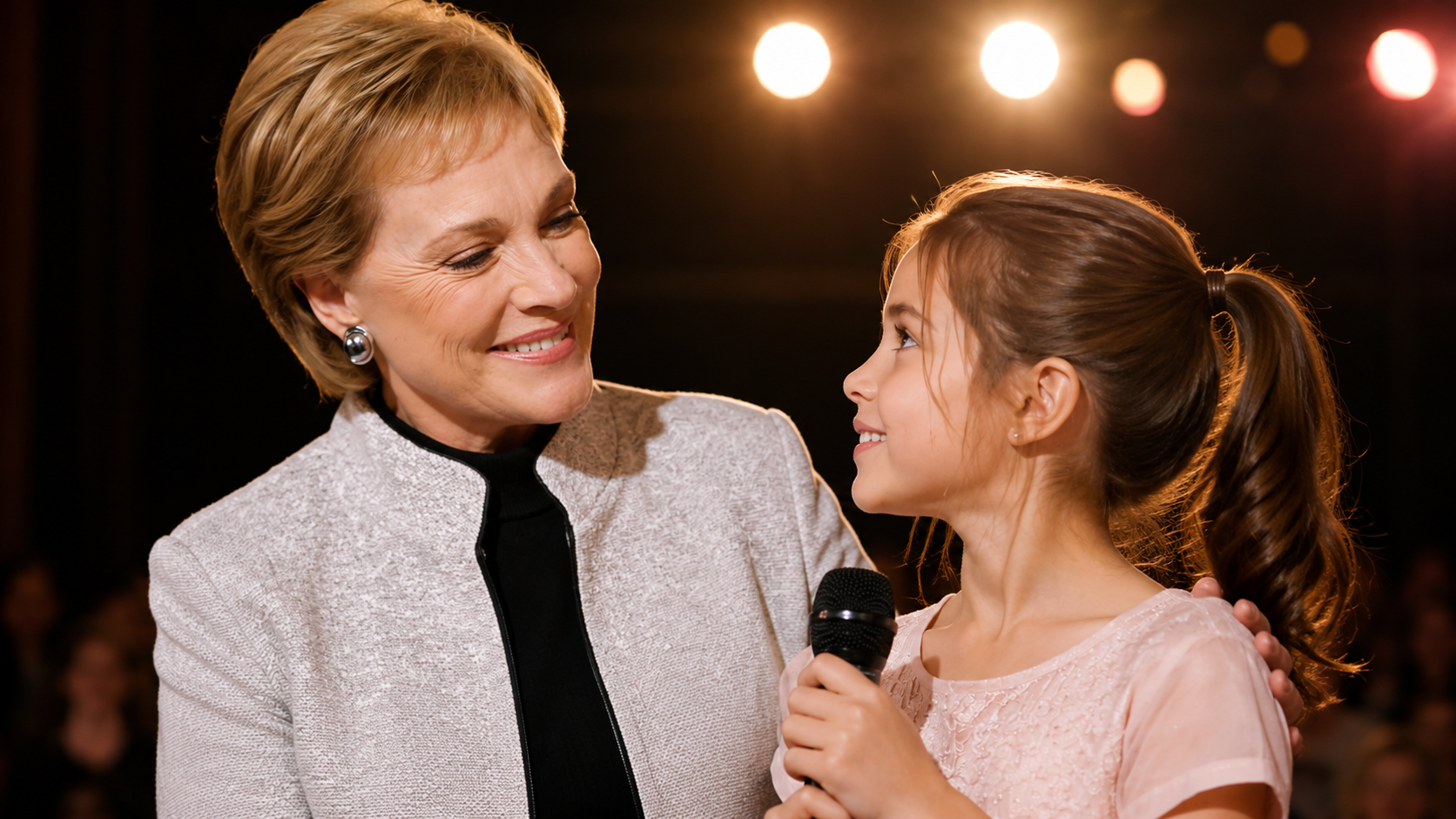
Near the end of the event, Julie invited several children to meet her backstage.
Sophie was chosen.
She could hardly believe it.
When it was finally her turn, Sophie quietly admitted,
“I love singing… but I’m too scared for anyone to hear me.”
Julie smiled kindly.
Instead of giving a long speech, she asked a simple question.
“When you sing alone, how does your heart feel?”
Sophie thought for a moment.
“Happy.”
“And when you imagine everyone judging you?”
“It feels heavy.”
Julie nodded gently.
“Then perhaps,” she said, “don’t sing for the audience.”
Sophie looked puzzled.
Julie continued.
“Sing for the happiness in your heart instead.”
Those simple words stayed with Sophie all night.
Before they left, Julie handed her a small autograph.
Across the bottom she wrote:
‘The smallest brave step often begins the greatest adventure. Love, Julie Andrews.’
Sophie carefully placed the card inside her music notebook.
She had no idea that just a few weeks later, those words would give her the courage to take the first step that would change far more than her own life…
Part 2: Heartwarming Fiction
Julie Andrews Helped a Young Fan Overcome Her Fear of Performing—Her First Brave Step Inspired Hundreds of Children to Believe in Themselves
Three weeks later, Sophie’s school announced its annual spring performance.
Every class would take part.
There would be music, dancing, poetry, and short plays.
When Mrs. Collins asked who wanted to sing solo, Sophie immediately looked down at her desk.
Her heart began pounding.
She wanted to raise her hand.
But fear whispered the same old words.
You’ll freeze.
Everyone will stare.
You’ll embarrass yourself again.
That afternoon, Sophie opened her music notebook.
Julie Andrews’ message was still tucked inside.
“The smallest brave step often begins the greatest adventure.”
Sophie read it again.
And again.
Finally, she went to Mrs. Collins.
“I want to try,” Sophie whispered.
Her teacher smiled.
“Then we’ll start small.”
Instead of practicing before the whole class, Sophie first sang for Mrs. Collins alone.
The next day, she sang for two classmates.
Then five.
Then ten.
Each time, her hands still trembled.
But she finished the song.
Little by little, fear stopped controlling her.
On the night of the performance, hundreds of parents filled the auditorium.
Sophie stood behind the curtain, gripping the edge of her dress.
“I can’t do this,” she whispered.
Mrs. Collins knelt beside her.
“You don’t need to be fearless.”
Sophie looked at her teacher.
“You only need to take one brave step.”
The curtain opened.
Sophie walked onto the stage.
For a moment, she froze.
The microphone seemed enormous.
The lights were bright.
The audience was silent.
Then Sophie remembered Julie’s question.
How does your heart feel when you sing alone?
Happy.
So Sophie closed her eyes.
She stopped thinking about the audience.
She imagined herself singing in her bedroom.
And then…
she began.
Her first note was quiet.
The second was stronger.
By the middle of the song, Sophie had forgotten to be afraid.
Her voice filled the auditorium.
When she finished, there was a moment of silence.
Then everyone stood.
The applause was so loud that Sophie covered her mouth in disbelief.
Her mother was crying.
Her grandmother was clapping above her head.
Mrs. Collins stood backstage with tears in her eyes.
But something even more beautiful happened afterward.
Several children approached Sophie.
One little boy said, “I’m scared to play piano in front of people.”
A girl whispered, “I’m afraid to read my poem.”
Another child admitted, “I wanted to join the school play, but I thought everyone would laugh at me.”
Sophie suddenly understood something.
She had thought her brave moment belonged only to her.
It didn’t.
Her courage had given other children permission to try.
The following week, Mrs. Collins created something called The Brave Step Club.
Every Friday, children could practice something they were afraid to do.
Some sang.
Some danced.
Some read stories.
Some simply stood in front of the group and introduced themselves.
Nobody laughed.
Nobody judged.
They applauded every attempt.
Soon, nearly fifty children joined.
Then another school heard about the idea.
Then another.
Within months, hundreds of children were participating in their own Brave Step gatherings.
Each club followed one simple rule:
You don’t have to be perfect. You only have to try.
Sophie’s grandmother eventually wrote Julie Andrews a letter describing what had happened.
She explained how one quiet conversation had helped a frightened little girl take her first step onto a stage.
Several months later, Sophie received a reply.
She opened the envelope with trembling hands.
Inside was a short note.
Julie wrote that she was delighted to hear Sophie had found her courage.
But one sentence meant more than anything else.
“Remember, Sophie, courage grows whenever we share it with someone else.”
Sophie placed the new letter beside the first.
Years later, she would still keep both.
Not because they reminded her of meeting someone famous.
But because they reminded her of the day she learned something far more important.
Fear does not always disappear before we begin.
Sometimes courage simply means walking forward while fear walks beside us.
And sometimes one small brave step can travel much farther than we ever imagined.
For Sophie, it began with a trembling voice and one song.
For hundreds of other children, it became permission to believe:
Maybe I can do it too.
And that was the most beautiful performance of all.
THE END


