Part 1
For most of her life, Margaret Ellis believed that kindness was one of the most powerful things a person could give.
It didn’t require money.
It didn’t require fame.
Sometimes, she believed, all it required was noticing someone who felt invisible.
But at seventy-two years old, Margaret was beginning to wonder if she had been wrong.
She lived alone in a small cottage at the edge of a quiet English village. There were roses beside the front gate, photographs covering the mantel, and an old record player near the window.
Once, the cottage had been filled with laughter.
Margaret’s husband, Thomas, had been the kind of man who sang badly while washing dishes just to make her laugh.
Their daughter, Emily, had grown up there too.
Sunday dinners had been noisy. Christmas mornings had been crowded. Neighbors had stopped by without needing invitations.
But life had slowly changed.
Thomas passed away after forty-six years of marriage.
Emily moved abroad for work and could only visit occasionally.
Old friends either moved away, became ill, or disappeared quietly from Margaret’s life.
And the neighborhood changed.
People hurried past one another.
Doors stayed closed.
Conversations became shorter.
Margaret tried not to become bitter.
She continued doing the little things she had always done.
She baked biscuits for new neighbors.
She left flowers outside the home of a woman who had lost her husband.
She carried groceries for an elderly gentleman.
She even volunteered at the village library every Wednesday.
But something happened one winter that finally broke her spirit.
Margaret slipped on an icy pavement while carrying groceries home.
Her shopping bags scattered across the ground.
Apples rolled into the street.
A carton of milk burst beside her.
Margaret couldn’t immediately stand.
Several people passed.
One looked at her and continued walking.
Another stepped around the groceries.
Eventually, a delivery driver stopped his van and helped her.
Margaret thanked him repeatedly.
But that evening, sitting alone in her kitchen with a bruised knee, she began crying.
It wasn’t because she had fallen.
It was because people had seen her fall and simply continued walking.
For the first time in her life, Margaret wondered whether kindness was disappearing.
Over the following months, she changed.
She stopped baking for neighbors.
She stopped volunteering.
She stopped smiling at strangers because she no longer expected them to smile back.
Even the roses outside her cottage went unattended.
Then, one spring afternoon, Margaret’s daughter called.
“Mum, I sent you something.”
“What?”
“A ticket.”
Margaret sighed.
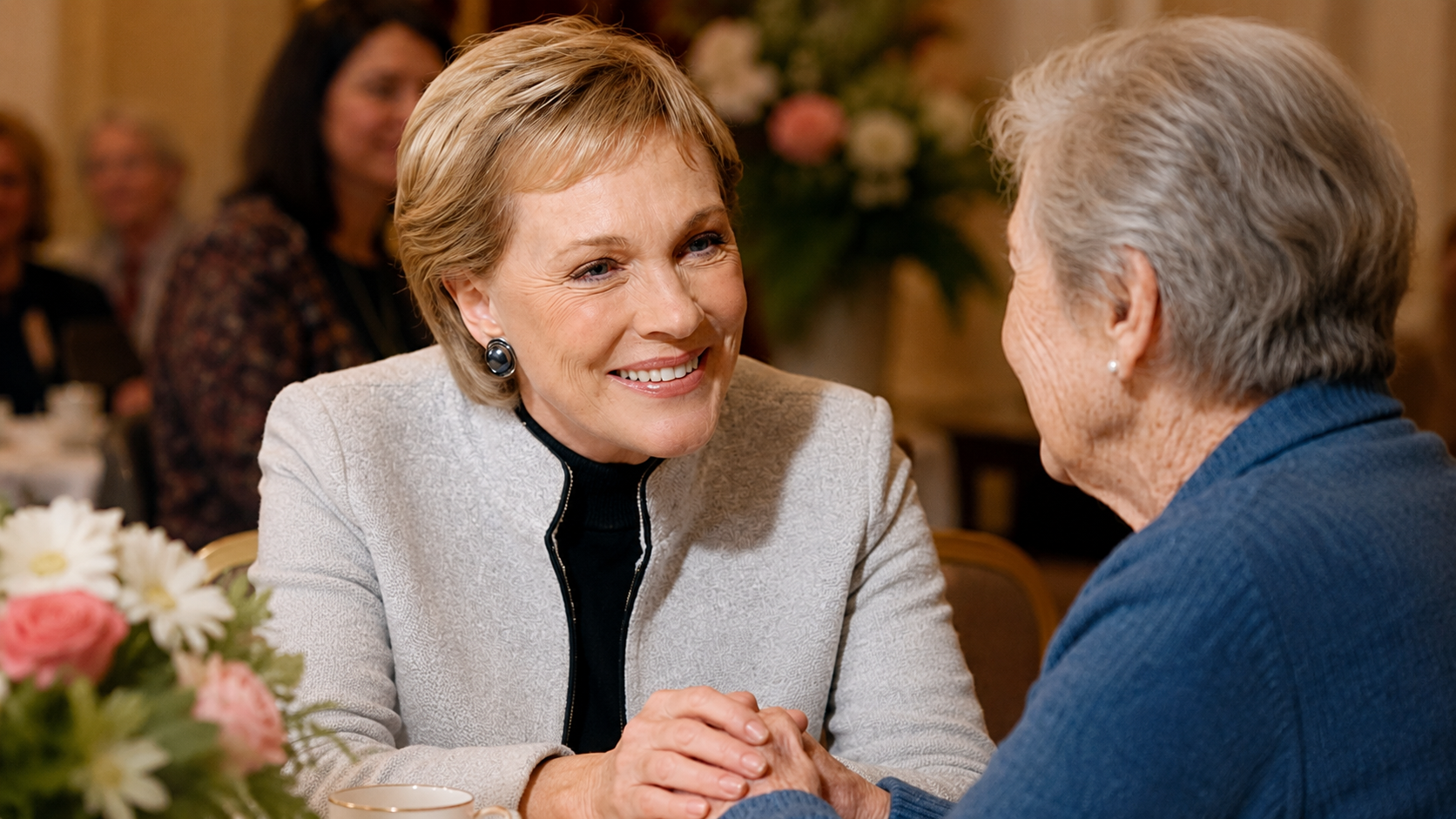
Emily had purchased a ticket for a small charity gathering where Julie Andrews was expected to appear as a special guest.
Margaret stared at the envelope when it arrived.
Julie Andrews had been part of some of the happiest memories of her life.
She remembered watching Mary Poppins with Emily when her daughter was little.
She remembered singing songs from The Sound of Music while preparing Sunday breakfast.
Thomas used to tease her.
“You know Julie Andrews sings those considerably better than you.”
Margaret would throw a kitchen towel at him.
Remembering it made her smile.
But only briefly.
She almost didn’t attend.
“What difference will one afternoon make?” she whispered.
Still, on the day of the gathering, Margaret put on her favorite blue coat and went.
The event was held in a beautiful old community hall.
People chatted excitedly while volunteers moved between tables.
Margaret chose a seat near the back.
She didn’t want attention.
She simply wanted to listen.
When Julie Andrews entered, the room filled with warm applause.
Margaret clapped too.
For a little while, she forgot how lonely she had been.
Julie spoke about music, memories, family, and the importance of encouraging young people.
Then she said something that caught Margaret’s attention.
“Kindness is rarely wasted. We may not always see where it goes, but sometimes a small act travels much farther than we could ever imagine.”
Margaret looked down.
She wanted to believe those words.
She really did.
But something inside her resisted.
After the event, several guests were invited to briefly meet Julie.
Margaret considered leaving.
Instead, she remained in line.
When her turn finally came, Julie greeted her warmly.
“Hello. What’s your name?”
“Margaret.”
“It’s lovely to meet you, Margaret.”
There was something so sincere about the way she said it that Margaret unexpectedly became emotional.
Julie noticed.
“Are you all right?”
Margaret quickly wiped her eyes.
“I’m sorry. This is embarrassing.”
“There’s nothing embarrassing about having feelings.”
That gentle response opened something inside Margaret.
She hesitated before saying quietly,
“You spoke about kindness today.”
Julie nodded.
“I did.”
“I used to believe exactly what you said.”
“Used to?”
Margaret looked away.
Then she told her.
She spoke about Thomas.
About the quiet cottage.
About friends disappearing.
And finally, about falling on the icy pavement while strangers walked around her.
“I know it sounds like such a small thing,” Margaret said. “But something changed inside me that day.”
Julie listened without interrupting.
Margaret continued.
“I spent my whole life believing people were basically good. But lately I’ve wondered whether kindness even matters anymore.”
For several seconds, Julie said nothing.
Then she gently reached across the small table between them.
“Margaret,” she said, “may I ask you something?”
Margaret nodded.
“Who finally helped you that day?”
“A delivery driver.”
“Did you know him?”
“No.”
“Did he know you?”
Margaret shook her head.
Julie smiled gently.
“Then perhaps kindness wasn’t absent that day.”
Margaret became quiet.
“It was simply late.”
Those words stayed between them.
Margaret’s eyes filled again.
But Julie wasn’t finished.
“The people who walked past disappointed you,” she continued. “And understandably so. But don’t allow the people who failed to stop to erase the person who did.”
Margaret stared at her.
She had replayed that winter afternoon hundreds of times.
But strangely, she always remembered the people who walked away.
She rarely remembered the man who stopped.
“I never thought about it like that,” she whispered.
Julie smiled.
“We often remember disappointment more loudly than kindness.”
Margaret slowly nodded.
Then something unexpected happened.
A young volunteer approached their table.
She looked nervous.
“Excuse me,” she said. “Mrs. Ellis?”
Margaret turned.
“Yes?”
The young woman smiled.
“You probably don’t remember me.”
Margaret studied her face.
She didn’t.
“My name is Sophie.”
Margaret apologized.
“I’m afraid I don’t remember.”
Sophie reached into her handbag and pulled out something small.
It was an old photograph.
She placed it on the table.
Margaret picked it up.
The photograph showed a little girl standing outside a library.
Margaret’s hands suddenly trembled.
“I remember this place.”
Sophie nodded.
“You should.”
Margaret looked closer.
Then Sophie said something that made Margaret’s heart stop.
“Because twenty years ago, you were the person who changed my life there.”
Margaret stared at her.
Julie quietly leaned back.
This conversation, it seemed, was about to become something much bigger than either of them had expected.
Part 2
Sophie sat down beside Margaret and carefully turned the old photograph around.
On the back, written in faded blue ink, were the words:
“To Sophie — Never believe one bad day decides your whole life.”
Margaret stared at the handwriting.
Her handwriting.
For a long moment, she could not speak.
Then fragments of an old memory began returning.
Twenty years earlier, Sophie had been a quiet little girl who often came to the village library alone.
Her clothes were usually too large.
Her shoes were worn.
She rarely borrowed books because she was afraid she would damage them.
Margaret had been volunteering at the library then.
At first, she simply noticed Sophie sitting in the same corner each afternoon.
Eventually, she started speaking to her.
One day, Sophie arrived crying.
Some children at school had laughed at her because her family could not afford the same things they had.
Sophie told Margaret she hated being poor.
She said she believed people only respected those who had money.
Margaret had sat beside her.
She didn’t give her a long speech.
She simply said,
“Money can change what you own, Sophie. But kindness changes who you become.”
Then Margaret gave her a small notebook.
“Write one good thing in here every day,” she said. “Even on difficult days.”
Sophie had looked doubtful.
“What if nothing good happens?”
“Then do something good for someone else. That can be your one good thing.”
Margaret had forgotten that conversation completely.
Sophie had not.
She opened her handbag again and pulled out a small, worn notebook.
The corners were bent.
The cover was faded.
Margaret covered her mouth.
“You kept it?”
“For twenty years.”
Sophie opened the first page.
The handwriting was childish.
Day 1: Mrs. Ellis gave me this notebook.
The next page read:
Day 2: I helped Mum carry the shopping.
Then:
Day 3: A boy dropped his pencils. I helped him pick them up.
Page after page followed.
As Sophie grew older, the handwriting changed.
So did the problems.
There were entries about her parents struggling.
About changing schools.
About losing her father.
About failing an important exam.
But almost every difficult entry ended with something good.
Made tea for Mum.
Helped an old man cross the street.
Sat with a new student at lunch.
Volunteered at the hospital.
Margaret’s eyes filled with tears.
“I had no idea.”
Sophie smiled.
“That’s the point, Mrs. Ellis.”
Margaret looked at her.
“You never knew what happened after you were kind to me.”
Sophie took a breath.
“That notebook changed the direction of my life.”
She explained that when she became older, she started volunteering regularly.
Eventually, she trained as a social worker.
Now she worked with children from struggling families.
Children who felt ashamed.
Children who felt forgotten.
Children who believed life had already decided their future.
“And do you know what I tell them?”
Margaret shook her head.
Sophie smiled through tears.
“I tell them that one bad day doesn’t decide their whole life.”
Margaret began crying.
Julie Andrews quietly reached for a tissue and handed it to her.
Sophie continued.
“I’ve probably said your words to hundreds of children.”
Margaret looked down at the notebook.
Something inside her was slowly changing.
For months, she had believed her kindness had disappeared into nothing.
She had believed nobody noticed.
Nobody remembered.
But sitting in front of her was proof that kindness could continue long after the giver had forgotten it.
Julie gently spoke.
“Do you see, Margaret?”
Margaret looked at her.
“You were searching for evidence that kindness still existed.”
Julie smiled.
“But perhaps you were part of the evidence all along.”
Margaret closed her eyes.
Those words reached somewhere deep.
She thought again about the icy pavement.
The strangers walking past.
For months, she had allowed those few moments to define how she saw people.
But now she remembered something else.
The delivery driver.
A stranger who stopped.
Sophie.
A frightened little girl who grew into a woman helping others.
And all the people Sophie had helped because of one small conversation in a library.
Margaret slowly wiped her tears.
“I think I’ve been looking in the wrong direction.”
Julie nodded.
“We all do sometimes.”
Then Sophie reached across the table.
“There’s something else you should know.”
Margaret laughed softly.
“I’m not sure my heart can manage another surprise.”
Sophie smiled.
“Remember the village library where we met?”
“Of course.”
“They’re starting an afternoon program for children who need extra support.”
Margaret listened carefully.
“They need volunteers.”
Sophie paused.
“I was hoping you might come back.”
Margaret stared at her.
Six months earlier, she would have refused.
She had convinced herself she was too old.
Too tired.
Too disappointed.
But now she imagined a lonely child sitting quietly in a corner.
Perhaps another Sophie.
Perhaps someone waiting for one person to notice.
Margaret smiled.
“When do I start?”
Sophie immediately hugged her.
Julie watched them with tears in her eyes.
A few weeks later, Margaret returned to the library.
The first afternoon felt strange.
She stood outside the entrance for several minutes before walking in.
Then a little boy approached her.
He held a damaged book against his chest.
“Are you the new volunteer?”
Margaret smiled.
“I suppose I am.”
The boy looked nervous.
“I accidentally tore this page.”
Margaret examined it.
“We can fix that.”
“You’re not angry?”
“No.”
Together, they repaired the page with tape.
Before he left, Margaret gave him a small notebook.
“What’s this for?”
She smiled.
“For remembering good things.”
The boy looked confused.
Margaret laughed.
“Trust me. Someone once taught me how important that can be.”
Months passed.
Margaret became one of the library’s most beloved volunteers.
Her roses began blooming again.
She started baking biscuits for her neighbors.
She smiled at strangers.
Most smiled back.
Some didn’t.
But that no longer bothered her as much.
She finally understood something.
Kindness was never a guarantee that everyone would be kind in return.
It was a choice.
A choice to keep goodness alive even when disappointment tried to extinguish it.
One afternoon, Margaret received a letter.
Inside was a small card from Julie Andrews.
It read:
“Dear Margaret, never underestimate how far one gentle act can travel. Thank you for reminding all of us that hope often returns through the very kindness we once gave away.”
Margaret placed the card beside Thomas’s photograph.
Then she looked around her cottage.
For the first time in years, the house didn’t feel empty.
It felt peaceful.
That evening, someone knocked on the door.
It was a new family who had recently moved into the neighborhood.
The mother looked embarrassed.
“I’m sorry to bother you. Our oven isn’t working, and my daughter said she smelled something wonderful coming from your kitchen.”
Margaret laughed.
“I’ve just made far too many biscuits.”
She invited them inside.
Soon the little cottage was filled with voices again.
Children laughed at the kitchen table.
Tea was poured.
Stories were shared.
And Margaret suddenly understood something beautiful.
The world had never stopped needing kindness.
She had simply stopped believing her own kindness mattered.
But it did.
It always had.
Because kindness rarely announces where it is going.
Sometimes it disappears quietly into another person’s life.
Sometimes years pass.
Sometimes decades.
And then, when hope feels almost gone, it returns.
Not as repayment.
But as proof.
Proof that one gentle word can survive.
One thoughtful action can grow.
And one person choosing kindness can quietly inspire many others to do the same.
Margaret looked around the warm room and smiled.
Her faith in people had returned.
Not because everyone had become kind.
But because she finally understood that kindness only needed one person to begin.
THE END


