Part 1: The Woman Who Kept Going
For most of her life, Margaret Ellis had believed that courage did not always look brave.
Sometimes, courage was simply getting out of bed when your heart was heavy.
Sometimes, it was smiling at someone else while quietly carrying worries of your own.
And sometimes, it was hearing a familiar song and deciding that tomorrow was still worth waiting for.
Margaret was seventy-two years old when something extraordinary happened to her.
But the story really began many decades earlier.
She had grown up in a modest home where money was often scarce but music was everywhere. Her mother sang while preparing dinner. Her father whistled while fixing things around the house.
And Margaret loved movies.
One performer, in particular, held a special place in her heart.
Julie Andrews.
The first time Margaret saw Julie on screen, she was a young girl sitting beside her mother.
Margaret was captivated.
There was something about Julie’s voice, her warmth, and the hopeful characters she portrayed that stayed with her long after the movie ended.
As Margaret grew older, life became much harder than she had expected.
In her twenties, she married a kind man named Robert.
They didn’t have much, but they built a happy life together.
They raised two children in a small house with a garden behind it. Robert worked long hours, while Margaret took several jobs over the years to help support the family.
She cleaned offices.
She worked in a bakery.
She cared for elderly neighbors.
Whenever life became difficult, Margaret had a simple ritual.
She would play one of the songs she had loved since childhood.
Then she would tell herself, “Just keep going.”
Those four words became her quiet promise.
Years passed.
Then Robert became seriously ill.
Margaret became his primary caregiver while continuing to work whenever she could.
There were days when exhaustion overwhelmed her.
But she never wanted Robert to feel like a burden.
Every evening, she sat beside him.
They talked about their children.
They remembered old holidays.
And sometimes, they watched the films that had brought Margaret comfort since she was young.
Robert would smile whenever Julie Andrews appeared on screen.
“Your favorite,” he would say.
Margaret always laughed.
“Always.”
After several difficult years, Robert passed away.
For the first time in nearly forty years, Margaret found herself alone.
The silence in the house was unbearable.
But instead of giving up, she began volunteering at a small community center.
At first, she simply served tea and helped clean the kitchen.
Then she noticed something.
Many people who came through the doors were carrying struggles just as heavy as hers.
Some had lost spouses.
Some had lost jobs.
Some were raising children alone.
Others simply needed someone to listen.
Margaret began sitting with them.
She remembered birthdays.
She brought homemade cakes.
She collected winter coats.
When a family couldn’t afford groceries, Margaret quietly organized food donations.
She never called herself extraordinary.
Whenever someone thanked her, she gave the same answer.
“We all need someone sometimes.”
One day, a teenage volunteer named Sophie asked Margaret how she remained so hopeful after everything she had experienced.
Margaret thought for a moment.
Then she pointed toward an old photograph hanging beside her desk.
It showed Margaret as a young woman, standing outside a cinema.
“I learned a long time ago that difficult chapters don’t have to be the final chapters,” she said.
Sophie never forgot those words.
Neither did the other volunteers.
Over time, Margaret became the heart of the community center.
But few people knew that she still carried one small dream.
She had always wanted to meet Julie Andrews.
Not because Julie was famous.
Margaret simply wanted to say thank you.
“Her work reminded me to keep hope alive,” Margaret once told Sophie. “There were moments when I needed that more than anyone knew.”
Sophie quietly decided to do something.
With the help of several volunteers, she recorded a short video telling Margaret’s story.
She spoke about the years of hardship.
She spoke about Robert.
She spoke about Margaret’s decades of helping others despite having very little herself.
At the end of the video, Sophie said:
“Margaret has spent her entire life telling people not to give up. If there is one person she has always dreamed of thanking, it is Julie Andrews.”
They posted the video online.
Nobody expected much to happen.
But within days, thousands of people had watched it.
Comments poured in from strangers.
“Margaret reminds me of my grandmother.”
“I needed to hear her words today.”
“Please help her meet Julie.”
The video traveled farther than anyone imagined.
But Margaret knew nothing about it.
Several weeks later, Sophie told her that the community center was holding a small celebration in her honor.
Margaret protested immediately.
“You shouldn’t make a fuss over me.”
But Sophie smiled.
“For once, Margaret, just let people say thank you.”
On the afternoon of the celebration, the center was filled with families Margaret had helped over the years.
Children carried handmade cards.
Former volunteers returned.
One family brought flowers.
Margaret stood at the front of the room, overwhelmed.
Then Sophie walked toward her.
“We have one more surprise.”
The room suddenly became quiet.
A door at the back of the hall opened.
Margaret looked toward it.
For a moment, she couldn’t understand why everyone around her was smiling.
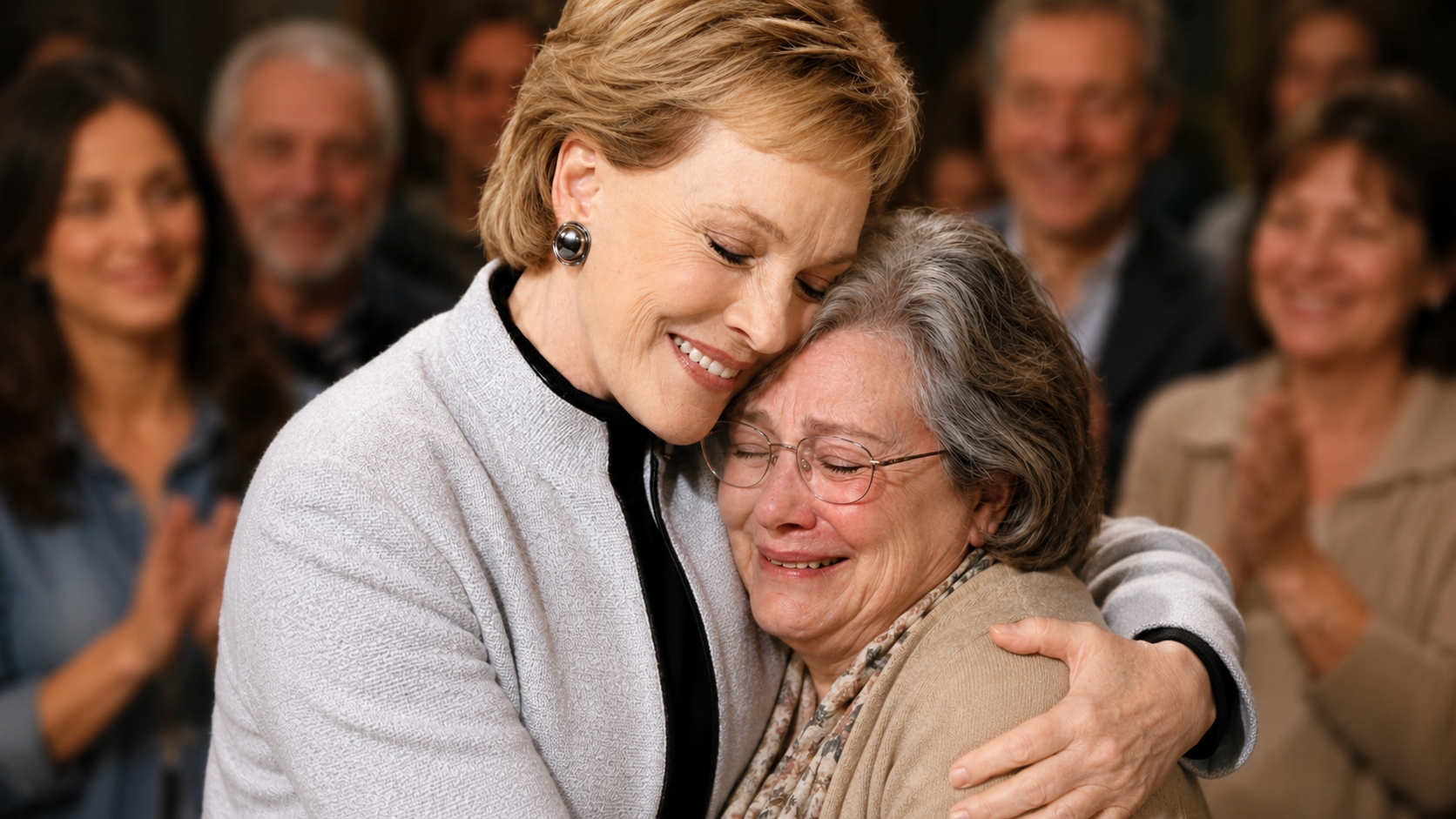
Then a familiar woman stepped into the room.
Margaret froze.
Her hand slowly rose to her mouth.
It was Julie Andrews.
The woman whose voice had accompanied Margaret through childhood, marriage, loss, grief, and countless difficult mornings was now walking toward her.
Margaret began to cry.
“Oh my goodness,” she whispered.
Julie approached her with a gentle smile.
“Margaret?”
Margaret nodded, unable to speak.
Julie reached out and took both of her hands.
“I’ve heard quite a lot about you.”
Margaret shook her head through her tears.
“No,” she finally managed to say. “I wanted to thank you.”
Julie looked at her warmly.
But what she said next brought the entire room to silence.
“I think, Margaret, there are thousands of people who would like to thank you.”
Margaret looked around the room.
She had no idea that the story of her quiet courage had already traveled around the world.
And she had no idea that her emotional meeting with Julie was about to inspire something far greater than anyone in that little community center could have imagined.
Part 2: The Hope She Passed On
Margaret could barely believe what was happening.
For years, she had imagined what she might say if she ever met Julie Andrews.
She had rehearsed the words in her mind.
Thank you for the music.
Thank you for the joy.
Thank you for helping me through difficult days.
But now that Julie was standing in front of her, Margaret found herself speechless.
Julie gently squeezed her hands.
“You have spent so much of your life lifting other people,” she said. “I thought it was time someone reminded you how much your life has mattered.”
Margaret lowered her eyes.
“I only did what anyone should do.”
Julie smiled.
“Perhaps. But not everyone does.”
The room fell quiet.
Around them stood people whose lives had been touched by Margaret.
A mother who had once received groceries when she had no money left.
An elderly widower who had nearly stopped leaving his home until Margaret began visiting him every Wednesday.
A young man who had once been homeless and now volunteered at the center.
Children who knew Margaret simply as the woman who always remembered their birthdays.
One by one, they began to share their stories.
A woman named Claire stepped forward first.
“Margaret helped me when I was at the lowest point of my life,” she said.
Her voice trembled.
“My husband had left, I had two small children, and I was afraid we would lose our apartment.”
Margaret immediately shook her head.
“You don’t have to tell everyone.”
But Claire smiled through her tears.
“I want to.”
She turned toward the room.
“Margaret showed up at my door with food, blankets, and a list of places that could help me. But what mattered most was what she said.”
Claire looked at Margaret.
“You told me, ‘This is a hard chapter. It is not the whole story.'”
Margaret began crying again.
Then another person stepped forward.
And another.
Every story carried the same message.
Margaret had been there.
Quietly.
Without expecting recognition.
Julie listened carefully.
When everyone had finished, she turned back toward Margaret.
“You spent years believing my work gave you hope,” Julie said softly.
“But look around you.”
Margaret did.
“Somewhere along the way, Margaret, you became that hope for other people.”
There was not a dry eye in the room.
For Margaret, those words were almost too much to bear.
All her life, she had believed she was simply surviving.
She had never considered that her survival might have inspired others.
The celebration continued into the afternoon.
Julie sat beside Margaret while they shared tea and spoke privately.
Margaret told her about Robert.
She described how he would tease her whenever one of Julie’s films appeared on television.
“He always knew I’d stop whatever I was doing to watch,” Margaret said.
Julie laughed.
“He sounds like a very patient man.”
“The most patient.”
For a few moments, Margaret was quiet.
Then she said something she had carried in her heart for years.
“After he died, I thought I had lost the best part of my life.”
Julie listened.
“But I eventually realized something,” Margaret continued. “Love doesn’t disappear when someone leaves us. It changes. You have to find somewhere else to put it.”
Julie looked at her.
Margaret glanced toward the families gathered around the room.
“So I put mine here.”
Julie reached over and held her hand.
“That may be one of the loveliest things I’ve ever heard.”
Unknown to Margaret, Sophie had recorded part of the celebration with permission from those present.
Later that evening, she shared a short clip online.
The video showed Julie meeting Margaret.
It showed Margaret crying.
And it captured Julie’s words:
“Somewhere along the way, you became that hope for other people.”
The response was immediate.
Within days, thousands of people had shared the video.
But something unexpected began happening.
People started posting their own stories.
A nurse wrote about a patient who had inspired her never to give up.
A teacher shared the story of a struggling student who had returned years later to thank her.
A widower described how volunteering had helped him survive his grief.
A young woman wrote about caring for her disabled brother while working two jobs.
Every story ended with the same simple message:
Keep going.
Soon, the phrase became part of a growing online movement.
People began using the words to encourage strangers.
“Keep going. Your story is not finished.”
Schools displayed the message.
Community centers painted it on signs.
Charities began sharing stories of ordinary people who had survived extraordinary hardships.
Margaret was overwhelmed.
“I don’t understand why people are paying attention to me,” she told Sophie.
Sophie smiled.
“Because you’re not really telling them your story.”
Margaret looked confused.
“You’re reminding them of their own.”
That explanation finally made sense.
Margaret had never been famous.
She had never written a book.
She had never stood on a grand stage.
She had simply lived.
She had suffered.
She had lost people she loved.
She had worried about money.
She had cried alone.
And somehow, she had continued.
That was what people recognized.
The truth that courage was not always dramatic.
Sometimes courage was making breakfast.
Answering the phone.
Going to work.
Helping a neighbor.
Trying again after disappointment.
A few months after their meeting, Julie sent Margaret a handwritten letter.
Margaret opened it at the community center.
Inside was a simple message.
“Dear Margaret,
Meeting you reminded me of something important.
We may never know how far a single act of kindness travels.
You believed that certain songs and stories helped carry you through difficult times.
But your own life has now become a story carrying others.
Thank you for never giving up.
And thank you for showing so many people that hope can be passed from one person to another.
With affection,
Julie.”
Margaret read the letter several times.
Then she carefully placed it in a frame.
She hung it beside the old photograph of herself outside the cinema.
But underneath it, she added something else.
A small handwritten sign.
It said:
“Your hardest chapter does not have to be your last.”
Years later, visitors still came to the community center.
Some had seen Margaret’s story online.
Others had heard about it from friends.
Many arrived during difficult periods in their own lives.
Margaret welcomed them exactly as she always had.
With tea.
With patience.
And with time.
Whenever someone told her they didn’t know how they could keep going, Margaret never gave them complicated advice.
She simply sat beside them.
Then she smiled.
“Take one more step,” she would say.
“You don’t have to see the whole road today.”
And somewhere far beyond that little community center, thousands of people continued sharing the message inspired by one woman who had survived more than most people ever knew.
A woman who thought she was simply holding on.
A woman who discovered that her quiet perseverance had been giving others strength all along.
Margaret had once dreamed of meeting Julie Andrews so she could thank her for inspiring her not to give up.
But when that day finally came, something beautiful happened.
The lifelong fan discovered that she had become an inspiration too.
And perhaps that was the greatest surprise of all.
Because sometimes the people who feel the most ordinary are carrying the most extraordinary stories.
And sometimes, simply refusing to give up can become a light for someone you may never even meet.
The End


