Part 1: The Empty Chair at the Table
Every Sunday morning, long before most of the city had opened its curtains, Margaret Ellis was already standing in her tiny kitchen.
At sixty-two, Margaret lived a simple life. She had retired from her job as a school cafeteria cook two years earlier, but retirement had never felt quite right to her.
For more than three decades, she had spent her days feeding children.
She remembered their favorite meals, their birthdays, and even which children needed an extra helping because there might not be enough food waiting for them at home.
Cooking, Margaret believed, was never just about filling an empty stomach.
It was a way of saying, You matter to someone.
That belief became even stronger after her husband, Thomas, passed away.
For the first time in forty years, Margaret found herself eating dinner alone.
She would prepare two plates without thinking.
Then she would look across the table and see Thomas’s empty chair.
Some evenings, the silence felt heavier than the loneliness itself.
One rainy Sunday, Margaret cooked far too much chicken soup.
She stared at the large pot on her stove and suddenly thought about Mr. Wilson, an eighty-four-year-old widower who lived three houses away.
She filled a container, wrapped a piece of bread in foil, and walked through the rain to his home.
When Mr. Wilson opened the door, his face changed immediately.
“Margaret?” he asked. “What are you doing out in this weather?”
“I made too much soup,” she said with a smile. “I thought you might help me with my little problem.”
Mr. Wilson laughed.
But when Margaret handed him the warm meal, his eyes filled with tears.
“No one has brought me dinner since my wife died,” he whispered.
Those words stayed with Margaret.
The following Sunday, she cooked three extra meals.
Then five.
Then ten.
She began asking around the neighborhood if anyone knew an older person who lived alone.
The list grew quickly.
There was Evelyn, who hadn’t left her apartment in months because walking had become difficult.
There was George, a retired bus driver whose children lived hundreds of miles away.
There was Mrs. Chen, who always insisted she didn’t need anything but secretly waited beside her window every Sunday afternoon for Margaret’s little blue car.
Margaret called her project Sunday Supper.
She never charged anyone.
She paid for the ingredients from her retirement savings and accepted occasional donations from neighbors.
But Margaret offered something that wasn’t written on any menu.
Time.
Whenever possible, she stayed for a few minutes.
She listened to stories.
She looked at old photographs.
She heard about marriages that had lasted fifty years, children who had moved away, careers that had been forgotten, and dreams that still lived quietly inside aging hearts.
Sometimes the seniors barely touched their food while Margaret was there.
They were simply happy to have someone to talk to.
Within a year, Margaret was delivering nearly forty meals every Sunday.
But the project was becoming difficult to manage alone.
Then, unexpectedly, a letter changed everything.
Margaret had been a lifelong admirer of Julie Andrews.
Her late husband used to joke that if Margaret could invite anyone in the world to dinner, Julie would be sitting at their table before he had time to set down the plates.
One evening, Margaret decided to write to her.
She didn’t ask for money.
She didn’t ask for publicity.
She simply told Julie about Sunday Supper.
At the end of the letter, Margaret wrote:
“I started delivering meals because I understood what it felt like to sit across from an empty chair. But somewhere along the way, I realized there are thousands of empty chairs in this city. Sometimes people don’t need something extraordinary. They just need someone to knock on the door.”
Margaret mailed the letter and forgot about it.
Months passed.
Then, on a quiet Saturday afternoon, there was a knock at her door.
Margaret wiped flour from her hands and opened it.
For several seconds, she couldn’t speak.
Standing on her doorstep was Julie Andrews.
Margaret stared at her.
Julie smiled warmly.
“I believe you have quite a lot of cooking to do tomorrow,” she said. “I wondered if you could use another pair of hands.”
Margaret covered her mouth.
“You… read my letter?”
“I did,” Julie replied. “And I’ve been thinking about those empty chairs ever since.”
The next morning, the two women stood side by side in Margaret’s kitchen.
Julie chopped vegetables while Margaret prepared trays of roasted chicken, potatoes, and carrots.
They laughed when Julie admitted that Margaret was clearly the expert in the kitchen.
“You’re giving me the easy jobs,” Julie teased.
“I’m protecting the seniors,” Margaret replied.
Neither woman wanted publicity.
Julie had come for one reason—to help.
Together, they loaded the meals into Margaret’s little blue car.
Their first stop was Mr. Wilson.
When he opened the door and saw Julie Andrews standing beside Margaret holding his Sunday dinner, he blinked several times.
“I must have fallen asleep,” he finally said.
Julie laughed.
“No, Mr. Wilson. But I hope we’re not too late for supper.”
They sat with him for nearly an hour.
Mr. Wilson told stories about his late wife and the ballroom dancing they had loved when they were young.
Before they left, Julie asked him something simple.
“What do you miss most?”
Mr. Wilson looked toward an old photograph on the wall.
“Eating with people,” he said.
That answer followed Julie and Margaret throughout the day.
At house after house, they heard similar stories.
The seniors appreciated the meals.
But what they truly missed was companionship.
At their final delivery, they visited eighty-seven-year-old Evelyn.
Her apartment was small and beautifully tidy.
On the dining table sat two plates.
Margaret looked at them curiously.
“I always set an extra place,” Evelyn explained softly. “It makes the room feel less empty.”
Julie looked at Margaret.
Neither needed to say anything.
That evening, back in Margaret’s kitchen, they sat exhausted at the table.
Forty meals had been delivered.
But Julie couldn’t stop thinking about Evelyn’s second plate.
“What if we did something different next Sunday?” Julie asked.
Margaret raised an eyebrow.
“Different how?”
“What if, instead of bringing dinner to forty separate tables, we brought everyone to one table?”
Margaret smiled sadly.
“Some of them can’t drive. Some can barely walk.”
“Then we’ll find drivers,” Julie said.
“We’d need a place.”
“We’ll find one.”
“And enough food for everyone.”
Julie smiled.
“Margaret, I believe I know a very determined cook.”
Margaret laughed.
They decided to organize one special community dinner.
Just one.
A local church offered its hall for free. Neighbors volunteered to drive seniors to the event. A bakery donated bread, while a grocery store provided vegetables.
Word spread quietly.
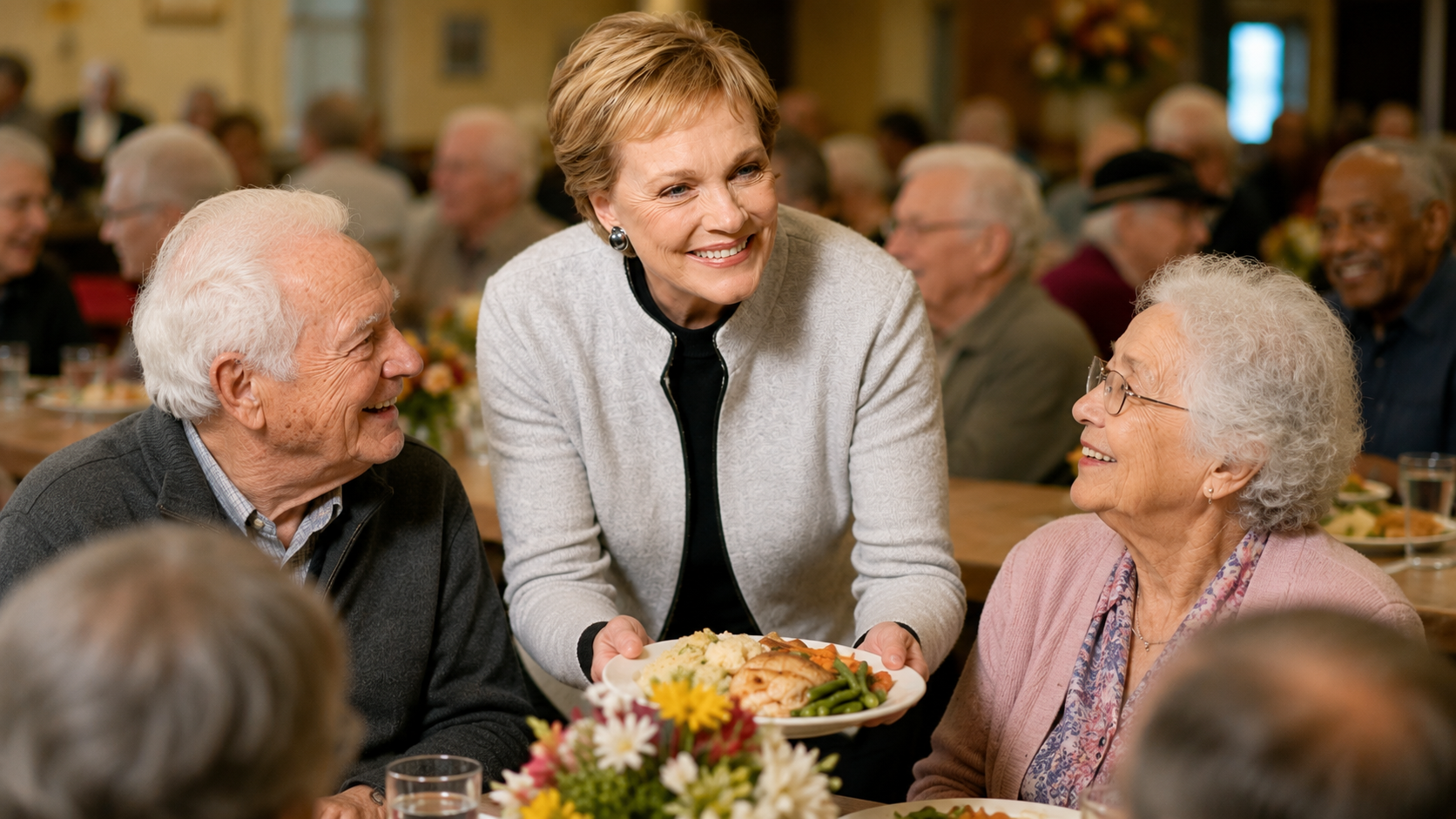
By Sunday evening, sixty-three elderly men and women were seated around long tables decorated with simple flowers.
For some, it was the first time they had eaten with a large group in years.
Julie and Margaret moved between the tables, serving meals and introducing people who had lived only streets apart but had never met.
Mr. Wilson discovered that another guest had served in the same military unit decades earlier.
Mrs. Chen met a retired music teacher who shared her love of classical songs.
Evelyn sat beside a young volunteer who listened for nearly an hour as she talked about her late husband.
The room filled with conversation.
Then something unexpected happened.
Julie noticed one elderly man sitting alone at the end of a table.
His name was Arthur.
He hadn’t spoken to anyone all evening.
Margaret quietly explained that Arthur had lost his wife only three weeks earlier.
Julie carried a plate to him and sat in the empty chair beside him.
For a while, neither of them spoke.
Then Arthur whispered, “This was her favorite meal.”
He looked down at the roasted chicken and potatoes.
“I almost didn’t come tonight.”
“I’m glad you did,” Julie said.
Arthur nodded.
“So am I.”
Then he looked around the crowded hall.
“I thought I was the only one who felt this lonely.”
Julie gently placed her hand over his.
“Sometimes loneliness convinces us we’re alone in feeling alone.”
Arthur’s eyes filled with tears.
At that moment, Margaret stood near the kitchen doorway watching.
She suddenly understood that Sunday Supper had never truly been about delivering food.
It was about bringing people back to the table.
Before the evening ended, something remarkable began.
A young volunteer approached Margaret.
“Could we do this again next month?”
Then a restaurant owner offered to provide the next meal.
A taxi company volunteered transportation.
A group of university students offered to become regular companions for seniors.
Someone from another neighborhood asked if they could start their own Sunday Supper.
By the time Margaret began stacking the empty plates, a handwritten sheet near the entrance was filled with more than one hundred names of people offering to help.
Margaret stared at it in disbelief.
Julie walked over and stood beside her.
“You said there were thousands of empty chairs in this city,” Julie reminded her.
Margaret nodded.
Julie looked across the hall, where Arthur was now laughing quietly with Mr. Wilson.
“Perhaps,” she said, “we simply need to start filling them.”
Margaret thought that special dinner would be the beginning of a monthly gathering.
She had no idea what was about to happen.
Because the next morning, a photograph taken by one of the volunteers began circulating throughout the city.
It didn’t show Julie Andrews.
It didn’t show Margaret.
It showed something far simpler.
Arthur was sitting at a crowded table, smiling for the first time since losing his wife.
Beside the photograph were six words:
“No one should have to eat alone.”
Within days, thousands of people had shared it.
Restaurants began calling.
Schools wanted to volunteer.
Community centers offered their buildings.
And then the mayor’s office contacted Margaret with a proposal so unexpected that she had to ask them to repeat it.
The small Sunday meal she had started in her kitchen was about to become something neither she nor Julie could ever have imagined.
And at the center of it all was one simple promise:
In their city, there would always be room for one more person at the table.
Part 2: A City Learns to Share the Table
The call from the mayor’s office came on a Tuesday morning.
Margaret almost ignored it.
She was standing in her kitchen, surrounded by grocery receipts, handwritten delivery lists, and three containers of soup she had promised to drop off before lunch.
When the phone rang for the third time, she finally answered.
“Margaret Ellis?”
“Yes?”
“This is the mayor’s community outreach office. We’d like to speak with you about Sunday Supper.”
Margaret immediately became nervous.
She wondered if she had accidentally broken some food regulation.
Instead, the woman on the phone said something Margaret never expected.
“We’ve been receiving calls from neighborhoods all across the city. People want to help. Restaurants want to donate meals. Community centers want to host dinners. The mayor would like to support a citywide Sunday Supper program.”
Margaret sat down slowly.
“Citywide?”
“Yes.”
She looked around her tiny kitchen.
A year earlier, Sunday Supper had been one pot of chicken soup carried through the rain to a lonely widower.
Now the city wanted to turn it into a tradition.
Margaret’s first thought was of Julie.
She called her immediately.
Julie listened quietly as Margaret explained everything.
When she finished, there was a brief silence.
Then Julie said, “Well, Margaret, it seems your kitchen has become rather crowded.”
Margaret laughed.
“I don’t know if I can do this.”
“Perhaps you don’t have to do it alone anymore.”
Those words became the heart of what happened next.
The city offered logistical support, but Margaret insisted on one condition.
Sunday Supper could never become something cold or complicated.
It couldn’t simply be a food delivery service.
Every meal had to come with human connection.
Every volunteer had to understand that the most important question was not, “Did you get your dinner?”
It was, “How are you?”
Margaret told the first group of volunteers, “A meal fills the stomach. A conversation can fill an empty room.”
Soon, restaurants across the city began choosing one Sunday each month to prepare extra meals.
Local bakeries donated bread.
Farmers provided vegetables.
Taxi drivers volunteered rides.
Teenagers carried trays into apartment buildings.
Retired nurses checked on seniors who had been forgotten by neighbors.
Musicians began performing at community dinners.
Libraries organized reading groups.
Schools encouraged students to write letters to elderly residents who rarely received mail.
The project grew faster than anyone imagined.
But Margaret worried about losing the small, personal feeling that had made Sunday Supper special.
So she created one simple tradition.
At every community dinner, one chair at each table remained empty until the last moment.
When guests arrived, volunteers looked for anyone standing alone.
That person was invited to take the empty seat.
Margaret called it “The Welcome Chair.”
“No chair stays empty,” she would say.
“No person gets forgotten.”
The idea spread throughout the city.
Soon, people began placing small wooden signs on tables that read:
Reserved for someone who needs a friend.
Julie continued helping whenever she could.
She never wanted to become the center of attention.
Sometimes she quietly served soup.
Sometimes she sat beside a senior and listened.
Sometimes she washed dishes in the kitchen after everyone had gone home.
One evening, a volunteer laughed when she saw Julie standing at a sink covered in soap bubbles.
“Do people know you’re back here washing plates?”
Julie smiled.
“I rather hope they don’t.”
But the person who mattered most to Margaret was still Arthur.
The elderly widower who had almost refused to attend that first special dinner became one of Sunday Supper’s most devoted volunteers.
At first, he simply came to eat.
Then he began arriving early to set tables.
Eventually, he volunteered to welcome new guests.
Arthur understood loneliness.
He could recognize it in people’s faces.
Whenever someone entered the hall looking uncertain, Arthur would walk over and say the same thing.
“Come sit with me. I saved you a place.”
Months passed.
Then one Sunday, Arthur noticed a woman standing near the entrance.
Her name was Eleanor.
She was seventy-nine and had recently moved to the city after her sister passed away.
She knew no one.
Arthur invited her to the Welcome Chair.
They talked throughout dinner.
The next month, Eleanor returned.
Then she became a volunteer too.
Soon, she and Arthur were greeting newcomers together.
Margaret watched their friendship grow and often thought about how close Arthur had come to staying home that first evening.
One decision had changed his life.
And now he was changing the lives of others.
A year after the first community dinner, Sunday Supper operated in twenty-three neighborhoods.
More than eight hundred seniors had received regular meals.
But the numbers never impressed Margaret as much as the smaller moments.
A ninety-one-year-old woman celebrated her birthday with other people for the first time in six years.
A retired teacher began tutoring children who volunteered at the dinners.
A lonely grandfather met a university student who later visited him every week.
Two widows who lived in the same apartment building discovered they had been eating alone only three floors apart.
One evening, Margaret received a letter.
The handwriting was shaky.
It came from Mr. Wilson, the first person she had ever delivered soup to.
He wrote:
*”Dear Margaret,
You once told me you made too much soup.
We both know that wasn’t really true.
You saw a lonely old man and gave him a reason to open his door.
I thought you were bringing me dinner.
I understand now that you were bringing me back into the world.
Thank you for knocking.”*
Margaret cried when she read it.
She framed the letter and hung it in the Sunday Supper kitchen.
Whenever volunteers became overwhelmed, she pointed to it.
“That’s why we’re here,” she said.
Not long after, the city announced something extraordinary.
From that year forward, the first Sunday of every month would officially become Community Supper Sunday.
Restaurants, churches, schools, community centers, and families were encouraged to invite seniors and anyone experiencing loneliness to share a meal.
The announcement was made at the same church hall where Margaret and Julie had organized their first special dinner.
The hall looked very different now.
Hundreds of people filled the room.
At the front stood a long table.
Margaret had been asked to speak.
She hated public speaking.
As she approached the microphone, she looked toward Julie, who sat quietly among the volunteers.
Then she saw Arthur and Eleanor.
She saw Mr. Wilson.
She saw dozens of people who had once eaten alone.
Margaret took a deep breath.
“When my husband died,” she began, “I thought the hardest part of losing someone would be missing their voice.”
The room became silent.
“But sometimes, the hardest part was the empty chair.”
She paused.
“I started cooking because I didn’t know what else to do with that emptiness.”
Her voice trembled.
“Then I discovered something.”
She looked around the hall.
“There were empty chairs everywhere.”
Margaret smiled through tears.
“But an empty chair doesn’t always have to represent someone we’ve lost.”
“It can also represent someone we haven’t met yet.”
The audience remained completely still.
“So leave room at your table.”
“For the neighbor you’ve never spoken to.”
“For the widow eating alone.”
“For the man whose children live far away.”
“For the person who says they’re fine but secretly hopes someone will knock on the door.”
Then Margaret looked toward Julie.
“And sometimes, one person helps you realize that a small act of kindness doesn’t have to remain small.”
Julie smiled.
The room erupted into applause.
But the most beautiful moment came later.
After dinner, Margaret walked outside.
The city lights glowed beneath the evening sky.
Julie joined her.
For a moment, they simply stood together.
“Do you remember that first Sunday?” Margaret asked.
“Very well.”
“I thought we were delivering forty meals.”
Julie smiled.
“We were.”
Margaret shook her head.
“No.”
She looked through the windows of the hall.
Inside, Arthur was helping an elderly man into a chair.
Teenagers were laughing with seniors.
Volunteers were clearing tables.
People who had once been strangers were exchanging phone numbers.
“We were delivering invitations,” Margaret said.
Julie turned toward her.
“Invitations?”
“To come back into the world.”
Julie smiled softly.
“Yes,” she said. “I suppose you were.”
Years later, Sunday Supper became one of the city’s most beloved traditions.
Every first Sunday of the month, thousands of people shared meals across hundreds of tables.
Some gathered in churches.
Others in restaurants.
Some in community centers.
And some simply invited an elderly neighbor into their home.
The idea spread beyond the city.
Other towns began creating their own versions.
Then other states.
Then communities in distant countries.
But Margaret never called Sunday Supper a movement.
To her, it remained something much simpler.
A knock on a door.
A warm meal.
A chair pulled away from the table.
And four words:
“Come sit with us.”
On the fifth anniversary of the first community dinner, Margaret returned to her kitchen.
She placed a pot of chicken soup on the stove.
Her home was quieter now.
But it no longer felt empty.
There was a knock at the door.
When Margaret opened it, Julie was standing there.
Behind her were Arthur and Eleanor.
Mr. Wilson arrived moments later.
Then came several volunteers.
Within minutes, Margaret’s little house was filled with laughter.
She looked at the table.
Every chair was taken.
Almost.
At the far end, one seat remained empty.
Julie noticed it.
“Are we expecting someone else?”
Margaret smiled.
“I always leave one chair open now.”
“For whom?”
Margaret looked toward the door.
“For whoever might need it.”
And just then, the doorbell rang.
Margaret smiled and stood.
“I’ll get it.”
Because after everything she had learned, she knew one thing for certain.
Sometimes the smallest act of kindness begins with a meal.
Sometimes it begins with a letter.
Sometimes it begins with one unexpected visitor standing at your door.
But most often, it begins when someone looks at an empty chair and decides that no one should have to sit alone.
And in that city, on the first Sunday of every month, thousands of people continued to make the same quiet promise:
There would always be room for one more.
The End.


