Part 1: The Promise He Was Afraid He Couldn’t Keep
For nearly forty years, Daniel Whitmore had never imagined a life without his wife, Margaret.
They had built everything together.
A modest home on a quiet street. A garden filled with roses. Sunday mornings over tea. Long evening walks when the weather was kind.
But what Daniel remembered most was Margaret’s extraordinary ability to notice people others overlooked.
She noticed the elderly neighbor who hadn’t received a visitor in weeks.
She noticed the exhausted mother quietly counting coins at the grocery store.
She noticed children arriving at school in winter without proper coats.
And whenever Margaret noticed someone struggling, she tried to help.
“You don’t have to change the whole world,” she often told Daniel. “You just have to make someone’s corner of it a little warmer.”
That simple belief became the heart of her life.
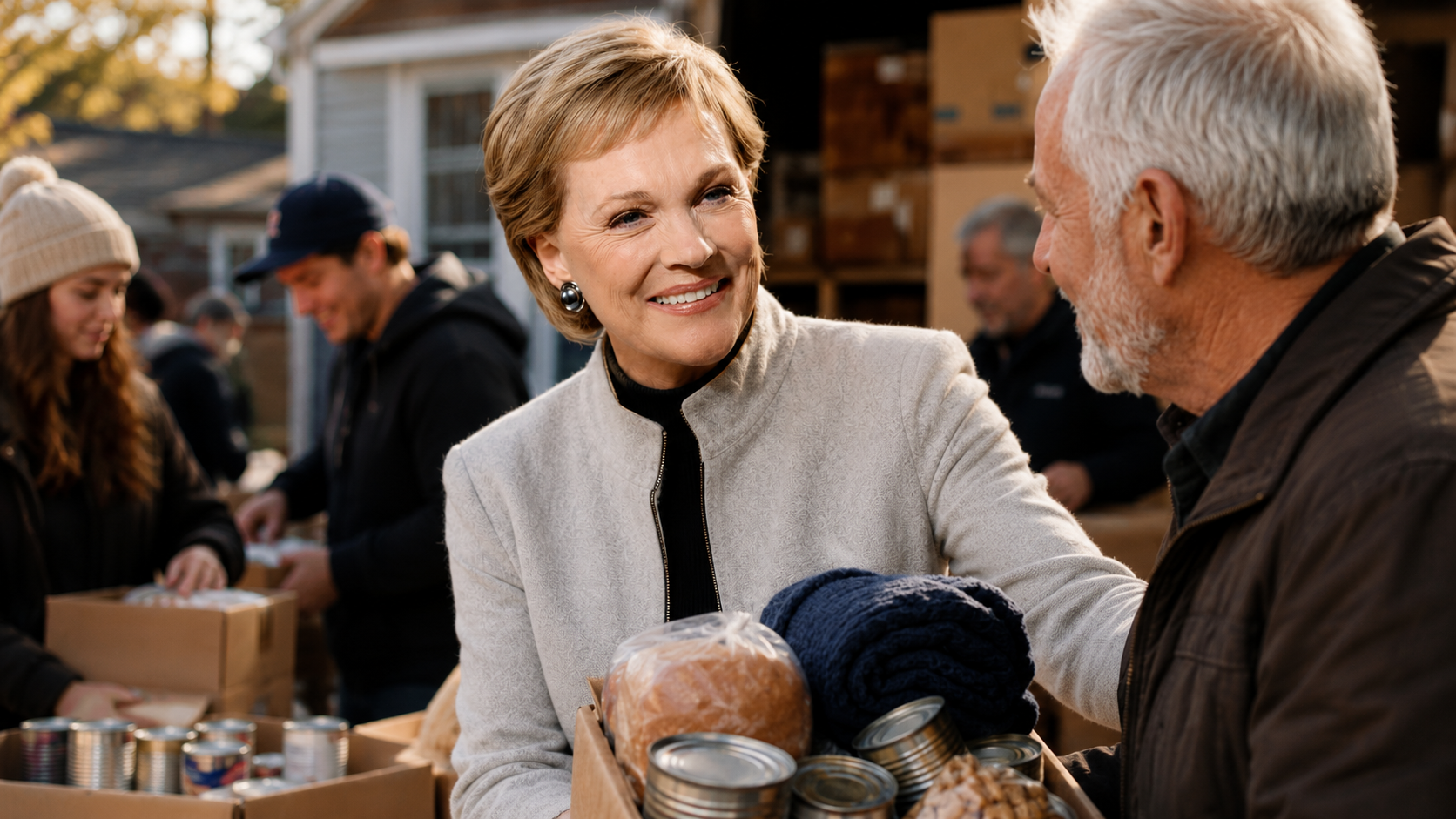
Every month, Margaret gathered food, warm clothing, books, and small necessities for struggling families in their community. She called her little project The Open Door Mission.
It wasn’t an official charity.
There was no large building or paid staff.
Most of the supplies were stored in Daniel and Margaret’s garage.
A few friends volunteered. Local shopkeepers occasionally donated boxes of food. Children from the neighborhood brought toys they had outgrown.
Margaret organized everything herself.
For more than fifteen years, she quietly helped hundreds of families.
Then, after a sudden illness, Margaret passed away.
Daniel’s world became painfully silent.
For months, he barely entered the garage.
The boxes remained exactly where Margaret had left them.
Winter coats hung from a metal rack.
Children’s books filled several shelves.
On a folding table sat a handwritten list of families Margaret had planned to visit.
Daniel couldn’t bring himself to move anything.
Every object reminded him of her.
One rainy afternoon, almost six months after Margaret’s death, Daniel finally walked into the garage.
He intended to begin clearing it out.
Instead, he found an envelope resting inside Margaret’s old wooden donation box.
His name was written across the front.
For Daniel.
His hands trembled as he opened it.
Inside was a short letter.
“My dearest Daniel,
If you’re reading this, perhaps I’m no longer able to continue the work we started.
I know you may think this mission belonged to me.
But it never did.
It belongs to every person who believes kindness should continue moving forward.
Please don’t feel you have to do everything I did.
Just open the door.
Someone else will help carry the boxes.
Someone else will bring the food.
Someone else will find the families.
Kindness has a way of finding more hands.
All you have to do is begin.
Love always,
Margaret.”
Daniel sat on an old chair and cried.
For the first time since losing her, something inside him shifted.
He didn’t feel less grief.
But suddenly, the grief had somewhere to go.
The next morning, Daniel placed a handwritten sign outside his house.
THE OPEN DOOR MISSION WILL CONTINUE.
He didn’t know how.
He didn’t know who would help.
But he had made a promise.
Weeks passed.
Daniel tried to restart Margaret’s work, but everything felt overwhelming.
He was seventy-one years old. His knees hurt when he carried heavy boxes. He struggled with paperwork and had no idea how to organize volunteers.
Some days, only one or two people came.
Other days, no one came at all.
Daniel began wondering whether Margaret’s mission would quietly disappear.
Then something unexpected happened.
A letter arrived from a woman named Eleanor Price.
Eleanor had once received help from Margaret during one of the hardest periods of her life. Years earlier, after losing her job, Margaret had quietly delivered groceries and winter clothing to Eleanor’s family.
Eleanor had never forgotten it.
She also happened to be a lifelong admirer of Julie Andrews.
Knowing that Julie Andrews had long represented warmth and compassion to her, Eleanor wrote a heartfelt letter describing Margaret’s mission and Daniel’s struggle to keep it alive.
She never expected a reply.
But several weeks later, Daniel’s telephone rang.
The voice on the other end introduced herself.
Daniel thought it was a joke.
Then he heard a familiar, gracious voice.
“Mr. Whitmore,” the woman said gently, “I’ve been told about your wife.”
Daniel froze.
It was Julie Andrews.
In this imagined story, Julie had heard about Margaret’s years of quiet service and Daniel’s attempt to continue her work.
“I don’t know if I can do what she did,” Daniel admitted.
There was a pause.
“Perhaps you don’t have to,” Julie replied. “Perhaps you simply have to do what you can.”
Daniel looked toward Margaret’s photograph.
“That’s almost exactly what she told me.”
A few days later, Julie arrived quietly in Daniel’s town.
There were no flashing cameras.
No grand announcement.
She simply walked through the open garage door.
Daniel stood beside Margaret’s donation table, speechless.
Julie looked around at the shelves of books, boxes of canned food, children’s coats, and handwritten notes.
Then she noticed Margaret’s wooden donation box.
“This was hers?” Julie asked.
Daniel nodded.
Julie placed her hand gently on the edge of the box.
“Then perhaps,” she said, “this is where we begin.”
Together, they decided to organize one special community event.
They called it Margaret’s Day of Giving.
The plan was simple.
For one day, anyone could bring something useful.
A bag of groceries.
A warm coat.
A children’s book.
A toy.
Or simply an hour of their time.
Daniel expected perhaps fifty people.
Julie encouraged him to prepare for more.
The morning of the event arrived beneath a gray winter sky.
At seven o’clock, Daniel opened his front door.
No one was there.
At eight, only three volunteers had arrived.
Daniel stared down the empty street.
His shoulders sank.
“Maybe people have forgotten,” he whispered.
Julie stood beside him.
“Give them a little time.”
Then, just after eight-thirty, a car appeared.
Then another.
And another.
Within minutes, vehicles were lining the street.
Families arrived carrying boxes.
Teenagers brought bags of clothing.
A bakery delivered hundreds of fresh rolls.
A bookstore donated children’s books.
An elderly woman arrived carrying one handmade blanket.
“It’s all I have to give,” she said.
Daniel held the blanket carefully.
“It’s enough.”
By noon, Margaret’s small garage could no longer contain the donations.
Tables were placed across the front yard.
Volunteers filled the driveway.
Children decorated boxes with hearts and handwritten messages.
Daniel stood in the middle of it all, overwhelmed.
Then he noticed a little girl approaching him.
She couldn’t have been more than eight years old.
She held a small photograph.
“Mr. Daniel?”
He bent down.
“My mother said your wife helped us when I was a baby.”
She handed him the photograph.
It showed Margaret standing beside a young mother holding an infant.
Daniel recognized his wife’s smile immediately.
The little girl looked at him.
“My mother said we came today because Mrs. Margaret told her that when life gets better, you should help someone else.”
Daniel couldn’t speak.
Julie watched from several feet away as the little girl placed a children’s book into the donation box.
Daniel wiped his eyes.
That was when he finally understood.
Margaret’s kindness had never stopped.
It had simply traveled through other people.
But the most extraordinary moment was still to come.
Late that afternoon, as volunteers prepared to deliver the first boxes to local families, a large group appeared at the end of the street.
Daniel didn’t recognize them.
There were dozens of people.
Some carried photographs.
Others held letters.
As they walked closer, Daniel realized they all had something in common.
Every single one of them had once been helped by Margaret.
And they had returned for one reason.
This time, they wanted to be the ones who gave.
Daniel looked at Julie, tears filling his eyes.
She smiled.
“Your wife was right,” she said softly.
“Kindness found more hands.”
Daniel opened Margaret’s old wooden donation box one more time.
Inside, beneath the day’s contributions, he discovered a second envelope he had somehow never seen before.
On the front, in Margaret’s handwriting, were five simple words:
For the day they return.
Daniel’s heart began pounding.
He slowly opened the envelope.
And what Margaret had written inside would transform their little Day of Giving into something far greater than Daniel—or anyone in the town—could have imagined.
Part 2: A Legacy of Love
Daniel stood beneath the gray winter sky, surrounded by boxes of food, warm coats, children’s books, and dozens of people whose lives had once been touched by Margaret.
But for a moment, he heard none of it.
His attention was fixed on the envelope in his hands.
For the day they return.
Margaret’s handwriting was unmistakable.
Daniel carefully opened it.
Inside was a folded sheet of paper.
He began to read.
“My dearest Daniel,
If this letter has been found, then perhaps something wonderful has happened.
Maybe some of the people we once helped have come back.
Maybe they are standing where we once stood, ready to help someone else.
If so, please tell them this:
They owe me nothing.
Kindness is not a debt.
It is a gift.
And the best way to repay a gift is not to return it to the person who gave it.
It is to pass it forward.
My greatest hope was never to build a large charity.
It was to build a circle.
A circle where the person receiving help today might become the person offering help tomorrow.
If that circle has begun, Daniel, please keep it going.
And please know that wherever you are standing when you read this, I am proud of you.
Love always,
Margaret.”
Daniel lowered the letter.
For several seconds, no one spoke.
Then he looked around.
Standing before him were people Margaret had helped over fifteen years.
A father whose family had once received Christmas groceries.
A woman who had been given warm clothing after leaving a difficult home.
A retired teacher whose medical bills had once left her unable to buy food.
A young man Margaret had helped when he was a homeless teenager.
Every one of them had returned.
Not to ask for anything.
But to give.
Daniel’s voice broke.
“She knew,” he whispered.
Julie Andrews stood beside him.
“Perhaps she hoped,” Julie said softly.
Daniel looked down at the letter again.
Then he smiled through his tears.
“That’s even more beautiful.”
That afternoon, the first deliveries began.
Daniel had originally planned to send out twenty boxes.
Instead, volunteers filled more than a hundred.
Cars left the neighborhood one after another.
Every vehicle carried food, clothing, books, and handwritten notes of encouragement.
Julie joined Daniel in the first car.
Their destination was a small apartment on the edge of town.
Inside lived a young mother named Rebecca and her two children.
Rebecca had recently lost her job.
She had been skipping meals so her children could eat.
When Daniel knocked on her door, she expected another bill collector.
Instead, she found strangers carrying groceries.
Her youngest son stared at the boxes.
“Are those for us?”
Daniel smiled.
“They are.”
The little boy looked confused.
“Why?”
Daniel remembered Margaret’s letter.
“Because everyone needs a little help sometimes.”
Rebecca covered her mouth as tears filled her eyes.
Julie handed her daughter a book.
“You don’t have to explain anything,” she said gently. “Just take care of your family.”
Rebecca began crying.
Daniel felt the familiar ache of missing Margaret.
But this time, something was different.
The pain was still there.
Yet beside it was warmth.
For months, Daniel had believed continuing Margaret’s mission meant trying to replace her.
Now he understood.
He could never replace Margaret.
He didn’t have to.
He only had to continue the love she had started.
By evening, every donated box had been delivered.
Volunteers returned to Daniel’s home exhausted, cold, and smiling.
Someone made tea.
Someone else brought soup.
Children sat together on the garage floor, sorting the few books that remained.
Daniel looked around at the crowded room.
For the first time since Margaret’s death, the garage didn’t feel like a museum of memories.
It felt alive again.
Julie sat beside him.
“You did it,” she said.
Daniel shook his head.
“We did it.”
Then he looked around.
“No. She did.”
Julie smiled.
“Perhaps all of you did.”
Before leaving that evening, the volunteers gathered around Margaret’s old wooden donation box.
Daniel placed her final letter inside a clear frame.
He set it on the wall.
Beneath it, someone added a handwritten sign.
KINDNESS IS NOT A DEBT. PASS IT FORWARD.
The first Margaret’s Day of Giving ended.
But something unexpected happened the next morning.
At seven o’clock, Daniel opened his front door.
There were three boxes sitting on the porch.
One contained canned food.
Another held children’s clothing.
The third was filled with books.
On top was a note.
For the next family who needs them.
Daniel smiled.
The following day, more donations arrived.
Then more.
Within two weeks, Daniel’s garage was full again.
But this time, Daniel was not alone.
Eleanor volunteered to organize donations.
The young man Margaret had once helped as a teenager offered to manage deliveries.
A local accountant volunteered to handle paperwork.
The owner of an empty storefront offered the building for almost no rent.
A retired carpenter gathered friends to repair the shelves.
The bakery promised weekly bread.
The bookstore created a permanent children’s book donation program.
Margaret’s words were becoming real.
Someone else was carrying the boxes.
Someone else was bringing the food.
Someone else was finding the families.
Kindness had found more hands.
Julie remained involved in the fictional mission from afar.
She helped introduce the small organization to people who believed in its purpose.
But she insisted that Margaret’s name remain at the center.
“This was never about one famous person helping,” she told Daniel during one telephone call.
“It’s about ordinary people discovering they are capable of extraordinary kindness.”
Within a year, The Open Door Mission moved from Daniel’s garage into the renovated storefront.
Above the entrance hung a simple sign.
THE MARGARET WHITMORE OPEN DOOR CENTER
Daniel stood outside on opening morning.
He carried Margaret’s photograph.
Hundreds of people gathered along the street.
Some had received help.
Some had given help.
Many had done both.
Julie returned for the opening.
There were reporters this time.
But Daniel barely noticed them.
His eyes were fixed on the front doors.
Beside the entrance was a small plaque containing Margaret’s favorite words:
You don’t have to change the whole world.
Just make someone’s corner of it a little warmer.
Daniel touched the plaque.
“I wish she could see this.”
Julie stood beside him.
“Daniel,” she said, “look around.”
He did.
He saw children carrying books into the building.
He saw teenagers stacking food.
He saw elderly volunteers folding blankets.
He saw Rebecca, the young mother from that first Day of Giving, helping another family choose winter coats.
Her life had improved.
She had found work.
Now she had returned as a volunteer.
Daniel smiled.
Julie continued.
“I think this is how she sees it.”
Years passed.
Margaret’s Day of Giving became an annual tradition.
Then it spread.
Nearby towns began organizing their own.
Schools created student volunteer teams.
Businesses donated supplies.
Families began setting aside one day every year to serve someone they had never met.
The original mission that had once existed inside one woman’s garage eventually helped thousands of people.
But Daniel always insisted that the numbers were not the most important part.
The most important thing was the circle.
One winter afternoon, several years after the first Day of Giving, Daniel sat inside the Open Door Center.
He was older now.
His steps were slower.
On the wall hung photographs from the mission’s history.
In the center was one picture of Margaret.
Daniel looked at it every morning.
A little girl approached him.
She held a small bag of children’s books.
“My mother said I should give these to someone who needs them.”
Daniel recognized the girl.
She was Rebecca’s daughter.
The same child who had received a book from Julie on that first Day of Giving.
Now she was a teenager.
Daniel smiled.
“Why did you decide to donate them?”
The girl shrugged.
“Because someone gave us books when we needed them.”
Daniel felt tears gathering in his eyes.
The circle.
Margaret’s circle.
It was still turning.
That evening, Daniel walked through the quiet center after everyone had gone home.
He stopped beside Margaret’s wooden donation box.
It had been preserved behind glass.
Next to it was her final letter.
Daniel placed his hand against the glass.
“For a long time,” he whispered, “I thought losing you meant everything we built together had ended.”
He paused.
“But I was wrong.”
Outside, volunteers were loading another van.
Somewhere across town, a family was about to receive groceries.
A child was about to receive a warm coat.
A lonely elderly person was about to receive a visit.
Daniel smiled.
“You never really left, did you?”
The answer came not in words.
It came in the laughter outside.
In the boxes being carried.
In the doors opening.
In the hands reaching toward one another.
Margaret’s life had ended.
But her kindness had not.
Julie had helped Daniel understand something his grief had hidden from him:
A legacy is not something we leave behind when we are gone.
A true legacy continues moving through the people we loved, the lives we touched, and the kindness we inspired.
What began as one widower’s promise to his late wife had grown into thousands of small promises made by strangers to one another.
To notice.
To care.
To give.
And to keep the door open.
Daniel looked once more at Margaret’s photograph.
Then he turned off the lights and stepped outside.
A volunteer was struggling to lift a heavy box into the van.
Daniel walked over.
“Need a hand?”
The volunteer smiled.
“Always.”
Daniel took one side of the box.
Together, they carried it forward.
Exactly as Margaret had known they would.
The End


